From Surf Wiki (app.surf) — the open knowledge base
Foil bearing
Type of air bearing
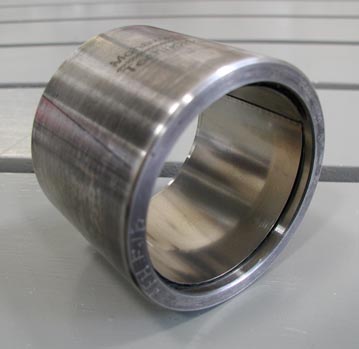
Type of air bearing
A foil bearing, also known as a foil-air bearing, is a type of air bearing. A shaft is supported by a compliant, spring-loaded journal lining made of foil. Once the shaft is spinning fast enough, the working fluid (usually air) pushes the foil away from the shaft so that no contact occurs. The shaft and foil are separated by the air's high pressure, which is generated by the rotation that pulls gas into the bearing via viscosity effects. The high speed of the shaft with respect to the foil is required to initiate the air gap, and once this has been achieved, no wear occurs. Unlike aerostatic or hydrostatic bearings, foil bearings require no external pressurisation system for the working fluid, so the hydrodynamic bearing is self-starting.
Development


Foil bearings were first developed in the late 1950s by AiResearch Mfg. Co. of the Garrett Corporation using independent R&D funds to serve military and space applications.{{cite journal |archive-url = https://web.archive.org/web/20160415030128/http://www.rddynamics.com/pdfs/Foil-Bearings-Cleared-to-Land.pdf |archive-date=15 April 2016 |url-access=subscription}}
Current-generation foil bearings with advanced coatings have greatly exceeded the limitations of earlier designs. Antiwear coatings exist that allow over 100,000 start/stop cycles for typical applications.{{cite journal |author-link=Hooshang Heshmat |access-date=2006-09-25 |archive-url=https://web.archive.org/web/20080214192746/http://store.asme.org/product.asp?catalog_name=Conference%20Papers&category_name=%26nbsp%3B_WTC2005T-5&product_id=WTC2005-63712 |archive-date=2008-02-14
Applications
Turbomachinery is the most common application because foil bearings operate at high speed.{{cite journal |access-date=2007-08-18 |archive-url=https://web.archive.org/web/20070930201550/http://www.sae.org/technical/papers/2006-01-3055 |archive-date=2007-09-30 Commercial applications in production include microturbines,{{cite conference |book-title=Proceedings of the ASME Turbo Expo 2006: Power for Land, Sea, and Air |book-title=Proceedings of the ASME Turbo Expo 2025: Power for Land, Sea, and Air |book-title=Proceedings of the ASME Turbo Expo 2025: Power for Land, Sea, and Air
- Higher efficiency, due to a lower heat loss to friction; instead of fluid friction, the main source of heat is parasitic drag
- Increased reliability
- Higher speed capability
- Quieter operation
- Wider operating temperature range (40–2,500 K)
- High vibration and shock load capacity
- No scheduled maintenance
- No external support system
- Truly oil free where contamination is an issue
- Capable of operating above critical speed
Areas of current research are:
- Higher load capacity
- Improved damping
- Improved coatings
The main disadvantages are:
- Lower capacity than roller or oil bearings
- Wear during start-up and stopping
- High speed required for operation
References
References
- (13 April 2020). "Compressors with foil bearings applied in fuel cells".
- (31 March 2025). "Oil-free Gas Foil Bearing Chiller".
- "ECC Refrigeration Compressor".
- Some early history is reported in Giri L. Agrawal (1997), "http://www.rddynamics.com/pdfs/foil-97-gt-347.pdf — An Overview" (PDF). Publication 97-GT-347. American Society of Mechanical Engineers.
This article was imported from Wikipedia and is available under the Creative Commons Attribution-ShareAlike 4.0 License. Content has been adapted to SurfDoc format. Original contributors can be found on the article history page.
Ask Mako anything about Foil bearing — get instant answers, deeper analysis, and related topics.
Research with MakoFree with your Surf account
Create a free account to save articles, ask Mako questions, and organize your research.
Sign up freeThis content may have been generated or modified by AI. CloudSurf Software LLC is not responsible for the accuracy, completeness, or reliability of AI-generated content. Always verify important information from primary sources.
Report