From Surf Wiki (app.surf) — the open knowledge base
Fluorination by sulfur tetrafluoride
Fluorination by sulfur tetrafluoride produces organofluorine compounds from oxygen-containing organic functional groups using sulfur tetrafluoride. The reaction has broad scope, and SF4 is an inexpensive reagent. It is however hazardous gas whose handling requires specialized apparatus. Thus, for many laboratory scale fluorinations diethylaminosulfur trifluoride ("DAST") is used instead.
Main functional group conversions
Carboxylic acids, amides, esters, and carboxylate salts convert to the trifluoromethyl derivatives, although conditions vary widely: : For carboxlic acids, the first step gives the acyl fluorides, in keeping with the tendency of SF4 to fluorinate acidic hydroxyl groups: : Similarly SF4 converts sulfonic acids to sulfonyl fluorides: : Aldehydes and ketones convert to geminal difluorides: : Alcohols convert to alkyl fluorides, although this conversion works best with acidic alcohols, such as fluorinated alcohols: :
Mechanism
The mechanism of fluorination by SF4 is assumed to resemble chlorination by phosphorus pentachloride. Hydrogen fluoride, a useful solvent for these reactions, activates SF4: : Species of the type ROSF3 are often invoked as intermediates. In the case of aldehydes and ketones, SF4 is thought to initially add across the double bond to give R2CFOSF3.
Examples
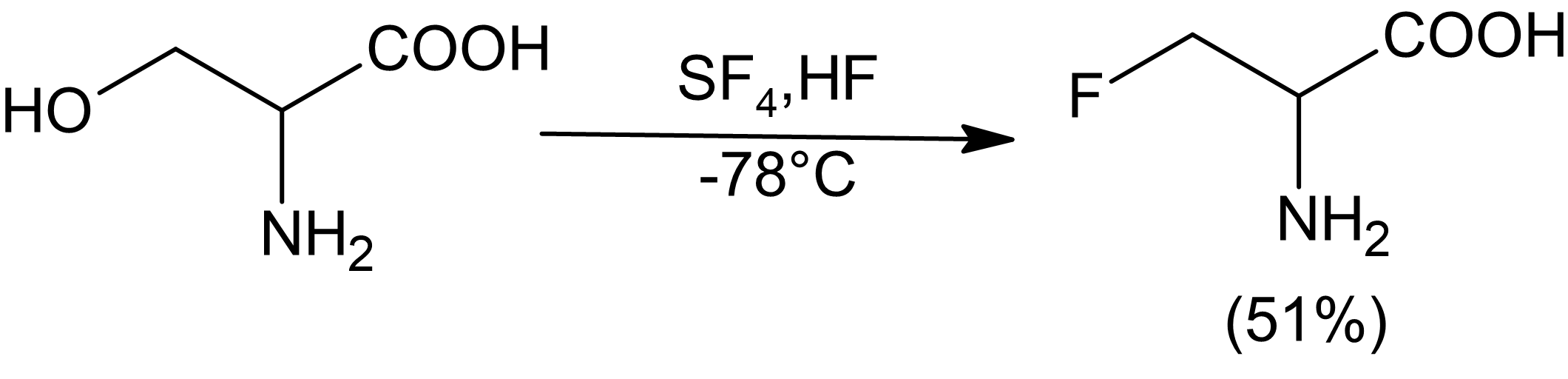
A solution of sulfur tetrafluoride in hydrogen fluoride converts hydroxy-containing amino acids to the fluoro amino acids:
When vicinal diols are combined with SF4, difluorination occurs with inversion of configuration at only one of the alcohols. This was demonstrated in the synthesis of meso-difluorosuccinate from (L)-tartrate and the synthesis of (D)- and (L)-difluorosuccinate from meso-tartrate.
.png)
Carbonyl compounds generally react with SF4 to yield geminal difluorides. Reaction times tend to be on the order of hours and yields are moderate. Fluorination of lactones can provide heterocyclic fluorides, although ring opening has been observed for γ-butyrolactone. The six-membered lactide does not experience ring opening.

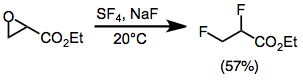
Fluorination opens epoxides to give either geminal or vicinal difluorides in most cases. Monoarylepoxides give geminal products with migration of the aryl group. Yields are low for sterically hindered di- and trisubstituted epoxides. Epoxides substituted with an ester group give vicinal difluorides via an alkoxysulfur trifluoride intermediate.
Carboxylic acids react with SF4 to afford trifluoromethyl compounds:{{OrgSynth | author = Hasek, W. R. : The formation of the trifluoromethyl derivative sometimes competes with formation of tetrafluoroalkyl ethers, which arise from the reaction between difluoromethyl cation and acyl fluoride.
Sulfur tetrafluoride can be used to fluorinate polymers efficiently. This often has a profound effect on polymer properties—fluorination of polyvinyl alcohol, for instance, improves its resistance to strong acids and bases.
A prostaglandin bearing a trifluoromethyl group at C-16 is prepared using sulfur tetrafluoride.

References
References
- (1985). "Organic Reactions".
- (2011). "Organic Reactions".
- (1975). "Selective Fluorination of Hydroxy Amines and Hydroxy Amino Acids with Sulfur Tetrafluoride in Liquid Hydrogen Fluoride". The Journal of Organic Chemistry.
- Bell, M.; Hudlicky, M. ''J. Fluorine Chem.'' '''1980''', ''15'', 191.
- Mobbs, H. ''J. Fluorine Chem.'' '''1971''', ''1'', 361.
- Muratov, N.; Burmakov, I.; Kunshenko, V.; Alekseeva, A.; Yagupol'skii, M. ''J. Org. Chem. USSR (Engl. Transl.)'' '''1982''', ''18'', 1220.
- Yagupol'skii, M.; Golikov, I.; Alekseeva, A.; Aleksandrov, M. ''J. Org. Chem. USSR (Engl. Transl.)'' '''1971''', ''7'', 737.
- Dmowski, W.; Kolinski, A. ''Rocz. Chem.'' '''1974''', ''48'', 1697.
- Dmowski, W.; Kolinski, A. ''Pol. J. Chem.'' '''1978''', ''52'', 547.
- Bezsolitsen, P.; Gorbunov, N.; Nazarov, A.; Khardin, P. ''Vysokomol. Soedin., Ser. A'' '''1972''', ''14'', 950 [C.A., 77, 75710e (1972)].
- Holland, G. W.; Jernow, J. L.; Rosen, P. U.S. Pat. 4,256,911 (1981) [C.A., 89, 146500x (1978)].
- {{March6th
- (2006). "Encyclopedia of Reagents for Organic Synthesis".
This article was imported from Wikipedia and is available under the Creative Commons Attribution-ShareAlike 4.0 License. Content has been adapted to SurfDoc format. Original contributors can be found on the article history page.
Ask Mako anything about Fluorination by sulfur tetrafluoride — get instant answers, deeper analysis, and related topics.
Research with MakoFree with your Surf account
Create a free account to save articles, ask Mako questions, and organize your research.
Sign up freeThis content may have been generated or modified by AI. CloudSurf Software LLC is not responsible for the accuracy, completeness, or reliability of AI-generated content. Always verify important information from primary sources.
Report