From Surf Wiki (app.surf) — the open knowledge base
Float (horse-drawn)
Horse cart with low rear for loading deliveries
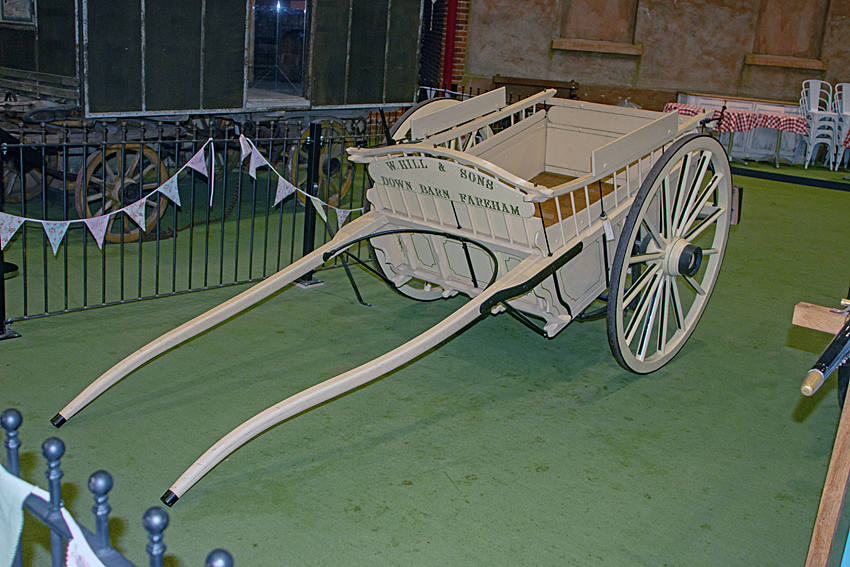
Horse cart with low rear for loading deliveries
horse-drawn vehicles
A float is a form of two-wheeled horse-drawn cart, often with a dropped axle to give an especially low load-bed. They were intended for use by deliverymen and the carrying of heavy or unstable items such as milk churns.
Description

The axle passes beneath the load-bed of the cart and is cranked upwards at each side, allowing the floor of the cart to be lower than the center of the wheels. This allows the load to be carried low, for stability and ease of loading with heavy objects such as churns or barrels. The high position of the axle ends allows large wheels, giving a smooth ride. The box body is often open at the rear, or has a tailboard which can be let down. Rather than a driving seat or box, they are driven from a standing position, alongside the load. Floats were drawn by a single horse or, especially in Ireland, a donkey. A rough type of float used in Ireland was called a shandrydan or shandydan.
Use

Milk churns were transported to the customer and milk was ladled out into the customer's container. The churn-carrying float became obsolete as bottled milk became common, with milkmen using trolleys, vans and carts, but the name "float" survives today for all forms of delivery of milk including today's powered milk floats.
The float design was also used for hauling heavy stone, horse ambulances, and carrying livestock.
The term is also used for a showy advertising vehicle and for commercial vehicle classes in horse shows, sometimes called an "exhibition float". In America, a goods wagon pulled by a single horse was often called a float.
Etymology
The word "float" is derived from the days when heavy goods were transported by river. In London, the Lord Mayor's Show was originally floated down the River Thames.
References
References
- "Shandydan".
- O'Brien, John. "The Old Mass Shandrydan".
- Arnold, James. (1979). "All drawn by horses". [[David & Charles]].
- Percy W Blandford. (1976). "Old Farm Tools and Machinery". [[David & Charles]].
- Parry, David. (1979). "English Horse Drawn Vehicles". [[Frederick Warne & Co.]].
- Smith, D.J.M.. (1988). "A Dictionary of Horse Drawn Vehicles". J.A. Allen.
- Thompson, John. (1977). "Horse-drawn Trade Vehicles". J. Thompson.
- Walrond, Sallie. (1979). "The Encyclopaedia of Driving". Country Life Books.
- Walrond, Sallie. (1992). "Looking at Carriages". Pelham.
This article was imported from Wikipedia and is available under the Creative Commons Attribution-ShareAlike 4.0 License. Content has been adapted to SurfDoc format. Original contributors can be found on the article history page.
Ask Mako anything about Float (horse-drawn) — get instant answers, deeper analysis, and related topics.
Research with MakoFree with your Surf account
Create a free account to save articles, ask Mako questions, and organize your research.
Sign up freeThis content may have been generated or modified by AI. CloudSurf Software LLC is not responsible for the accuracy, completeness, or reliability of AI-generated content. Always verify important information from primary sources.
Report