From Surf Wiki (app.surf) — the open knowledge base
Flint glass
Type of optical glass

Type of optical glass
Flint glass is optical glass that has relatively high refractive index and low Abbe number (high dispersion). Flint glasses are arbitrarily defined as having an Abbe number of 50 to 55 or less. The currently known flint glasses have refractive indices ranging between 1.45 and 2.00.
Traditionally, flint glasses were lead glasses containing around 4–60% lead(II) oxide; however, the manufacture and disposal of these glasses were sources of pollution.
In many modern flint glasses, lead oxides are replaced with other metal oxides such as titanium dioxide and zirconium dioxide without significantly altering the optical properties of the glass.
Applications
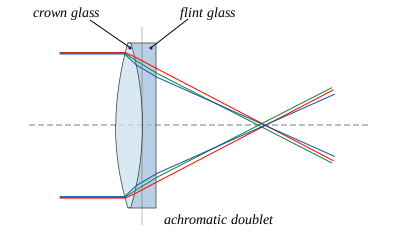
A concave lens of flint glass is commonly combined with a convex lens of crown glass to produce an achromatic doublet lens because of their compensating optical properties, which reduces chromatic aberration (colour defects).
History
With respect to glass, the term flint derives from the flint nodules found in the chalk deposits of southeast England that were used as a source of high purity silica by George Ravenscroft, , to produce a potash lead glass that was the precursor to English lead crystal.
References
This article was imported from Wikipedia and is available under the Creative Commons Attribution-ShareAlike 4.0 License. Content has been adapted to SurfDoc format. Original contributors can be found on the article history page.
Ask Mako anything about Flint glass — get instant answers, deeper analysis, and related topics.
Research with MakoFree with your Surf account
Create a free account to save articles, ask Mako questions, and organize your research.
Sign up freeThis content may have been generated or modified by AI. CloudSurf Software LLC is not responsible for the accuracy, completeness, or reliability of AI-generated content. Always verify important information from primary sources.
Report