From Surf Wiki (app.surf) — the open knowledge base
Flemish Region
Northernmost federal region of Belgium

Northernmost federal region of Belgium
| Field | Value | |||||
|---|---|---|---|---|---|---|
| <!-- See Template:Infobox settlement for additional fields and descriptions --> | name | Flemish Region | ||||
| native_name | nl | |||||
| native_name_lang | nl | |||||
| other_name | fr | |||||
| de | ||||||
| settlement_type | Region | |||||
| image_flag | Flag of Flanders.svg | |||||
| flag_size | 125px | |||||
| flag_link | Flag of Flanders | |||||
| image_shield | Vlaanderen wapen.svg | |||||
| shield_link | Coat of arms of Flanders | |||||
| image_map | Flemish Region in Belgium and Europe.svg | |||||
| coordinates | ||||||
| subdivision_type | Country | |||||
| subdivision_name | Belgium | |||||
| subdivision_type2 | Community | |||||
| subdivision_name2 | Flemish Community | |||||
| established_date | 1993 | |||||
| seat_type | Seat | |||||
| seat | City of Brussels (which is not part of the Flemish Region) | |||||
| leader_title | Executive | |||||
| leader_name | Flemish Government | |||||
| leader_title1 | Governing parties (2024) | |||||
| leader_name1 | N-VA, Vooruit, CD&V | |||||
| leader_title2 | Minister-President | |||||
| leader_name2 | Matthias Diependaele (N-VA) | |||||
| leader_title3 | Legislature | |||||
| leader_name3 | Flemish Parliament | |||||
| leader_title4 | Speaker | |||||
| leader_name4 | Liesbeth Homans (N–VA) | |||||
| area_total_km2 | 13626 | |||||
| area_footnotes | ||||||
| population_total | 6,821,770 | |||||
| population_as_of | 1 January 2024 | |||||
| population_density_km2 | auto | |||||
| population_footnotes | ||||||
| demographics_type1 | Demographics | |||||
| demographics1_footnotes | tags -- | |||||
| demographics1_title1 | Ethnic group | |||||
| demographics1_info1 | Flemings | |||||
| demographics1_title2 | Languages | |||||
| demographics1_info2 | {{ubl | |||||
| Flemish Sign Language (legally recognized)<ref>{{Cite web | title | VGT: een erkende taal Departement Cultuur, Jeugd & Media | url=https://www.vlaanderen.be/cjm/nl/cultuur/vlaamse-gebarentaal/vgt-een-erkende-taal | access-date=2024-06-07 | website=www.vlaanderen.be | language=nl}} |
| demographics_type2 | GDP | |||||
| demographics2_footnotes | ||||||
| demographics2_title1 | Total | |||||
| demographics2_info1 | €330.495 billion (2022) | |||||
| iso_code | BE-VLG | |||||
| anthem | De Vlaamse Leeuw | |||||
| ("The Flemish Lion") | ||||||
| blank_name_sec1 | Celebration Day | |||||
| blank_info_sec1 | 11 July | |||||
| website |
the present-day region of Belgium also known as Flanders
de |Dutch |French (in municipalities with language facilities) |Flemish Sign Language (legally recognized) ("The Flemish Lion")
The Flemish Region (, ), usually simply referred to as Flanders ( ), is one of the three regions of Belgium—alongside the Walloon Region and the Brussels-Capital Region. Covering the northern portion of the country, the Flemish Region is primarily Dutch-speaking. With an area of 13626 km², it accounts for only 45% of Belgium's territory, but 58% of its population. It is one of the most densely populated regions of Europe with around 500 /km2.
The Flemish Region is distinct from the Flemish Community: the latter encompasses both the inhabitants of the Flemish Region and the Dutch-speaking minority living in the Brussels-Capital Region. It borders the Netherlands and France.
Politics
Immediately after its establishment in 1980, the region transferred all its constitutional competencies to the Flemish Community. Thus, the current Flemish authorities (Flemish Parliament and Flemish Government) represent all the Flemish people, including those living in the Brussels-Capital Region. Hence, the Flemish Region is governed by the Flemish Community institutions. However, members of the Flemish Community parliament elected in the Brussels-Capital Region have no right to vote on Flemish regional affairs.
Administrative divisions
The Flemish Region comprises five provinces, each consisting of administrative arrondissements that, in turn, contain municipalities (in total 285 municipalities in Flanders).
The seat of the Flemish parliament is located in Brussels, which is an enclave withinbut not part ofthe Flemish region, being specified that the Brussels-Capital Region is established as an administrative region of Belgium in its own right. In contrast, the Walloon parliament has established its parliament in the territory of Wallonia, specifically in the city of Namur, Namur Province.
| Province | Capital city | Administrative | |||||||
|---|---|---|---|---|---|---|---|---|---|
| arrondissements | Population | ||||||||
| (1 January 2020) | Area | Population density | Flemish Region | 22 | 6,629,143 | 13,626 km2 | 490 /km2 | ||
| 1 | Antwerp (Antwerpen) | Antwerp (Antwerpen) | Antwerp, Mechelen, Turnhout | 1,869,730 | 2876 km2 | 650 /km2 | |||
| 2 | Limburg (Belgium) (Limburg) | Hasselt | Hasselt, Maaseik, Tongeren | 877,370 | 2427 km2 | 360 /km2 | |||
| 3 | East Flanders (Oost-Vlaanderen) | Ghent (Gent) | Aalst, Dendermonde, Eeklo, Gent, Oudenaarde, Sint-Niklaas | 1,525,255 | 3007 km2 | 510 /km2 | |||
| 4 | Flemish Brabant (Vlaams-Brabant) | Leuven | Halle-Vilvoorde, Leuven | 1,155,843 | 2118 km2 | 550 /km2 | |||
| 5 | West Flanders (West-Vlaanderen) | Bruges (Brugge) | Bruges, Diksmuide, Ypres, Kortrijk, Ostend, Roeselare, Tielt, Veurne | 1,200,945 | 3197 km2 | 380 /km2 |
Economy
Flanders is home to a diversified modern economy, with emphasis put on research and development. Many enterprises work closely with local knowledge and research centres to develop new products and services. The Gross domestic product (GDP) of the region was €270 billion in 2018, accounting for 59% of Belgium's economic output. GDP per capita adjusted for purchasing power was €36,300 or 136% of the EU27 average in the same year.
Transport
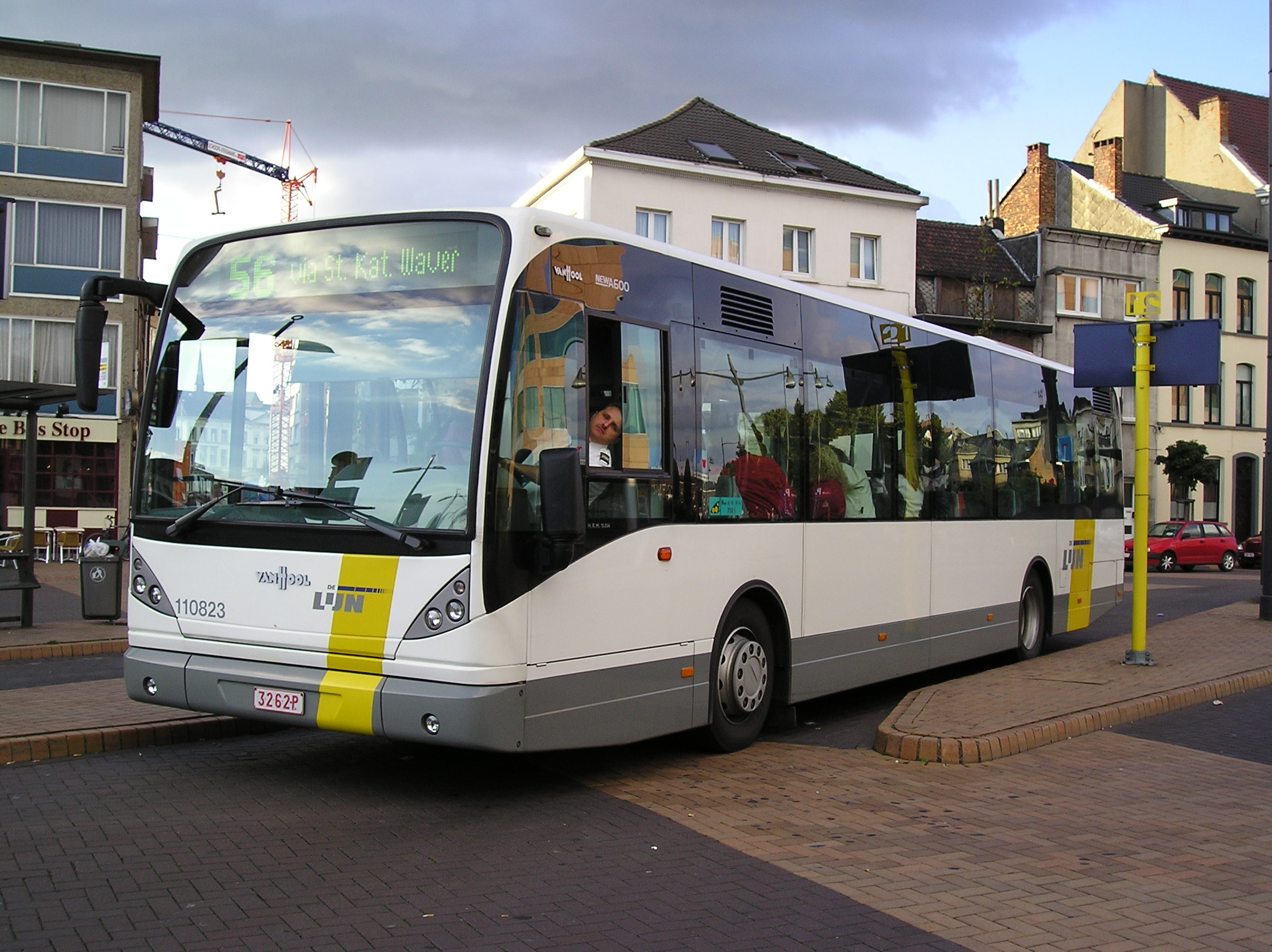
"De Lijn" serves as the main public transport company, run by the Flemish government. It consists of buses and trams. TEC is the equivalent company in Wallonia, and MIVB-STIB in Brussels. The railway network run by the NMBS, however, is a federal responsibility.
The Flemish government is also responsible for about 500 kilometers of regional roads (Dutch: gewestwegen) and about 900 kilometers of highways in the territory of the Flemish Region. Other types of roads are provincial roads and municipal roads.
The region is served by these airports:
- Brussels Airport
- Antwerp International Airport
- Ostend–Bruges International Airport
Demographics
Cities
Largest cities in the region include (with population figures as of 1 January 2018):
- Antwerp (523,248)
- Ghent (260,341)
- Bruges (118,284)
- Leuven (101,396)
- Mechelen (86,304)
- Aalst (85,715)
- Hasselt (77,651)
- Sint-Niklaas (76,756)
- Kortrijk (76,265)
- Ostend (71,332)
- Genk (66,110)
- Roeselare (62,301)
The Flemish Diamond (Dutch: Vlaamse Ruit) is the name of the central, populous area in Flanders and consists of several of these cities, such as Antwerp, Ghent, Leuven and Mechelen. Approximately 5.5 million people live in the area.
Language
The official language of the Flemish Region is Dutch. The dialect cluster spoken in the region is sometimes colloquially referred to as Flemish (Vlaams), Flemish Dutch (Vlaams-Nederlands), Belgian Dutch (Belgisch-Nederlands), or Southern Dutch (Zuid-Nederlands). Spelling and grammar are regulated by a single authority, the Dutch Language Union (Nederlandse Taalunie), comprising a committee of ministers of the Flemish and Dutch governments, their advisory council of appointed experts, a controlling commission of 22 parliamentarians, and a secretariat. The term Flemish can be applied to the Dutch spoken in Flanders; it shows many regional and local variations. The main dialect groups include West Flemish, East Flemish, Brabantian and Limburgish.
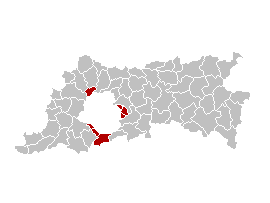
French (specifically Belgian French) may also be used in the Flemish Region for certain administrative purposes in a limited number of the so-called "municipalities with language facilities" around the Brussels-Capital Region and on the border with Wallonia. These "rim municipalities" around Brussels are Drogenbos, Kraainem, Linkebeek, Sint-Genesius-Rode, Wemmel and Wezembeek-Oppem. Brussels was originally a Dutch-speaking city (Brabantian dialect to be exact), but it was francised in the 19th and 20th centuries and is now officially bilingual in French and Dutch (although largely French-speaking in practice). Municipalities with language facilities on the border with Wallonia are Bever (), Herstappe, Mesen (), Ronse (), Spiere-Helkijn (), and Voeren ().
Religion
According to a 2016 survey by the Free University of Brussels, 68% of Flemish citizens are Roman Catholic, 2% are Protestant, 26% are irreligious, while 2% have other religions.
International relations
Twin regions and sister regions
- JPN Aichi, Japan
References
Footnotes
Notes
References
- (11 April 2020). "Occupation du sol sur base du Registre cadastral, Belgique. Revenus en euro. Superficies en hectare. Superficie totale en pour mille". [[Statistics Belgium]].
- (26 May 2020). "On 1 January 2020, Belgium had 11,492,641 inhabitants". [[Statistics Belgium]].
- "VGT: een erkende taal {{!}} Departement Cultuur, Jeugd & Media".
- "EU regions by GDP, Eurostat".
- (May 2014). "The Belgian Constitution". Belgian House of Representatives.
- "Flanders | Flanders fits you". Flanders.be.
- "Regional GDP per capita ranged from 30% to 263% of the EU average in 2018".
- "Kant-en-klare rapporten". Aps.vlaanderen.be.
- (14 October 2014). "Flemish, Vlaams". [[BBC]].
- De Cock, Barbara. (2006). "Flemish language policy in an era of globalisation". Gencat.cat.
- "Flemish language, alphabet and pronunciation". Omniglot.
- "De Taalunie – Wie zijn wij?". Nederlandse Taalunie.
- "De Taalunie – Werkwijze en beleid". Nederlandse Taalunie.
- Hoeksema, Jack. "College 4 – 1830 Belgische onafhankelijkheid, Noord-Zuidverschillen, Dialecten en de rijksgrens, Frans-Vlaanderen". [[University of Groningen]] (host site).
- Backhaus, Peter. (2007). "Linguistic Landscapes: A Comparative Study of Urban Multilingualism in Tokyo". Multilingual Matters Ltd.
- (May 2007). "La Constitution belge (Art. 4)". the [[Belgian Senate]].
- Janssens, Rudi. (2008). "Taalgebruik in Brussel en de plaats van het Nederlands — Enkele recente bevindingen".
- "ベルギー3地域と「友好交流及び相互協力に関する覚書」を締結".
This article was imported from Wikipedia and is available under the Creative Commons Attribution-ShareAlike 4.0 License. Content has been adapted to SurfDoc format. Original contributors can be found on the article history page.
Ask Mako anything about Flemish Region — get instant answers, deeper analysis, and related topics.
Research with MakoFree with your Surf account
Create a free account to save articles, ask Mako questions, and organize your research.
Sign up freeThis content may have been generated or modified by AI. CloudSurf Software LLC is not responsible for the accuracy, completeness, or reliability of AI-generated content. Always verify important information from primary sources.
Report