From Surf Wiki (app.surf) — the open knowledge base
Flemish Government
Executive branch of Flemish Community and Region
.png)
Executive branch of Flemish Community and Region
| Field | Value | |
|---|---|---|
| government_name | Flemish Government | |
| nativename | Vlaamse Regering | |
| image | [[File:Logo Vlaamse overheid.gif | 260px]] |
| caption | Emblem of the Flemish administration (Dutch: Vlaamse overheid) | |
| date_established | ||
| polity | Flanders (Community & Region) | |
| address | Place des Martyrs / Martelaarsplein | |
| 1000 City of Brussels, Brussels-Capital Region, Belgium | ||
| leader_title | Minister-President | |
| appointed | Flemish Parliament | |
| budget | € 44.7 billion (2018) | |
| responsible | Flemish Parliament | |
| url | www.flanders.be |
1000 City of Brussels, Brussels-Capital Region, Belgium The Flemish Government ( ) is the executive branch of the Flemish Community and the Flemish Region of Belgium. It consists of a government cabinet, headed by the Minister-President and accountable to the Flemish Parliament, and the public administration (civil service) divided into 13 policy areas, each with an executive department and multiple agencies.
The Flemish Government cabinet consists of up to a maximum of eleven ministers, chosen by the Flemish Parliament. At least one minister must come from Brussels. The ministers are drawn from the political parties which, in practice, form the governing coalition. The Government is chaired by the Flemish Minister-President. Ministers head executive departments of the government administration. Ministers must defend their policies and performance in person before the Flemish Parliament. The Flemish Government must receive and keep the confidence of the Flemish Parliament. Until 1993 the Flemish Government was called the Flemish Executive (Vlaamse Executieve).
Cabinet composition
[[Diependaele Government|Diependaele]] (2024-current)
[[Jambon Government|Jambon]] (2019–2024)
.png)
| Party | Name | Function |
|---|
[[Homans Government|Homans]] (2019)
| Flemish Government - Homans 2019 (Jul-Oct) | Party | Name | Function |
|---|
[[Bourgeois Government|Bourgeois]] (2014–2019)
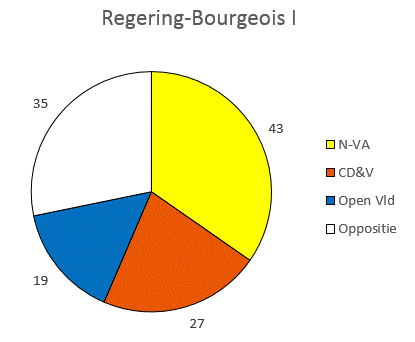
| Flemish Government - Bourgeois 2014–2019 | Party | Name | Function |
|---|
[[Peeters II Government|Peeters II]] (2009–2014)
Following the 7 June 2009 election, CD&V (31 seats), N-VA (16 seats) and SP.A (19 seats) parties formed a coalition.

| Flemish Government - Peeters II 2009–2014 | Party | Name | Function |
|---|
Leterme I/Peeters I (2004–2009)


Following the 2004 election, (29 seats)/ (6 seats), / (25 seats) and (19 seats) parties formed a coalition.
- From 19 July 2004 to 26 June 2007, the Minister-President of Flanders was Yves Leterme (CD&V), leading a coalition of CD&V-N-VA, VLD-Vivant, and SP.A-Vl.Pro.
- On 26 June 2007, in the aftermath of the 2007 Belgian general elections, Yves Leterme and Inge Vervotte resigned as minister-president and minister in the Flemish Government to take their seats in the Belgian Parliament. On 28 June Kris Peeters was sworn in as new minister-president, taking over the responsibilities of Leterme, and Vanackere and Crevits replaced Vervotte and Peeters as Flemish ministers.
- On 10 October 2007 Fientje Moerman resigned due to the fallout of a hiring scandal; she was replaced as vice-minister-president by Dirk Van Mechelen and as minister by Patricia Ceysens.
- On 22 September 2008 Geert Bourgeois (N-VA) was forced to resign due to pressure by the SP.A-Vl.Pro and Open VLD coalition partners because of his party's no confidence vote in the federal government of Leterme and their lack of trust in further negotiations by the Regions regarding the state reform. His portfolios of Administrative Affairs, Foreign Policy, Media and Tourism were taken over by minister-president Peeters.
- On 30 December 2008 Steven Vanackere resigned to become federal Minister of Civil Service and Public Enterprises. He was replaced in the Flemish Government by Veerle Heeren.
The composition at the end of the legislature: |party-CD&V = CD&V|party-CD&V-color =#F7991D |party-SPA = SP.A|party-SPA-color =#DC1F30 |party-VLD = VLD|party-VLD-color =#0087DC
Dewael I (1999–2003)/Somers I (2003–2004)


After the regional elections of 1999, a coalition of VLD, SP, Agalev and the VU was formed with Patrick Dewael (VLD) as Minister-President.
After the federal elections of June 2003, Patrick Dewael resigned as Minister-President and went to the federal political level. He was succeeded by Bart Somers as Flemish Minister-President until the end of term in 2004. Due to changes in political parties, the coalition was different:
- Volksunie (VU) fell apart. Instead, Spirit entered the coalition
- the SP was renamed to SP.a
- Agalev was renamed to Groen!
Van den Brande IV (1995–1999)

After the regional elections of 1995 (which were the first direct elections for the Flemish Parliament), a coalition of CVP and SP was formed.
| Minister | Name | Party |
|---|---|---|
| Minister-President, Foreign Policy, European Affairs, Science and Technology | Luc Van den Brande | |
| Vice-Minister-President, Education and Public Administration | Luc Van den Bossche | |
| Environment and Labour | Theo Kelchtermans | |
| Finance, Budget and Health Policy | Wivina Demeester | |
| Public Works, Transport and Spatial Planning | Eddy Baldewijns | |
| Economy, SME, Agriculture and Media | Eric Van Rompuy | |
| Home Affairs, Urban Policy and Housing | Leo Peeters | |
| Culture, Family Policy and Welfare | Luc Martens | |
| Brussels Affairs and Equal en Equal Opportunities Policy | Anne Van Asbroeck |
List of Flemish Minister-Presidents
Main article: Minister-President of Flanders
| Name | Period | Party | Comments |
|---|---|---|---|
| Rika De Backer | 1974 – 1981 | CVP | Only of Flemish Community |
| Gaston Geens | 22 December 1981 – 21 January 1992 | CVP | |
| Luc Van den Brande | 21 February 1992 – 1999 | CVP | |
| Patrick Dewael | 13 July 1999 – 5 June 2003 | VLD | |
| Bart Somers | 11 June 2003 – 20 July 2004 | VLD | |
| Yves Leterme | 20 July 2004 – 28 June 2007 | CD&V | |
| Kris Peeters | 28 June 2007 – 25 July 2014 | CD&V | |
| Geert Bourgeois | 25 July 2014 – 2 July 2019 | N-VA | |
| Liesbeth Homans | 2 July 2019 – 2 October 2019 | N-VA | |
| Jan Jambon | 2 October 2019 – present | N-VA |
Administration

The Flemish administration (Dutch: Vlaamse overheid) denotes the Flemish civil service. With the 2006 reform program Better Administrative Policy (Dutch: Beter Bestuurlijk Beleid), the Flemish civil service is designed to make the Flemish public administration more efficient and transparent.
The tasks of the Flemish public administration are now organised in 13 policy areas. Each policy area comprises a department and a number of (semi-) independent government agencies. Only those with their own article are mentioned below.
The 11 policy areas are:
- Public Governance and the Chancellery (KB)
- Foreign Affairs (iV)
- Liaison Agency Flanders-Europe (vleva)
- Flanders Investment and Trade (FIT)
- Finance and Budget (FB)
- Education and Training (OV)
- Economy, Science and Innovation (EWI)
- Agency for Innovation by Science and Technology (IWT)
- Participatiemaatschappij Vlaanderen (PMV)
- National Botanic Garden of Belgium
- Culture, Youth, Sport and Media (CJSM)
- Agency for the Promotion of Physical Development, Sport and the Outdoor Recreation (Bloso)
- Royal Museum of Fine Arts Antwerp (KMSKA)
- Welfare, Public Health and Family (WVG)
- Care Inspectorate
- Agriculture and Fisheries (LV)
- Work and Social Economy (WSE)
- Mobility and Public Works (MOW)
- Flemish Transport Company "De Lijn"
- Environment (OMG)
- Flemish Energy Agency (VEA)
- Immovable Heritage
Several other institutes, such as the Flemish Opera and the Flemish Institute for Technological Research (VITO), were not incorporated into the above structure.
Every year, the Minister-President presents the current state of affairs in Flanders and the Government's plans for next year during the September Declaration on the fourth Monday in September.
Budget
The below figures use the 2018 budget as example, which had €44.7 billion in expenses and €42.3 billion in revenue.
The revenue comes from the following sources:
- 56% – Special financing law: the so-called "shared taxes" and "merged taxes" which the federal government raises through income taxes and VAT and partially transfers to the communities and regions based on a complex formula
- 34% – Fiscal autonomy
- 18% – Opcentiemen: additional "centimes" to the federal income tax (the height of which can be set by the Flemish Government)
- 16% – Regional taxes (taxes under the proper authority of the Flemish Government), such as the traffic tax and inheritance tax
- 10% – Other revenues
The expenses are as follows per policy area:
| €0.13 billion | Higher Entities | Operating costs of the ministerial cabinets and the Flemish Parliament |
|---|
Projects
The Flemish Government owns the rights to Flanders Today, an English-speaking online and print newspaper focused on current affairs in Flanders and Brussels. The project was launched in 2007 by Geert Bourgeois – then Minister of Foreign Affairs and Tourism -, for three main reasons:
- Facilitating the integration of expats living in the region by informing them of the region's current events.
- Informing international journalists about the region, as most foreign correspondents based in Brussels get their news from the French-speaking press because the majority cannot read Dutch. Flanders Today would act as a counterweight to that side of every story.
- Informing diplomats, investors, potential tourists and others outside of Belgium's borders about the region. In May 2017, the Flemish Government announced it would not be rebidding the Flanders Today project. Both the print and the online version of the paper are to be shut down in October 2017.
References
References
- "De Vlaamse begroting in cijfers". Flemish government.
- "Save Flanders Today!".
- "UPDATE: Flanders Today contract cancelled {{!}} Flanders Today".
This article was imported from Wikipedia and is available under the Creative Commons Attribution-ShareAlike 4.0 License. Content has been adapted to SurfDoc format. Original contributors can be found on the article history page.
Ask Mako anything about Flemish Government — get instant answers, deeper analysis, and related topics.
Research with MakoFree with your Surf account
Create a free account to save articles, ask Mako questions, and organize your research.
Sign up freeThis content may have been generated or modified by AI. CloudSurf Software LLC is not responsible for the accuracy, completeness, or reliability of AI-generated content. Always verify important information from primary sources.
Report