From Surf Wiki (app.surf) — the open knowledge base
Flemish dialects
Varieties of Dutch spoken in Flanders, Belgium
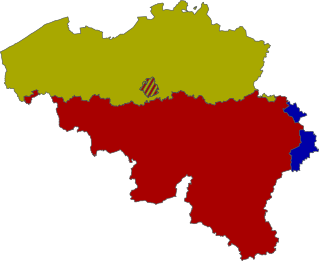
Varieties of Dutch spoken in Flanders, Belgium
| Field | Value |
|---|---|
| name | Flemish |
| nativename | Vlaams |
| states | Belgium, Netherlands, France |
| ethnicity | Flemings |
| region | Belgian Flanders, Zeelandic Flanders, French Flanders |
| speakers | 6.5 million |
| date | 2016 |
| ref | |
| familycolor | Indo-European |
| fam2 | Germanic |
| fam3 | West Germanic |
| fam4 | Istvaeonic |
| fam5 | Low Franconian |
| fam6 | Dutch |
| dia1 | West Flemish |
| dia2 | East Flemish |
| dia3 | Brabantian |
| dia4 | Limburgish |
| iso1 | nl |
| iso1comment | for Dutch |
| iso2b | dut |
| iso2t | nld |
| iso2comment | for Dutch |
| iso3 | nld |
| iso3comment | for Dutch |
| lc1 | vls |
| ld1 | West Flemish |
| lc2 | zea |
| ld2 | Zeelandic |
| lc3 | lim |
| ld3 | Limburgish |
| glotto | dutc1256 |
| glottoname | Dutch |
| ietf | nl-BE |
Flemish (Vlaams ) is a Low Franconian dialect cluster of the Dutch language. It is sometimes referred to as Flemish Dutch (Vlaams-Nederlands), Belgian Dutch (Belgisch-Nederlands ), or Southern Dutch (Zuid-Nederlands). Flemish is native to the region known as Flanders in northern Belgium; it is spoken by Flemings, the dominant ethnic group of the region. Outside of Belgium Flanders, it is also spoken to some extent in French Flanders and the Dutch Zeelandic Flanders.
Terminology
The term Flemish itself has become ambiguous. Nowadays, it is used in at least five ways, depending on the context. These include:
- An indication of Dutch written and spoken in Flanders including the Dutch standard language as well as the non-standardized dialects, including intermediate forms between vernacular dialects and the standard. Some linguists avoid the term Flemish in this context and prefer the designation Belgian-Dutch or South-Dutch
- A synonym for the so-called intermediate language in Flanders region, the Tussentaal
- An indication of the non-standardized dialects and regiolects of Flanders region, so extending beyond East Flemish and West Flemish dialects to include some Limburgish and Brabantian dialects
- An indication of the non-standardized dialects of only the former County of Flanders, i.e. the current provinces of West Flanders and East Flanders, Zeelandic Flanders and French Flanders
- An indication of the non-standardized West Flemish dialects of the province of West Flanders, the Dutch Zeelandic Flanders and French Frans-Vlaanderen
Glottolog considers Western Flemish to be a separate language, classified as a part of the Southwestern Dutch family together with the Zeelandic language. According to Glottolog, Western Flemish includes the dialects of French Flemish and West Flemish. Brabantian and East Flemish are classified as Dutch dialects, under the Central Southern Dutch dialect group. Ethnologue considers Limburgish and West Flemish to be separate (regional) languages.
Characteristics
Dutch is the majority language in Belgium, used in the written language by three-fifths of the population of Belgium. It is one of the three national and state languages of Belgium, together with French and German, and is the only official language of the Flemish Region.
The various Dutch dialects spoken in Belgium contain a number of lexical and grammatical features that distinguish them from the standard Dutch. Standard Dutch words can have a completely different meaning in Flemish or imply different context, comparable to the differences between the British and North American variants of English. As is also the case in the Netherlands, the pronunciation of Standard Dutch is affected by the native dialect of the speaker.
All Dutch dialect groups spoken in Belgium are spoken in adjacent areas of the Netherlands as well. East Flemish forms a continuum with both Brabantic and West Flemish. Standard Dutch is primarily based on the Hollandic dialect (spoken in the Western provinces of the Netherlands) and to a lesser extent on Brabantian, which is the dominant dialect in Flanders, as well as in the south of the Netherlands.
Tussentaal
The supra-regional, semi-standardized colloquial form (mesolect) of Dutch spoken in Belgium uses the vocabulary and the sound inventory of the Brabantic dialects. It is often called an "in-between-language" or "intermediate language", intermediate between dialects and standard Dutch. Despite its name, Brabantian is the dominant contributor to the Flemish Dutch tussentaal.
It is a rather informal variety of speech, which occupies an intermediate position between vernacular dialects and the standard language. It incorporates phonetic, lexical and grammatical elements not part of the standard language but drawn from local dialects.
It is a relatively new phenomenon that has been gaining popularity during the past decades. Some linguists note that it seems to be undergoing a process of (limited) standardisation or that it is evolving into a koiné variety.
Tussentaal is slowly gaining popularity in Flanders because it is used a lot in television dramas and comedies. Often, middle-class characters in a television series will be speaking tussentaal, lower-class characters use the dialect of the location where the show is set (such as Western Flanders), and upper-class characters will speak Standard Dutch. That has given tussentaal the status of normality in Flanders. It is slowly being accepted by the general population, but it has met with objections from writers and academics who argue that it dilutes the usage of Standard Dutch. Tussentaal is used in entertainment television but rarely in informative programmes (like the news), which normally use Flemish accents with standard Dutch vocabulary.
Belgicisms
A belgicism is a word or expression that occurs only in the Belgian variant of Dutch. Some are rarely used, others are used daily and are considered part of the Belgian-Dutch standard language. Many belgicisms are loanwords and words or expressions literally translated from French (also called gallicisms); others, in contrast, are actually remarkably purist, such as droogzwierder (a compound of Dutch droog "dry" and zwierder "spinner") meaning "spin dryer" (common standard Dutch: centrifuge, a loanword from French), and duimspijker (a compound of Dutch duim "thumb" and spijker "nail") meaning "thumbtack" (common standard Dutch: punaise, a loanword from French). Among the belgicisms, there are also many words that are considered obsolete, formal, or purist in standard Dutch. Moreover, many belgicisms have their origin in the Belgian official nomenclature. For example, misdaad "felony" is not a legal term in the Netherlands, but it is in Belgium.
Etymology
The English adjective Flemish (first attested as flemmysshe, ; compare Flæming, ), meaning "from Flanders", was probably borrowed from Old Frisian. The Old Dutch form is flāmisk, which becomes vlamesc, vlaemsch in Middle Dutch and Vlaams in Modern Dutch.
The word Vlaams itself is derived from Ingvaeonic **flâm-*, from Germanic flauma-, meaning 'flooded'. The name Vlaanderen was formed from a stem **flâm-, with a suffix -đr/dr- attached.
Notes
References
References
- "ATLAS – Dutch: Who speaks it?". University College London.
- (14 October 2014). "Flemish, Vlaams". [[BBC]].
- De Cock, Barbara. (2006). "Flemish language policy in an era of globalisation". Gencat.cat.
- "Flemish language, alphabet and pronunciation". Omniglot.
- Lichfield, John. (18 December 2007). "Belgium: A nation divided". The Independent.
- link. (2013-10-21 . Dienst Taaladvies van de Vlaamse Overheid (Department for Language advice of the [[Flemish government]]).)
- Harbert, Wayne. (2007). "The Germanic Languages". Cambridge University Press.
- Kooij, Jan. (2009). "The World's Major Languages". Routledge.
- Casert, Raf. (20 February 2005). "Belgium Bickering Over French and Dutch, Its Dual Languages". [[Los Angeles Times]].
- "About Belgium – Language Matters".
- (1994). "The Germanic Languages". Routledge.
- "Vlaams".
- (1999-02-19). "Linguistic map of Benelux".
- Their [[ISO 639-3]] codes are ''vls'' and ''lim'', respectively.
- (2005). "Het Nederlands vroeger en nu". Acco.
- (2014-06-10). "De gesproken standaardtaal: het Algemeen Beschaafd Nederlands". Niederländische Philologie, Freie Universität Berlin.
- Geeraerts, Dirk. (2001). "Een zondagspak? Het Nederlands in Vlaanderen: gedrag, beleid, attitudes". Ons Erfdeel.
- (2005). "Het Nederlands vroeger en nu". Acco.
- "Algemeen Vlaams". VlaamseTaal.be.
- link. (2022-12-26 . Essays bij het emeritaat van Frans Daems. Gent: Academia Press, 1–9, p.2.)
- "Standaardtaal of tussentaal op televisie". Universiteit Gent.
- Vervaeke, Leen. (8 February 2014). "Actie tegen onverstaanbare Vlaamse 'tussentaal' op televisie". De Volkskrant.
- Jo Verhoeven, ''Illustrations of the IPA: Belgian Standard Dutch'' ([https://www.cambridge.org/core/services/aop-cambridge-core/content/view/40E060F565C2A84B07993980D2957D49/S0025100305002173a.pdf/belgian_standard_dutch.pdf PDF])
- "Flēmish". [[Middle English Dictionary]] (MED).
- "Flēming". [[Middle English Dictionary]] (MED).
- "Flemish". Etymonline.com}} which cites {{lang.
- "flāmisk". Oudnederlands Woordenboek (ONW).
- Instituut voor de Nederlandse Taal: [https://gtb.ivdnt.org/search/ ''De Geïntegreerde Taal-Bank'']:
Woordenboek der Nederlandsche Taal (WNT), entry [https://gtb.ivdnt.org/iWDB/search?actie=article&wdb=WNT&id=M080691&lemma=vlaming ''VlamingI''];
cp.: Oudnederlands Woordenboek (ONW), entry ''[https://gtb.ivdnt.org/iWDB/search?actie=article&wdb=ONW&id=ID3676&lemma=fl%C4%81mink flāmink]'': "Morfologie: ''afleiding, basiswoord (substantief):'' flāma ‘overstroomd gebied’; ''suffix:'' ink ‘vormt afstammingsnamen’"; Vroegmiddelnederlands Woordenboek (VMNW), entry [https://gtb.ivdnt.org/iWDB/search?actie=article&wdb=VMNW&id=ID6036&lemma=vlaendren ''Vlaendren'']: "Etymologie: ''Dat.pl. van'' flandr- '''overstroomd gebied' met het suffix'' -dr-.".
Cognate to Middle English ''flēm'' 'current of a stream': [https://quod.lib.umich.edu/m/middle-english-dictionary/dictionary/MED16260 Middle English Compendium → Middle English Dictionary (MED): ''flēm n.(2)'']
This article was imported from Wikipedia and is available under the Creative Commons Attribution-ShareAlike 4.0 License. Content has been adapted to SurfDoc format. Original contributors can be found on the article history page.
Ask Mako anything about Flemish dialects — get instant answers, deeper analysis, and related topics.
Research with MakoFree with your Surf account
Create a free account to save articles, ask Mako questions, and organize your research.
Sign up freeThis content may have been generated or modified by AI. CloudSurf Software LLC is not responsible for the accuracy, completeness, or reliability of AI-generated content. Always verify important information from primary sources.
Report