From Surf Wiki (app.surf) — the open knowledge base
Flavia Caesariensis
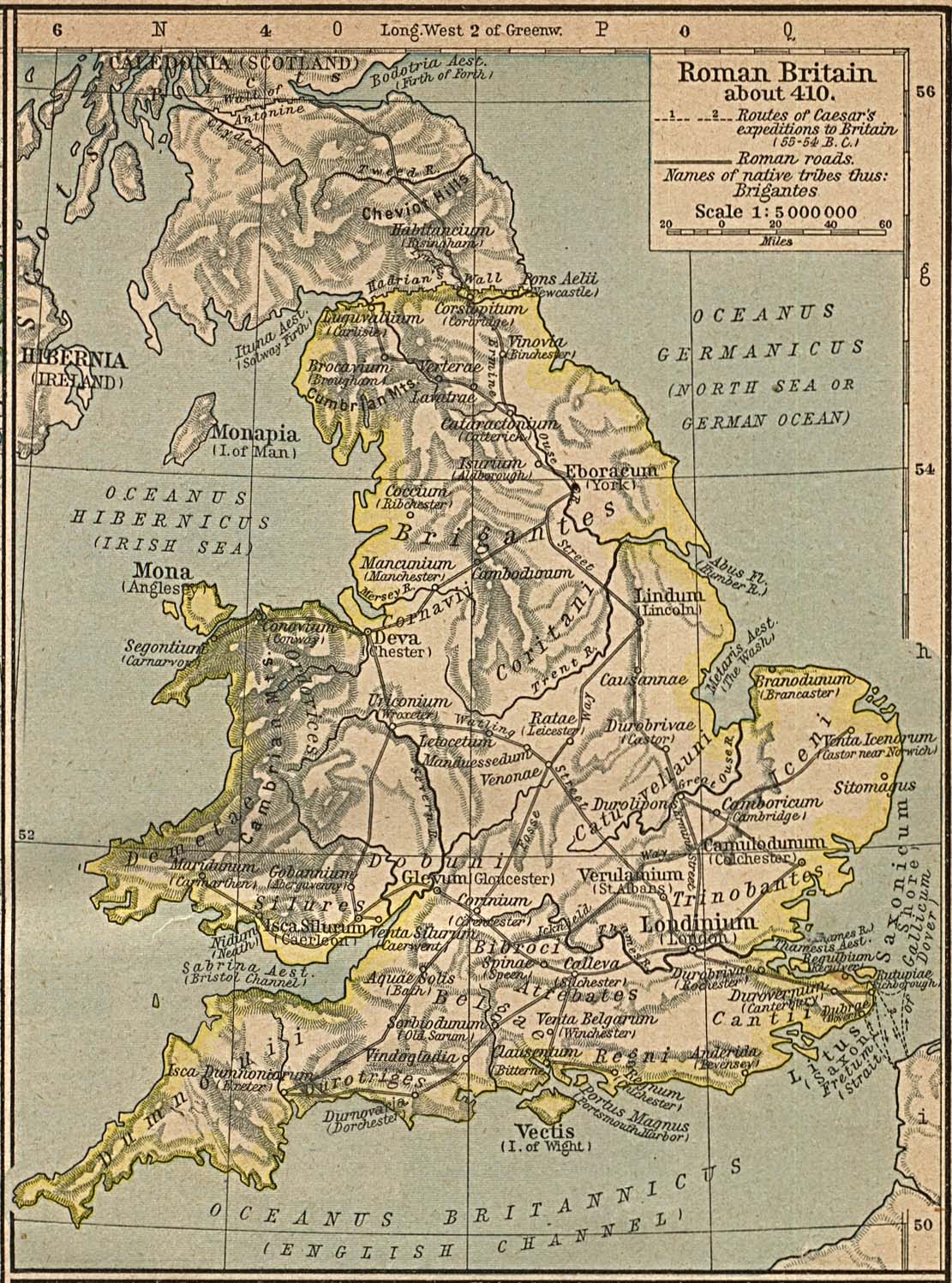
Flavia Caesariensis (Latin for "The Caesarian province of Flavius"), sometimes known as Britannia Flavia, was one of the provinces of the Diocese of "the Britains" created during the Diocletian Reforms at the end of the 3rd century. It was probably created after the defeat of the usurper Allectus by Constantius Chlorus in AD 296 and was mentioned in the Verona List of the Roman provinces. It seems to have been named after Chlorus's family and was probably located beside Maxima Caesariensis, but their positions and capitals remain uncertain. At present, most scholars place Flavia Caesariensis in the southern Pennines, possibly reaching the Irish Sea and including the lands of the Iceni. Its capital is sometimes placed at Lindum Colonia (Lincoln). NOTOC


History
Following the Roman conquest, Britain was administered as a single province from Camulodunum (Colchester) and then Londinium (London) until the Severan Reforms following the revolt of its governor Clodius Albinus. These divided the territory into Upper and Lower Britain (Britannia Superior and Inferior), whose respective capitals were at Londinium and Eboracum (York). During the first phases of the Diocletian Reforms, Britain was under the control of the Allectus's Britannic Empire as part of the Carausian Revolt. At some point after the territory was retaken by Constantius Chlorus in AD 296, the Diocese of the Britains (with its vicar at Londinium) was formed and made a part of Prefecture of Gaul. The Britains were divided among three, four, or five provinces,
The placement and capitals of these late British provinces are uncertain, although the Notitia Dignitatum lists the governor (praeses) of Flavia being of equestrian rank, making it unlikely to have been based in Londinium. The list of bishops who attended the 314 Council of Arles is patently corrupt{{refn|"Nomina Episcoporum, cum Clericis Suis, Quinam, et ex Quibus Provinciis, ad Arelatensem Synodum Convenerint" ["The Names of the Bishops with Their Clerics who Came Together at the Synod of Arles and from which Province They Came"] from the Consilia in Thackery Camden took it as Caerleon, with Bishop Stillingfleet and Thackery proposing that a scribal error created Civ. Col. Londin. from an original Civ. Col. Leg. II (Caerleon).
Describing the metropolitan sees of the early British church established by SS Fagan and "Duvian", Gerald of Wales placed Flavia around London, extending into Mercia. Bertram's highly-influential forgery The Description of Britain placed it similarly: although not including London, it included central England and was bound by the Severn, the Thames, the North Sea, and the Humber and Mersey; this was accepted for a century from the 1740s to the 1840s before being revealed as a forgery. Modern scholars usually place Londinium in Maxima rather than Flavia. Birley has argued that Maxima and Flavia originally consisted of a single province, which received the name Britannia Caesariensis as a mark of favour for support against the rebel Allectus in 296. Although Flavia is usually thought to have been formed from the old province of Lower Britain, Birley proposes that Upper Britain was divided in two (between Prima and Caesariensis) and then three (Prima, Maxima, and Flavia). This repeats Camden's earlier theory (relying on Sextus Rufus) that Maxima was formed first and Flavia followed sometime after.
References
References
- Frere, Sheppard. (1967). "Britannia: a history of Roman Britain". Harvard University Press.
- Camden, William. (1610). "Britain, or, a Chorographicall Description of the most flourishing Kingdomes, England, Scotland, and Ireland".
- Dornier, Ann. (1982). "The Province of Valentia". Britannia.
- ''[[Notitia Dignitatum]]''.
- [[Verona List]].
- [[Labbé, Philippe]] & [[Gabriel Cossart]] (eds.) [https://download.digitale-sammlungen.de/BOOKS/pdf_download.pl?id=bsb10321964 ''Sacrosancta Concilia ad Regiam Editionem Exacta: quae Nunc Quarta Parte Prodit Actior'' [''The Sancrosanct Councils Exacted for the Royal Edition: which the Editors Now Produce in Four Parts''], Vol. I: "Ab Initiis Æræ Christianæ ad Annum CCCXXIV" ["From the Beginning of the Christian Era to the Year 324"], col. 1429.] The Typographical Society for Ecclesiastical Books (Paris), 1671.
- {{in lang. la but generally assumed to have mimicked the Roman administration: the identification of [[Lindum Colonia]] as a provincial capital rests on proposed emendations of one or the other of the bishops from the cities ''Londinensi'' and ''colonia Londinensium''. Those emendations are highly speculative: [[Bishop Ussher]] proposed ''[[Colonia Victricensis. Colonia]]'', [[John Selden. Selden]] ''[[Camaloden]]'' or ''[[Camalodon]]'', and [[Henry Spelman
- Giraldus Cambriensis [Gerald of Wales]. [https://archive.org/stream/ycymmrodor30cymmuoft#page/130/mode/2up ''De Inuectionibus'' [On Invectives], Vol. II, Ch. I, in ''Y Cymmrodor: The Magazine of the Honourable Society of Cymmrodorion'', Vol. XXX, pp. 130–1.] George Simpson & Co. (Devizes), 1920. {{in lang. la
- [[Gerald of Wales]]. Translated by [[W.S. Davies]] as [https://archive.org/stream/ycymmrodor30cymmuoft#page/16/mode/2up ''The Book of Invectives of Giraldus Cambrensis'' in ''Y Cymmrodor: The Magazine of the Honourable Society of Cymmrodorion'', Vol. XXX, p. 16.] George Simpson & Co. (Devizes), 1920.
- Hughes, William. [https://books.google.com/books?id=rR1bAAAAcAAJ&pg=PA87 ''The Geography of British History: A Geographical Description of the British Islands at Successive Periods from the Earliest Times to the Present Day: With a Sketch of the Commencement of Colonisation on the Part of the English Nation'', p. 87.] Longman, Green, Longman, Roberts, & Green (London), 1863.
This article was imported from Wikipedia and is available under the Creative Commons Attribution-ShareAlike 4.0 License. Content has been adapted to SurfDoc format. Original contributors can be found on the article history page.
Ask Mako anything about Flavia Caesariensis — get instant answers, deeper analysis, and related topics.
Research with MakoFree with your Surf account
Create a free account to save articles, ask Mako questions, and organize your research.
Sign up freeThis content may have been generated or modified by AI. CloudSurf Software LLC is not responsible for the accuracy, completeness, or reliability of AI-generated content. Always verify important information from primary sources.
Report