From Surf Wiki (app.surf) — the open knowledge base
Flatiron District
Neighborhood in New York City
Neighborhood in New York City
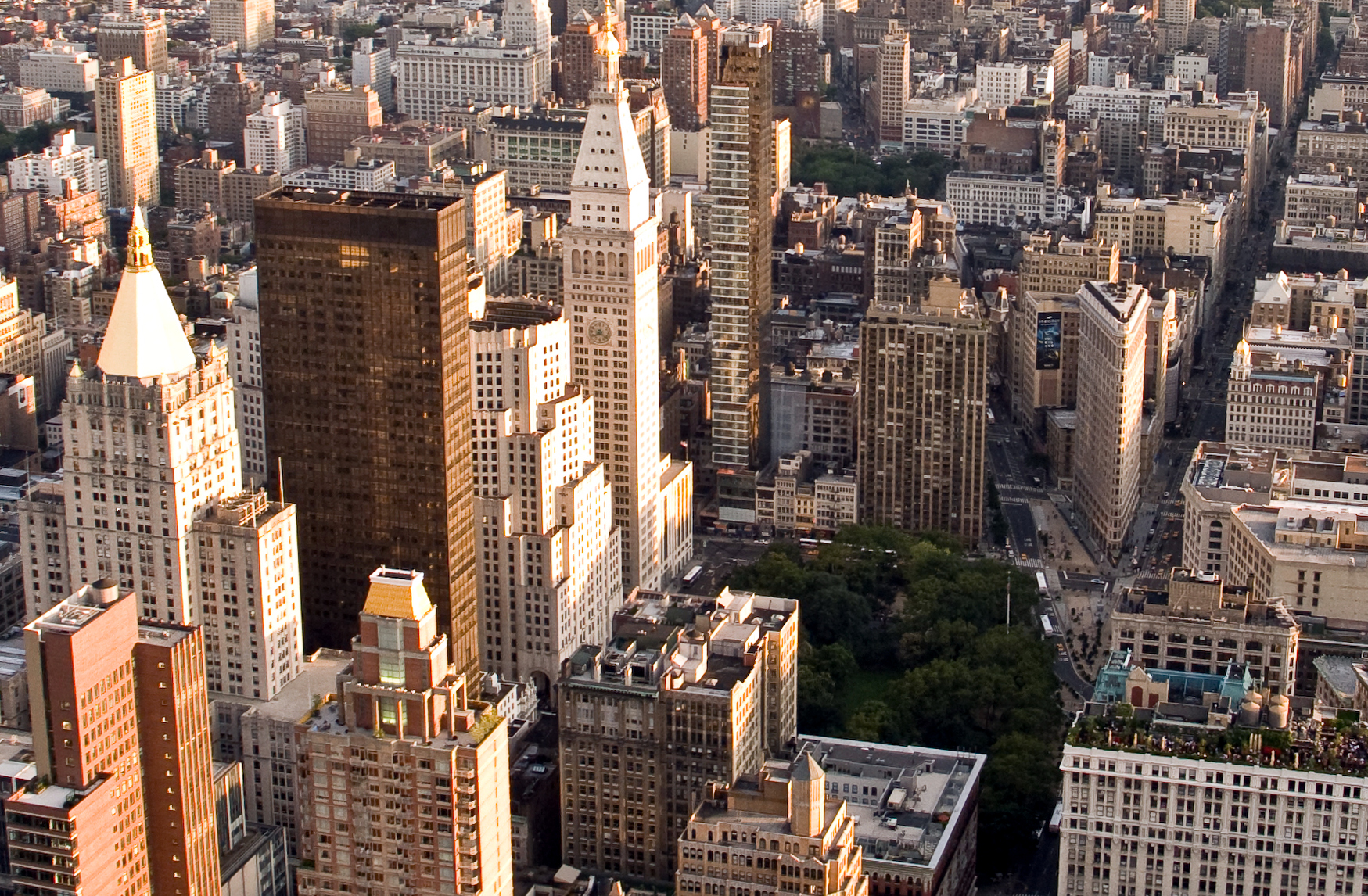
The Flatiron Building is the triangular building at right center. To the left is the Met Life Tower, with Madison Square Park in the center. Madison Avenue begins at 23rd Street between the park and the tower, and runs uptown (toward bottom of image). Madison Square is the intersection in front of the Flatiron, where Fifth Avenue and Broadway cross. (Fifth goes to the right, Broadway to the left.) The trees of Union Square Park can be seen in the top center of the image.]]
The Flatiron District is a neighborhood in the borough of Manhattan of New York City, named after the Flatiron Building at 23rd Street, Broadway and Fifth Avenue. Generally, the Flatiron District is bounded by 14th Street, Union Square and Greenwich Village to the south; the Avenue of the Americas (Sixth Avenue) and Chelsea to the west; 23rd Street and Madison Square (or NoMad) to the north; and Park Avenue South and Gramercy Park to the east.
Broadway cuts through the middle of the district, and Madison Avenue begins at 23rd Street and runs north. At the north (uptown) end of the district is Madison Square Park, which was completely renovated in 2001. The Flatiron District encompasses within its boundaries the Ladies' Mile Historic District and the birthplace of Theodore Roosevelt, a National Historic Site. The Flatiron District was also the birthplace of Silicon Alley, a metonym for New York's high technology sector, which has since spread beyond the area.
The Flatiron District is part of Manhattan Community District 5. Residents are represented by the Flatiron Alliance neighborhood association and nearby businesses by the Flatiron NoMad Partnership business improvement district, though the two have different (partially overlapping) boundaries.
History and name


The designation "Flatiron District" dates from around 1985, and came about because of its increasingly residential character, and the influx of many restaurants into the area – real estate agents needed an appealing name to call the area in their ads. Before that, the area was primarily commercial, with numerous small clothing and toy manufacturers, because of the large number of photographers' studios and associated businesses located there, the photographers having come because of the relatively cheap rents.
As of the 2000s, many publishers have their offices in the district, as well as advertising agencies, and the number of computer- and Web-related start-up companies in the area caused it to be considered part of "Silicon Alley" or "Multimedia Gulch", along with TriBeCa and SoHo.
The Flatiron district was bounded by the center of the printing trades south of 23rd Street and the garment industry starting to the north of 23rd Street. With the collapse of the printing trades and the textile industries in New York City, the area's business focus shifted towards technology companies, and to firms serving the employees in the high-tech, finance, media, legal, and medical sectors.
Buildings
The Flatiron District is located in the part of Manhattan where the bedrock Manhattan schist is located deeper underground than it is above 29th Street and below Canal Street. Under the influence of zoning laws, the tallest buildings in the area used to top out at around 20 stories; older buildings of 3-6 floors are still numerous, especially on the side streets.
Notable buildings in the district include the Flatiron Building, one of the oldest of the original New York skyscrapers. To the east, at 1 Madison Avenue, is the Met Life Tower, built in 1909 and at 700 ft was the tallest building in the world until 1913, when the Woolworth Building was completed. It is now occupied by Credit Suisse since MetLife moved their headquarters to the Pan Am Building. The marble clock tower of the building, modeled on St Mark's Campanile in Venice, dominates Madison Square and the park there.
Nearby, on Madison Avenue between 26th and 27th Streets, on the site of the old Madison Square Garden, is the New York Life Building, built in 1928 and designed by Cass Gilbert, with a square tower topped by a pyramid covered with gold-colored tiles. The Appellate Division Courthouse of New York State on Madison Avenue at 25th Street, was completed in 1900 by architect James Brown Lord, who used a third of the construction budget to decorate the building with statues and murals.
Completed in 2010, One Madison Park, a 50-story luxury condominium tower, sits at 23 East 22nd Street, at the foot of Madison Avenue and across from Madison Square Park. It is nearly as tall as the Met Life Tower (617.5 ft, compared to 700 ft for the Tower), and taller than the Flatiron Building. The triplex penthouse was purchased for $57.3 million in February 2014.
Another landmark is the 1909 sidewalk clock outside 200 Fifth Avenue.
Education
The campus of the City University of New York's Baruch College is located between 23rd and 25th Streets on Lexington Avenue, at the eastern edge of the district. The Field Building at 23rd Street and Lexington Avenue, the oldest building on the Baruch campus, sits on the former site of the Free Academy (now City College of New York), which was founded in 1847 and was the first institution of free public higher education in the United States. Baruch's Newman Vertical Campus as well as the Zicklin School of Business, the largest collegiate school of business in the United States, are also located on 24th and 25th Streets between Third and Lexington Avenues.
Culture and shopping
Cultural attractions in the area include Tibet House US, the Tibetan cultural preservation and education nonprofit founded by Robert Thurman and Richard Gere, which features a gallery and exhibitions on 15th Street. The Museum of Sex and the Gershwin Hotel, are both located on 27th Street. The Gershwin is a tribute to the late pop artist Andy Warhol, and features some of his art and memorabilia throughout the hotel.
The area has many stores, such as Ann Taylor, Victoria's Secret, Club Monaco, and Origins. "Big-box" retailers dominate Sixth Avenue between 14th Street and 23rd Street, at the district's western edge.
One of the neighborhood's older restaurants is Eisenberg's Sandwich Shop, founded in 1929. The classic 40 foot lunch counter restaurant at 174 Fifth Avenue, near East 22nd Street, changed owners five times over the last 94 years. It was saved from closing in 2005 by a loyal customer, closed again in March 2021 due to the Covid pandemic, and reopened as S & P, named for a sandwich shop that opened in the space in 1928.
Notable residents
- Joe Quesada, comic book writer/artist/editor, and Chief Creative Officer of Marvel Comics.
- Chelsea Clinton, the daughter of U.S. President Bill Clinton and Secretary of State Hillary Clinton, as well as her husband Marc Mezvinsky and their children, moved to the Flatiron District in 2016, having previously lived in nearby NoMad and Gramercy Park.
References
Notes
References
- {{cite enc-nyc2
- Jack Finnegan. (2007). "Newcomer's Handbook For Moving to and Living in New York City".
- Aileen Jacobson. (2017-02-22). "Living in the Flatiron District: Not Just a Place to Shop". New York Times.
- John Freeman Gill. (2012-04-01). "Flatiron District/Living In: Profile, Always High, Keeps Current Too". New York Times.
- "Flatiron District". [[PropertyShark]].
- Neighborhoods in New York City do not have official status, and their boundaries are not specifically set by the city. (There are a number of [[Community Boards of Manhattan. Community Boards]], whose boundaries are officially set, but these are fairly large and generally contain a number of neighborhoods and the [http://www.nyc.gov/html/dcp/html/neighbor/neigh.shtml neighborhood map] {{webarchive. link. (September 15, 2012 issued by the Department of City Planning only shows the largest ones.) Because of this, the definition of where neighborhoods begin and end is subject to a variety of forces, including the efforts of real estate concerns to promote certain areas, the use of neighborhood names in media news reports, and the everyday usage of people.)
- Karim Lahlou. "Startups move to co-shared offices amid high real estate prices". [[The Midtown Gazette]].
- Fergal Gallagher. (2015-11-04). "The mysterious origins of the term Silicon Alley revealed". Built in NYC.
- "NYC Planning {{!}} Community Profiles". New York City Department of City Planning.
- "Block Associations".
- [http://www.neighborhoodlink.com/Flatiron_Alliance Flatiron Alliance]
- [https://flatironnomad.nyc/about-us/pages/what-we-do/ "Flatiron District Map"] on the Flatiron NoMad Partnership website
- [http://www.flatirondistrict.nyc/uploaded/files/Where%20Then%20Meets%20Now/Where_Then_Meets_Now_FINAL_11415.pdf Flatiron: Where Then Meets Now / Flatiron District: The Synergies of Real Estate & Coworking Culture, Fall 2015]
- (December 22, 1991). "If You're Thinking of Living in: The Flatiron District". [[The New York Times]].
- Bill Cresenzo. (2009-01-21). "Midtown proves its mettle". Brokers Weekly (via Corcoran).
- Kennedy, Shawn G.. (June 3, 1987). "In Flatiron Area, Cafe Expansion". The New York Times.
- and was sometimes called the '''Toy District'''. The [[Toy Center]] buildings at 23rd Street and Broadway date from this period, and the annual [[American International Toy Fair]] took place there beginning in 1903, except for 1945. When much of this business moved outside the U.S., the area began to be referred to as the '''Photo District'''{{cite flatiron}} p.268
- Hawkins, David S.. (October 30, 1988). "If You're Thinking of Living in:; Flatiron District". The New York Times.
- Blau, Eleanor. (July 25, 1985). "Mix of People and Business". The New York Times.
- Pulley, Brett. (February 13, 1995). "New York Striving to Become Technology's Creative Center". The New York Times.
- Barr, Jason; Tassier, Troy; and Trendafilov, Rossen. [https://archive.fordham.edu/ECONOMICS_RESEARCH/PAPERS/dp2010_09_barr_tassier_trendafilov.pdf ''Bedrock Depth and the Formation of the Manhattan Skyline, 1890-1915''], [[Fordham University]], August 2010. Accessed December 30, 2023. "The conventional wisdom holds that Manhattan developed two business centers—downtown and midtown—because bedrock is close to the surface in these locations, with a bedrock 'valley' deep below the surface in between.... We find that bedrock depths had very little influence on the creation of separate business districts; rather its poly-centric development was due to residential and manufacturing patterns, and public transportation hubs. We do find evidence, however, that bedrock depths influenced the placement of skyscrapers within business districts."
- [https://old.skyscraper.org/EXHIBITIONS/WOOLWORTH/nw_metlife.php Metropolitan Life Insurance Tower], [[Skyscraper Museum]]. Accessed December 30, 2023. "Constructed in 1908, the tower of the Metropolitan Life Insurance Company was an addition to the existing 11-story home office structure intended to proclaim the stability of the company that had become the world's largest insurer. This Tower, designed by Napoleon LeBrun, held the title as the world's tallest structure, at 700 feet, until 1913 when the Woolworth building left it in its shadow."
- [[Christopher Gray (architectural historian). Gray, Christopher]]. [https://www.nytimes.com/1996/05/26/realestate/streetscapes-metropolitan-life-1-madison-avenue-for-brief-moment-tallest.html 'Streetscapes/Metropolitan Life at 1 Madison Avenue; For a Brief Moment, the Tallest Building in the World"], ''[[The New York Times]]'', May 26, 1996. Accessed December 30, 2023. "By 1907, as the Metropolitan tower was under construction, a new building for the Singer Sewing Machine Company was nearing completion at 140 Broadway; it would rise to 612 feet. In that year Metropolitan Life revised its plans to produce a 700-foot tower -- the tallest in the world.... But as an advertisement the tower succeeded, even after it was topped by the 792-foot Woolworth Building in 1913."
- Wacha, Audrey. [https://www.curbed.com/2023/08/one-madison-avenue-office-ibm-kpf-madison-square-park.html "What’s That New Glass Building Attached to the Old Met Life Tower?"], [[Curbed]], August 9, 2023. Accessed December 30, 2023. "But the building that (literally) overshadows them all is the Metropolitan Life Insurance Company Tower, also known as One Madison Avenue — not to be confused with the MetLife Building that looms over Grand Central or One Madison, a new luxury-condo building one block south developed by Related. With one oversize clock on each façade and a spire inspired by St. Mark’s Campanile in Venice, the Met Life Tower has dominated the corner of East 24th Street for more than a century."
- [https://madisonsquarepark.org/community/news/2021/04/history-of-the-new-york-life-building/ History of the New York Life Building], Madison Square Park Conservancy, August 8, 2014. Accessed December 30, 2023. "On the same piece of land that once housed the grand first and second Madison Square Gardens, on Madison Avenue between 26th and 27th streets, rose the New York Life Building. Famed architect Cass Gilbert (1859-1934), an early proponent of skyscrapers, was awarded the commission to design the building. Erected between 1926 and 1928, Gilbert’s 34-story, 617 foot tall, neo-gothic office building eventually became one of the New York skyline’s most iconic buildings.... The building’s recognizable pyramidal roof, originally plated in gold leaf, eventually eroded and was replaced with gold colored tile."
- [https://www.nyc.gov/site/dcas/business/dcasmanagedbuildings/appellate-courthouse.page Manhattan Appellate Courthouse], [[New York City Department of Citywide Administrative Services]]. Accessed December 30, 2023. "The architect James Brown Lord was given the then unheard of sum of $700,000 to construct the courthouse. Responding to the 'City Beautiful' movement, Lord was instructed to use a large percentage of the construction budget for decoration. Despite spending a third of the total cost on decorative features, like statues and murals, he managed to complete the building under budget by over $60,000."
- Rubinstein, Dana. (April 16, 2010). "One Madison Park to Receivership; Flood of Sales to Come?". [[The New York Observer]].
- Finn, Robin. (July 11, 2014). "Big Ticket | Rupert Murdoch's Trophy Pad, Expanded". [[The New York Times]].
- {{cite AIA4
- "Map and Directions - Baruch College". [[Baruch College]].
- Holland, Heather. (April 24, 2014). "Baruch College's Oldest Building Gets $90M Upgrade".
- [https://www.ccny.cuny.edu/about/history Our History], [[City College of New York]]. Accessed December 30, 2023. "The City College of New York was originally founded as the Free Academy of the City of New York in 1847 by wealthy businessman and president of the Board of Education, Townsend Harris, who would go on to establish diplomatic relations between the United States and Japan.... The Baruch School of Business at the City College of New York, named after CCNY alumnus Bernard Baruch, opened on 23rd Street in Manhattan in 1919, and became Baruch College in 1968 with the establishment of The City University of New York - now the largest public urban university system in the United States, and consisting of 25 institutions, including its founding college, City College."
- "Tibet House". NYC & Company.
- Koppel, Lily. (March 23, 2006). "Sandwich Shop Stays, Saved by a Regular". [[The New York Times]].
- (March 11, 2021). "Eisenberg's, a New York Institution, Is a Goner". [[New York (magazine).
- (September 21, 2022). "Court Street Grocers' Revamp of the Iconic Eisenberg's Sandwich Shop Is Here". [[Eater (website).
- Mala, Elisa (September 30, 2011). [https://www.nytimes.com/2011/10/02/nyregion/for-joe-quesada-no-rest-from-the-drawing-board-on-sundays.html?_r=2&partner=rss&emc=rss "Espresso and the Incredible Hulk"]. ''The New York Times''.
- Heller, Jill. (March 15, 2013). "Chelsea Clinton Apartment: Former First Daughter Scoops Up $10.5 Million Madison Square Park Pad". [[International Business Times]].
- Walker, Ameena. (2016-07-29). "Chelsea Clinton's former Madison Square Park pad already in contract".
This article was imported from Wikipedia and is available under the Creative Commons Attribution-ShareAlike 4.0 License. Content has been adapted to SurfDoc format. Original contributors can be found on the article history page.
Ask Mako anything about Flatiron District — get instant answers, deeper analysis, and related topics.
Research with MakoFree with your Surf account
Create a free account to save articles, ask Mako questions, and organize your research.
Sign up freeThis content may have been generated or modified by AI. CloudSurf Software LLC is not responsible for the accuracy, completeness, or reliability of AI-generated content. Always verify important information from primary sources.
Report