From Surf Wiki (app.surf) — the open knowledge base
Flat (theatre)
Flat piece of theatrical scenery
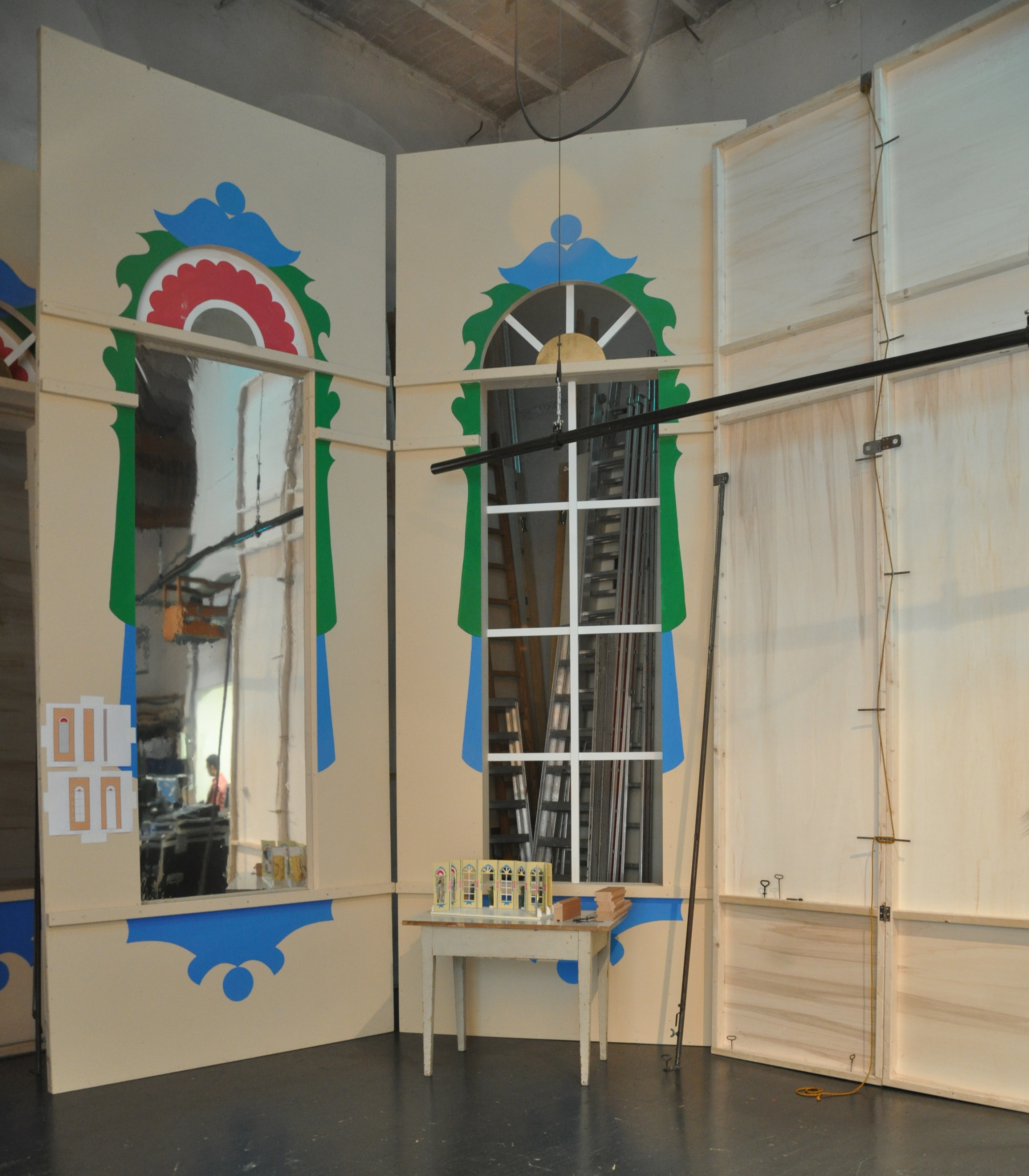
Flat piece of theatrical scenery
A flat (short for scenery flat) or coulisse is a flat piece of theatrical scenery which is painted and positioned on stage so as to give the appearance of buildings or other background.
Flats can be soft covered (covered with cloth such as muslin) or hard covered (covered with decorative plywood such as luan). Soft-covered flats have changed little from their origin in the Italian Renaissance. Flats with a frame that places the width of the lumber parallel to the face are called "Broadway" or "stage" flats. Hard-covered flats with a frame that is perpendicular to the paint surface are referred to as "Hollywood" or "studio" flats.
Usually flats are built in standard sizes of 8 ft, 10 ft, or 12 ft tall so that walls or other scenery may easily be constructed, and so that flats may be stored and reused for subsequent productions.
Often affixed to battens flown in from the fly tower or loft for the scenes in which they are used, they may also be stored at the sides of the stage, called wings, and braced to the floor when in use for an entire performance.
Flat construction

Parts of a flat
Rails (or plates) are the top and bottom framing members of a flat. Rails run the full width of the flat (4 ft, for a 4 ×, flat).
Stiles (or studs) are the vertical members of the frame. The length of the stiles is the full height of the flat, minus the combined width of the rails (7 ft, for a 4 x, flat constructed of 2+1/2 in, rails).
Toggles are horizontal cross pieces that run between the stiles or studs. The number and placement of toggles depends on the type of flat. The length of the toggles is the total width of the flat minus the combined width of the stiles (3 ft, for a 4 x, soft-cover flat constructed of 2+1/2 in, stiles).
Corner blocks are used to join the corners of a soft-cover flat. They are normally made of 1/4 in plywood, and are triangles with corners of 45°, 45°, and 90°. They are most often made by ripping the plywood at 6+1/2 in and then mitering it at 45 degree angles to create triangles with 9 in legs.
Keystones join the toggles to the stiles of soft-cover flats. They are 8 in long, and normally rip sawn to the same width as the toggles (usually 2+3/4 in) on one end, and 3+1/2 in on the other, forming a shape similar to the keystone of an archway.
Straps can be used in place of keystones. They are 8 in long and 2+1/2 in wide (same as toggle) rectangles. They are easier to construct than keystones, but not as strong due to their narrower dimension and reduced glue/nailing surface area.
A coffin lock or screws may be used to join securely adjacent flats, or traditionally with a lash line cleat, where cotton sash cord is lashed around cleats installed on the flat's edges. This allows for quick standing and striking of the set.
Styles
Broadway or stage flats are generally constructed of 1 × nominal (3/4 × actual) pine boards. The boards are laid out flat on the shop floor, squared, and joined with the keystones and corner blocks. The keystones and corner blocks are inset 1 in from the outside edge, which allows for flats to be hinged or butted together. They are then glued in place, and stapled or screwed down. The flat can then be flipped over and covered with muslin or decorative plywood. Toggles in a Broadway flat are placed on 4 ft centers.
Broadway flats can also be constructed using Half-lap and Cross-lap joints instead of keystones and corner blocks, and joins stiles, rails, and toggles, by sawing a 3/8 in deep half-lap at the ends of the pieces, and/or a 3/8 in deep dado groove mid-piece, which are then glued and stapled together. Dados can be made using a radial arm saw or table saw, and a dado stack cutter (two outer circular saw blades and one or more "chippers" between them, giving a much wider cut). Setting up for a dado stack is approximately the same as for preparing keystones and cornerblocks, but requires less layout, as the length of stiles, rails and, toggles are equal to the face of your flat.
Hollywood or studio flats can be made in various thicknesses to suit a particular design, but are most often made of 1 × nominal (3/4 × actual) pine boards. The boards are laid out on edge on the shop floor, the ends are glued together and stapled or screwed. Keystones and corner blocks are not normally used. Once assembled, the flat can be covered with 1/4 in or 1/8 in decorative plywood, which is glued on and stapled. The toggles in a Hollywood flat are placed on 2 ft centers.
Hollywood flats may receive a muslin skin over the decorative plywood face. The face is covered in a mixture of water and white glue, the muslin is applied and the entire flat is covered with the water/glue mixture again, to shrink and attach the muslin.
References
- Friedman, Sally (1994). Backstage Handbook: an illustrated almanac of technical information., Broadway Press.
References
This article was imported from Wikipedia and is available under the Creative Commons Attribution-ShareAlike 4.0 License. Content has been adapted to SurfDoc format. Original contributors can be found on the article history page.
Ask Mako anything about Flat (theatre) — get instant answers, deeper analysis, and related topics.
Research with MakoFree with your Surf account
Create a free account to save articles, ask Mako questions, and organize your research.
Sign up freeThis content may have been generated or modified by AI. CloudSurf Software LLC is not responsible for the accuracy, completeness, or reliability of AI-generated content. Always verify important information from primary sources.
Report