From Surf Wiki (app.surf) — the open knowledge base
Flags of the Confederate States of America
none

none
| Field | Value | ||
|---|---|---|---|
| Name | Confederate States of America | ||
| Image | Flag of the Confederate States (1861–1863).svg | ||
| Imagetext | The first national flag of the ConfederateStates ofAmerica | ||
| Nickname | "The Stars and Bars" | ||
| Use | National flag | ||
| Symbol | |||
| Proportion | 5:9 | ||
| Adoption | {{ubl | March 4, 1861(first 7-star version) | |
| Design | Three horizontal stripes of equal height, alternating red and white, with a blue square two-thirds the height of the flag as the canton. Inside the canton are seven (1861), eleven (1863), or thirteen (1865) white five-pointed stars of equal size, arranged in a circle and pointing outward. | ||
| Designer | Nicola Marschall | ||
| Image2 | Flag of the Confederate States of America (1863-1865).svg | ||
| Alt2 | Second flag of the Confederate States of America | ||
| Imagetext2 | The second national flag of the ConfederateStates ofAmerica | ||
| Nickname2 | "The Stainless Banner" | ||
| Use2 | National flag | ||
| Symbol2 | |||
| Proportion2 | 1:2 | ||
| Adoption2 | May 1, 1863 | ||
| Design2 | A white rectangle two times as wide as it is tall, a red quadrilateral in the canton, inside the canton is a blue saltire with white outlining, with thirteen white five-pointed stars of equal size inside the saltire. | ||
| Image3 | Flag of the Confederate States of America (1865).svg | ||
| Alt3 | Third flag of the Confederate States of America | ||
| Imagetext3 | The third national flag of the ConfederateStates ofAmerica | ||
| Nickname3 | "The Blood-Stained Banner" | ||
| Use3 | National flag | ||
| Symbol3 | |||
| Proportion3 | 2:3 | ||
| Adoption3 | March 4, 1865 | ||
| Design3 | A white rectangle, one-and-a-half times as wide as it is tall, a red vertical stripe on the far right of the rectangle, a red quadrilateral in the canton, inside the canton is a blue saltire with white outlining, with thirteen white five-pointed stars of equal size inside the saltire. | ||
| Designer3 | Maj. Arthur L. Rogers |
December 10, 1861(final 13-star version)}}
The flags of the Confederate States of America have a history of three successive designs during the American CivilWar. The flags were known as the "Stars and Bars", used from 1861 to1863; the "Stainless Banner", used from 1863 to1865; and the "** Banner**", used in1865 shortly before the Confederacy's dissolution. A rejected national flag design was also used as a battleflag by the ConfederateArmy and featured in the "Stainless Banner" and " Banner" designs. Although this design was never a , it is the most commonly-recognized symbol of the Confederacy.
Since the end of the Civil War, private and officialuse of the Confederateflags, particularly the battleflag, has continued amid philosophical, political, cultural, and racial controversy in the UnitedStates. These include flags displayed in states; cities, towns and counties; schools, colleges and universities; private organizations and associations; and individuals. The battleflag was also featured in the stateflags of Georgia and Mississippi, although it was removed by Georgia in2003 and Mississippi in2020. However, the new design of the Georgiaflag still references the original "Stars and Bars" iteration of the Georgiaflag. After the Georgiaflag was changed in2001, the city of Trenton, Georgia, has used a flag design nearly identical to the previous version with the battleflag.
It is estimated that 500–544 flags were captured during the war by the Union. The flags were sent to the WarDepartment in Washington.
First flag: the "Stars and Bars" (1861–1863)
| File:CSA FLAG 4.3.1861-21.5.1861.svg|First flag with 7 stars (March4 May18, 1861) | File:CSA Flag 21.5.1861-2.7.1861.svg|Flag with 9 stars (May18 July2, 1861) | File:CSA Flag 2.7.1861-28.11.1861.svg|Flag with 11 stars (July2 November28, 1861) | File:Flag of the Confederate States (1861–1863).svg|Last flag with 13 stars (December10, 1861 May1, 1863)
The Confederacy's first official national flag, often called the ****, flew from March4, 1861, to May1, 1863. Twomen claim to have designed the flag. While it has been traditionally attributed to Prussian-American artist Nicola Marschall from Marion, Alabama, evidence now shows that OrenRandolph from Louisburg, NorthCarolina likely also designed a similar flag at the same time. Alabama and NorthCarolina both certified that theirs was the first design, but an investigation into both men's claims has revealed evidence that supports both men.
The flag is very similar to the flag of the United States, and is said to resemble the flag of Austria, with which Nicola Marschall would have been familiar. The original version of the flag featured a circle of seven white stars in the canton, representing the seven states of the South that originally composed the Confederacy: SouthCarolina, Mississippi, Florida, Alabama, Georgia, Louisiana, and Texas. The "Stars and Bars" flag was adopted on March4, 1861, in the first temporary national capital of Montgomery, Alabama, and raised over the dome of that first Confederate capitol. Marschall also designed the Confederatearmy uniform.
One of the first acts of the Provisional Confederate Congress was to create the Committeeof the Flag andSeal, chaired by WilliamPorcher Miles, a Democratic congressman and "" from . The committee asked the public to submit thoughts and ideas on the topic and was, as historian JohnM. Coski puts it, "overwhelmed by requests not to abandon the 'oldflag' of the UnitedStates." Miles had already designed a flag that later became known as the Confederate BattleFlag, and he favored his flag over the "Stars and Bars" proposal. But given the popular support for a flag similar to the U.S.flag ("the Stars and Stripes"), the "Stars and Bars" design was approved by the committee.
As the Confederacy grew, so did the numbers of stars: two were added for Virginia and Arkansas in May1861, followed by two more representing Tennessee and NorthCarolina inJuly, and finally twomore for Missouri and Kentucky.
When the American Civil War broke out, the "Stars and Bars" confused the battlefield at the because of its similarity to the U.S. (orUnion) flag, especially when it was hanging limply on its flagstaff. The "Stars and Bars" was also criticized on ideological grounds for its resemblance to the U.S.flag. Many Confederates disliked the Stars and Bars, seeing it as symbolic of a centralized federal power against which the Confederate states claimed to be seceding. As early as April1861, a month after the flag's adoption, some were already criticizing the flag, calling it a "servile imitation" and a "detested parody" of the U.S.flag. In January1862, GeorgeWilliam Bagby, writing for the Southern Literary Messenger, wrote that many Confederates disliked the flag. "Everybody wants a new Confederateflag," Bagby wrote. "The present one is universally hated. It resembles the Yankeeflag, and that is enough to make it unutterably detestable." The editor of the expressed a similarview: "It seems to be generally agreed that the 'Stars and Bars' will never do for us. They resemble too closely the dishonored 'Flagof ' ...we imagine that the 'BattleFlag' will become the SouthernFlag by popular acclaim." WilliamT. Thompson, the editor of the , also objected to the flag, due to its aesthetic similarity to the U.S.flag, which for some Confederates had negative associations with emancipation and abolitionism. Thompson stated in April1863 that he disliked the adoptedflag "on account of its resemblance to that of the abolition despotism against which we are fighting."
Over the course of the flag's use by the CSA, additional stars were added to the canton, eventually bringing the total number to thirteen-a reflection of the Confederacy's claims of having admitted the borderstates of Kentucky and Missouri, where slavery was still widely practiced. The first showing of the flag was outside the BenJohnson House in Bardstown, Kentucky; the design was also in use as the Confederatenavy's battle ensign. The design uses the same starformation as the .
Second flag: the "Stainless Banner" (1863–1865)
| Second national flag (May1, 1863 March4, 1865), 2:1ratio | Second national flag (May1, 1863 March4, 1865) as commonly manufactured, with a 3:2ratio | A 12-star variant of the "Stainless Banner" produced in Mobile, Alabama | Variant captured following the Battleof Painesville, 1865 | Garrison flag of , the "Southern Gibraltar" |
|---|
Many different designs were proposed during the solicitation for a second Confederate nationalflag, nearly all based on the Battle Flag. By1863, it had become well-known and popular among those living in the Confederacy. The Confederate Congress specified that the new design be a white field "...with the union (now used as the battleflag) to be a square of the width of the flag, having the groundred; thereupon a broad saltire of blue, bordered with white, and emblazoned with mullets or stars, corresponding in number to that of the ConfederateStates."

The flag is also known as the Stainless Banner, and the matter of the person behind its design remains a point of contention. On April23, 1863, the Savannah MorningNews editor WilliamTappan Thompson, with assistance from WilliamRoss Postell, a Confederate blockade runner, published an editorial championing a design featuring the battleflag on a white background he referred to later as "The WhiteMan's Flag", a name which never caught on.
The Confederate Congress debated whether the white field should have a blue stripe and whether it should be bordered in red. William Miles delivered a speech supporting the simple white design that was eventually approved. He argued that the battleflag must be used, but it was necessary to emblazon it for a nationalflag, but as simply as possible, with a plain white field. When Thompson received word the Congress had adopted the design with a blue stripe, he published an editorial on April28 in opposition, writing that "the blue bar running up the center of the white field and joining with the right lower arm of the blue cross, is in bad taste, and utterly destructive of the symmetry and harmony of the design." Gray stated that the white field represented "purity, truth, and freedom."
Regardless of who truly originated the Stainless Banner's design, whether by heeding Thompson's editorials or Beauregard's letter, the Confederate Congress officially adopted the Stainless Banner on May1, 1863. The flags that were actually produced by the Richmond Clothing Depot used the adopted for the Confederatenavy's battle ensign, rather than the official .
Initial reaction to the second national flag was favorable, but over time it became criticized for being "too white." Military officers also voiced complaints about the flag being too white, for various reasons, such as the danger of being mistaken for a flagof truce, especially on naval ships where it was too easily soiled. The observed that it was essentially a battle flag upon a flagof truce and might send a mixed message. Due to the flag's resemblance to one of truce, some Confederate soldiers cut off the flag's white portion, leaving only the canton.
The first official use of the "Stainless Banner" was to drape the coffin of General ThomasJ. "Stonewall" Jackson as it layin state in the , May12, 1863. As a result of this first usage, the flag received the alternate nickname of the "JacksonFlag".
Third flag: the "Blood-Stained Banner" (1865)
| Third national flag (after March4, 1865) | Third national flag as commonly manufactured, with a square canton | Third national flag variant produced from an example of the second national flag | A 12-star variant of the " Banner" produced in Mobile, Alabama |
|---|
Rogers lobbied successfully to have this alteration introduced in the Confederate Senate. Rogers defended his redesign as symbolizing the primary origins of the people of the Confederacy, with the saltire of the Scottishflag and the red bar from the flagof France, and having "as little as possible of the Yankeeblue" the UnionArmy wore blue, the Confederatesgray.
The Flag Act of 1865, passed by the Confederate Congress near the very end of the war, describes the flag in the following language:
Due to the timing, very few of these third national flags were actually manufactured and put into use in the field, with many Confederates never seeing the flag. Moreover, the ones made by the Richmond Clothing Depot used the square canton of the second nationalflag rather than the slightly rectangular one that was specified by the law.
State flags
|[[File:No flag.svg|180x100px|border]]|Flag of Alabama No flag |[[File:No flag.svg|180x100px|border]]|Flag of Arkansas No flag |[[File:Flag of Florida (1861-1865).svg|180x100px|border]]|Flag of Florida (September 13, 1861) |[[File:Flag of the State of Georgia (1861, red).svg|180x100px|border]]|Flag of Georgia (de facto) |[[File:Flag of Louisiana (February 1861).svg|180x100px|border]]|Flag of Louisiana (February 11, 1861) |[[File:Flag of Mississippi (1861-1865).svg|180x100px|border]]|Flag of Mississippi (March 30, 1861) |[[File:Flag of North Carolina (1861).svg|180x100px|border]]|Flag of North Carolina (June 22, 1861) |[[File:Flag of South Carolina (January 1861).svg|180x100px|border]]|Flag of South Carolina (January 26, 1861) |[[File:Tennessee 1861 proposed.svg|180x100px|border]]|width=180|Flag of Tennessee (proposed) |[[File:Flag of Texas (1839–1879).svg|180x100px|border]]|Flag of Texas (January 25, 1839) |[[File:Flag of Virginia (1861).svg|180x100px|border]]|Flag of Virginia (April 30, 1861)
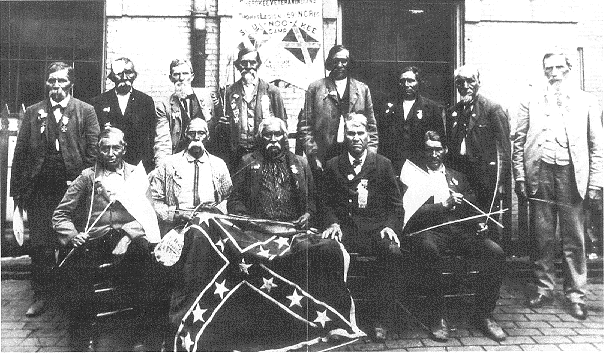
Indian Territory
Main article: Indian Territory in the American Civil War
|File:Flag of the Choctaw Brigade.svg|Flag of the Choctaw Nation () |File:Flag of the Confederate States for the Muscogee (Creek) Nation.svg|Flag of the Creek Nation () |File:Seminola confederats.svg|Flag of the Seminole Nation () |File:Flag of the Cherokee Braves.svg|National Color of the 1st Cherokee Mounted Rifles
Battle flag
.svg)

_(1895)_(14576050240).jpg)
At the First Battle of Manassas, near Manassas, Virginia, the similarity between the "Stars and Bars" and the "Stars and Stripes" caused confusion and military problems. Regiments carried flags to help commanders observe and assess battles in the warfare of the era. At a distance, the two nationalflags were hard to tell apart. Also, Confederate regiments carried many other flags, which added to the possibility of confusion.
After the battle, General P. G. T. Beauregard wrote that he was "resolved then to have [ourflag] changed if possible, or to adopt for my command a 'Battleflag', which would be Entirely different from any State or Federalflag". He turned to his aide, who happened to be WilliamPorcher Miles, the former chairman of the ConfederateCongress's Committeeon the Flag and Seal. Miles described his rejected nationalflag design to Beauregard. Miles also told the Committeeon the Flag and Seal about the general's complaints and request that the nationalflag be changed. The committee rejected the idea by a -one vote, after which Beauregard proposed the idea of having twoflags. He described the idea in a letter to his commanding general JosephE. Johnston:
The flag that Miles had favored when he was chairman of the "Committeeon the Flag and Seal" eventually became the battleflag and, ultimately, the Confederacy's most popular flag.
According to Museum of the Confederacy Director JohnCoski, Miles' design was inspired by one of the many "secessionistflags" flown at the SouthCarolina secession convention in Charleston of December1860. That flag was a blue Cross (an upright or Latincross) on a redfield, with 15white stars on the cross, representing the slave-holding states, and, on the redfield, palmetto and crescent symbols. Miles received various feedback on this design, including a critique from Charles Moise, a "Southerner of Jewish persuasion." Moise liked the design but asked that "...the symbol of a particular religion not be made the symbol of the nation." Taking this into account, Miles changed his flag, removing the palmetto and crescent, and substituting a heraldic saltire('X') for the upright cross. The number of stars was changed several times as well. He described these changes and his reasons for making them in early1861. The diagonal cross was preferable, he wrote, because "it avoided the religious objection about the cross (from the Jews and many Protestant sects), because it did not stand out so conspicuously as if the cross had been placed upright thus." He also argued that the diagonal cross was "more Heraldric than Ecclesiastical, it being the 'saltire' of Heraldry, and significant of strength and progress."
According to Coski, the Saint Andrew's Cross (also used on the flagof Scotland as a white saltire on a bluefield) had no special place in Southern iconography at the time. If Miles had not been eager to conciliate the SouthernJews, his flag would have used the traditional upright "SaintGeorge's Cross" (as used on the flagof England, a redcross on a white field). JamesB. Walton submitted a battleflag design essentially identical to Miles' except with an upright SaintGeorge's Cross, but Beauregard chose the diagonal cross design.
Miles' flag and all the flag designs up to that point were rectangular ("oblong") in shape. General Johnston suggested making it square to conserve material. Johnston also specified the various sizes to be used by different types of military units. Generals Beauregard and Johnston and Quartermaster‐General Cabell approved the Confederate BattleFlag's design at the Ratcliffehome, which served briefly as Beauregard's headquarters, near Fairfax CourtHouse in September1861. The 12thstar represented Missouri. President JeffersonDavis arrived by train at FairfaxStation soon after and was shown the design for the new battleflag at the RatcliffeHouse. and her sister, along with her cousin, ConstanceCary Harrison, made prototypes. One such flag resides in the collection of Richmond's Museumof theConfederacy and the other is in the Confederate MemorialHall Museum in .
On November 28, 1861, Confederate soldiers in General 's newly reorganized Armyof NorthernVirginia received the new battleflags in ceremonies at Centreville and Manassas, Virginia, and carried them throughout the CivilWar. Beauregard gave a speech encouraging the soldiers to treat the new flag with honor and that it must never be surrendered. Many soldiers wrote home about the ceremony and the impression the flag had upon them, the "fighting colors" boosting morale after the confusion at FirstManassas. From then on, the battleflag grew in its identification with the Confederacy and theSouth in general. The flag's stars represented the number of states in the Confederacy. The distance between the stars decreased as the number of states increased, reaching thirteen when the secessionist factions of Kentucky and Missouri joined in late1861.
The Army of Northern Virginia battle flag assumed a prominent place when it was adopted as the copyrighted emblem of the United Confederate Veterans. Its continued use by the SouthernArmy's veteran's groups, the United Confederate Veterans(U.C.V.) and the later Sonsof Confederate Veterans(S.C.V.), and elements of the design by related similar female descendants organizations of the (U.D.C.), led to the assumption that it was, as it has been termed, "the soldier's flag" or "the Confederate battleflag."
The square "battle flag" is also properly known as "the flag of the Armyof NorthernVirginia". It was sometimes called "Beauregard'sflag" or "the Virginia battleflag". A marker declaring Fairfax, Virginia, as the birthplace of the Confederate battleflag was dedicated on April12, 2008, near the intersection of Main and OakStreets, in Fairfax, Virginia.
Flag of the Army of Tennessee To boost the morale of the Army of Tennessee, GeneralJohnston introduced a new battleflag for the entire army. This flag bore a basic design similar to the one he had contributed to creating in Virginia in1861 and had been commissioned in Mobile while he was in command in Mississippi in1863. These flags for infantry and cavalry were to measure 37 by. The white edgingcross was about 2 inwide and was often filled with battle honors. The stars were from 3+1/2 to, with a 6 in cross. Flags for artillery were 30 by overall.
| [[File:South Carolina Sovereignty-Secession Flag.svg|x100px|border]]|The South Carolina sovereignty/secessionflag is said to have inspired the battleflag.
| [[File:Battle flag of the Confederate States of America (With White Border).svg|x100px|border]]|The Battle Flag of the
| [[File:Army of Tennessee Battle Flag.svg|x100px|border]]|Battle Flag of the Armyof Tennessee, late1863 to1865
| [[File:Army of the Trans-Mississippi Flag.svg|x100px|border]]|The battle flag used by the the
| [[File:Forrest's Cavalry Corps Flag.svg|x100px|border]]|Battle flag of Forrest's Cavalry Corps, 1863–1865
| [[File:Army of kentucky banner.svg|x100px|border]]|Battle flag of the
| [[File:Flag of Bragg's Corps.svg|x100px|border]]|Battle flag of
||
National flag proposals
Hundreds of proposed national flag designs were submitted to the ConfederateCongress during competitions to find a first and second (April1862; April1863) nationalflag.
First national flag proposals
When the Confederate States of America was founded during the Montgomery Convention that took place on February4, 1861, a nationalflag was not selected by the convention, as no proposals had been submitted. President JeffersonDavis's inauguration took place under the of Alabama, and the celebratory parade was led by a unit carrying the of Georgia.
Realizing that they quickly needed a national banner to represent their sovereignty, the the set up the Committeeon Flag and Seal. The chairman was WilliamPorcher Miles, who was also the SouthCarolina representative in the Confederate Houseof Representatives.
The committee began a competition to find a new national flag, with an unwritten adoption deadline of March4, 1861, the date of PresidentLincoln's inauguration. This would serve to show the world that theSouth was truly sovereign. Hundreds of examples were submitted from across the ConfederateStates and from states that were not yet part of theConfederacy (e.g.Kentucky), and even from Unionstates (such as NewYork). Many of the proposed designs paid homage to the "Stars and Stripes", the result of a sense of nostalgia in early1861 that many of the new Confederate citizens felt toward theUnion. Some of the homages were outright mimicry, while others were less obviously inspired by the Stars and Stripes yet were still intended to pay homage to that flag.
Those inspired by the Stars and Stripes were discounted almost immediately by the committee because they mirrored the Union'sflag too closely. While others were wildly different, many of which were very complex and extravagant, they were largely discounted because of the complexity and expense that would be involved in their production.
The winner of the competition was Nicola Marschall's "Stars and Bars" flag. This flag was selected by theCongress on March4, 1861, the day of the deadline. The firstflag was produced in a rush, as the date had already been selected for an official ceremony; credited the speedy completion of the first "Stars and Bars"flag to "fair and nimble fingers". This flag, made of , was raised by Letitia Tyler over the Alabama State Capitol. TheCongress inspected two other finalist designs on March4. One was a "Blue ring or circle on a field of red", while the other consisted of alternating red and blue stripes with a bluecanton containing stars. These two designs were lost, and their existence is known only from an 1872letter sent by Miles to .
Miles was not pleased with any of the proposals. He did not share in the Unionnostalgia, believing that the South'sflag should be completely different from that of the North. He proposed a flag design featuring a bluesaltire on white fimbriation with a field of red. He had originally planned to employ a blue St.George's Cross similar to that of the SouthCarolina SovereigntyFlag, but was dissuaded from doing so. Within the bluesaltire were seven white stars representing the current seven states of the Confederacy, two on each of the leftarms, one on each of the rightarms and one in the middle. However, Miles'sflag was not by the rest of theCongress. Onecongressman even mocked it as looking "like a pair of suspenders". Miles'sflag lost to the Stars and Bars.
| File:A. Bonand's flag proposal 1.jpg|First variant of flag proposal by A.Bonand of Savannah, Georgia | File:A. Bonand's flag proposal 2.svg|Second variant of flag proposal by A.Bonand | File:Confederateproposalladiesofcharleston.png|Flag proposal submitted by the "Ladiesof Charleston" | File:ConfederateproposalLPHonour1.jpg|First variant of flag proposal by of Charleston, South Carolina | File:ConfederateproposalLPHonour2.png|L. P. Honour's second variant of first national flag proposal | File:ConfederateproposalJohnSansom.jpg|Confederate first national flag proposal by John Sansom of Alabama | File:Confederate States Proposed1 1861.svg|William Porcher Miles' flag proposal, ancestor flag of the Confederate BattleFlag | File:Confederateproposaljohnggaines.png|John G. Gaines' First national flag proposal | File:ConfederateproposalJMJennings.png|Flag proposal by of Lowndesboro, Alabama | File:Confederateproposalsamuelwhite.png|Samuel White's flag proposal | File:Confederate flag proposal (Louisville).svg|Flag proposal submitted by an unknown person of Louisville, Kentucky | File:Confederate States Proposed3 1861.svg|One of three finalist designs examined by Congress on March4, 1861, lost out to Stars and Bars | File:Confederate States Proposed2 1861.svg|Second of three finalists in the Confederate first national flag competition | File:ConfederateproposalMrsEGCarpenter.png|Confederate flag proposal by of Cassville, Georgia | File:ConfederateproposalThomasHHobbs.png|Confederate flag proposal by ThomasH. Hobbs of Chattanooga, Tennessee | File:ConfederateproposalEugeneWytheBaylor.png|Flag proposal by EugeneWythe Baylor of Louisiana | File:ConfederateproposalbyH.png|Flag proposal submitted by 'H' of South Carolina | File:Confederateproposalhamiltoncoupes1stfeb1861.jpg|A Confederate flag proposal by Hamilton Coupes that was submitted on February1, 1861 | File:Confederateproposalireneriddle.png|The Confederate national flag proposal of Irene Riddle of Eutaw, Alabama | File:WilliamTRiddleproposed1.png|This flag proposal was the first variant submitted by WilliamT. Riddle of Eutaw, Alabama. Riddle submitted his flag proposals to on February21, 1861. | File:Confederate States Proposed 1862.svg|Flag proposed in 1862 | File:Confederate States Proposed 1862 (Dexter Per Bend Sinister).svg|Flag proposed in 1862 | File:Confederate States Proposed 1863.svg|Flag proposed in 1863 | File:Confederate States Proposed 1863 Amendment1.svg|Flag proposed in 1863 | File:Battle flag of the Confederate States of America (3-5).svg|Congressman Swan's Amendment to SenateBill No.132
Flag variants
In addition to the Confederacy's national flags, a wide variety of flags and banners were flown by Southerners during the CivilWar. Most famously, the was used as an unofficialflag during the earlymonths of1861. It was flying above the Confederate batteries that first opened fire on in Charleston harbor, beginning the CivilWar. The "VanDorn battleflag" was also carried by Confederate troops fighting in the and Westerntheaters ofwar. Many military units also carried their own regimentalflags into battle. Though there are only three officialflags with the correct number of stars.
| File:Bonnieblue.svg|The Bonnie Blue flag | File:Flag of the Army of Northern Virginia.svg|Flag of the Armyof NorthernVirginia or " HeadquartersFlag" | File:KGC FLAG.png|Flag of Knights of the Golden Circle | File:The Van Dorn Flag.svg|The "Van Dorn battle flag" used in the Western theaters of operation | File:Flag of the Confederate States Marine Corps.svg|7-star First national flag of the ConfederateStates MarineCorps | File:Polk’s Corps Battle Flag Second Issue.svg|Flag of FirstCorps, Armyof Tennessee | File:10th_Mississippi_flag.png|A Polk's Corps-style Battle Flag of the 10th Mississippi Infantry Regiment | File:Perote Guards flag.svg|The first battle flag of the Perote Guards (CompanyD, 1st Regiment Alabama Infantry). Flag officially used: September1860 Summer1861 | File:JP Gillis Flag.svg|George P. Gilliss flag, also known as the BidermanFlag, one of the few Confederateflags captured inCalifornia (Sacramento) | File:SibleyFlag.svg|The "Sibley Flag", Battle Flag of the Army of New Mexico, commanded by General HenryHopkins Sibley | File:Flag of the Confederate States Revenue Service.svg|The ensign of the Confederate States Revenue Service, designed by of SouthCarolina on April10, 1861 | File:Missouri Regiments Army Banner.svg|Flag flown by Confederate Missouri regiments during the Vicksburg campaign | File:Garrison flag of Vicksburg.svg | Flag variant with 12stars that served as the GarrisonFlag of Vicksburg, Mississippi during the Vicksburg campaign | File:Flag of the Cherokee Braves.svg|Flag of the Cherokee Braves | File:Flag of Breckinridge's Corps.svg|Flag of regiments of the Orphan Brigade | File:Hardee's moon flag.png|Hardee battle flag | File:6th FLA 3rd Pattern Hardee Flag.jpg|6th Florida Hardee battle flag | File:Cassidy battle flag.svg|Cassidy battle flag | File:1FLAinf1.gif|Flag of the 1st Florida Infantry Regiment | File:1st Florida Cavalry & 4th Florida Infantry Regiments Flag.png|Flag of the combined 1stFlorida Cavalry and 4thFlorida Infantry Regiments | File:Maryland 2nd Inf-1st Bn Battle Flag.jpg|Flag of the 2ndMaryland Infantry Regiment/1stMaryland Battalion | File:17th Texas Infantry Flag.svg|Flag of the 17th Texas Infantry Regiment | File:37th VA Inf.jpg|Flag of the 37th Virginia Infantry Regiment | File:Flag of the Sixth Louisiana Regiment.svg|Flag of the 6th Louisiana Infantry Regiment|File:7th Florida Infantry Regimental Colors - ANV Pattern.jpg|Flag of the 7th Florida Infantry Regiment | File:Flag of the 26th Texas Cavalry Regiment.svg|Flag of the 26th Texas Cavalry Regiment | File:32nd Texas Cavalry.svg|Flag of the 32nd Texas Cavalry Regiment | File:47VAflag.png|Flag of the 47th Virginia Infantry Regiment | File:Flag of Waul's Legion.gif|Flag of Waul's Legion | File:Flag of Terry's Texas Rangers.gif|Attributed flag of Terry's TexasRangers | File:6th FL 4th Hardee Pattern.jpg|Flag of the 6th Florida Infantry Regiment}}
Controversy
.svg)
Though never having historically represented the Confederate States ofAmerica as a country, nor having been officially recognized as one of its nationalflags, the BattleFlag of the Armyof Tennessee and its variants are now flagtypes commonly referred to as the "Confederateflag". It is also known as the "rebelflag", "Dixieflag" and "****". It is sometimes incorrectly called the "Stars and Bars", the name of the first national Confederateflag.
The "rebel flag" is considered by some to be a divisive and polarizing symbol in the UnitedStates, while its supporters maintain that it is a symbol of regional cultural pride.
A YouGov poll in 2020 of more than 34,000 Americans reported that 41% viewed the flag as representing racism, and 34% viewed it as symbolizing Southern heritage. A July2021 Politico–Morning Consultpoll of 1,996 registered voters reported that 47% viewed it as a symbol of Southern pride while 36% viewed it as a symbol of racism. In a 2017scientific article about the psychology of the Confederateflag's supporters, the authors found the primary reasons for the flag's support to be Southern regional patriotism, political conservatism, or White American racial biases against African-Americans. However, the authors indicated that the majority of the flag's supporters did not tend towards racial biases as the reason for their support.
Gallery
Arkansas
File:22nd-ark-inf-flag.jpg|Flag of the 22nd Arkansas Infantry Regiment (Possibly )
Alabama
File:Flag of Hilliard's Legion.png|Flag of Hilliard's Legion File:1st Alabama Infantry flag.jpg|Flag of the 1st Alabama Infantry Regiment File:1st Alabama Cavalry flag.jpg|Flag of the 1st Alabama Cavalry Regiment File:PrattvilleDragoonFlag.jpg|Recreated flag of the Prattville Dragoons File:6th Alabama Cavalry flag.jpg|Flag of the 6th Alabama Cavalry Regiment File:Florence Guards (Company K, 7th Alabama Infantry) flag.png|Flag of the Florence Guards (CompanyK, 7th Alabama Infantry Regiment) File:8th Alabama Infantry Flag.jpg|Flag of the 8th Alabama Infantry Regiment File:10th Alabama Infantry flag.jpg|Flag of the 10th Alabama Infantry Regiment File:11th Alabama Infantry flag.jpg|Flag of the 11th Alabama Infantry Regiment File:13th Alabama Infantry flag.jpg|Flag of the 13th Alabama Infantry Regiment File:14th Alabama Infantry flag.jpg|Flag of the 14th Alabama Infantry Regiment File:15th Alabama Infantry flag.jpg|Flag of the 15th Alabama Infantry Regiment File:18th Alabama Infantry flag.jpg|Flag of the 18th Alabama Infantry Regiment File:18th Alabama Infantry flag (Hardee pattern).jpg|Flag of the 18th Alabama Infantry Regiment (Hardee Version) File:20th Alabama Infantry flag.jpg|Flag of the 20th Alabama Infantry Regiment File:22nd Alabama Infantry flag (Polk's and Bragg's Corps pattern).jpg|Flag of the 22nd Alabama Infantry Regiment File:23rd Alabama Infantry flag.jpg|Flag of the 23rd Alabama Infantry Regiment File:24th Alabama Infantry flag (Company E, Dickinson Guards).jpg|Flag of the 24th Alabama Infantry Regiment (Company E, Dickson Guards) File:26th Alabama Infantry flag.jpg|Flag of the 26th Alabama Infantry Regiment File:28th Alabama Infantry flag.jpg|Flag of the 28th Alabama Infantry Regiment File:29th Alabama Infantry flag.jpg|Flag of the 26th Alabama Infantry Regiment File:36th Alabama Infantry Regiment flag, issued 1864.jpg|Flag of the 36th Alabama Infantry Regiment File:57th Alabama Infantry Flag.jpg|Flag of the 57th Alabama Infantry Regiment File:59th Alabama Infantry Regiment Flag.jpg|Flag of the 59th Alabama Infantry Regiment
Florida
File:Guidon of the Company B, 2nd Florida Cavalry, C.S.A.jpg|Guidon of the company B, 2nd Florida Cavalry Regiment
Georgia
File:Flag of Fort McAllister, GA, US.jpg|Confederate National flag of Fort McAllister File:Fort McAllister battle flag, GA, US.jpg|Battle Flag of the Emmett Rifles
Louisiana
File:Confederate flag of Fort Jackson, LA, US.JPG|Confederate National Flag captured from Fort Jackson File:Kennedy's Battalion flag.jpg|Flag of Kennedy's Battalion
Mississippi
File:Battle flag of the 2nd Mississippi Regiment.jpg|Flag of the 2nd Mississippi Infantry Regiment File:History of the Ninth regiment, Connecticut volunteer infantry, "The Irish regiment," in the war of the rebellion, 1861-65. The record of a gallant command on the march, in battle and in bivouac (1903) (14759587101).jpg|Flag of the 3rd Mississippi Infantry Regiment File:11th Mississippi Infantry Regiment battle flag army.mil-2008-09-10-145530.jpg|Flag of the 11th Mississippi Infantry Regiment File:Flag of the 18th Mississippi Infantry.jpg|Flag of the 18th Mississippi Infantry Regiment File:Battle Flag of the 37th Mississippi Infantry.jpg|Flag of the 37th Mississippi Infantry Regiment File:Battle flag of the 48th Mississippi Regiment.jpg|Flag of the 48th Mississippi Infantry Regiment
Tennessee
File:Battle Flag of the 4th Tennessee Infantry.jpg|Flag of the 4th Tennessee Infantry Regiment File:14th Tennessee Infantry Regiment Battle Flag.jpg|Flag of the 14th Tennessee Infantry Regiment
Texas
File:Flag of Hood's Texas Brigade.jpg|Flag of Hood's Texas Brigade File:1stTexasFlag.jpg|Flag of the 1st Texas Infantry Regiment File:3rd Texas Infantry flag.jpg|Flag of the 3rd Texas Infantry Regiment File:TSLAC 306-4049 3rd Texas Cavalry Regiment Flag.jpg|Flag of the 3rd Texas Cavalry Regiment File:Fourth Texas Infantry Flag.jpg|Flag of the 4th Texas Infantry Regiment File:Regimental flag of the Fifth Texas Infantry, Hood's Texas Brigade.jpg|Flag of the 5th Texas Infantry Regiment File:Flag of the 6th Texas Infantry and the 15th Texas Cavalry (dismounted) Consolidated, Granbury's Texas Brigade.jpg|Flag of the 6th Texas Infantry Regiment, 16th Texas Cavalry Regiment (dismounted) Consolidated File:Ninth Texas Cavalry Flag (black and white).jpg|First flag of the 9th Texas Cavalry Regiment File:Battle Flag of the 9th Texas Cavalry.jpg|Second flag of the 9th Texas Cavalry Regiment File:10th Texas Infantry Regiment Flag.jpg|Flag of the 10th Texas Infantry Regiment File:Flag of the 11th Texas Cavalry.jpg|Flag of the 11th Texas Cavalry Regiment File:16th Texas Infantry Regiment, Company G flag.jpg|Flag of the 16th Texas Infantry Regiment File:17th and 18th Texas Cavalry (dismounted), Consolidated.jpg|Flag of the 17th and 18th Texas Cavalry Regiment File:20th Texas.jpg|Flag of the 20th Texas Infantry Regiment File:Terry's Texas Rangers Confederate flag.jpg|Flag of Terry's Texas Rangers
Virginia
File:Battle Flag of the 2nd Virginia Infantry.jpg|Flag of the 2nd Virginia Infantry Regiment File:Battle Flag of the 4th Virginia Infantry.jpg|Flag of the 4th Virginia Infantry Regiment File:Battle Flag of the 8th Virginia Cavalry, CSA.jpg|Flag of the 8th Virginia Cavalry Regiment File:Battle Flag of the 9th Virginia Infantry.jpg|Flag of the 9th Virginia Infantry Regiment File:10th Virginia Infantry Regiment flag carried into the first battle of Manassas, July 20-21, 1861.jpg|Flag carried into battle by the 10th Virginia Infantry Regiment at the First Battle of Manassas File:Battle Flag of the 10th Virginia Cavalry.jpg|Flag of the 10th virginia Cavalry Regiment File:13th Virginia Infantry Flag.jpg|Flag of the 13th Virginia Infantry Regiment File:18VAflag.jpg|Flag of the 18th Virginia Infantry Regiment File:19th Virginia Infantry Flag.jpg|Flag of the 19th Virginia Infantry Regiment File:28th Virginia Infantry Color.jpg|Flag of the 28th Virginia Infantry Regiment File:Flag of the 42nd Virginia Infantry.jpg|Flag of the 42nd Virginia Infantry Regiment File:Battle Flag of the 54th Virginia Infantry, CSA.jpg|Flag of the 54th Virginia Infantry Regiment File:Battle Flag of the 56th Virginia Infantry, CSA.jpg|Flag of the 56th Virginia Infantry Regiment File:61st Virginia Volunteer Infantry Regiment Battle Flag.jpg|Flag of the 61st Virginia Infantry Regiment
Notes
References
Sources
"Southern Confederacy" (Atlanta, Georgia), 5 Feb 1865, pg 2. Congressional, Richmond, 4 Feb: A bill to establish the flag of the Confederate States was adopted without opposition, and the flag was displayed in the Capitol today. The only change was a substitution of a red bar for one-half of the white field of the former flag, composing the flag's outer end.
References
- {{harvnb. Preble. 1872
- {{harvnb. Preble. 1880
- {{harvnb. Coski. 2013. "A handful of contemporaries linked the new flag design to the "[[peculiar institution]]" that was at the heart of the South's economy, social system and polity: slavery. Bagby characterized the flag motif as the "[[Southern Cross]]"{{snd the constellation, not a religious symbol{{snd and hailed it for pointing 'the destiny of the Southern master and his African slave' southward to 'the banks of [[Amazon River. the Amazon]],' a reference to the desire among many Southerners to expand Confederate territory into [[Latin America]]. In contrast, the Savannah, Georgia, ''Morning News'' editor focused on the white field on which the Southern Cross was emblazoned. "As a people, we are fighting to maintain the heaven-ordained supremacy of the white man over the inferior or colored races. A White Flag would be thus emblematical of our cause." He dubbed the new flag "the White Man's Flag," a sobriquet that never gained traction."
- Thompson, William T.. (April 23, 1863}}{{full citation needed). "[[Savannah Morning News".
- Thompson, William T.. (April 28, 1863}}{{full citation needed). "[[Savannah Morning News".
- Thompson, William T.. (May 4, 1863}}{{full citation needed). "[[Savannah Morning News".
- (2010). "The Confederate and Neo Confederate Reader: The Great Truth about the 'Lost Cause'". [[University Press of Mississippi]].
- "What you should know about the Confederate flag's evolution". [[Los Angeles Times]].
- Wood, Marie Stevens Walker. (1957). "Stevens-Davis and allied families: a memorial volume of history, biography, and genealogy".
- Allen, Frederick. (May 25, 1996). "Atlanta Rising: The Invention of an International City 1946–1996". [[Taylor Trade]].
- "The Second Confederate National Flag (Flags of the Confederacy)".
- "Southern Historical Society Papers, Volume 32., Confederate States' flags.".
- "Returned Flags Booklet, 1905 {{!}} A State Divided".
- "Stars and Bars {{!}} NCpedia".
- (April 25, 2011). "Nicola Marschall". The Encyclopedia of Alabama.
- "Ladd, Catherine". Appleton & Company.
- "Ladd, Catherine".
- Hume, Edgar Erskine. (August 1940). "Nicola Marschall: Excerpts from "The German Artist Who Designed the Confederate Flag and Uniform"". The American-German Review.
- {{harvnb. Coski. 2005
- {{harvnb. Coski. 2005
- "The Declarations of Causes of Seceding States". Civil War Trust.
- Ben Brumfield. (2015-06-24). "Confederate battle flag: Separating the myths from facts".
- In explaining the white background of his design, Thompson wrote, "As a people, we are fighting to maintain the Heaven-ordained [[White supremacy. C. J. Villeré, dated April{{nbsp24, 1863, a design similar to the flag which was eventually created was proposed by General {{nowr. [[P. G. T. Beauregard]], "whose earlier penchant for practicality had established the precedent for visual distinctiveness on the battlefield, propos[ing] that 'a good design for the national{{nbspflag would be the present {{nowr. battle-flag as [[wikt:Union Jack. Union{{nbspJack]], and the rest all white or all blue'... The final version of the second national{{nbspflag, adopted May{{nbsp1, 1863, did just this: it set the [[St. Andrew's Cross (flag). St.{{nbspAndrew's Cross]] of stars in the Union{{nbspJack with the rest of the civilian banner entirely white."Bonner, Robert E., "Flag Culture and the Consolidation of Confederate Nationalism." ''Journal of Southern History'', Vol. 68, No. 2 (May 2002), 318–319.
- {{harvnb. Coski. 2013. "Some congressmen and newspaper editors favored making the Army of Northern Virginia battle flag (in a rectangular shape) itself the new national{{nbspflag. But Beauregard and others felt the nation needed its own distinctive symbol, and so recommended that the Southern Cross be emblazoned in the corner of a white field."
- (May 13, 1863). "Letter of Beauregard to Villere, April 24, 1863". Daily Dispatch.
- (2000). "Confederate Symbols in the Contemporary South". [[University Press of Florida]].
- {{harvnb. Coski. 2005
- Confederate Congressman [[Peter W. Gray. Peter{{nbspW. Gray]] proposed the amendment that gave the flag its white field.Journal of the Confederate Congress, Volume 6, p.477
- Richmond Whig, May 5, 1863
- {{harvnb. Coski. 2005
- {{harvnb. Coski. 2005
- John D. Wright, The Language of the Civil War, p.284
- {{harvnb. Coski. 2005
- "The Third Confederate National Flag (Flags of the Confederacy)".
- [http://www.tmealf.com/DH/choctaw.html "Don Healy's Native American Flags: Choctaw Nation."] Retrieved January 15, 2014.
- (2003). "Native American flags".
- Gevinson, Alan. "The Reason Behind the 'Stars and Bars". Teachinghistory.org.
- {{harvnb. Coski. 2009
- {{harvnb. Coski. 2005
- {{harvnb. Coski. 2005
- {{harvnb. Coski. 2005
- {{harvnb. Coski. 2005
- {{harvnb. Coski. 2005
- "Birthplace of the Confederate Battle Flag".
- (2008). "37 New Historical Markers for Virginia's Roadways". Virginia Department of Historic Resources.
- "2008 Virginia Marker Dedication: Birthplace of the Confederate Battle Flag".
- [https://confederateflags.org/army/fotcaot/#aot]
- "American Civil War Flags".
- [https://archive.org/details/documentaryhisto00thia/page/n251/mode/2up "Congressman Swan's Amendment to Senate Bill №132"]
- [[North & South (US magazine). North & South – The Official Magazine of the Civil War Society]], Volume 11, Number 2, Page 30, Retrieved April 16, 2010, [http://www.northandsouthmagazine.com/images/volume11/ind11-1.pdf "The Stars and Bars"] {{webarchive. link. (July 14, 2011)
- {{harvnb. Coski. 2005
- (June 26, 2015). "Why the Confederate Flag Made a 20th Century Comeback".
- The Associated Press. (July 10, 2015). "Confederate flag removed: A history of the divisive symbol". Oregon Live.
- Chapman, Roger. (2011). "Culture Wars: An Encyclopedia of Issues, Viewpoints, and Voices". [[M.E. Sharpe]].
- (April 3, 2005). "'The Confederate Battle Flag': Clashing Symbols". [[The New York Times]].
- Sanders, Linley. (January 13, 2020). "What the Confederate flag means in America today".
- (July 14, 2021). "American Electorate Continues to Favor Leaving Confederate Relics in Place".
- "National Tracking Poll #2107045 / July 09-12, 2021 / Crosstabulation Results".
- (2017). "Support for the Confederate Battle Flag in the Southern United States: Racism or Southern Pride?". Journal of Social and Political Psychology.
- "Alabama Civil War Period Flag Collection: Hilliard's Legion".
This article was imported from Wikipedia and is available under the Creative Commons Attribution-ShareAlike 4.0 License. Content has been adapted to SurfDoc format. Original contributors can be found on the article history page.
Ask Mako anything about Flags of the Confederate States of America — get instant answers, deeper analysis, and related topics.
Research with MakoFree with your Surf account
Create a free account to save articles, ask Mako questions, and organize your research.
Sign up freeThis content may have been generated or modified by AI. CloudSurf Software LLC is not responsible for the accuracy, completeness, or reliability of AI-generated content. Always verify important information from primary sources.
Report