From Surf Wiki (app.surf) — the open knowledge base
Flag of Japan
none
none
| Field | Value | ||||
|---|---|---|---|---|---|
| Name | Japan | ||||
| Image | Flag of Japan.svg | ||||
| Nickname | ja or ja | ||||
| Use | 110110 | ||||
| Symbol | |||||
| Proportion | 2:3 | ||||
| Adoption | 16th century (first use) {{ubl | (civil ensign) | |||
| {{Start date and age | 1999 | 08 | 13 | df | y}} (national flag)}} |
| Relinquished | 1945 (replaced with US flag during Occupied Japan era) | ||||
| Design | A crimson disc centered on a white field |
1950 (end of Occupied Japan era) | (national flag)}}
The national flag of Japan is a rectangular white banner with a red circle at its center. The flag is officially called the but is more commonly known in Japan as the . It embodies the country's sobriquet: the Land of the Rising Sun.
The ja flag is designated as the national flag in the Act on National Flag and Anthem, which was promulgated and became effective on 13 August 1999. Although no earlier legislation had specified a national flag, the sun-disc flag had already become the de facto national flag of Japan. Two proclamations issued in 1870 by the Daijō-kan, the governmental body of the early Meiji period, each had a provision for a design of the national flag. A sun-disc flag was adopted as the national flag for merchant ships under Proclamation No. 57 of Meiji 3 (issued on 27 January 1870), and as the national flag used by the Navy under Proclamation No. 651 of Meiji 3 (issued on 3 October 1870). Use of the ja was severely restricted during the early years of the Allied occupation of Japan after World War II; these restrictions were later relaxed.
The sun plays an important role in Japanese mythology and religion, as the Emperor is said to be the direct descendant of the Shinto sun goddess Amaterasu, and the legitimacy of the ruling house rested on this divine appointment. The name of the country as well as the design of the flag reflect this central importance of the sun. The ancient history ja says that Emperor Monmu used a flag representing the sun in his court in 701, the first recorded use of a sun-motif flag in Japan. The oldest existing flag is preserved in Unpō-ji temple, Kōshū, Yamanashi, which is older than the 16th century, and an ancient legend says that the flag was given to the temple by Emperor Go-Reizei in the 11th century. During the Meiji Restoration, the sun disc and the Rising Sun Ensign of the Imperial Japanese Navy and Army became major symbols in the emerging Japanese Empire. Propaganda posters, textbooks, and films depicted the flag as a source of pride and patriotism. In Japanese homes, citizens were required to display the flag during national holidays, celebrations and other occasions as decreed by the government. Different tokens of devotion to Japan and its Emperor featuring the ja motif became popular among the public during the Second Sino-Japanese War and other conflicts. These tokens ranged from slogans written on the flag to clothing items and dishes that resembled the flag.
Public perception of the national flag varies. Historically, both Western and Japanese sources have described the flag as a powerful and enduring symbol to the Japanese. Since the end of World War II (the Pacific War), the use of the flag and the national anthem ja has been a contentious issue for Japan's public schools, and disputes about their use have led to protests and lawsuits. Several military banners of Japan are based on the ja, including the sunrayed naval ensign. The ja also serves as a template for other Japanese flags in public and private use.
History
Ancient to medieval


.svg)
The exact origin of the ja is unknown, but the rising sun has carried symbolic meaning since the early 7th century. Japan is often referred to as "the land of the rising sun". The Japanese archipelago is east of the Asian mainland, and is thus where the sun "rises". In 607, an official correspondence that began with "from the Emperor of the rising sun" was sent to the Chinese Emperor Yang of Sui.
The sun is closely related to the Imperial family, as legend states the imperial throne was descended from the sun goddess Amaterasu. The religion, which is categorized as the ancient Ko-Shintō religion of the Japanese people, includes nature worship and animism, and the faith has been worshiping the sun, especially in agriculture and fishing. The Imperial God, Amaterasu-ōmikami, is the sun goddess. From the Yayoi period (300 BCE) to the Kofun period (250 CE) (Yamato period), the , a large bronze mirror with patterns like a flower-petal, was used as a celebration of the shape of the shining sun and there is a theory that one of the Three Sacred Treasures, Yata no Kagami, is used like this mirror.
During the Eastern expedition, Emperor Jimmu's brother Itsuse no Mikoto was killed in a battle against the local chieftain Nagasunehiko ("the long-legged man") in Naniwa (modern-day Osaka). Emperor Jimmu realized, as a descendant of the sun, that he did not want to fight towards the sun (to the east), but to fight from the sun (to the west). The Emperor's clan therefore went to the east side of Kii Peninsula to battle westward. They reached Kumano (or Ise) and went towards Yamato. They were victorious at the second battle with Nagasunehiko and conquered the Kinki region.
The use of the sun-shaped flag was thought to have taken place since the emperor's direct imperial rule (親政) was established after the Isshi Incident in 645 (first year of the Taika).
The Japanese history text ja, completed in 797, has the first recorded use of the sun-motif flag by Emperor Monmu's in 701 (the first year of the Taihō era). For the decoration of the ceremony hall on New Year's Day the was raised.
One prominent theory is influenced by the results of the Genpei War (1180–1185). Until the Heian period, the Nishiki flag, a symbol of the Imperial Court, had a golden sun circle and a silver moon circle on a red background. At the end of the Heian era, the Taira clan called themselves a government army and used the red flag with a gold circle as per the Imperial Court. The Genji (Minamoto clan) were in opposition so they used a white flag with a red circle when they fought the Genpei War (1180–1185). When the Taira clan was defeated, the samurai government was formed by the Genji. The warlords who came after such as Oda Nobunaga and Tokugawa Ieyasu realized they were successors of Genji, and so raised the ja flag in battle.
In the 12th-century work The Tale of the Heike, it was written that different samurai carried drawings of the sun on their fans. One legend related to the national flag is attributed to the Buddhist priest Nichiren. Supposedly, during a 13th-century Mongolian invasion of Japan, Nichiren gave a sun banner to the ja to carry into battle.
During the Battle of Nagashino (28 June 1575), Oda Nobunaga and Tokugawa Ieyasu's allied forces fought Takeda Katsuyori. Both Nobunaga and Ieyasu had their own flags with family crests, but they also held the ja. On the other hand, the Takeda clan side also raised the ja. Therefore, the ja was used as a national symbol.
One of Japan's oldest flags is housed at the Unpo-ji temple in Kōshū city, Yamanashi Prefecture. Legend states it was given by Emperor Go-Reizei to Minamoto no Yoshimitsu and has been treated as a family treasure by the Takeda clan for the past 1,000 years, and is at least older than 16th century.
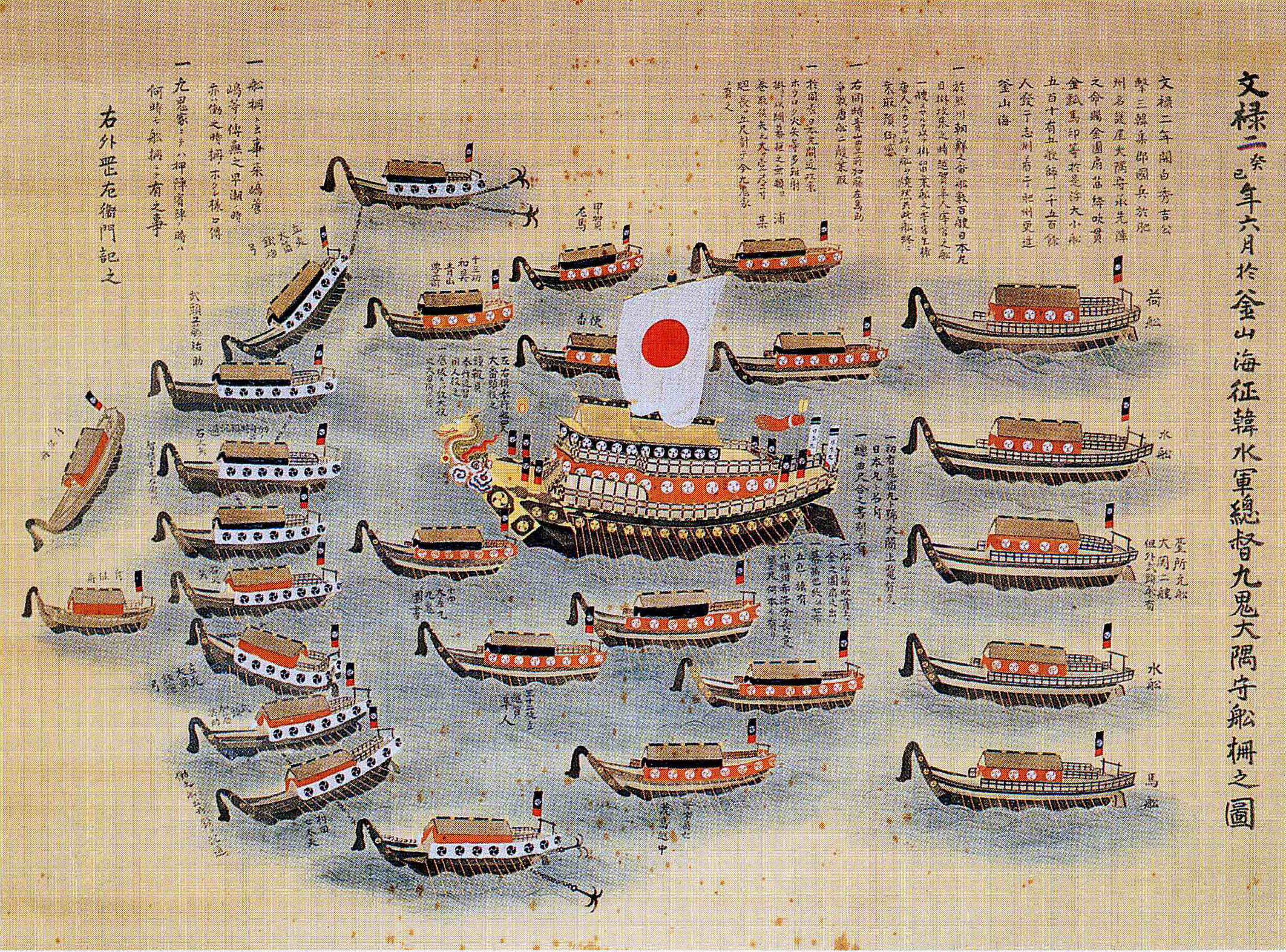
In the 16th century unification period, each ja had flags that were used primarily in battle. Most of the flags were long banners usually charged with the ja (family crest) of the ja lord. Members of the same family would have had different flags to carry into battle. The flags served as identification and were displayed by soldiers on their backs and horses. Generals also had their own flags, most of which differed from soldiers' flags due to their square shape.
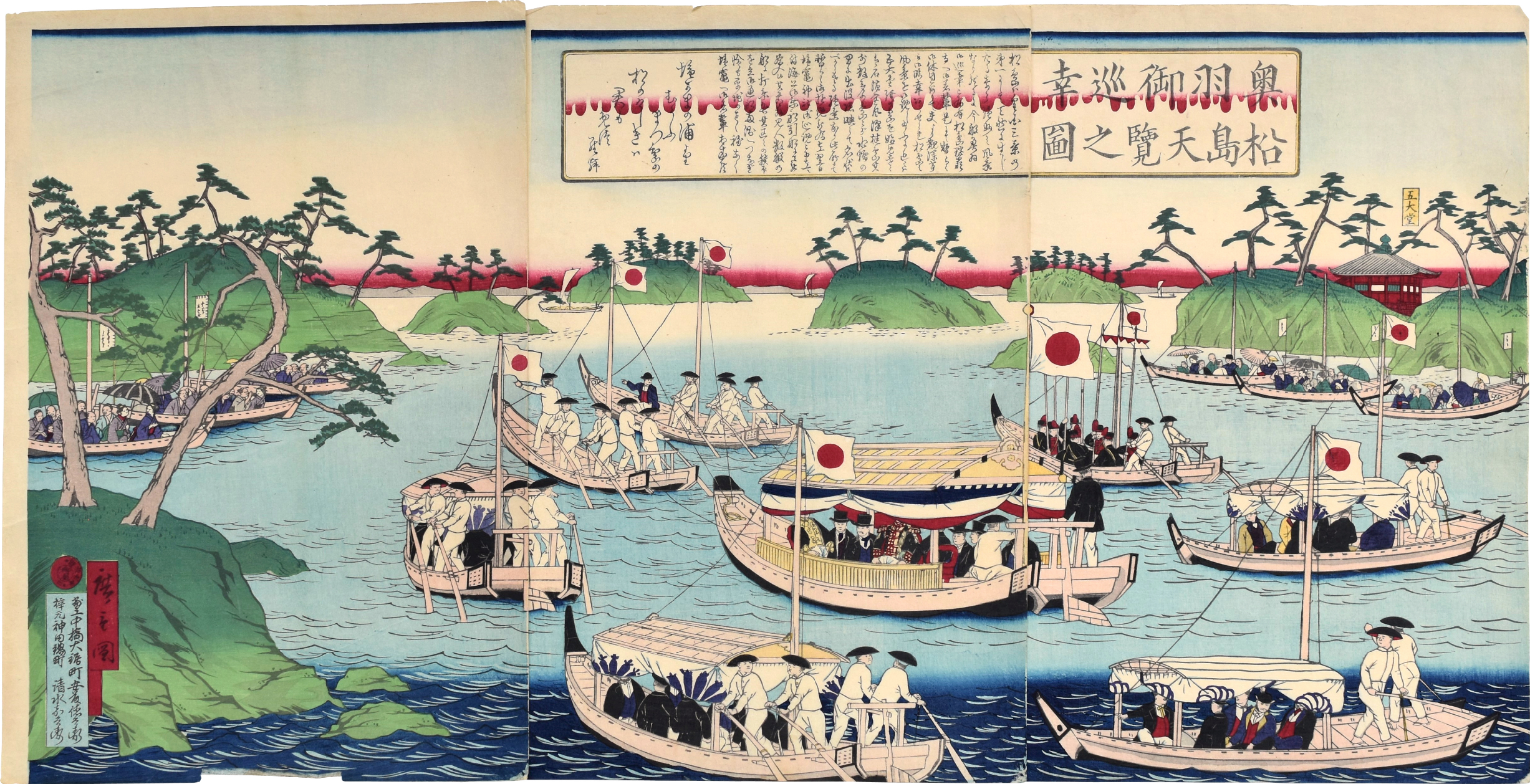
In 1854, during the Tokugawa shogunate, Japanese ships were ordered to hoist the ja to distinguish themselves from foreign ships. Before then, different types of ja flags were used on vessels that were trading with the U.S. and Russia. The ja was decreed the merchant flag of Japan in 1870 and was the legal national flag from 1870 to 1885, making it the first national flag Japan adopted.
While the idea of national symbols was strange to the Japanese, the Meiji Government needed them to communicate with the outside world. This became especially important after the landing of U.S. Commodore Matthew Perry in Yokohama Bay. Further Meiji Government implementations gave more identifications to Japan, including the anthem ja and the imperial seal. In 1885, all previous laws not published in the Official Gazette of Japan were abolished. Because of this ruling by the new cabinet of Japan, the ja was the de facto national flag since no law was in place after the Meiji Restoration.
Early conflicts and the Pacific War


The use of the national flag grew as Japan sought to develop an empire, and the ja was present at celebrations after victories in the First Sino-Japanese and Russo-Japanese Wars. The flag was also used in war efforts throughout the country. A Japanese propaganda film in 1934 portrayed foreign national flags as incomplete or defective with their designs, while portraying the Japanese flag as perfect in all forms. In 1937, a group of girls from Hiroshima Prefecture showed solidarity with Japanese soldiers fighting in China during the Second Sino-Japanese War, by eating "flag meals" that consisted of an umeboshi in the middle of a bed of rice. The ja became the main symbol of Japan's war mobilization and solidarity with its soldiers until the 1940s.
Japan's early victories in the Sino-Japanese War resulted in the ja again being used for celebrations. It was seen in the hands of every Japanese during parades.
Textbooks during this period also had the ja printed with various slogans expressing devotion to the Emperor and the country. Patriotism was taught as a virtue to Japanese children. Expressions of patriotism, such as displaying the flag or worshiping the Emperor daily, were all part of being a "good Japanese".
The flag was a tool of Japanese imperialism in the occupied Southeast Asian areas during the Second World War: people had to use the flag, and schoolchildren sang ja in morning flag raising ceremonies. Local flags were allowed for some areas such as the Philippines, Indonesia, and Manchukuo. In Korea which was part of the Empire of Japan, the ja and other symbols were used to declare that the Koreans were subjects of the empire.
During the Pacific War, Americans coined the derogatory term "meatballs" for the ja and Japanese military aircraft insignia. To the Japanese, the ja was the "Rising Sun flag that would light the darkness of the entire world". To Westerners, it was one of the Japanese military's most powerful symbols.
U.S. occupation===
Right: The civil and naval ensign of occupied Japan. The ja simultaneously remained in de facto use.
The ja was the de facto flag of Japan throughout World War II and the occupation period. During the occupation of Japan after World War II, permission from the Supreme Commander of the Allied Powers (SCAPJ) was needed to fly the ja. Sources differ on the degree to which the use of the ja flag was restricted; some use the term "banned;" however, while the original restrictions were severe, they did not amount to an outright ban.
After World War II, an ensign was used by Japanese civil ships of the United States Naval Shipping Control Authority for Japanese Merchant Marines. Modified from the "E" signal code, the ensign was used from September 1945 until the U.S. occupation of Japan ceased. U.S. ships operating in Japanese waters used a modified "O" signal flag as their ensign.
On 2 May 1947, General Douglas MacArthur lifted the restrictions on displaying the ja in the grounds of the National Diet Building, on the Imperial Palace, on the Prime Minister's residence, and on the Supreme Court building with the ratification of the new Constitution of Japan. Those restrictions were further relaxed in 1948, when people were allowed to fly the flag on national holidays. In January 1949, the restrictions were abolished and anyone could fly the ja at any time without permission. As a result, schools and homes were encouraged to fly the ja until the early 1950s.
Postwar to 1999
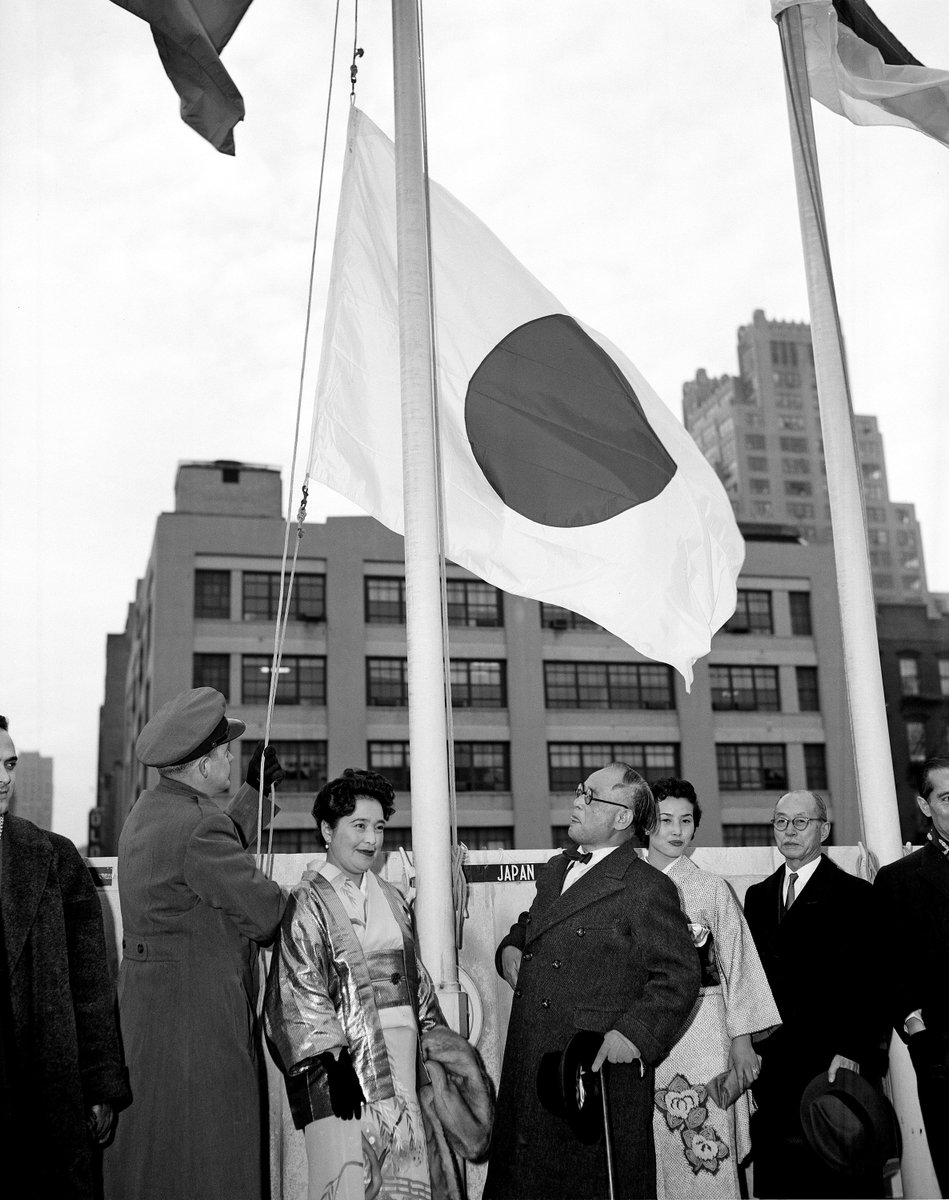
Since World War II, Japan's flag has been criticized for its association with the country's militaristic past. Similar objections have also been raised to the current national anthem of Japan, ja. The feelings about the ja and ja represented a general shift from a patriotic feeling about ja (Great Japan) to the pacifist and anti-militarist ja. Because of this ideological shift, the flag was used less often in Japan directly after the war even though restrictions were lifted by the SCAPJ in 1949.
As Japan began to re-establish itself diplomatically, the ja was used as a political weapon overseas. In a visit by Emperor Hirohito and Empress Kōjun to the Netherlands, the ja was burned by Dutch citizens who demanded that he either be sent home to Japan or tried for the deaths of Dutch prisoners of war during the Second World War. Domestically, the flag was not even used in protests against a new Status of Forces Agreement being negotiated between the U.S. and Japan. The most common flag used by the trade unions and other protesters was the red flag of revolt.
An issue with the ja and national anthem was raised once again when Tokyo hosted the 1964 Summer Olympic Games. Before the Olympic Games, the size of the sun disc of the national flag was changed partly because the sun disc was not considered striking when it was being flown with other national flags. Tadamasa Fukiura, a color specialist, chose to set the sun disc at two-thirds of the flag's length. Fukiura also chose the flag colors for the 1964 games as well as for the 1998 Winter Olympics in Nagano.
In 1989, the death of Emperor Hirohito once again raised moral issues about the national flag. Conservatives felt that if the flag could be used during the ceremonies without reopening old wounds, they might have a chance to propose that the ja become the national flag without being challenged about its meaning. During an official six-day mourning period, flags were flown at half staff or draped in black bunting all across Japan. Despite reports of protesters vandalizing the ja on the day of the Emperor's funeral, schools' right to fly the Japanese flag at half-staff without reservations brought success to the conservatives.
Since 1999
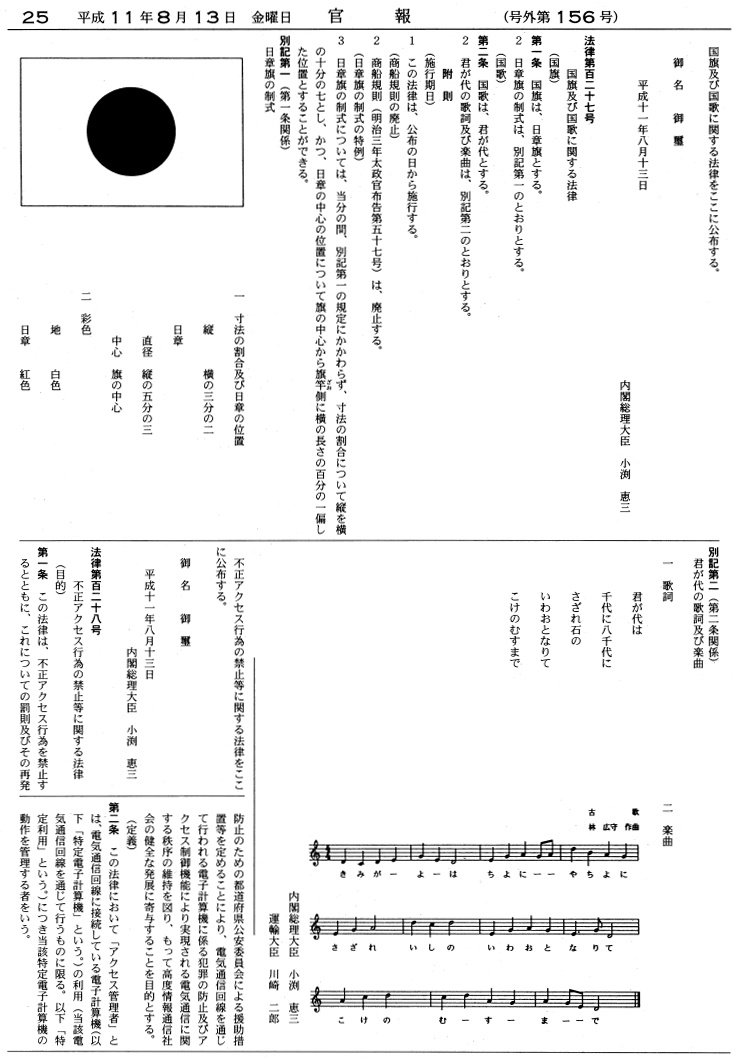
The Law Regarding the National Flag and National Anthem was passed in 1999, choosing both the ja and ja as Japan's national symbols. The passage of the law stemmed from the suicide of the principal of Sera High School in Sera, Hiroshima, Toshihiro Ishikawa, who could not resolve a dispute between his school board and his teachers over the use of the ja and ja. The Act is one of the most controversial laws passed by the Diet since the 1992 "Law Concerning Cooperation for United Nations Peacekeeping Operations and Other Operations", also known as the "International Peace Cooperation Law".
Prime Minister Keizō Obuchi of the Liberal Democratic Party (LDP) decided to draft legislation to make the ja and ja official symbols of Japan in 2000. His Chief Cabinet Secretary, Hiromu Nonaka, wanted the legislation to be completed by the 10th anniversary of Emperor Akihito's enthronement. This is not the first time legislation was considered for establishing both symbols as official. In 1974, with the backdrop of the 1972 return of Okinawa to Japan and the 1973 oil crisis, Prime Minister Kakuei Tanaka hinted at a law being passed enshrining both symbols in the law of Japan. In addition to instructing the schools to teach and play ja, Tanaka wanted students to raise the ja flag in a ceremony every morning, and to adopt a moral curriculum based on certain elements of the Imperial Rescript on Education pronounced by the Meiji Emperor in 1890. Tanaka was unsuccessful in passing the law through the Diet that year.
The main supporters of the bill were the LDP and the Komeito (CGP), while the opposition included the Social Democratic Party (SDPJ) and Communist Party (JCP), who cited the connotations both symbols had with the war era. The CPJ was further opposed for not allowing the issue to be decided by the public. Meanwhile, the Democratic Party of Japan (DPJ) could not develop party consensus on it. DPJ President and future prime minister Naoto Kan stated that the DPJ must support the bill because the party already recognized both symbols as the symbols of Japan. Deputy Secretary General and future prime minister Yukio Hatoyama thought that this bill would cause further divisions among society and the public schools. Hatoyama voted for the bill while Kan voted against it.
Before the vote, there were calls for the bills to be separated at the Diet. Waseda University professor Norihiro Kato stated that ja is a separate issue more complex than the ja flag. Attempts to designate only the ja as the national flag by the DPJ and other parties during the vote of the bill were rejected by the Diet. The House of Representatives passed the bill on 22 July 1999, by a 403 to 86 vote. The legislation was sent to the House of Councilors on 28 July and was passed on 9 August. It was enacted into law on 13 August.
On 8 August 2009, a photograph was taken at a DPJ rally for the House of Representatives election showing a banner that was hanging from a ceiling. The banner was made of two ja flags cut and sewn together to form the shape of the DPJ logo. This infuriated the LDP and Prime Minister Tarō Asō, saying this act was unforgivable. In response, DPJ President Yukio Hatoyama (who voted for the Law Regarding the National Flag and National Anthem) said that the banner was not the ja and should not be regarded as such.
Flag design
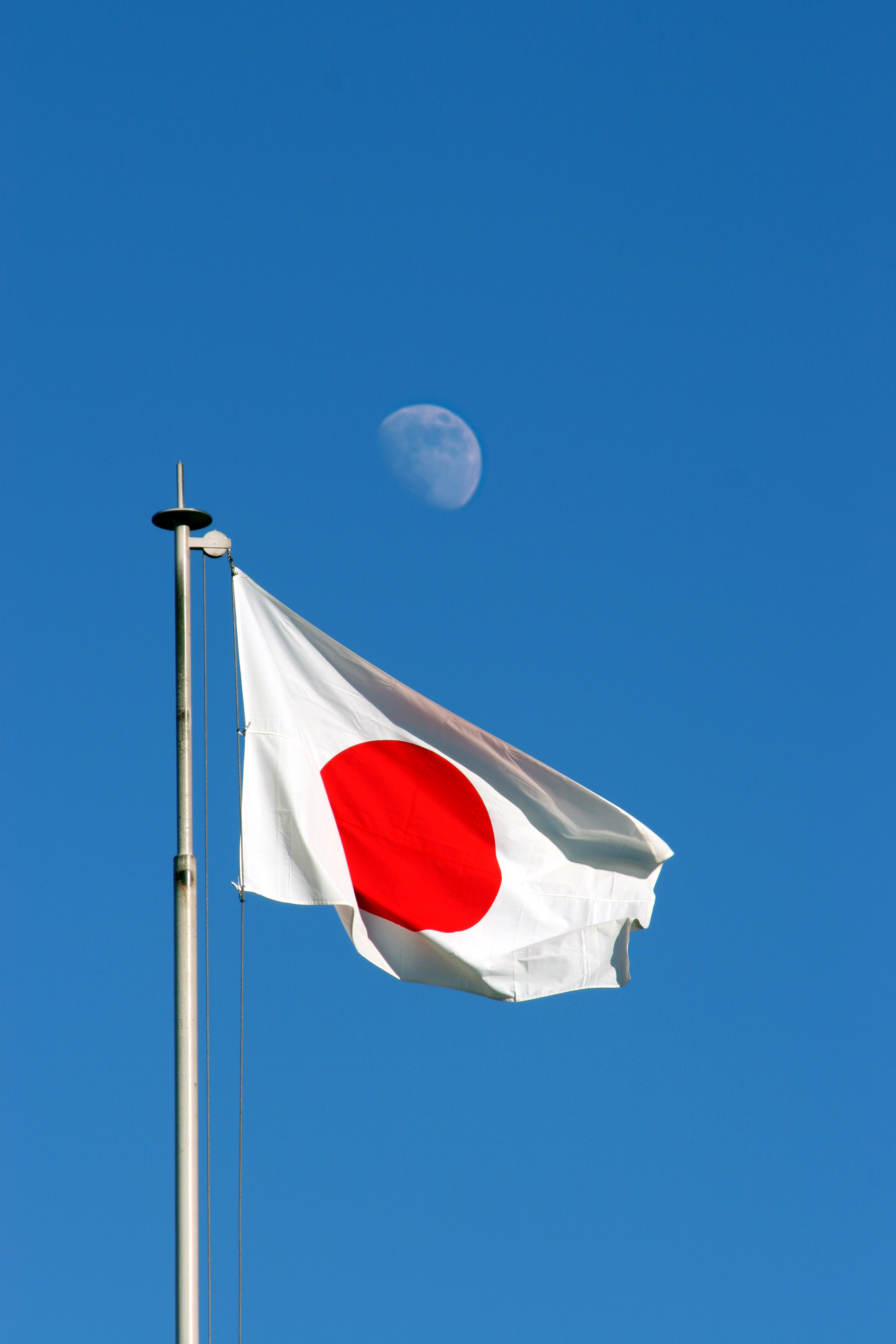
Passed in 1870, the Prime Minister's Proclamation No. 57 had two provisions related to the national flag. The first provision specified who flew the flag and how it was flown; the second specified how the flag was made. The ratio was seven units width and ten units length (7:10). The red disc, which represents the sun, was calculated to be three-fifths of the hoist width. The law decreed the disc to be in the center, but it was usually placed one-hundredth () towards the hoist. (This makes the disc appear centered when the flag is flying; this technique is used in other flags, such as those of Bangladesh and Palau.) On 3 October of the same year, regulations about the design of the merchant ensign and other naval flags were passed. For the merchant flag, the ratio was two units width and three units length (2:3). The size of the disc remained the same, but the sun disc was placed one-twentieth () towards the hoist.

When the Law Regarding the National Flag and National Anthem passed, the dimensions of the flag were slightly altered. The overall ratio of the flag was changed to two units width by three units length (2:3). The red disc was shifted towards the center, but the overall size of the disc stayed the same. The background of the flag is white and the center is a red circle, but the exact color shades were not defined in the 1999 law. The only hint given about the red color is that it is a "deep" shade.
Issued by the Japan Defense Agency (now the Ministry of Defense) in 1973 (Shōwa 48), specifications list the red color of the flag as 5R 4/12 and the white as N9 in the Munsell color chart. The document was changed on 21 March 2008 (Heisei 20) to match the flag's construction with current legislation and updated the Munsell colors. The document lists acrylic fiber and nylon as fibers that could be used in construction of flags used by the military. For acrylic, the red color is 5.7R 3.7/15.5 and white is N9.4; nylon has 6.2R 4/15.2 for red and N9.2 for white. In a document issued by the Official Development Assistance (ODA), the red color for the ja and the ODA logo is listed as DIC 156 and CMYK 0-100-90-0. During deliberations about the Law Regarding the National Flag and National Anthem, there was a suggestion to either use a bright red shade or use one from the color pool of the Japanese Industrial Standards.
Colour chart
| Official colour (white) | Official colour (red) | Colour system | Source | Year |
|---|---|---|---|---|
| N9 | 5R 4/12 | Munsell | DSP Z 8701C | 1973 |
| N/A | 156 | DIC | ODA Symbol Mark Guidelines | 1995 |
Use and customs

When the ja was first introduced, there was some resentment among the Japanese over the flag, resulting in some protests. It took some time for the flag to gain acceptance among the people, which was largely achieved by the government requiring citizens to greet the Emperor with it.
Before World War II, all homes were required to display ja on national holidays. Since the war, the display of the flag of Japan is mostly limited to buildings attached to national and local governments such as city halls; it is rarely seen at private homes or commercial buildings, but some people and companies have advocated displaying the flag on holidays. Although the government of Japan encourages citizens and residents to fly the ja during national holidays, they are not legally required to do so. Since the Emperor's 80th birthday on 23 December 2002, the Kyushu Railway Company has displayed the ja at 330 stations.
Starting in 1995, the ODA has used the ja motif in their official logo. The design itself was not created by the government (the logo was chosen from 5,000 designs submitted by the public) but the government was trying to increase the visualization of the ja through their aid packages and development programs. According to the ODA, the use of the flag is the most effective way to symbolize aid provided by the Japanese people.
{{transliteration|ja|Hinomaru Yosegaki}}
Main article: Good Luck Flag

During World War II, it was a popular custom for friends, classmates, and relatives of a deploying soldier to sign a ja and present it to him. The flag was also used as a good luck charm and a prayer to wish the soldier back safely from battle. One term for this kind of charm is . One tradition is that no writing should touch the sun disc. After battles, these flags were often captured or later found on deceased Japanese soldiers. Some of these flags have become souvenirs, and some have been returned to Japan and the descendants of the deceased.
In modern times, the ja is still being used. The tradition of signing the ja as a good luck charm still continues, though in a limited fashion. The ja is shown at sporting events to give support to the Japanese national team. The is used for campaigning soldiers, athletes, retirees, transfer students in a community and for friends. The colored paper and flag has writing with a message. In modern Japan, it is given as a present to a person at a send-off party, for athletes, a farewell party for colleagues or transfer students, for graduation and retirement. After natural disasters such as the 2011 Tōhoku Earthquake and tsunami people write notes on a ja to show support.
{{transliteration|ja|Hachimaki}}

The is a white headband (bandana) with the red sun in the middle. Phrases are usually written on it. It is worn as a symbol of perseverance, effort, and/or courage by the wearer. These are worn on many occasions by for example sports spectators, women giving birth, students in cram school, office workers, tradesmen taking pride in their work etc. During World War II, the phrases "Certain Victory" or "Seven Lives" was written on the ja and worn by kamikaze pilots. This denoted that the pilot was willing to die for his country.
{{transliteration|ja|Hinomaru bentō}}

ja and ja are types of Japanese lunch boxes, which can feature ja rice. The ja consists of ja (steamed white rice) with a red ja (dried plum) in the center which represents the sun and the flag of Japan. A ja lunch box only has white rice and a red ja in the center. The salty, vinegar-soaked ja acts as a preservative for the rice. There are also ja rice bowls, which are less common.
Culture and perception
.jpg)
According to polls conducted by mainstream media, most Japanese people had perceived the flag of Japan as the national flag even before the passage of the Law Regarding the National Flag and National Anthem in 1999. Despite this, controversies surrounding the use of the flag in school events or media still remain. For example, liberal newspapers such as the ja and ja often feature articles critical of the flag of Japan, reflecting their leaderships' political spectrum. To other Japanese, the flag represents the time where democracy was suppressed when Japan was an empire.
The display of the national flag at homes and businesses is also debated in Japanese society. Because of its association with ja (right wing) activists, reactionary politics, or hooliganism, most homes and businesses do not fly the flag. There is no requirement to fly the flag on any national holiday or special events. The town of Kanazawa, Ishikawa proposed plans in September 2012 to use government funds to buy flags with the purpose of encouraging citizens to fly the flag on national holidays.
Negative perceptions of the national flag exist in former colonies of Japan as well as within Japan itself, such as in Okinawa Prefecture. In one notable example of this, on 26 October 1987, an Okinawan supermarket owner burned the flag before the start of the National Sports Festival of Japan. The flag burner, Shōichi Chibana, burned the ja not only to show opposition to atrocities committed by the Japanese army and the continued presence of U.S. forces but also to prevent it from being displayed in public. Other incidents in Okinawa included the flag being torn down during school ceremonies and students refusing to honor the flag as it was being raised to the sounds of ja. In the capital city of Naha, Okinawa, the ja was raised for the first time since the return of Okinawa to Japan to celebrate the city's 80th anniversary in 2001. In the People's Republic of China and Republic of Korea, both of which had been occupied by the Empire of Japan, the 1999 formal adoption of the ja was met with reactions of Japan moving towards the right and also a step towards re-militarization. The passage of the 1999 law also coincided with the debates about the status of the Yasukuni Shrine, U.S.-Japan military cooperation, and the creation of a missile defense program. In other nations that Japan occupied, the 1999 law was met with mixed reactions or glossed over. In Singapore, the older generation still harbors ill feelings toward the flag while the younger generation does not hold similar views. The Philippine government not only believed that Japan was not going to revert to militarism, but the goal of the 1999 law was to formally establish two symbols (the flag and anthem) in law and every state has a right to create national symbols. Japan has no law criminalizing the burning of the ja, whereas foreign flags cannot be burned in Japan.
Protocol

According to protocol, the flag may fly from sunrise until sunset; businesses and schools are permitted to fly the flag from opening to closing. When flying the flags of Japan and another country at the same time in Japan, the Japanese flag takes the position of honor and the flag of the guest country flies to its right. Both flags must be at the same height and of equal size. When more than one foreign flag is displayed, Japan's flag is arranged in the alphabetical order prescribed by the United Nations. When the flag becomes unsuitable to use, it is customarily burned in private. The Law Regarding the National Flag and Anthem does not specify on how the flag should be used, but different prefectures came up with their own regulations to use the ja and other prefectural flags.
Mourning
The ja flag has at least two mourning styles. One is to display the flag at half-staff, as is common in many countries. The offices of the Ministry of Foreign Affairs also hoist the flag at half-staff when a funeral is performed for a foreign nation's head of state.
An alternative mourning style is to wrap the spherical finial with black cloth and place a black ribbon, known as a mourning flag, above the flag. This style dates back to the death of Emperor Meiji on 30 July 1912, and the Cabinet issued an ordinance stipulating that the national flag should be raised in mourning when the Emperor dies. The Cabinet has the authority to announce the half-staffing of the national flag.
Public schools
.jpg)
Since the end of World War II, the Ministry of Education has issued statements and regulations to promote the usage of both the ja and ja (national anthem) at schools under their jurisdiction. The first of these statements was released in 1950, stating that it was desirable, but not required, to use both symbols. This desire was later expanded to include both symbols on national holidays and during ceremonial events to encourage students on what national holidays are and to promote defense education. In a 1989 reform of the education guidelines, the LDP-controlled government first demanded that the flag must be used in school ceremonies and that proper respect must be given to it and to ja. Punishments for school officials who did not follow this order were also enacted with the 1989 reforms.
The 1999 curriculum guideline issued by the Ministry of Education after the passage of the Law Regarding the National Flag and Anthem decrees that "on entrance and graduation ceremonies, schools must raise the flag of Japan and instruct students to sing the ja, given the significance of the flag and the song." Additionally, the ministry's commentary on the 1999 curriculum guideline for elementary schools note that "given the advance of internationalization, along with fostering patriotism and awareness of being Japanese, it is important to nurture school children's respectful attitude toward the flag of Japan and ja as they grow up to be respected Japanese citizens in an internationalized society." The ministry also stated that if Japanese students cannot respect their own symbols, then they will not be able to respect the symbols of other nations.
Schools have been the center of controversy over both the anthem and the national flag. The Tokyo Board of Education requires the use of both the anthem and flag at events under their jurisdiction. The order requires school teachers to respect both symbols or risk losing their jobs. Some have protested that such rules violate the Constitution of Japan, but the Board has argued that since schools are government agencies, their employees have an obligation to teach their students how to be good Japanese citizens. As a sign of protest, schools refused to display the ja at school graduations and some parents ripped down the flag. Teachers have unsuccessfully brought criminal complaints against Tokyo Governor Shintarō Ishihara and senior officials for ordering teachers to honor the ja and ja. After earlier opposition, the Japan Teachers Union accepts the use of both the flag and anthem; the smaller All Japan Teachers and Staffs Union still opposes both symbols and their use inside the school system.
Related flags
Main article: List of Japanese flags
Military flags
.jpg)
The Japan Self-Defense Forces (JSDF) and the Japan Ground Self-Defense Force use the Rising Sun Flag with eight red rays extending outward, called . A gold border is situated partially around the edge.
A well-known variant of the sun disc design is the sun disc with 16 red rays in a Siemens star formation, which was also historically used by Japan's military, particularly the Imperial Japanese Army and the Imperial Japanese Navy. The ensign, known in Japanese as the , was first adopted as the war flag on 15 May 1870, and was used until the end of World War II in 1945. It was re-adopted on 30 June 1954, and is now used as the war flag and naval ensign of the Japan Ground Self-Defense Force (JGSDF) and the Japan Maritime Self-Defense Force (JMSDF). JSDF Chief of Staff Katsutoshi Kawano said the Rising Sun Flag is the Maritime Self-Defense Force sailors' "pride". Due to its continued use by the Imperial Japanese Army, this flag carries the negative connotation similar to the Nazi flag in China and Korea. These formerly colonized countries state that this flag is a symbol of Japanese imperialism during World War II, and was an ongoing conflict event for the 2020 Tokyo Olympics. The JMSDF also employs the use of a masthead pennant. First adopted in 1914 and readopted in 1965, the masthead pennant contains a simplified version of the naval ensign at the hoist end, with the rest of the pennant colored white. The ratio of the pennant is between 1:40 and 1:90.
The Japan Air Self-Defense Force (JASDF), established independently in 1952, has only the plain sun disc as its emblem. This is the only branch of service with an emblem that does not invoke the rayed Imperial Standard. However, the branch does have an ensign to fly on bases and during parades. The Japan Air Self-Defense Force flag was first adopted in 1955 after the JASDF was created in 1954. The flag is cobalt blue with a gold winged eagle on top of a combined star, the moon, the ja sun disc and clouds. The latest version of the JASDF flag was re-adopted on 19 March 2001.
Although not an official national flag, the Z signal flag played a major role in Japanese naval history. On 27 May 1905, Admiral Heihachirō Tōgō of the ja was preparing to engage the Russian Baltic Fleet. Before the Battle of Tsushima began, Togo raised the Z flag on the ja and engaged the Russian fleet, winning the battle for Japan. The raising of the flag said to the crew the following: "The fate of Imperial Japan hangs on this one battle; all hands will exert themselves and do their best." The Z flag was also raised on the aircraft carrier ja on the eve of Japan's attack on Pearl Harbor, Hawaii, in December 1941.
File:War flag of the Imperial Japanese Army (1868-1945).svg| Pre-WWII war flag of the Imperial Japanese Army (1868–1945) File:Naval ensign of the Empire of Japan.svg| Pre-WWII flag of the Imperial Japanese Navy (1889–1945) File:Flag of JSDF.svg| Post WWII flag of the Japan Ground Self-Defense Force File:Naval Ensign of Japan.svg| Post WWII flag of the Japan Maritime Self-Defense Force (1954–present) File:Flag of the Japan Air Self-Defense Force.svg| Post WWII flag of the Japan Air Self-Defense Force (JASDF) File:Roundel of Japan (1943).svg|Pre-WWII roundel (military aircraft insignia) of Navy and Army military aircraft File:Roundel of Japan.svg|Post WWII roundel of the aircraft JGSDF JMSDF and JASDF
Imperial flags

Beginning in 1870, flags were created for the Japanese Emperor (then Emperor Meiji), the Empress, and other members of the imperial family. At first, the Emperor's flag was ornate, with a sun resting in the center of an artistic pattern. He had flags that were used on land, at sea, and when he was in a carriage. The imperial family was also granted flags to be used at sea and while on land (one for use on foot and one carriage flag). The carriage flags were a monocolored chrysanthemum, with 16 petals, placed in the center of a monocolored background. These flags were discarded in 1889 when the Emperor decided to use the chrysanthemum on a red background as his flag. With minor changes in the color shades and proportions, the flags adopted in 1889 are still in use by the imperial family.
The current Emperor's flag is a 16-petal chrysanthemum, colored in gold, centered on a red background with a 2:3 ratio. The Empress uses the same flag, except the shape is that of a swallow tail. The crown prince and the crown princess use the same flags, except with a smaller chrysanthemum and a white border in the middle of the flags. The chrysanthemum has been associated with the Imperial throne since the rule of Emperor Go-Toba in the 12th century, but it did not become the exclusive symbol of the Imperial throne until 1868.
Subnational flags
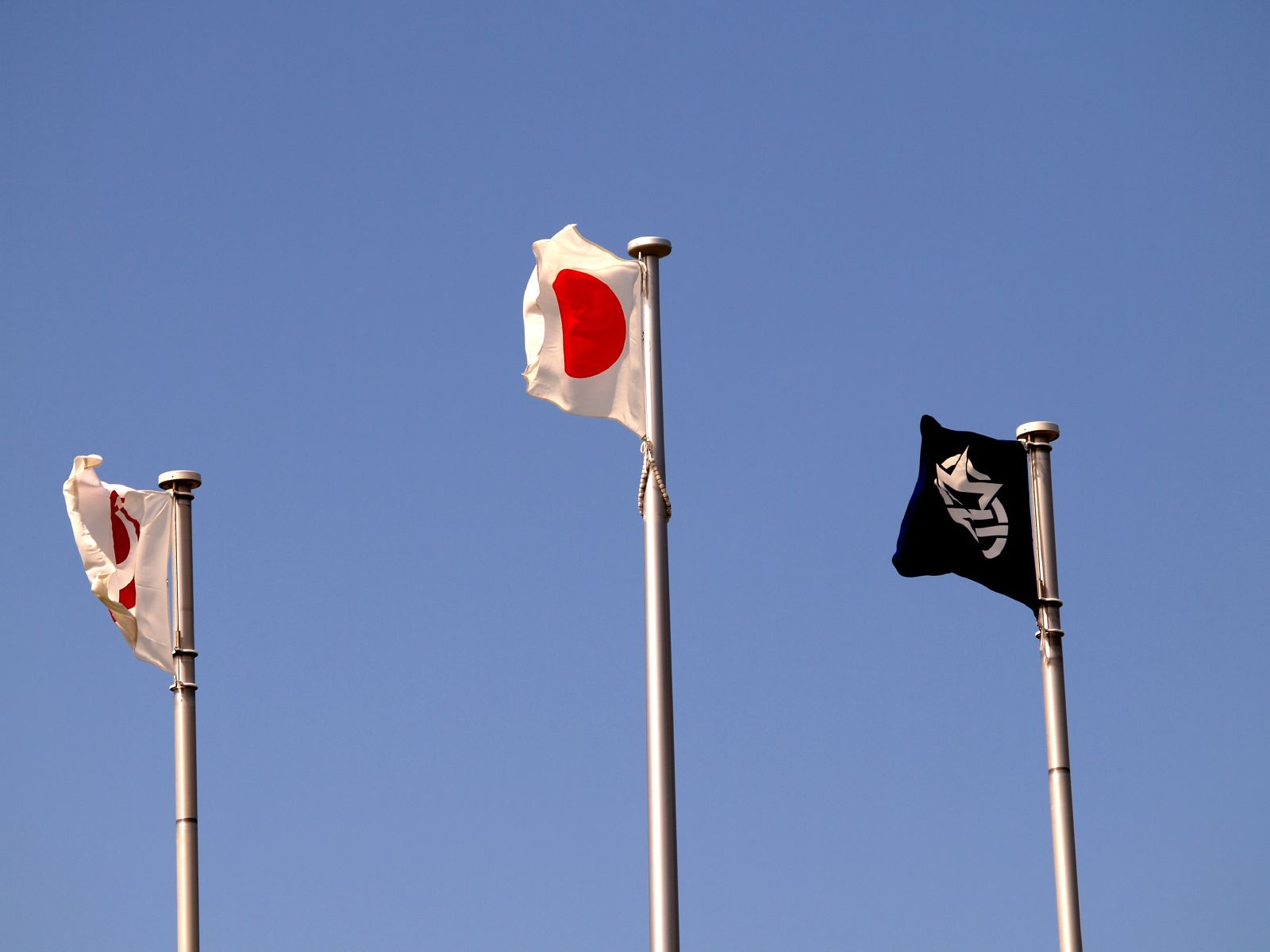
Each of the 47 prefectures of Japan has its own flag which, like the national flag, consists of a symbol – called a ja – charged upon a monocolored field (except for Ehime Prefecture, where the background is bicolored). There are several prefecture flags, such as Hiroshima's, that match their specifications to the national flag (2:3 ratio, ja placed in the center and is the length of the flag). Some of the ja display the name of the prefecture in Japanese characters; others are stylized depictions of the location or another special feature of the prefecture. An example of a prefectural flag is that of Nagano, where the orange ja character appears in the center of a white disc. One interpretation of the ja is that the ja symbol represents a mountain and the white disc, a lake. The orange color represents the sun while the white color represents the snow of the region.
Municipalities can also adopt flags of their own. The designs of the city flags are similar to the prefectural flags: a ja on a monocolored background. An example is the flag of Amakusa in Kumamoto Prefecture: the city symbol is composed of the ja character ✓and surrounded by waves. This symbol is centered on a white flag, with a ratio of 2:3. Both the city emblem and the flag were adopted in 2006.
Derivatives

In addition to the flags used by the military, several other flag designs were inspired by the national flag. The former Japan Post flag consisted of the ja with a red horizontal bar placed in the center of the flag. There was also a thin white ring around the red sun. It was later replaced by a flag that consisted of the 〒 postal mark in red on a white background.
Two recently-designed national flags resemble the Japanese flag. In 1971, Bangladesh gained independence from Pakistan, and it adopted a national flag that had a green background, charged with an off-centered red disc that contained a golden map of Bangladesh. The current flag, adopted in 1972, dropped the golden map and kept everything else. The Government of Bangladesh officially calls the red disc a circle; the red color symbolizes the blood that was shed to create their country. The island nation of Palau uses a flag of similar design, but the color scheme is completely different. While the Government of Palau does not cite the Japanese flag as an influence on their national flag, Japan did administer Palau from 1914 until 1944. The flag of Palau is an off-centered golden-yellow full moon on a sky blue background. The moon stands for peace and a young nation while the blue background represents Palau's transition to self-government from 1981 to 1994, when it achieved full independence.
The Japanese naval ensign also influenced other flag designs. One such flag design is used by the ja. At the bottom hoist of the flag, one quarter of the sun is displayed. The kanji character 朝 is displayed on the flag, colored white, covering most of the sun. The rays extend from the sun, occurring in a red and white alternating order, culminating in 13 total stripes. The flag is commonly seen at the National High School Baseball Championship, as the ja is a main sponsor of the tournament. The rank flags and ensigns of the Imperial Japanese Navy also based their designs on the naval ensign.
Gallery
File:National flag of Japan at Meiji Memorial Picture Gallery 20141030.jpg|Japanese flag at the Meiji Memorial File:Vice President Pence's Trip to Asia (39425260534).jpg|Japan Self-Defense Forces honor guards holding the national flag during Mike Pence's visit File:G7 flags, Toronto.jpg|Flags of Japan and other G7 states flying in Toronto File:Undokai-schoolgates-may2012.jpg|A series of Japanese flags in a school entrance File:Yokohama harbor.jpg|Yokohama City (left) and the ja (center) flying on Yokohama Harbor File:2013 Tokyo Fire Department Dezome Ceremony 01.JPG|Firefighters in Tokyo holding the Japanese national flag during a ceremony File:Hinomaru estadio.jpg|Large flags of Japan at the Tokyo Olympic Stadium during the final match of the East Asian Football Championship (14 February 2010) File:Totenko-Rooster Crows with hinomaru and lady by Takeuchi Keishu 1909 MET DP143126.jpg|Totenko-Rooster Crows with ja and lady, 1909
References
Footnotes
Notes
Bibliography===
Legislation===
References
- {{cite wikisource. 郵船商船規則]]. Government of Japan
- {{cite act. link. (27 October 1870)
- "日の丸の御旗". Yamanashi Tourism Organization.
- "宝物殿の案内". Unpoji.
- Axelrod, Alan. (2009). "Little-Known Wars of Great and Lasting Impact: The Turning Points in Our History We Should Know More About". Fair Winds.
- (2000). "National Flag and Anthem". Japanese Ministry of Foreign Affairs.
- {{Harvnb. Edgington. 2003
- {{Harvnb. Dyer. 1909
- {{harvnb. Ashkenazi. 2003
- {{harvnb. Hall. 1996
- 森浩一著「日本神話の考古学」(朝日新聞出版 1993年7月)
- 「日本古典文学大系 2 風土記」(岩波書店 1958年4月)の伊勢国風土記逸文に、神武天皇が[[伊勢国造]]の祖の天日別命に命じて[[伊勢国]]に攻め込ませ、国津神の[[伊勢津彦]]を追い出して伊勢を平定したとある。
- 熊野からでは北に向かって戦う事になる。このため[[鈴木眞年]]のように、伊勢まで行って西から[[奈良盆地. 大和盆地]]に侵攻したとする説もある。
- 泉欣七郎、千田健共編『日本なんでもはじめ』ナンバーワン、1985年、149頁、{{ISBN. 978-4-931016-06-4
- (23 December 2015). "「国旗」の真実をどれだけ知っていますか".
- "Shoku Nihongi".
- link. (28 January 2021)
- {{Harvnb. Itoh. 2003
- {{Harvnb. Feldman. 2004
- Hongo, Jun. (17 July 2007). "Hinomaru, 'Kimigayo' express conflicts both past and future". [[The Japan Times]].
- {{Harvnb. Turnbull. 2001
- {{harvnb. Goodman, Neary. 1996
- (2 July 2009). "レファレンス事例詳細". National Diet Library.
- {{Harvnb. Feiler. 2004
- {{Harvnb. Ohnuki-Tierney. 2002
- {{Harvnb. Rohl. 2005
- {{Harvnb. Befu. 1992
- {{Harvnb. Befu. 2001
- {{Harvnb. Nornes. 2003
- {{Harvnb. Cwiertka. 2007
- {{Harvnb. Partner. 2004
- {{Harvnb. Tipton. 2002
- {{Harvnb. Newell. 1982
- (21 June 1937). "The Camera Overseas: The Japanese People Voted Against Frontier Friction".
- (2008). "The Controversial Philippine National Flag". National Historical Institute.
- {{Harvnb. Taylor. 2004
- {{harvnb. Goodman, Neary. 1996
- Morita, D. (19 April 2007) "A Story of Treason", San Francisco: ''[[Nichi Bei Times]]''.
- {{Harvnb. Ebrey. 2004
- Hauser, Ernest. (10 June 1940). "Son of Heaven".
- (1 September 1999). "国旗,国歌の由来等". Ministry of Education.
- (1997). "New Directions in the Study of Meiji Japan". Brill.
- 吉田 藤人. "邦人船員消滅".
- University of Leicester. (1987). "The Journal of Transport History". University of Leicester.
- {{Harvnb. Carr, Hulme. 1956
- Yoshida, Shigeru. (2 May 1947). "Letter from Shigeru Yoshida to General MacArthur dated May 2, 1947". National Diet Library.
- MacArthur, Douglas. (2 May 1947). "Letter from Douglas MacArthur to Prime Minister dated May 2, 1947". National Archives of Japan.
- {{harvnb. Goodman, Neary. 1996
- {{Harvnb. Meyer. 2009
- {{Harvnb. Large. 1992
- {{Harvnb. Yamazumi. 1988
- {{cite AV media. New Star Creation. (2009)
- {{harvnb. Borneman. 2003
- Chira, Susan. (7 January 1989). "Hirohito, 124th Emperor of Japan, Is Dead at 87". [[The New York Times]].
- {{harvnb. Kataoka. 1991
- {{Harvnb. Aspinall. 2001
- (23 July 1999). "Vote in Japan Backs Flag and Ode as Symbols". The New York Times.
- {{harvnb. Williams. 2006
- {{Harvnb. Itoh. 2003
- {{harvnb. Goodman, Neary. 1996
- (17 June 1974). "Education: Tanaka v. the Teachers".
- {{harvnb. Okano. 1999
- (21 July 1999). "国旗国歌法制化についての民主党の考え方". Democratic Party of Japan.
- (2005). "Contemporary Japanese Thought". Columbia University Press.
- (22 July 1999). "国旗・国歌法案、衆院で可決 民主党は自主投票". Democratic Party of Japan.
- (22 July 1999). "第145回国会 本会議 第47号". National Diet Library.
- (13 August 1999). "議案審議経過情報: 国旗及び国歌に関する法律案". House of Representatives.
- (30 August 2009). "【日本の議論】日の丸裁断による民主党旗問題 国旗の侮辱行為への罰則は是か非か". Sankei Digital.
- {{Harvnb. 明治3年太政官布告第57号
- {{Harvnb. Takenaka. 2003
- {{Harvnb. 明治3年太政官布告第651号
- {{Harvnb. Takenaka. 2003
- {{Harvnb. 国旗及び国歌に関する法律
- (1 January 2008). "Basic / General Information on Japan". Consulate-General of Japan in San Francisco.
- (2006). "National Flag & National Anthem". Cabinet Office, Government of Japan.
- (27 November 1973). "Defense Specification Z 8701C (DSPZ8701C)". Ministry of Defense.
- (1 September 1995). "日章旗のマーク、ODAシンボルマーク". Office of Developmental Assistance.
- (2 August 1999). "第145回国会 国旗及び国歌に関する特別委員会 第4号". National Diet Library.
- Hexadecimal obtained by placing the colors in [http://www.feelimage.jp/analyzer/productinfo_3.htm Feelimage Analyzer] {{Webarchive. link. (25 January 2010)
- "DICカラーガイド情報検索 (ver 1.4)". DIC Corporation.
- "国旗と国歌". Ministry of Foreign Affairs.
- Yoshida, Shigeru. (27 April 1954). "答弁書第九号". House of Councillors.
- (26 November 2002). "JR九州、日の丸を掲揚へ 有人330駅、祝日に". 47news.
- "Ministry of Foreign Affairs of Japan".
- "開催中の平和資料館収蔵品展から「日の丸寄せ書き」について". City of Himeji, Hyogo Prefecture.
- {{Harvnb. Smith. 1975
- McBain, Roger. (9 July 2005). "Going back home". Courier & Press.
- {{Harvnb. Takenaka. 2003
- "13-1".
- (24 March 2015). "Hachimaki – Japanese Headbands – DuncanSensei Japanese".
- {{Harvnb. Cutler. 2001
- Spacey, John. (24 January 2014). "Japan's Patriotic Bento Box (Hinomaru)". Japan Talk.
- (18 July 1999). "国旗・国歌法制化について". TV Asahi.
- (2002). "テレビニュースの多様化により、異なる番組の固定視聴者間に生じる意見の差". Hoso Bunka Foundation.
- {{Harvnb. Khan. 1998
- "Town eyes subsidy for residents to buy flag". The Japan Times.
- Wundunn, Sheryl. (11 November 1995). "Yomitan Journal: A Pacifist Landlord Makes War on Okinawa Bases". The New York Times.
- Smits, Gregory. (2000). "Okinawa in Postwar Japanese Politics and the Economy". Penn State University.
- (21 May 2001). "Hinomaru flies at Naha for first time in 29 years". The Japan Times.
- Itoh, Mayumi. (2001–2007). "Japan's Neo-Nationalism: The Role of the Hinomaru and Kimigayo Legislation". JPRI Working Paper.
- {{harvnb. Lauterpacht. 2002
- {{Harvnb. Inoguchi, Jain. 2000
- "プロトコール". Ministry of Foreign Affairs.
- {{Harvnb. 国旗及び国歌の取扱いについて
- {{Harvnb. 国旗及び県旗の取扱いについて
- "Page 1 「グローカル通信」平成21年5月号 プロトコール講座". Ministry of Foreign Affairs.
- {{Harvnb. 大正元年閣令第一号
- (14 May 1963). "全国戦没者追悼式の実施に関する件". National Diet Library.
- {{Harvnb. Trevor. 2001
- (11 September 2001). "学習指導要領における国旗及び国歌の取扱い". Hiroshima Prefectural Board of Education Secretariat.
- (1999). "小学校学習指導要領解説社会編,音楽編,特別活動編". Ministry of Education.
- {{Harvnb. Aspinall. 2001
- Weisman, Steven R.. (29 April 1990). "For Japanese, Flag and Anthem Sometimes Divide". The New York Times.
- McCurry, Justin. (5 June 2006). "A touchy subject". The Guardian.
- (5 January 2006). "Ishihara's Hinomaru order called legit".
- {{Harvnb. Heenan. 1998
- {{harvnb. 自衛隊法施行令
- (6 October 2018). "Japan to skip S. Korea fleet event over 'rising sun' flag". The Asahi Shimbun.
- 国际, 在线. (11 August 2006). "赵薇欲代言抗日网游洗刷"军旗装事件"之辱(图)". [[Xinhua]].
- {{Harvnb. 海上自衛隊旗章規則
- {{Harvnb. 〇海上自衛隊の使用する航空機の分類等及び塗粧標準等に 関する達
- {{Harvnb. 自衛隊の旗に関する訓令
- 桜星の数はかつての陸上自衛隊と同様、階級ではなく部隊規模を示していた。
- "Air Self Defense Force (Japan)".
- {{Harvnb. Carpenter. 2004
- {{Harvnb. Fujitani. 1996
- {{Harvnb. Matoba. 1901
- {{Harvnb. Takahashi. 1903
- "皇室儀制令".
- (2009). "愛媛県のシンボル". Government of Ehime Prefecture.
- {{Harvnb. 広島県県章および県旗の制定
- (2006). "長野県の県章 – 県旗". Government of Nagano Prefecture.
- {{Harvnb. 天草市章
- {{Harvnb. 天草市旗
- "郵便のマーク". Communications Museum "Tei Park".
- (2005–2007). "People's Republic of Bangladesh Flag Rules (1972)". Prime Minister's Office, People's Republic of Bangladesh.
- "Facts and Figures". Embassy of Bangladesh in the Netherlands.
- Van Fossen, Anthony B.. (1992). "The International Political Economy of Pacific Islands Flags of Convenience". Australia-Asia.
- (18 July 2008). "Palau Flag". Republic of Palau National Government.
- {{Harvnb. Smith. 2001
- {{Harvnb. Saito. 1987
- {{Harvnb. Tazagi. 2004
- {{harvnb. Mangan. 2000
- {{harvnb. Gordon. 1915
This article was imported from Wikipedia and is available under the Creative Commons Attribution-ShareAlike 4.0 License. Content has been adapted to SurfDoc format. Original contributors can be found on the article history page.
Ask Mako anything about Flag of Japan — get instant answers, deeper analysis, and related topics.
Research with MakoFree with your Surf account
Create a free account to save articles, ask Mako questions, and organize your research.
Sign up freeThis content may have been generated or modified by AI. CloudSurf Software LLC is not responsible for the accuracy, completeness, or reliability of AI-generated content. Always verify important information from primary sources.
Report