From Surf Wiki (app.surf) — the open knowledge base
Flag of Indonesia
none

none
| Field | Value |
|---|---|
| Name | Republic of Indonesia |
| Image | Flag of Indonesia.svg |
| Nickname | |
| Use | 111111 |
| Symbol | |
| Proportion | 2:3 |
| Adoption | 11 November 1293 (Majapahit Empire) |
| 28 October 1928 (standardized) | |
| (original) | |
| (official) | |
| Design | A horizontal bicolour of red and white |
| Designer | Jayakatwang |
| Image2 | Flag of Indonesia (physical version).svg |
| Symbol2 | |
| Use2 | Physical version |
| Proportion2 | 2:3 |
28 October 1928 (standardized) (original) (official) The national flag of Indonesia is bicolor, with two horizontal bands, red (top) and white (bottom) with an overall ratio of 2:3. It was introduced and hoisted in public during the proclamation of independence on 17 August 1945 at 56 Jalan Proklamasi (formerly Jalan Pegangsaan Timur) in Jakarta, and again when the Dutch formally transferred sovereignty on 27 December 1949. The design of the flag has remained unchanged since.
The flag of Indonesia is graphically similar to the flag of Monaco, with a slight difference in the shade of red, and ratio of its dimensions. The flag of Poland has similar dimensions but has the colours reversed: white on top and red on the bottom. In both Monaco's and Poland's flags, the reds are of a slightly darker shade than that of Indonesia. The flag of Singapore has exactly the same dimensions as Indonesia's, but supplemented with a white crescent moon and five stars in a pentagram at the upper left corner of the flag, of which the red is of a slightly lighter shade.
The "Naval Jack of Indonesia" is reserved for sole use by the Indonesian Navy. It flies from the jackstaff of every active Indonesian warship while anchored or moored pierside and on special occasions. The design of the jack is described as nine alternating stripes, consisted of five red and four white stripes. It is nicknamed Sang Saka Merah Putih, . The naval jack dates to the age of Majapahit Empire. This empire, renowned for its great maritime strength, flew similar jacks on its vessels.
History

The flag's colours are derived from the banner of the 13th century Majapahit Empire. However, it has been suggested that the red and white symbolism can trace its origin to the older common Austronesian mythology of the duality of Mother Earth (red) and Father Sky (white). This is why these colours appear in so many flags throughout Austronesia, from Tahiti to Madagascar. The earliest records of the red and white panji or pataka (a long flag on a curved bamboo pole) can be found in the Pararaton chronicle; according to this source, the Jayakatwang troops from Gelang-Gelang hoisted the red and white banner during their invasion of Singhasari in the early 12th century. This suggests that even before the Majapahit era, the red and white colours were already revered and used as the kingdom's banner in the Kediri era (1042 – ).
Red and white textile colouring was available in ancient Indonesia. White is the natural colour of woven cotton fabrics, while red is one of the earliest natural dyes, acquired from either teak leaves, the flowers of Averrhoa bilimbi, or the skin of mangosteen fruits.
It was not only the Javanese kingdoms that used red and white. The battle flag of King Si Singamangaraja IX of Batak lands bore an image of white twin swords called piso gaja dompak against a red background. During the Aceh War of 1873–1904, Aceh warriors used a battle flag with the image of a sword, star and crescent, sun, and some Quranic script in white on a red background. The red and white flag of the Buginese Bone kingdom in South Sulawesi is called Woromporang. The Balinese Badung (Puri Pamecutan) royal banner is red, white, and black. Prince Diponegoro also used a red and white banner during the Java War (1825–1830).

In the early 20th century, these colours were revived by students and then nationalists as an expression of nationalism against the Dutch. A precursor design was first seen on the cover of a Dutch magazine titled Gedenkboek 1908-1923 run by the Perhimpoenan Indonesia ('Indonesian Association'). Compiling 13 letters written by its anonymous members, it had a sinister hoisted flag of a red and white stripe superimposed with the head of a banteng facing away from the hoist. The modern red and white flag sans banteng head was first flown in Java in 1928, it was quickly prohibited under Dutch rule. It became the flag adopted by the Kesatuan Melayu Muda to symbolise Malay nationalism against European colonialism, now widely named as the Sang Saka Malaya. Upon Indonesia's declaration of independence on 17 August 1945, it was adopted as the national flag, and has been in use ever since. After Indonesia's independence was recognized, Monaco, which had a similar flag, filed a complaint which was largely ignored.
Hotel Yamato incident
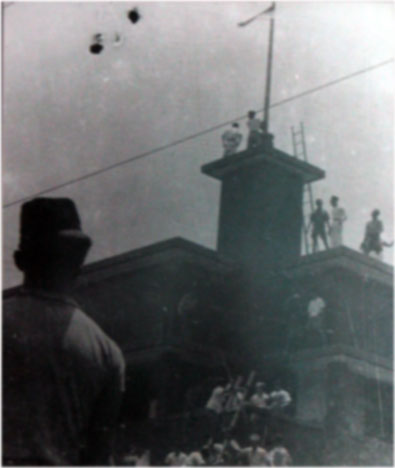
The flag featured in a well-known incident during the Indonesian War of Independence when during the lead-up to the Battle of Surabaya in late 1945, Indonesian youths removed a colonial Dutch flag flying over the Yamato Hotel, tore off the blue strip and re-hoisted it as an Indonesian flag. The hotel was subsequently renamed briefly as Hotel Merdeka, meaning "independence hotel".
File:Flag of the Dutch East India Company.svg|Flag of the Dutch East India Company used 20 March 1602 – 1 January 1800 File:Flag of the Netherlands.svg|Flag of the Dutch East Indies used 1 January 1800 – 27 December 1949 File:Flag of Japan (1870-1999).svg|Flag of Imperial Japan used 8 March 1942 – 17 August 1945 (3 years 5 months) File:Flag of Indonesia.svg|Flag of Indonesia used 17 August 1945 – present File:Bendera Latihan - Practice Flag.svg|Practice flag used for national flag replacement during rehearsals
Name
According to Article 35 of the 1945 Constitution, the official name of the flag is Sang Saka Merah-Putih. The flag is commonly called Bendera Merah-Putih ('Red-and-White Flag'). Occasionally, it is also called Sang Dwiwarna ('The Bicolour'). Sang Saka Merah-Putih refers to the historical flag called Bendera Pusaka ('Heirloom Flag') and its replica. The Bendera Pusaka is the flag that was flown in front of Sukarno's house after he proclaimed Indonesia's independence on 17 August 1945. The original Bendera Pusaka was sewn by Fatmawati and was hoisted every year in front of the Merdeka Palace during the independence day ceremony. It was hoisted for the last time on 17 August 1968. Since then it has been preserved and replaced by a replica since the original flag was deemed to be too fragile.
Symbolism
Several opinions have been expressed on the meaning of the red and white in the Indonesian flag. One of them is that the red stands for courage, while the white stands for purity. Another opinion is that red represents the human body or physical life, while white represents the soul or spiritual life; together they stand for a complete human being.
As Sukarno said:
The colours are the same as those used in the flag of the Majapahit.
Colours
| [[File:Flag of Indonesia.svg | 30px]] | ||||
|---|---|---|---|---|---|
| Digital scheme | RGB red | White | [[File:Flag of Indonesia (physical version).svg | 30px]] | |
| Physical scheme | Pigment red | White | |||
| RGB | 255-0-0 | 255-255-255 | RGB | 237-28-36 | 255-255-255 |
| Hex | #FF0000 | #FFFFFF | Hex | #ED1C24 | #FFFFFF |
| CMYK | 0, 100, 100, 0 | 0, 0, 0, 0 | CMYK | 0, 88, 85, 7 | 0, 0, 0, 0 |
Usage
.svg)

.jpg)
.jpg)
Regulation and flag protocol
The flag is described in Article 35, Chapter XV, of the Constitution of Indonesia; Law No. 24/2009; and Government Regulation No. 40/1958.
The raising of the flag should be conducted in the time between sunrise until sunset, but in certain circumstances, it can be done at night. In daily use, the flag should be flown at every commemoration such as Indonesian Independence Day on 17 August every year, by the citizens who have a right to use it at home, building or office, schools, colleges, public and private transport and the representative office of Indonesia in overseas.
It can be used as the cover of the coffin of a President or former Presidents, Vice President or former Vice Presidents, Members of Cabinet, Speaker of People's Representative Council, and Head of Government, members of the Indonesian Armed Forces, and persons who are members of the Indonesian National Police who died in service, or an Indonesian citizen who made contributions to their nation as a badge of honor.
The flag must be displayed every day in places such as the Presidential Palace, government and private office buildings, border posts and outer islands in the territory of Indonesia, and the National Heroes Cemetery.
The flag should be displayed everywhere on special days, which are:
- 2 May: National Education Day.
- 20 May: National Awakening Day.
- 1 June: Day of the Birth of Pancasila.
- 17 August: Indonesia Independence Day.
- 28 October: Youth Pledge Day.
- 10 November: Heroes Day.
Half-mast
The flag should be displayed at half-mast as a sign of mourning on these days:
- 30 September, in remembrance of the 30 September Movement. After the Fall of Suharto and the end of the New Order in 1998, this tradition was stopped. However, the tradition of half-masting the flag on this day has been restarted in recent years.
- 12 October, in remembrance of the victims of the 2002 Bali Bombings
- 26 December, in remembrance of victims of the 2004 Indian Ocean earthquake and tsunami.
- Three days after the death of President or former Presidents, Vice President or former Vice Presidents, Members of Cabinet, Speaker of People's Representative Council, and Head of Government.
- Other mourning days established by national or local governments.
Prohibited acts
Article 24 of Law No. 24/2009 on Flags, Language, National Symbols, and Anthems, states that people are prohibited from:
- destroying, tearing, trampling, burning, or performing other actions with the intention to tarnish, insult, or degrade the honour of the national flag;
- using the national flag for billboards or commercials;
- flying the national flag if it is damaged, torn, smudged, crumpled, or faded;
- printing on, embroidering or adding letters, numbers, images or other signs, or adding badges or any objects to the national flag;
- using the national flag to cover a ceiling or roof, or for wrapping or covering goods in a way that can degrade the honor of the national flag.
Article 66 and 67 of Law No. 24/2009 states that anyone who commits any of these prohibited acts may be punishable with imprisonment for up to five years or be subject to a fine of up to five hundred million rupiah.
References
References
- (1 May 2007). "National Flag, Coat of Arms, Anthem". Embassy of Indonesia, Oslo, Norway.
- (29 January 2020). "Tradisi TNI Angkatan Laut: Pewarisan Nilai-Nilai Luhur dalam Membangun Semangat Juang dan Karakter Prajurit Matra Laut". Indonesian Navy.
- "Flag of Indonesia".
- (13 June 2010). "Earth Mothers and Sky Fathers of Austronesia".
- "Natural Dye Extraction From Teak Leves (Tectona Grandis) Using Ultrasound Assisted Extraction Method for Dyeing on Cotton Fabric".
- (2017). "Extraction, Characterization and Application of Natural Dyes from the Fresh Mangosteen (Garcinia mangostana L.) Peel". International Journal on Advanced Science, Engineering and Information Technology.
- (17 November 2009). "Kompas.Com".
- (30 October 2007). "Sejarah Bendera Merah Putih".
- (25 August 2011). "PANYINGKUL! Jurnalisme Orang Biasa".
- ian macdonald. "Flags in Bali".
- (1986). "In het land van de Overheerser: Indonesiërs in Nederland 1600-1950". Brill.
- (6 September 2006). "Indonesia". [[Flags of the World (website).
- (11 May 2005). "What are the rules for national flags?". BBC Magazine.
- "Hotel Majapahit: Brief History".
- Cahoon, Ben. "Indonesia".
- Ramadhian Fadillah. (17 August 2016). "Kenapa bendera Indonesia Merah-Putih? Ini jawaban Soekarno". Merdeka.com.
- Smith, Whitney. (9 February 2001). "Flag of Indonesia". Encyclopædia Britannica Online.
- "Konstitusi, Lambang Negara, Bendera, Lagu Kebangsaan dan Bahasa". Government of Indonesia.
- (2009). "Undang-undang Republik Indonesia Nomor 24 Tahun 2009 Tentang Bendera, Bahasa, dan Lambang Negara, serta Lagu Kebangsaan".
- (1958). "Peraturan Pemerintah Nomor 40 Tahun 1958 tentang Bendera Kebangsaan Republik Indonesia".
- "The 1945 Constitution of The Republic of Indonesia".
- (12 August 2009). "Mencermati UU No 24 Tahun 2009 tentang Bendera, Bahasa, dan Lambang Negara serta Lagu Kebangsaan".
- (2 October 2017). "Flag Ceremony Commemorating The Day of The Power of Pancasila Year 2017 UB".
- (12 September 2019). "Governor Instructs Half-Flag Raising". Government of West Java Province.
This article was imported from Wikipedia and is available under the Creative Commons Attribution-ShareAlike 4.0 License. Content has been adapted to SurfDoc format. Original contributors can be found on the article history page.
Ask Mako anything about Flag of Indonesia — get instant answers, deeper analysis, and related topics.
Research with MakoFree with your Surf account
Create a free account to save articles, ask Mako questions, and organize your research.
Sign up freeThis content may have been generated or modified by AI. CloudSurf Software LLC is not responsible for the accuracy, completeness, or reliability of AI-generated content. Always verify important information from primary sources.
Report