From Surf Wiki (app.surf) — the open knowledge base
Flag of Iceland
none
none
| Field | Value |
|---|---|
| Name | Iceland |
| Image | Flag of Iceland.svg |
| Use | 100100 |
| Symbol | |
| Proportion | 18:25 |
| Adoption | (standardization from 1918) |
| Design | A blue field with the white-edged red Nordic cross that extends to the edges; the vertical part of the cross is shifted to the hoist side. |
| In Blazon, "Azure, a cross gules fimbriated argent". | |
| Designer | Matthías Þórðarson |
| Image2 | Flag_of_Iceland_(state).svg |
| Noborder2 | yes |
| Use2 | 011011 |
| Symbol2 | |
| Proportion2 | 9:16 |
In Blazon, "Azure, a cross gules fimbriated argent".

The flag of Iceland () is defined in Law No. 34/1944, adopted on 17 June 1944, the day Iceland became a republic. The law, entitled The Law of the National Flag of Icelanders and the State Arms, describes the flag as follows:
The civil national flag of Icelanders is sky-blue with a snow-white cross and a fiery-red cross inside the white cross. The arms of the crosses extend to the edges of the flag and their width is , and the red cross of the width of the flag. The blue sections are rectangles: the hoist sections are equilateral, and the outer sections are the same width as them but twice as long. The ratio between the width and length of the flag is 18:25.
A blue-and-white flag (a white Nordic cross on a blue field) was used as an unofficial national symbol from the late 19th century and was first displayed publicly in 1897. The present design dates from 1915, when a red cross was added within the white cross, in part to distinguish the flag from similar designs. As with other Nordic cross flags, the cross is traditionally associated with Christianity.
The flag was adopted as the national flag of Iceland when Iceland was granted sovereignty by Denmark in 1918. The colours are commonly interpreted as representing elements of the country's landscape: red for volcanic fire, white for ice and snow, and blue for the mountains and surrounding sea.
History

According to a legend cited by Andrew Evans' Iceland, the Danish Dannebrog originated when a red cloth with a white cross fell from the sky during the 13th-century Battle of Valdemar. In this account, Denmark used the cross motif throughout its Nordic territories as a symbol of divine favour; as the Nordic countries later gained independence, they retained the cross as a traditional emblem.
The Icelandic civil flag was used unofficially from the late 19th century, originally as a white cross on a blue field. The current design was adopted on 19 June 1915, when King Kristján X issued a decree allowing it to be flown in Icelandic territorial waters (where the Danish flag had previously been required) and specifying the addition of a red cross to distinguish it from similar foreign flags. The colours are often described as referring to Iceland's natural features: blue for the mountains, white for snow and ice, and red for volcanic fire.
File:Light Blue Flag of Iceland.svg| The civil flag as it appeared between 1918 and 1944, when the blue colour was classified as "ultramarine blue". It has an aspect ratio of 18:25. File:Hvítbláinn.svg|[[File:IFIS Proposed.svg]] A former flag which never became official, known as Hvítbláinn ("the white-blue"), in use by Icelandic republicans around 1900. A very similar design has subsequently been adopted as the flag of Shetland. File:Flag of Iceland - 1914 Proposal.svg|[[File:IFIS Proposed.svg]] A flag proposed by Magnús Þórðarson in 1914
Laws regarding the flag
On 17 June 1944, the day Iceland became a republic, a law was enacted governing the national flag and the coat of arms. Subsequent legislation and regulations have supplemented the original act, including measures adopted in 1991 concerning official flag days and flag times, as well as the specification of the flag's colours.
The act sets out the dimensions of the civil flag and of official variants used by state institutions, including those used by diplomatic missions and the Ministry of Foreign Affairs. It also regulates how the flag is to be displayed in different contexts, such as on flagpoles, buildings, and vessels.
Under the act, the use of the flag is regulated and subject to conditions. It requires that the flag be treated with respect and kept in good condition, and provides penalties for acts or speech deemed to show disrespect towards the flag, including fines or imprisonment of up to one year.
The 1944 act envisaged separate rules on official flag days and flag times; these provisions were not implemented until 1991. Under the 1991 rules, the flag may not be flown before 07:00 and should normally be taken down by sunset; it must not, in any case, remain flown after midnight. Exceptions are provided for outdoor assemblies, official gatherings, funerals, and memorials, where the flag may remain flown for the duration of the event, but not beyond midnight.
Icelandic flag days

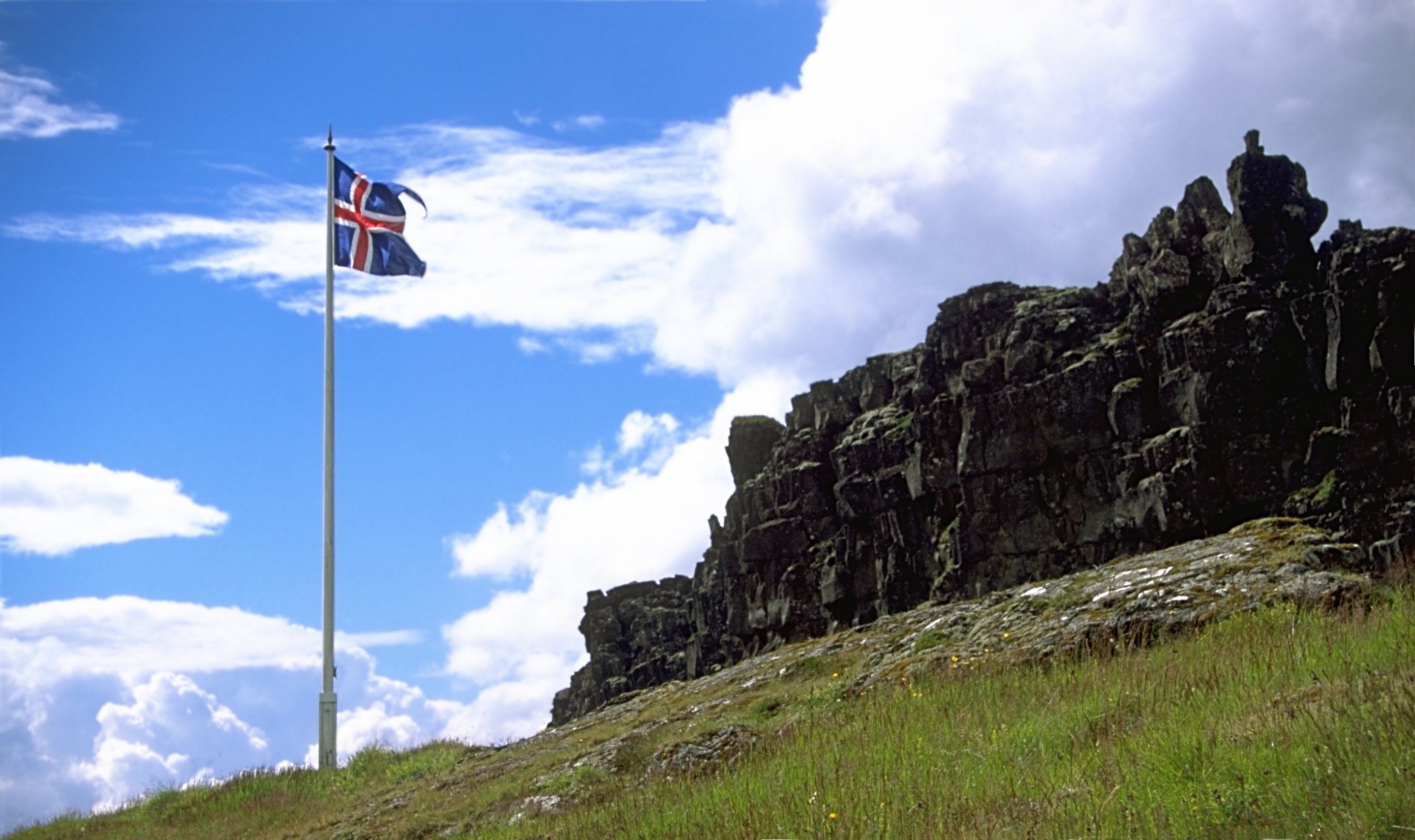
According to Law No. 5 of 23 January 1991, the following are nationally sanctioned flag days. On these days, the flag is to be flown at state buildings and at institutions under the supervision of state authorities and official representatives. The Prime Minister's Office may announce additional flag days each year. On flag days the flag is flown fully hoisted, except on Good Friday, when it is flown at half-mast.
- The birthday of the president of Iceland, currently 11 October
- New Year's Day
- Good Friday
- Easter
- First Day of Summer
- 1 May
- Pentecost
- Sailors Day
- Icelandic National Day
- Icelandic Language Day
- 1 December, Sovereignty Day
- Christmas
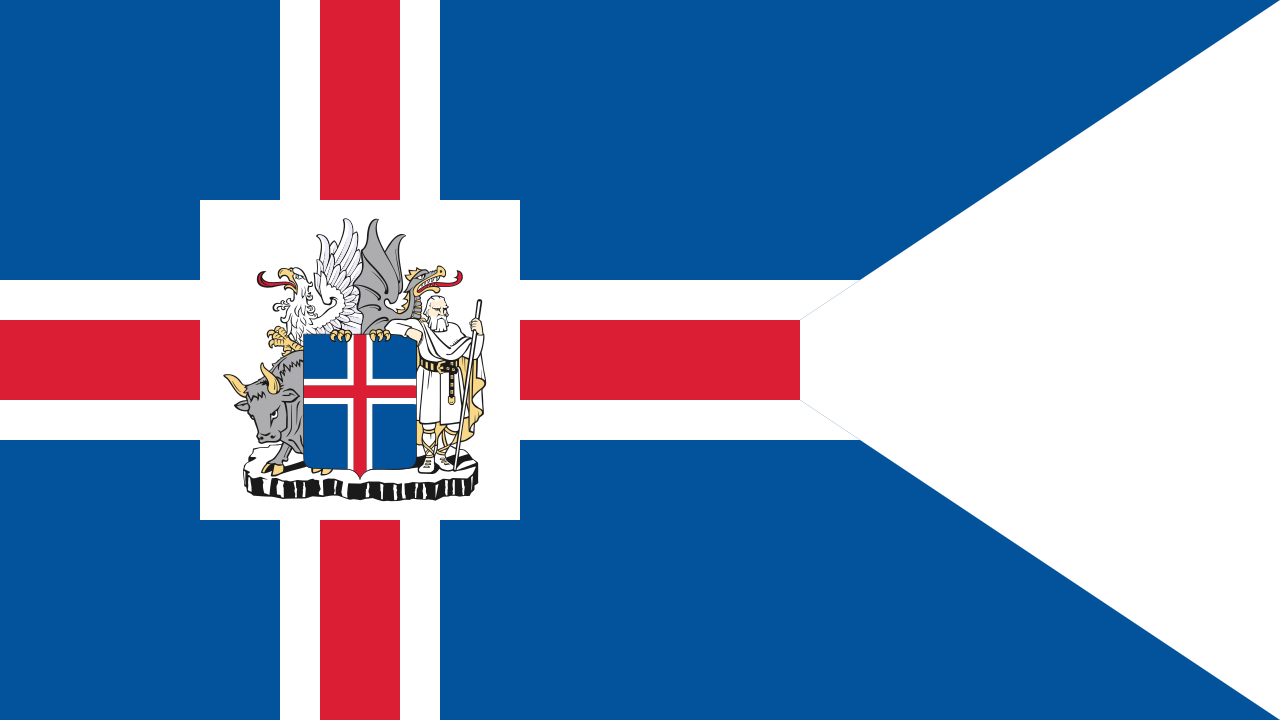
The state flag

The Icelandic state flag (Ríkisfáni), also known as the Tjúgufáni, was first flown on 1 December 1918 from the Ministry offices, although detailed rules on its use were not finalised until 12 February 1919.
The state flag is flown on government buildings and embassies, and may also be used on other buildings when they are in official use by the state. It serves as the naval ensign of the Icelandic Coast Guard, and may be flown by state vessels and other ships in official service.
The customs service flag is flown at buildings and checkpoints used by the Directorate of Customs, and may also be used by vessels operated by the Directorate.
The presidential flag is flown at the President's residences and used on vehicles transporting the President.
Colours of the flag
Official colour specifications for the Icelandic flag were issued in 1991. The law refers to the Standard Colour of Textile (Dictionnaire International de la Couleur) system, and the Government of Iceland has also published equivalents in widely used colour systems, including Pantone, CMYK, RGB, hex triplet and Avery.
| Scheme | Blue | White | Red |
|---|---|---|---|
| SCOTDIC | 693009 | 95 | ICELAND FLAG RED |
| Scheme | Blue | White | Red |
|---|---|---|---|
| Hex | #02529C | #FFFFFF | #DC1E35 |
| RGB | 2, 82, 156 | 255, 255, 255 | 220, 30, 53 |
| Pantone | 287 | 1c | 199 |
| CMYK | 100, 75, 2, 18 | 0, 0, 0, 0 | 0, 100, 72, 0 |
| Avery | 520 | 501 | 503 |
Construction sheets
References
- Lög um þjóðfána Íslendinga og ríkisskjaldarmerkið. ( 1944 nr. 34 17. júní ). : Retrieved 14 May 2004 from http://www.althingi.is/lagas/130a/1944034.html
- Forsetaúrskurður um fánadaga og fánatíma. ( 1991 nr. 5 23. janúar ). : Retrieved 14 May 2004 from http://www.althingi.is/lagas/125b/1991005.html
- Auglýsing um liti íslenska fánans. ( 1991 nr. 6 23. janúar ). : Retrieved 14 May 2004 from http://www.althingi.is/lagas/125b/1991006.html
- Lög um breyting á lögum nr. 34 17. júní 1944, um þjóðfána Íslendinga. : Retrieved 14 May 2004 from http://www.althingi.is/altext/stjt/1998.067.html
References
- [http://eng.forsaetisraduneyti.is/state-symbols/icelandic-national-flag/proportion/ Icelandic National Flag Proportion - Prime Minister's Office]
- (1 September 2025). "Lög um þjóðfána Íslendinga og ríkisskjaldarmerkið". [[Althing.
- Jeroen Temperman. (2010). "State Religion Relationships and Human Rights Law". [[Martinus Nijhoff Publishers]].
- Carol A. Foley. (1996). "The Australian Flag: Colonial Relic or Contemporary Icon". William Gaunt & Sons.
- "History of the Icelandic Flag". Prime Minister's Office.
- Andrew Evans. (2008). "Iceland". Bradt.
- Karlsson, Gunnar. (2000). "The History of Iceland". C. Hurst & Co..
- "AUGLÝSING um liti íslenska fánans.".
This article was imported from Wikipedia and is available under the Creative Commons Attribution-ShareAlike 4.0 License. Content has been adapted to SurfDoc format. Original contributors can be found on the article history page.
Ask Mako anything about Flag of Iceland — get instant answers, deeper analysis, and related topics.
Research with MakoFree with your Surf account
Create a free account to save articles, ask Mako questions, and organize your research.
Sign up freeThis content may have been generated or modified by AI. CloudSurf Software LLC is not responsible for the accuracy, completeness, or reliability of AI-generated content. Always verify important information from primary sources.
Report