From Surf Wiki (app.surf) — the open knowledge base
Flag of China
none
_-_IMG_1104.jpg)
none
| Field | Value | ||||
|---|---|---|---|---|---|
| Name | People's Republic of China | ||||
| Nickname | Five-star Red Flag | ||||
| Image | Flag of the People's Republic of China.svg | ||||
| Use | 110110 | ||||
| Symbol | |||||
| Proportion | 2:3 | ||||
| Adoption | {{plainlist | ||||
| * {{Start date and age | df | yes | 1949 | 09 | 27}} (approved) |
| * {{Start date and age | df | yes | 1949 | 10 | 01}} (introduced) |
| Designer | Zeng Liansong | ||||
| Design | A large golden star within an arc of four smaller golden stars, in the canton, on a field of Chinese red. |
the flag of the People's Republic of China since its creation in 1949
- (approved)
- (introduced)
The national flag of the People's Republic of China, also known as the Five-star Red Flag, is a Chinese red field with five golden stars charged at the canton. The design features one large star, with four smaller stars in an arc set off towards the fly.
The first national flag of China, called the Yellow Dragon Flag, was adopted by the Qing dynasty in 1862, featuring the Azure Dragon on a plain yellow field with the red flaming pearl in the upper left corner. On January 10, 1912, with the Xinhai Revolution and the establishment of the Republic of China, the Five-Colored Flag was adopted as the national flag by the Beiyang government, feauturing five colored stripes representing the five major ethnic groups in China. After the successful Northern Expedition, which saw the Kuomintang overthrowing the Beiyang government, which adopted a flag consisting of a red field with a blue canton bearing a white disk surrounded by twelve triangles as China's national flag.
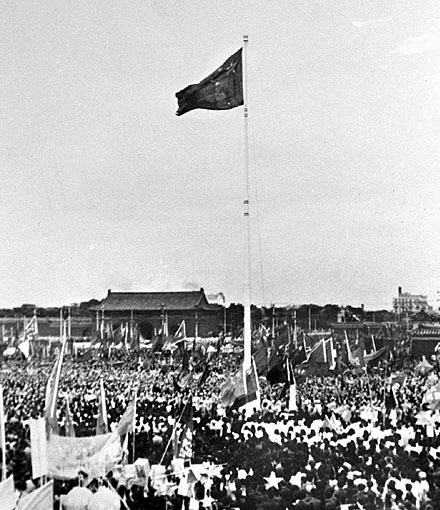
The Five-star Red Flag was adopted as the national flag of China since the foundation of the People's Republic of China on 1 October 1949. The flag was designed by Zeng Liansong. The red represents the Chinese Communist Revolution. The five stars and their relationships to each other represent the unity of four social classes of Chinese people, symbolized by four smaller stars, under the Chinese Communist Party (CCP), symbolized by the large star. The flag was first hoisted by the People's Liberation Army (PLA) on a pole overlooking Beijing's Tiananmen Square on 1 October 1949, at a ceremony proclaiming the establishment of the People's Republic of China.
Current design
Symbolism
According to the official government interpretation of the flag, the red background symbolizes the Chinese Communist Revolution. The five stars and their relationship represents the unity of Chinese people under the leadership of the CCP. The orientation of the stars shows that the unity should revolve around a center. The larger star symbolizes the CCP, and the four smaller stars symbolize the four social classes of China's New Democracy mentioned in Mao Zedong's "On the People's Democratic Dictatorship": the working class, the peasantry, the urban petite bourgeoisie, and the national bourgeoisie. It is sometimes incorrectly stated that the five stars of the flag represent the five largest ethnic groups: Han Chinese, Zhuangs, Hui people, Manchus and Uyghurs. This is generally regarded as an erroneous conflation with the "Five Races Under One Union" flag, used by the Beiyang government of Republic of China, whose different-colored stripes represented the Han Chinese, Hui people, Manchus, Mongols and Tibetans.
Construction
The construction sheet for the national flag was published on 28 September 1949 by an order from the Presidium of the First Plenary Session of the CPPCC. The information can also be found in the document "GB 12982-2004: National flag" that was released by the Standardization Administration of China.
| Construction sheet | Standard | |
|---|---|---|
| [[File:Flag of China (construction sheet).svg | 450px]] |
Size specifications
The Law on the National Flag notes five possible sizes that could be made for the national flag. According to Article 4 of the National Flag Law, people's governments of provinces, autonomous regions and municipalities directly under the Central Government are directed to authorize companies to make any copy of the national flag. Besides five official sizes for flying on flagpoles, there are another four smaller sizes for other purposes, such as decoration on cars or display in meeting rooms.
| Size | 1 | 2 | 3 | 4 | 5 | 6 | 7 | 8 | 9 | |
|---|---|---|---|---|---|---|---|---|---|---|
| Length × width (cm) | 288 × 192 | 240 × 160 | 192 × 128 | 144 × 96 | 96 × 64 | 66 × 44 | 45 × 30 | 30 × 20 | 21 × 14 |
Color specifications
The colors of the national flag are stipulated in the document "GB 12983-2004: Standard Color Sample of the National Flag", and promulgated by the Standardization Administration of China. The colors are in specified in CIE 1964 xyY10 color space under standard illuminant D65.
| Fabric | Luminance Y10 | Color coordinate | Allowable error margin | x10 | y10 | Synthetic fiber | Red | Gold | Silk | Red | Gold | Cotton cloth | Red | Gold | Sleeve | White | |
|---|---|---|---|---|---|---|---|---|---|---|---|---|---|---|---|---|---|
| 9.4 | 0.555 | 0.328 | All are \Delta E_{ab}^{\,\bullet}\le 2.0 | ||||||||||||||
| 41.2 | 0.446 | 0.489 | |||||||||||||||
| 12.3 | 0.565 | 0.325 | |||||||||||||||
| 32.4 | 0.450 | 0.463 | |||||||||||||||
| 9.2 | 0.595 | 0.328 | |||||||||||||||
| 33.0 | 0.467 | 0.463 | |||||||||||||||
| 78.0 | – | – | The luminance Y10 must not be less than 78 |
Color schemeFor computer display, the National Flag Law defers to "standard" PNG images posted on the National People's Congress website. The specific colors used, in the sRGB space of the PNG file, are:
| [[File:Flag of the People's Republic of China.svg | 30px]] | Red | Yellow |
|---|---|---|---|
| RGB | `238/28/37` | `255/255/0` | |
| Hexadecimal | `#EE1C25` | `#FFFF00` | |
| CMYK | `0/88/84/7` | `0/0/100/0` |
Unicode
The Flag of China is represented as the Unicode emoji sequence and .
Protocol
The Law of the People's Republic of China on the National Flag was passed by 14th Meeting of the Standing Committee of the 7th National People's Congress on 28 June 1990 and was enforced starting 1 October 1990. The law set regulations on how to make the Chinese flag, what it looks like, where it can be flown and how it can be flown. The law also stresses that the national flag is "the symbol and hallmark of the People's Republic of China" and that everyone "shall respect and care for the National Flag".
Display

The National Flag Law has made detailed regulations on places or institutions for raising the national flag. Specifically, it stipulates the flag must be hung daily at the Tiananmen Square and Xinhuamen, the locations of the Central Committee of the Chinese Communist Party, the Standing Committee of the National People's Congress, the State Council, the Central Military Commission, the Central Commission for Discipline Inspection, the Supreme People's Procuratorate, the National Supervisory Commission and the National Committee of the Chinese People's Political Consultative Conference, the Ministry of Foreign Affairs, airports, ports, railway stations and other ports of entry and border or coastal defense posts.
The flag should be hung at all departments under the Party Central Committee and all local Party committees, all departments of the State Council, the standing committees of local people's congresses, local people's governments, local and special people's courts, local disciplinary inspection committees and local supervisory commissions, local and special people's procuratorates, local committees of the Chinese People's Political Consultative Conference, and all democratic parties and people's organizations, or property belonging to said places or institutions on working days. National flags should be raised in full-time schools except during vacations and Sundays. Schools are required to display the national flag every day except during winter and summer vacations and rest days, while public cultural and sports facilities such as libraries, museums, cultural centers, art galleries, museums of science and technology, memorial halls, exhibition halls, gymnasiums, and youth palaces are mandated to display the flag on the days they are open. In addition, the flag is displayed in public squares, parks and other public venues, as well as by residential buildings during important national holidays.
The flag displayed in the aforementioned conditions are raised morning and lowered in the evening. A Flag Raising Ceremony may be held during displays of the national flag, where the March of the Volunteers, the national anthem, shall be played or sung. Participants should stand at attention facing the national flag and salute. The ceremony is to be held daily at the Tiananmen Square, while schools hold the ceremony once a week except during holidays. When raising or lowering on an upright flagpole, the flag should rise and fall slowly. When raised, the flag must be raised to the top of the pole. When lowered, the national flag must not be allowed to touch the ground. When flown at half-mast, the national flag should first be raised to the top of the pole, and then lowered into a position where the distance between the top of the flag and the top of the pole is one-third of the total length of the flagpole; and when it is lowered, the national flag should first be raised to the top of the pole before lowering. The flag may be not raised in severe weather conditions. Damaged, faded or substandard flags must not be used, and the flag must not be displayed upside down or hung upside down.

The national flag of China takes precedent over other flags of the state. The national flag, when raised or carried in a procession with another flag or flags, is to be in front of the other flag or flags. Additionally, when the national flag and other flags are displayed at the same time, the national flag is to be placed in a central, higher, or prominent position. However, incidents violating the aforementioned provisions, such as the CCP flag leading the national flag, have occurred. When the national flags of two or more countries are displayed, protocol is regulated by the regulations of the Ministry of Foreign Affairs. The Central Military Commission is authorized to provide methods for the display and use of the national flag by the People's Liberation Army and the People's Armed Police.
Half-mast
The Chinese flag must be lowered to half-mast as a token of mourning when any of the following people die:
- President of the People's Republic of China
- Chairman of the Standing Committee of the National People's Congress
- Premier of the State Council
- Chairman of the Central Military Commission
- Chairman of the National Committee of the Chinese People's Political Consultative Conference
- People who have made outstanding contributions to the People's Republic of China.
- Those who have made outstanding contributions to the cause of world peace or human progress.
The flag may also be flown half-mast nationally or in specific places in the case of severe natural disasters, public health emergencies, or other events that cause heavy casualties, as well as during national memorial ceremonies. Departments of the State Council or of people's governments of province-level divisions are to report to the State Council in flying the flag half-mast in these cases, as well as for flying half-mast for those who have made outstanding contributions to the PRC or to the cause of world peace or human progress.
Folding the flag
- Fold horizontally along the center.
- Repeat, fold horizontally along the center.
- Fold vertically along the center of the flag.
- Repeat, fold vertically along the center of the flag.
- Repeat, fold vertically along the center of the flag.
- Repeat, fold vertically along the top
Prohibition of desecration
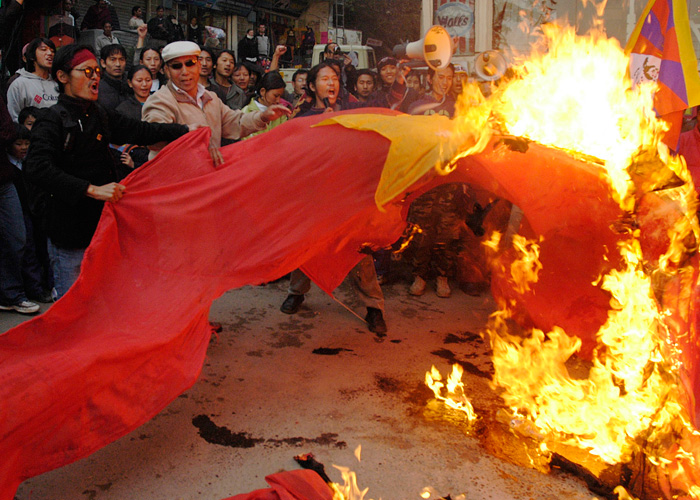
Flag desecration is prohibited in China. The Criminal Law provides for imprisonment up to three years, criminal detention, public surveillance, or deprivation of political rights for "whoever desecrates the National Flag or the National Emblem of the People's Republic of China by intentionally burning, mutilating, scrawling on, defiling or trampling upon it in a public place". Article 19 of the National Flag Law states that "Whoever intentionally insults the national flag of the People's Republic of China in public by burning, damaging, defacing, defiling, or trampling on it shall be investigated for criminal responsibility in accordance with the law; if the circumstances are minor, the public security organs shall impose a detention of not more than 15 days in accordance with the provisions of the Law on Penalties for Administration of Public Security." Some Taiwanese groups have burned the Chinese flag in protest of the PRC government.
History
Qing dynasty
The first national flag of China was the "Yellow Dragon Flag" used by the Qing dynasty — the last imperial dynasty in Chinese history — from 1862 until the overthrow of the monarchy during the 1911 Revolution. The flag that was adopted in 1862 was triangular, but the dynasty adopted a rectangular version of the dragon flag in 1889.
|Flag_of_China_(1862–1889).svg | Flag of the Qing Dynasty (1862–1889) |Flag_of_China_(1889–1912).svg | Flag of the Qing Dynasty (1889–1912)|alt3=
Republic of China
|File:Flag of China (1912–1928).svg | "Five races under one union" flag. Used by the Beiyang government (1912–1928). | |Flag of the Republic of China.svg| Flag of the Republic of China of the Nationalist government (flown only in Taiwan after 1949).
The canton (upper corner on the hoist side) originated from the "Blue Sky with a White Sun flag" () designed by Lu Haodong, a martyr of the 1911 Revolution. He presented his design to represent the revolutionary army at the inauguration of the Revive China Society, an anti-Qing society in Hong Kong, on 21 February 1895. This design was later adopted as the Kuomintang party flag and the Coat of Arms of the Republic of China. The "red Earth" portion was added by Sun Yat-sen in the winter of 1906, bringing the flag to its modern form. According to George Yeo, the then Foreign Minister of Singapore in 2011, in those days, the Blue Sky with a White Sun flag was sewn in the Sun Yat Sen Nanyang Memorial Hall (formerly known as the "Sun Yat Sen Villa") in Singapore by Teo Eng Hock and his wife.
During the Wuchang Uprising in 1911 that heralded the Republic, the various revolutionary armies had different flags. Lu Hao-tung's "Blue Sky with a White Sun" flag was used in the provinces of Guangdong, Guangxi, Yunnan, and Guizhou. In Wuhan, a flag with 18 yellow stars was used to represent the 18 administrative divisions at the time. In Shanghai and northern China, a "Five-Colored Flag" () (Five Races Under One Union flag) was used of five horizontal stripes representing the five major nationalities of China: the Han (red), the Manchu (yellow), the Mongol (blue), the Hui (white), and the Tibetan (black). When the government of the Republic of China was established on 1 January 1912, the "Five-Colored Flag" was selected by the provisional Senate as the national flag. The "18-Star Flag" was adopted by the army and the modern flag was adopted as a naval ensign. Sun Yat-sen, however, did not consider the five-colored flag appropriate, reasoning that horizontal order implied a hierarchy or class like that which existed during dynastic times. After President Yuan Shikai assumed dictatorial powers in 1913 by dissolving the National Assembly and outlawing the Kuomintang, Sun Yat-sen established a government-in-exile in Tokyo and employed the Blue Sky with a White Sun flag as the national ROC flag. He continued using this design when the Kuomintang established a rival government in Guangzhou in 1917. The Blue Sky with a White Sun flag was made the official national flag on 17 December 1928 after the Northern Expedition that overthrew the Beijing government. On 29 December 1928, Chinese warlord Zhang Xueliang announced that all banners of the Beiyang government in Manchuria would be replaced by the Blue Sky with a White Sun flag, thus nominally uniting China under one government.
During the Second Sino-Japanese War, the invading Japanese established a variety of puppet governments using several flag designs. The "Reformed Government", established in March 1938 in Nanjing, employed the Five-Colored Flag. When Wang Jingwei was slated to take over the Japanese-installed government in Nanjing in 1940, he demanded to use the modern flag as a means to challenge the authority of the Nationalist government in Chongqing under Chiang Kai-shek and position himself as the rightful successor to Sun Yat-sen. However, the Japanese preferred the Five-Colored flag. As a compromise, the Japanese suggested adding a triangular yellow pennant on top with the slogan "Peace, Anticommunism, National Construction" () in black, but this was rejected by Wang. In the end, Wang and the Japanese agreed that the yellow banner was to be used outdoors only until 1943, when the banner was abandoned, leaving two rival governments with the same flag, each claiming to be the legitimate national government of China. After the Chinese Civil War in 1949, the ROC government led by Chiang Kai-shek relocated its government and its institutions to the island of Taiwan. On the mainland, CCP forces of Mao Zedong established the People's Republic of China (PRC) and adopted their own national flag. On 23 October 1954, the National Emblem and National Flag of the Republic of China Act () was promulgated by the Legislative Yuan to specify the size, measure, ratio, production, and management of the flag.
|File:Flag_of_the_Republic_of_China_(draft_1).svg | Teo Eng Hock and his wife's proposal 1 for the ROC flag |File:Flag_of_the_Republic_of_China_(draft_2).svg | Proposal 2 for the ROC flag. |File:Flag of the Republic of China Army.svg | Proposal 3 for the ROC flag, later adopted as the Flag of the Republic of China Army |File:Flag_of_the_Republic_of_China.svg | Proposal 4 for the ROC flag, later officially adopted as the national flag
People's Republic of China
- Chinese characteristics (geography, nationality, history, culture, etc.);
- Power characteristics (people's democratic government, led by the working class and based on the worker-peasant alliance);
- The shape should be rectangular and the length-breadth ratio should be 3:2;
- The color should mainly be bright red (an early draft of the notice had the color as dark red, but this was changed to bright red by Zhou Enlai).
Zeng Liansong, a citizen from Wenzhou, Zhejiang, was working in Shanghai when the announcement came out; he wanted to create a flag design to express his patriotic enthusiasm for the new country. In the middle of July, he sat down in his attic over the course of several nights to come up with designs. His inspiration for the current design came from observing how stars shine in the night sky. He thusly thought of a Chinese proverb, "longing for the stars, longing for the moon" (盼星星盼月亮, pàn xīngxīng pàn yuèliàng), which shows yearning. He viewed the CCP as the great savior (大救星, dà jiùxīng "great saving star") of the Chinese people, symbolized by the flag's largest star. The idea for four small stars came from "On the People's Democratic Dictatorship", a speech by Mao Zedong, which defined the Chinese people as consisting of four social classes, also traditionally referred to in Asian cultures as the four occupations (士農工商, shì nóng gōng shāng) ("Scholars, Peasants, Workers, Merchants"). The color yellow implies that China belongs to the Chinese people, a "yellow race". After working out the details of the placement of the stars and their sizes (he had tried to put all of the stars in the center, but thought this too dull), he sent his "Five Stars on a Field of Red" (紅地五星旗, hóng de wǔxīng qí) design to the committee in the middle of August.
By 20 August, between 2,992 and 3,012 designs had been sent to the flag committee, including input from committee members themselves such as Guo Moruo and Tan Kah Kee. From 16 to 20 August, the designs were viewed at the Beijing Hotel and culled down to a list of 38. These designs are collected into a book named A Reference of National Flag Designs (國旗圖案參考資料). This book was then submitted to the newly established Chinese People's Political Consultative Conference (CPPCC) for further discussion. However, Zeng's design was not included until Tian Han nominated it again.
.jpg)
On the morning of 23 September, the representatives of the CPPCC discussed the national flags, but came to no conclusion. Some disliked the symbolism which Zeng attached to the four smaller stars, and said it should not include the bourgeoisie. The design Mao and others liked had a giant golden star in the corner on a red flag that was charged with a golden horizontal bar. But this design was strongly opposed by Zhang Zhizhong, who saw the golden bar as symbolizing China being divided into two. That night, Peng Guanghan (彭光涵) recommended Zeng's design to Zhou Enlai. Zhou was satisfied with it and asked for the creation of a larger copy of the design. Tan Kah Kee also gave his advice to Mao and Zhou that the power characteristics take precedence over Chinese geography characteristics, so there was no need to insist on the golden bar that symbolized the Yellow River. Two days later, Mao had a meeting in his office about the flag. He persuaded everyone to adopt Zeng's design, with some slight modifications. According to earlier discussions at the Beijing Hotel, the hammer and sickle from Zeng's original design was removed since it was similar to the flag of the Soviet Union. On 27 September 1949, Zeng's modified design was selected unanimously by the First Plenary Session of CPPCC, which changed the flag's name to "Five-star Red Flag".
On 29 September, the new flag was published in the People's Daily, so the design could be copied by other local authorities. The flag was officially unveiled and raised for the first time by Mao Zedong in Beijing's Tiananmen Square on 1 October 1949, at the formal announcement of the People's Republic of China. The first flag flown over Tiananmen Square was sewn together by Zhao Wenrui (赵文瑞), a seamstress who finished the task around 1pm on 30 September. Zeng had a hard time believing that his design was picked, due to the missing hammer and sickle from the giant star. However, he was officially congratulated by the General Office of the Central People's Government as the designer of the flag and received 5 million yuan for his work.
|File:Zeng Liansong's proposal for the PRC flag.svg | The original design submitted by Zeng Liansong |File:Mao Zedong's proposal for the PRC flag.svg | The "Yellow River" flag design originally preferred by Mao Zedong |File:Proposal 2 for the PRC flag.svg | Proposal 2 for the PRC flag |File:Proposal 3 for the PRC flag.svg | Proposal 3 for the PRC flag |File:Proposal 4 for the PRC flag.svg | Proposal 4 for the PRC flag
|File:Proposed_PRC_national_flag_001.svg | Proposal by Xiao Shufang |File:Proposed PRC national flags 006.svg | Proposal by Wu Yuzhang |File:Proposed-PRC-10.svg | Proposal by Ai Qing |File:Proposed PRC national flag 014.svg | Proposal by Zhu De |File:Proposed PRC national flag 015.svg | Proposal by Liang Congjie |File:Proposed PRC flag (Design 8, Guo Moruo).svg | Proposal by Guo Moruo |File:Guo Moruo's Proposal Flag for the PRC.svg | Proposal by Guo Moruo
Flags of the Special Administrative Regions
Main article: Flag of Hong Kong, Flag of Macau

Due to an order passed by the CCP Central Committee General Office and General Office of the State Council in 1997, cities and provinces are no longer allowed to adopt their own symbols. However, both of the Hong Kong and Macau Special Administrative Regions of China have their own special flags. The precise use of the SAR flags are regulated by laws passed by the National People's Congress.
The Flag of the Hong Kong Special Administrative Region features a stylized, white, five-petal Bauhinia blakeana flower in the center of a red field. On each petal is a red star; they symbolise Hong Kong's status under China, while the overall flag design signifies the reestablished link between postcolonial Hong Kong and China while demonstrating the "One country, two systems" political principle applied to the region. The flag of Hong Kong was adopted on 16 February 1990. On 10 August 1996, it received formal approval from the Preparatory Committee, a group which advised the People's Republic of China (PRC) on Hong Kong's transfer of sovereignty from the United Kingdom to the PRC in 1997. The flag was first officially hoisted on 1 July 1997, in the handover ceremony marking the transfer of sovereignty from the United Kingdom to China.
The Regional flag of the Macau Special Administrative Region is "Macau green" with a lotus flower above a stylized image of the Governor Nobre de Carvalho Bridge and water in white, beneath an arc of five gold, five-pointed stars: one large star in the center of the arc and four smaller ones. The lotus was chosen as the floral emblem of Macau. The Governor Nobre de Carvalho Bridge is a bridge linking the Macau Peninsula and the island of Taipa. The bridge is one of the most recognizable landmarks of the territory. The water beneath the lotus and the bridge symbolize Macau's position as a port and its role played in the territory. The five five-pointed stars echo the design of the national flag, symbolizing the relationship Macau has with its mother country. The design was chosen on 15 January 1993 by a committee that was drafting the Basic Law for the Macau SAR and was formally adopted by the Macau SAR Preparatory Committee on 16 January 1999. The flag was first officially hoisted on 20 December 1999, in the handover ceremony marking the transfer of sovereignty from Portugal to China.
Military flags
Main article: Flag of the People's Liberation Army
There are nine flags that are used by the People's Liberation Army (PLA), as well as one used by the People's Armed Police. The main feature of these flags is a golden star at the top left corner and two Chinese characters "八一" to the right of the star, all placed on a red background. The characters "八一" (literally "eight one") pay homage to the events on 1 August 1927 (8th month, 1st day); this was when the PLA was created by the CCP to start their rebellion against the Kuomintang Government in Nanchang. The main flag of the PLA was created on 15 June 1949 by a decree issued from Mao. The flag has a ratio of 5 by 4, which has a white sleeve measuring of the flag's length. For ceremonies, a PLA flag with golden fringe is placed on a pole with gold and red spiral stripes and topped with a golden finial and red tassel. Each branch of the PLA, the Ground Forces, Navy, Air Force, Rocket Force, Aerospace Force, Cyberspace Force, Information Support Force and the Joint Logistics Support Force, also have their own flags to use. In a 1992 order, the flags of the three branches were defined. The top of the flags is the same as the PLA flag; the bottom are occupied by the colors of the branches. The flag of the Ground Forces has a forest green bar at the bottom, the naval ensign has stripes of blue and white at the bottom, the Air Force uses a sky blue bar and the Rocket Force uses a yellow bar at the bottom. The forest green represents the earth, the blue and white stripes represent the seas, the sky blue represents the air and the yellow represents the flare of missile launching. On 10 January 2018, the People's Armed Police received a new flag following the design of the PLA branch flags with three olive stripes at the bottom.
|File:People's Liberation Army Flag of the People's Republic of China.svg | People's Liberation Army |File:Ground Force Flag of the People's Republic of China.svg | Ground Force |File:Naval Ensign of the People's Republic of China.svg | Navy |File:Air Force Flag of the People's Republic of China.svg | Air Force |File:Rocket Force Flag of the People's Republic of China.svg | Rocket Force |File:Aerospace Flag of the People's Republic of China.svg | Aerospace Force |File:Cyberspace Flag of the People's Republic of China.svg | Cyberspace Force |File:Information Support Flag of the People's Republic of China.svg | Information Support Force |File:Joint Logistics Support Flag of the People's Republic of China.svg | Joint Logistics Support Force |File:People's Armed Police Flag.svg | People's Armed Police
Communist Party flags
After the CCP was founded in 1921, various sections of the party made flags based on what the Bolsheviks used, producing various designs and patterns. On 28 April 1942, the CCP issued a decree announcing current flag and the pattern it should follow. The design was further defined in the CCP Constitution in 1996. The flag has a red background with a golden hammer and sickle, the CCP emblem, at the top left corner. The flag ratio is defined as two by three (24×36 units); the size of the emblem is eight units square, placed four units away from the hoist and three units away from the top of the flag.
The flag of the Communist Youth League of China was adopted on 4 May 1950. The design of the flag consists of the group emblem, a golden star surrounded by a ring of gold, charged on a red field. The construction of the flag consists of making the top hoist portion of the flag into twelve by eighteen units, placing the emblem in the middle of that rectangle. The radius of the emblem is four units.
The Young Pioneers of China currently uses two flags. The first flag is for pioneer battalions. The length of this flag is 90 cm; its width,120 cm. A golden badge of the Young Pioneers is placed in the center of the flag. However, for a company, a second, modified flag is used. The flag has a length of 60 cm and a width of 80 cm. A 20 cm triangle is cut out of the fly edge of the flag and the golden emblem is shifted closer towards the hoist.
|File:Flag of the Chinese Communist Party.svg | Chinese Communist Party |File:Flag of the Communist Youth League of China.svg | Communist Youth League of China |File:中国少年先锋队队旗 (大队旗).svg | Young Pioneers of China (Pioneer Battalions) |File:中国少年先锋队队旗 (中队旗).svg | Young Pioneers of China (Pioneer Companies)
Customs flag

The customs flag is the Chinese national flag with the emblem of customs at the lower right corner, which consists of a golden key and the Caduceus of Hermes, crossing each other. The current customs flag was officially adopted on 1 October 1953. The customs flag should be hung at the bow of the customs vessel.
Gallery
|File:Boeing 747-4J6 Air China B-2447 (7288535966).jpg |The Chinese flag on an Air China Boeing 747-400. |File:Yao Ming with the Chinese flag 2008 Summer Olympics - Opening Ceremony.jpg |Yao Ming holding the Chinese flag during the 2008 Summer Olympics Parade of Nations. |File:国旗 - panoramio.jpg |The Chinese flag flying in the middle of Tiananmen Square. |File:2012 Anti-Japan demonstrations2.jpg |Protesters waving PRC and ROC flags during an anti-Japan demonstration in Hong Kong in 2012. |File:2015 China Victory Day Parade (1).jpg |Flag of China flying in the 2015 Victory Day Parade. |File:Chinese Embassy in Nuku'alofa.jpg |The Chinese embassy in Nuku'alofa, Tonga with its national flag. |File:March of Nations.JPG |Chinese delegates with the Chinese flag marching into the stadium for the World Sports Festival. |File:HKSM 香港太空館 Hong Kong Space Museum Astronaut blue uniform Shen Zhou logo n RPChina red flag Jan-2013.JPG |The Chinese flag on the uniform of Shenzhou 5 spaceflight mission. |File:Guy with a large PRC flag running along side of torch 20080409.jpg |A man in San Francisco holding the Chinese flag during the torch relay for the 2008 Summer Olympics. |File:Парад в честь 70-летия Великой Победы - 40.jpg |The People's Liberation Army with the Chinese flag during the 2015 Moscow Victory Day Parade. |File:Élève chinoise Polytechnique.jpg |Chinese students with the Chinese flag at École Polytechnique. |File:Great Wall of China may 2007.JPG |The flag of China flown on the Great Wall of China.
References
References
- Lin, Chun. (2006). "The transformation of Chinese socialism". [[Duke University Press]].
- Shambaugh, David. (June 1994). "Book reviews". [[Cambridge University Press.
- Mayall, James. (1998). "The Columbia History of the 20th Century". [[Columbia University Press]].
- Zarrow, Peter Gue. (2005). "China in War and Revolution, 1895–1949". [[Routledge]].
- (1 October 1990). "Law About The National Flag of the People's Republic of China". Zhejiang Provincial Foreign Affairs Office}} [[:zh:s:中华人民共和国国旗法.
- "国家标准委标准制修订管理系统".
- (6 November 2005). "Specifications for the National Flag". Protocol Division, the Hong Kong Special Administrative Region Government of the People's Republic of China.
- (6 November 2005). "Standard Sizes of the National Flag". Protocol Division, the Hong Kong Special Administrative Region Government of the People's Republic of China.
- (2016). link. Shanghai Yingfeng Flag Co. Ltd
- (2004). link. Standardization Administration of China
- [https://web.archive.org/web/20210112023540/http://www.npc.gov.cn/npc/gqgggh/202012/84c174f138044a98ba211a15b316ffc4/files/afff82e8be374e8ebbf2f82085c7e971.pdf Article 9 of the National Flag Law of PRC]: "Standard version of national flag image for online usage is released on the website of the National People's Congress and the Government of China. (网络使用的国旗图案标准版本在中国人大网和中国政府网上发布。)"
- [https://web.archive.org/web/20210105135249/http://www.npc.gov.cn/npc/gqgggh/202012/7ac70d3a4cfb480ea9edc872bdc85578.shtml National Flag Image for Online Usage, National People's Congress of PRC]
- "🇨🇳 Flag for China Emoji".
- Daum, Jeremy. (20 October 2020). "National Flag Law of the PRC (2020 edition)".
- "Congressional-Executive Commission on China".
- (1 October 2022). "Flag raisings and burnings in Taiwan as some mark China's national day". [[Reuters]].
- Kek Koon, Wee. (20 November 2023). "The history of the Chinese national flag, from the 19th century Yellow Dragon to 1949's red design with its 5 stars, and what these symbolise". [[South China Morning Post]].
- (10 June 2011). "MFA Press Release Admin Page".
- "万圊远 Real Estate – 万圊远 Real Estate".
- ’’Flags through the ages and across the world’’, Whitney Smith, McGraw-Hill Book Company, 1975, Maidenhead, UK, p. 110
- link. Yu-liang. Tai. (23 October 1954)
- link. Yu-liang. Tai. (23 October 1954)
- (11 December 2012). "民国五色旗出自赵凤昌之手 一度被孙中山搁置".
- (1928-12-29). "Manchuria Joins Nanking Regime". [[The New York Times]].
- Cheung, Andrew. (1995). "Slogans, Symbols, and Legitimacy: The Case of Wang Jingwei's Nanjing Regime". East Asian Working Paper Series on Language and Politics in Modern China.
- link. Yu-liang. Tai. (23 October 1954)
- (8 October 2006). "Creation of the Flag, Emblem and Anthem of the People's Republic of China".
- link. PCNPCC. (10 July 1949)
- link. ""
- (24 May 2005). "National Flag of the People's Republic of China". Gov.cn.
- (2008). "1948–2008, Let history tell the future – the CPC Central Committee issued "51 slogan" 60 anniversary". China Publishing House.
- Chen, Yu. (13 August 2009). "The National People's active participation in the design within 1 month of flag design up to 2992 candidates".
- Bai, Zhi. (22 July 1999). "国旗是怎样诞生的". [[Guangming Daily]].
- Tian, Shuhe. (13 February 2009). "Zhang Zhizhong and the Birth of the 5 Star Red Flag".
- Peng Guanghan. (March 2003). "Witnesses to the Birth of the National Flag". The All-China Federation of returned overseas Chinese and overseas Chinese.
- (1 April 2009). "Stories About the National Flag, Emblem and Anthem". People's Liberation Army Publishing House.
- Wang Jianzhu. (9 October 2009). "Peng Han: the tortuous process of the flag's birth". [[Chinese Communist Party News Network]].
- (29 September 1949). "People's Daily".
- (7 August 2008). "The first one who stitched the flag of The People's Republic of China – Zhao Wenrui". QQ.com.
- Kong, Mark. (1 October 1999). "The Worker Who Forged the Red Flag". Chinese Business World.
- Han Tailun. (2000). "Witnessed the Tiananmen Square". Shaanxi People's Publishing House.
- (18 November 1997). "CPC Central Committee and State Council Notice On the Prohibition of the Creation and Use of Civic Flags". Wikisource.
- [[Preparatory Committee for the Hong Kong Special Administrative Region]]. (11 August 1996). "Decision of the Hong Kong SAR Flag".
- (16 January 1999). "Law Regarding The Flag and Emblem of the Hong Kong SAR". China.com.cn.
- (2002). "International Law Reports". [[Cambridge University Press]].
- link. Wenhui-xinmin United Press Group. (24 May 2007). (April 2012). link. Wenhui-xinmin United Press Group. (25 May 2007). (April 2012)
- 陶存. (2007). "Decade After the Return of Hong Kong". Shandong People's Publishing House.
- Aaronson, Jeffrey. "Schedule of Events".
- (2009). "Celebrating the 10th Anniversary of Macao's Return to China". Office of Hong Kong, Macao, and Taiwan Affairs, Ministry of Culture, P. R. China.
- 楊允中. "Lotus and the Macao Special Administrative Region of the Regional Flag and Regional Emblem". Macao Special Administrative Region Government and Environment Committee.
- "Flag and Emblem of the Macao SAR". Chengdu People's Government Foreign Affairs Office.
- Lee, Khoon Choy. (November 2005). "Pioneers of Modern China: Understanding the Inscrutable Chinese". World Scientific Publishing Co.
- Wu, Fei. (1 October 2009). "Military Parade Marks Anniversary". China Daily.
- (11 January 2009). "Flag of the People's Liberation Army". Yibin Shuangyong Information Network.
- (17 June 1978). "Central Military Commission Provisions On The Military Flag".
- "81 Flag and Other Signs".
- (23 June 2004). "Flag, Emblem and Song of the People's Liberation Army". Xinhua News Agency.
- (1 July 2016). "Uniform of Rocket Force". People's Daily.
- (2018-01-10). "国防部新闻发言人吴谦就武警部队旗寓意答问". [[Ministry of National Defense of the People's Republic of China]].
- (29 March 2013). "Flag and emblem of Communist Party of China". [[People's Daily]].
- (21 September 1996). "Provisions for Using the Flag and Emblem of the CPC".
- (18 November 2002). "XI Party Emblem and Flag".
- (6 January 2007). "Organization Song, Flag, Emblem and Card". [[Communist Youth League of China]].
- (27 September 2007). "Young Pioneers of China Unit Flag". Communist Youth League in Sichuan Province.
- (26 August 2005). "". link. **

This article was imported from Wikipedia and is available under the Creative Commons Attribution-ShareAlike 4.0 License. Content has been adapted to SurfDoc format. Original contributors can be found on the article history page.
Ask Mako anything about Flag of China — get instant answers, deeper analysis, and related topics.
Research with MakoFree with your Surf account
Create a free account to save articles, ask Mako questions, and organize your research.
Sign up freeThis content may have been generated or modified by AI. CloudSurf Software LLC is not responsible for the accuracy, completeness, or reliability of AI-generated content. Always verify important information from primary sources.
Report