From Surf Wiki (app.surf) — the open knowledge base
Flag of Belgium
none

none
| Field | Value |
|---|---|
| Name | Kingdom of Belgium |
| Image | Flag of Belgium.svg |
| Use | 111000 |
| Symbol | |
| Proportion | 13:15 |
| Design | A vertical tricolour of black, yellow, and red. |
| Adoption | |
| Image2 | Flag of Belgium (civil).svg |
| Use2 | 000100 |
| Symbol2 | |
| Proportion2 | 2:3 or similar |
| Design2 | A vertical tricolour of black, yellow, and red. |
In 1830, the flag, at that time non-officially, consisted of three horizontal bands, with the colors red, yellow and black. On 23 January 1831, the National Congress enshrined the tricolor in the Constitution, but did not determine the direction and order of the color bands. As a result, the "official" flag was given vertical stripes with the colors black, yellow and red.
Previous flags
After the death of Charlemagne, the present-day territory of Belgium (except the County of Flanders) became part of Lotharingia, which had a flag of two horizontal red stripes separated by a white stripe. The territory then passed into Spanish hands, and after the coronation of Charles V, Holy Roman Emperor, yellow and red, the colours of Spain, were added. From the 16th century to the end of the 18th century, the colours of what is now Belgium were red, white and yellow. Occasionally, the red Cross of Burgundy was placed on the white section of the flag.
During the period of Austrian rule, a number of different flags were tried. Eventually, the Austrian emperor imposed the Austrian flag. The population of Brussels was opposed to this, and, following the example of France, red, yellow and black cockades began to appear, those being the colours of Brabant. The colours thus correspond to the red lion of Hainaut, Limburg and Luxembourg, the yellow lion of Brabant, and the black lion of Flanders and Namur.
Independence and adoption of current flag
On 27 August 1830, the day after the rioting at the La Monnaie theatre and the start of the Belgian Revolution, the flag of France flew from the city hall of Brussels. The insurgents hastily replaced it with a tricolour of red, yellow, and black horizontal stripes (similar to the one used during the Brabant Revolution of 1789–1790 which had established the United States of Belgium) made at a nearby fabric store. As a result, Article 193 of the Constitution of Belgium describes the colours of the Belgian nation as Red, Yellow, and Black, the reverse order shown in the official flag.
On 23 January 1831, the stripes changed from horizontal to vertical, and on 12 October, the flag attained its modern form, with the black placed at the hoist side of the flag.
Design and specifications
The official guide to protocol in Belgium states that the national flag measures 2.6 m tall for each 3 m wide, giving it a ratio of 13:15. Each of the stripes is one-third of the width of the flag. The yellow is in fact yellow and not the darker gold of the flag of Germany, which is a black-red-gold tricolour, striped horizontally.
Variants

National flag and civil ensign
The national flag has the unusual proportions of 13:15. The 2:3 flag is the civil ensign, the correct flag for use by civilians at sea. File:Flag of Belgium.svg|Flag of Belgium File:Flag of Belgium (civil).svg|Civil flag of Belgium
Government Ensign of Belgium
The Belgian government ensign is used by state-owned vessels and government agencies operating at sea, including customs, police, and coast guard vessels, as well as official transport ships for Belgian authorities and maritime service vessels like those for pilotage, hydrography, and lighthouse maintenance. It distinguishes these ships from civilian vessels (which use the national flag) and navy.
The Belgian government ensign consists of a vertical tricolour of black, yellow, and red defaced by a lion rampant ensigned by a crown, both sable (black), the lion armed and langued gules (red). File:Government Ensign of Belgium.svg|Government Ensign of Belgium
Naval ensign and jack
The naval ensign of Belgium has the three national colours in a saltire, on a white field, with a black crown above crossed cannons at the top and a black anchor at the bottom. It was created in 1950, shortly after the Belgian Navy was re-established, having been a section of the British Royal Navy during World War II, and it is reminiscent of the White Ensign of the Royal Navy.
There is also an official Belgian naval jack, which is the same as the national flag, except in a 1:1 ratio, making it square. File:Naval Jack of Belgium.svg|Naval Jack of Belgium File:Belgian Navy commissioning pennant.svg|Belgian Naval pennant File:Naval auxiliary ensign.gif|The Belgian Naval Auxiliary Ensign
Royal standard and flags on the royal palaces
The royal standard of Belgium is the personal standard of the current king, Philippe, and features his monogram, an 'F' (for the Dutch 'Filip'), crossed with a 'P' in the four corners. The designs of royal standards of past monarchs have been similar.
The flags are flown above the palaces when the monarch is in Belgium, not necessarily just in one of the palaces. The flags are not flown if the monarch is on a state visit overseas or on holiday outside of Belgium. There have been exceptions to this rule, but, in general, presence or absence of the flag is a reasonably reliable indicator of whether or not the monarch is in the country. File:Flag of Belgium (with crown).svg|Flag of Belgium (with crown) File:Royal Standard of King Philippe of Belgium.svg|Royal Standard of King Philippe of Belgium
Military flags of Belgium
The flags of the Belgian Land, Air, and Naval Components represent their different branches in the Belgian military.
The flag of the Belgian Land Component was adopted on september 1st 1982 The flag is white with the Army shield topped by a Royal crown. The Army shield is red with a black embattled wall. The shield is charged with a raised sword hold by two hands, the sinister one being bare and the dexter one covered with a gauntlet. The dexter hand is placed over the sinister one. The sword and the hands are all yellow.The Royal crown is yellow with a red cap, decorated with white pearls and gems. The number, shape and colour of the pearls and gems vary from flag to flag
The flag of the Belgian Air Force was adopted on 4 February 1948. The flag of the Belgian Air Component is the badge of the air force and roundel of the Air force on a blue field.
The flag of the Belgian Navy was adopted on 2nd of march 1950. The ensign reminds the White Ensign of the Royal Navy, from which the Belgian Navy was re-established.The St. Andrew's cross was derived from the Cross of Burgundy, which decorated the ensigns of the Belgian ships during the Burgondian rule. The colours of the cross are the national colours.The crossed cannons highlight the military status of the ensign. The crown is the emblem of the kingdom, The anchors symbolize the ship's crews. File:Flag of the Belgian Army.svg|Flag of the Belgian Land Component File:Air Force Ensign of Belgium.svg|Air Force Ensign of Belgium File:Naval Ensign of Belgium.svg|Naval Ensign of Belgium
Historical flags
Belgium has had several flags throughout its history, reflecting different periods of smaller and bigger kingdoms such as the Duchy of Brabant (1183 – 1795) and the County of Flanders (863 – 1794) ... Or full rule over all Belgians like the Austrian Netherlands (1556 – 1715), Spanish Netherlands (1715 – 1795) and much more up until the independence of Belgium in 1831 after the Belgian revolution. File:Oriflamme of Charlemagne.png|Imperial Orilflamme of Charlemagne (800 – 888) File:Generieke vlag van Vlaanderen.svg|Flag of the County of Flanders (863 – 1794) File:LuikVlag.svg|Flag of the Prince-Bishopric of Liège (980 – 1795) File:Generieke vlag van Henegouwen.svg|Flag of the County of Hainaut (1071 – 1795) File:Hertogdom Brabant vlag.png|Flag of the Duchy of Brabant (1183 – 1795) File:Flag of Cross of Burgundy.svg|Flag of the Spanish Netherlands (1556 – 1715) File:Austrian Low Countries Flag.svg|Flag of the Austrian Netherlands (1715 – 1795) File:Flag of the Brabantine Revolution.svg|Flag of the United Belgian States (1789 – 1790) File:Flag of Belgium (1830).svg|First Belgian flag (1830 – 1831) File:Flag of Belgium.svg|Belgian flag (1831 – present)
Revolutionary flags
These flags were used during Belgian (or Brabantian) revolution, when the Belgian people fought for their independence: File:Flag of the Brabantine Revolution (with lion).png|Flag during the Brabant revolution, with lion (1789 – 1790) File:Flag of the Liege Volunteers 1830.png|Flag of volunteers of Liege (1830 – 1831)
Protocol
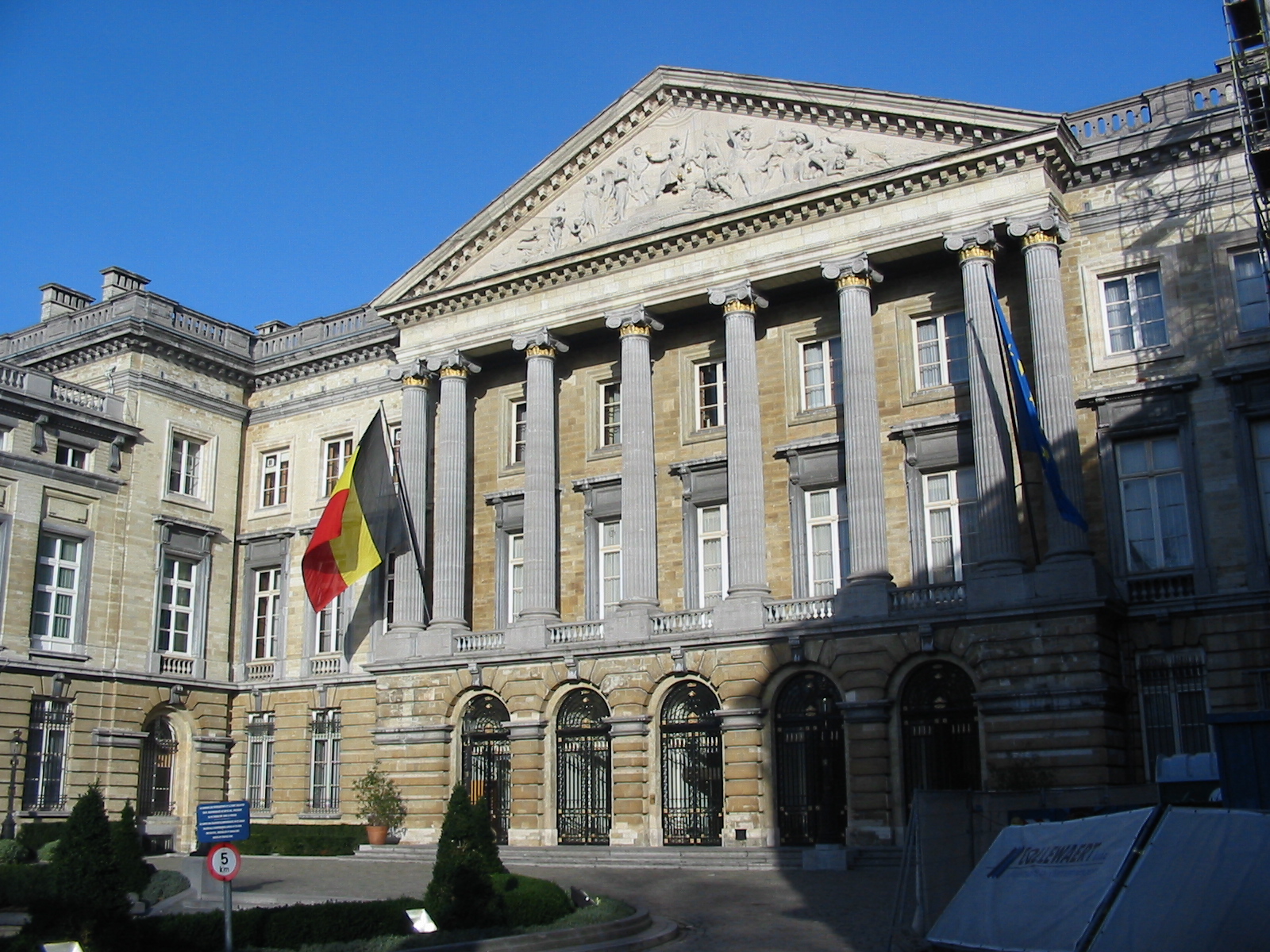
As Belgium is a federal state, the flag of Belgium and the flags of the communities or regions in principle occupy the same rank. Nonetheless, when flags are raised and lowered or carried in a procession, the national flag takes precedence over all the others.
The order of precedence is:
- The national flag of Belgium
- The flag of the community or region of Belgium
- The European Flag
- The flags of the provinces of Belgium, in alphabetical order in the local language, if more than one is flown
- The flag of the municipality
If there is a visiting head of state, that country's flag may be set second in precedence, all other flags dropping a rank.
References
References
- Van den Bussche, E.. (2008). "Noble Belgique, ô Mère chérie - LE PROTOCOLE EN BELGIQUE ''(PROTOCOL IN BELGIUM)''". Editions UGA.
This article was imported from Wikipedia and is available under the Creative Commons Attribution-ShareAlike 4.0 License. Content has been adapted to SurfDoc format. Original contributors can be found on the article history page.
Ask Mako anything about Flag of Belgium — get instant answers, deeper analysis, and related topics.
Research with MakoFree with your Surf account
Create a free account to save articles, ask Mako questions, and organize your research.
Sign up freeThis content may have been generated or modified by AI. CloudSurf Software LLC is not responsible for the accuracy, completeness, or reliability of AI-generated content. Always verify important information from primary sources.
Report