From Surf Wiki (app.surf) — the open knowledge base
Fixed-point iteration
Root-finding algorithm

Root-finding algorithm
In numerical analysis, fixed-point iteration is a method of computing fixed points of a function.
More specifically, given a function f defined on the real numbers with real values and given a point x_0 in the domain of f, the fixed-point iteration is x_{n+1}=f(x_n), , n=0, 1, 2, \dots which gives rise to the sequence x_0, x_1, x_2, \dots of iterated function applications x_0, f(x_0), f(f(x_0)), \dots which is hoped to converge to a point x_\text{fix}. If f is continuous, then one can prove that the obtained x_\text{fix} is a fixed point of f, i.e., f(x_\text{fix})=x_\text{fix} .
More generally, the function f can be defined on any metric space with values in that same space.
Examples
- A first simple and useful example is the Babylonian method for computing the square root of a 0, which consists in taking f(x) = \frac 1 2 \left(\frac a x + x\right), i.e. the mean value of x and a/x, to approach the limit x = \sqrt a (from whatever starting point x_0 \gg 0 ). This is a special case of Newton's method quoted below.
- The fixed-point iteration x_{n+1} = \cos x_n, converges to the unique fixed point of the function f(x) = \cos x, for any starting point x_0. This example does satisfy (at the latest after the first iteration step) the assumptions of the Banach fixed-point theorem. Hence, the error after n steps satisfies |x_n-x| \leq { q^n \over 1-q } | x_1 - x_0 | = C q^n (where we can take q = 0.85, if we start from x_0=1.) When the error is less than a multiple of q^n for some constant q, we say that we have linear convergence. The Banach fixed-point theorem allows one to obtain fixed-point iterations with linear convergence.
- The requirement that f is continuous is important, as the following example shows. The iteration x_{n+1} = \begin{cases} \frac{x_n}{2}, & x_n \ne 0\ 1, & x_n=0 \end{cases} converges to 0 for all values of x_0. However, 0 is not a fixed point of the function f(x) = \begin{cases} \frac{x}{2}, & x \ne 0\ 1, & x = 0 \end{cases} as this function is not continuous at x = 0, and in fact has no fixed points.
Attracting fixed points

An attracting fixed point of a function f is a fixed point xfix of f with a neighborhood U of "close enough" points around xfix such that for any value of x in U, the fixed-point iteration sequence x,\ f(x),\ f(f(x)),\ f(f(f(x))), \dots is contained in U and converges to xfix. The basin of attraction of xfix is the largest such neighborhood U.
The natural cosine function ("natural" means in radians, not degrees or other units) has exactly one fixed point, and that fixed point is attracting. In this case, "close enough" is not a stringent criterion at all—to demonstrate this, start with any real number and repeatedly press the cos key on a calculator (checking first that the calculator is in "radians" mode). It eventually converges to the Dottie number (about 0.739085133), which is a fixed point. That is where the graph of the cosine function intersects the line y = x.
Not all fixed points are attracting. For example, 0 is a fixed point of the function , but iteration of this function for any value other than zero rapidly diverges. We say that the fixed point of f(x) = 2x is repelling.
An attracting fixed point is said to be a stable fixed point if it is also Lyapunov stable.
A fixed point is said to be a neutrally stable fixed point if it is Lyapunov stable but not attracting. The center of a linear homogeneous differential equation of the second order is an example of a neutrally stable fixed point.
Multiple attracting points can be collected in an attracting fixed set.
Banach fixed-point theorem
The Banach fixed-point theorem gives a sufficient condition for the existence of attracting fixed points. A contraction mapping function f defined on a complete metric space has precisely one fixed point, and the fixed-point iteration is attracted towards that fixed point for any initial guess x_0 in the domain of the function. Common special cases are that (1) f is defined on the real line with real values and is Lipschitz continuous with Lipschitz constant L , and (2) the function f is continuously differentiable in an open neighbourhood of a fixed point xfix, and |f'(x_\text{fix})| .
Although there are other fixed-point theorems, this one in particular is very useful because not all fixed-points are attractive. When constructing a fixed-point iteration, it is very important to make sure it converges to the fixed point. We can usually use the Banach fixed-point theorem to show that the fixed point is attractive.
Attractors
Attracting fixed points are a special case of a wider mathematical concept of attractors. Fixed-point iterations are a discrete dynamical system on one variable. Bifurcation theory studies dynamical systems and classifies various behaviors such as attracting fixed points, periodic orbits, or strange attractors. An example system is the logistic map.
Iterative methods
Main article: Iterative method
In computational mathematics, an iterative method is a mathematical procedure that uses an initial value to generate a sequence of improving approximate solutions for a class of problems, in which the n-th approximation is derived from the previous ones. Convergent fixed-point iterations are mathematically rigorous formalizations of iterative methods.
Iterative method examples
If we write g(x) = x - \frac{f(x)}{f'(x)}, we may rewrite the Newton iteration as the fixed-point iteration x_{n+1} = g(x_n).
If this iteration converges to a fixed point x_\text{fix} of g, then x_\text{fix} = g(x_\text{fix}) = x_\text{fix} - \frac{f(x_\text{fix})}{f'(x_\text{fix})}, so f(x_\text{fix}) / f'(x_\text{fix}) = 0 , therefore f(x_\text{fix}) = 0, that is, x_\text{fix} is a root of f. Under the assumptions of the Banach fixed-point theorem, the Newton iteration, framed as a fixed-point method, demonstrates at least linear convergence. More detailed analysis shows quadratic convergence, i.e., |x_n - x_\text{fix}| , under certain circumstances.
Convergence acceleration
The speed of convergence of the iteration sequence can be increased by using a convergence acceleration method such as Anderson acceleration and Aitken's delta-squared process. The application of Aitken's method to fixed-point iteration is known as Steffensen's method, and it can be shown that Steffensen's method yields a rate of convergence that is at least quadratic.
Chaos game
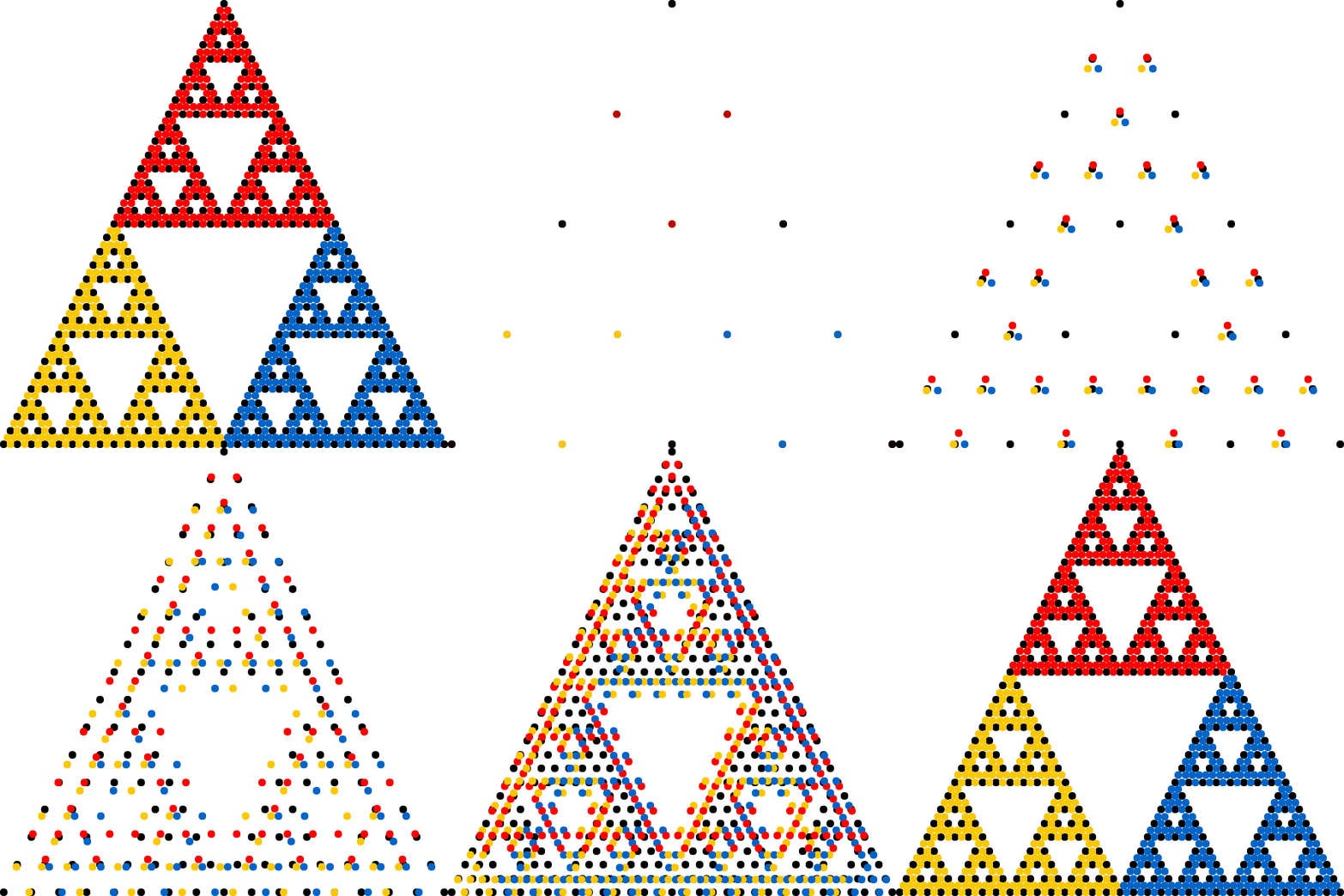
Main article: Chaos game
The term chaos game refers to a method of generating the fixed point of any iterated function system (IFS). Starting with any point x0, successive iterations are formed as , where f**r is a member of the given IFS randomly selected for each iteration. Hence the chaos game is a randomized fixed-point iteration. The chaos game allows plotting the general shape of a fractal such as the Sierpinski triangle by repeating the iterative process a large number of times. More mathematically, the iterations converge to the fixed point of the IFS. Whenever x0 belongs to the attractor of the IFS, all iterations x**k stay inside the attractor and, with probability 1, form a dense set in the latter.
References
References
- (17 September 2014). "Mathematics Without Boundaries: Surveys in Pure Mathematics". Springer.
- "Dottie Number". Wolfram Research, Inc..
- Brkic, Dejan (2017) Solution of the Implicit Colebrook Equation for Flow Friction Using Excel, Spreadsheets in Education (eJSiE): Vol. 10: Iss. 2, Article 2. Available at: https://sie.scholasticahq.com/article/4663-solution-of-the-implicit-colebrook-equation-for-flow-friction-using-excel
- Bellman, R. (1957). Dynamic programming, Princeton University Press.
- Sniedovich, M. (2010). Dynamic Programming: Foundations and Principles, [[Taylor & Francis]].
- Onozaki, Tamotsu. (2018). "Nonlinearity, Bounded Rationality, and Heterogeneity: Some Aspects of Market Economies as Complex Systems". Springer.
This article was imported from Wikipedia and is available under the Creative Commons Attribution-ShareAlike 4.0 License. Content has been adapted to SurfDoc format. Original contributors can be found on the article history page.
Ask Mako anything about Fixed-point iteration — get instant answers, deeper analysis, and related topics.
Research with MakoFree with your Surf account
Create a free account to save articles, ask Mako questions, and organize your research.
Sign up freeThis content may have been generated or modified by AI. CloudSurf Software LLC is not responsible for the accuracy, completeness, or reliability of AI-generated content. Always verify important information from primary sources.
Report