From Surf Wiki (app.surf) — the open knowledge base
Five Tathāgatas
Representations of the five qualities of the Adi-Buddha

Representations of the five qualities of the Adi-Buddha

In Mahayana and Vajrayana Buddhism, the Five Tathāgatas (Skt: पञ्चतथागत, pañcatathāgata; (Ch: 五方佛, Wǔfāngfó) or Five Wisdom Tathāgatas (Ch: 五智如来, Wǔzhì Rúlái), are the five cardinal male and female Buddhas that are inseparable co-equals, although the male cardinal Buddhas are more often represented. Collectively, the male and female Buddhas are known as the Five Buddha Families (pañcabuddhakula).
The five are also called the Five Great Buddhas or the Five Jinas (Skt. for "conqueror" or "victor"). They are understood to manifest in humans as Five Wisdom Energies, which are both personality tendencies and corresponding enlightened states of being.
Five Buddhas of the Five Directions
The Five Buddha Families are a common subject of Vajrayana and Tibetan Buddhist mandalas and they feature prominently in various Buddhist Tantras as the intrinsically inseparable They are sometimes seen as emanations and representations of the five qualities of the Adi-Buddha or "first Buddha", which is associated with the Dharmakāya. Some sources also include this "first Buddha" as a sixth Buddha along with the five.
The Five Tathāgatas are also venerated in East Asian Buddhist traditions. In Japanese Buddhism, the Five Tathagathas are the primary objects of realization and meditation in Shingon Buddhism, a school of Vajrayana Buddhism founded by Kōbō Daishi. In Chinese Buddhism, veneration of the five Buddhas has dispersed from Chinese Esoteric Buddhism into other Chinese Buddhist traditions like Chan Buddhism and Tiantai. They are enshrined in many Chinese Buddhist temples, and regularly invoked in rituals such as the Shuilu Fahui and the Yujia Yankou ritual, as well as in general prayers and chants.
They are also sometimes called the "Dhyani-buddhas", which is a term first recorded in English by Brian Houghton Hodgson, a British resident in Nepal, in the early 19th century, and is unattested in any surviving traditional primary sources.
| Five Directions | Five Families | Five Luminous Kings | ||||
|---|---|---|---|---|---|---|
| East | West | South | ||||
| Five Buddhas | [[File:Aksobhya Buddha.gif | frameless | x200px]] | [[File:Amitabha Buddha in Tangka.jpg | frameless | x200px]] |
| Aksobhya Buddha | Amitabha Buddha | Ratna-sambhava Buddha | ||||
| Vajra Family | Padma (Lotus) Family | Ratna (Jewel) Family | ||||
| Five Wisdoms | Grand Round Mirror Wisdom | Miraculous Observing Wisdom | ||||
| Ādarśa-jñāna | Pratyavekṣaṇa-jñāna | Samatā-jñāna | ||||
| 大圓鏡智 | 妙觀察智 | 平等性智 | ||||
| [[File:Trailokya-vijaya-raja.jpg | frameless | x200px]] | ||||
| Trailokyavijaya | [[File:Yamantaka Luminous King.jpg | frameless | x200px]] | |||
| Yamantaka | [[File:Kundali Luminous King.jpg | frameless | x200px]] | |||
| Kuṇḍali |
History

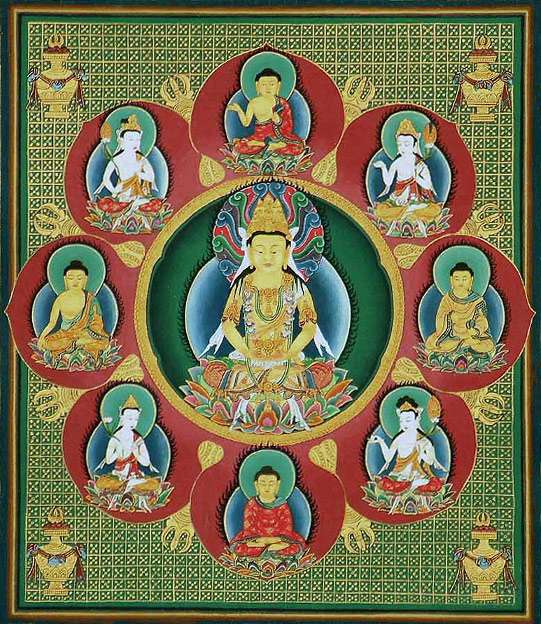

The Five Wisdom Buddha families are a development of the mature Buddhist Tantras. The now standard five Buddhas first appear in the Sarvatathāgatatattvasaṃgraha sutra (Compendium of Principles, c. late 7th century) and Vajrasekhara Sutra.
However, the tradition of various Buddhas corresponding to the main cardinal directions is not new to the Buddhist tantras. The idea appears in Mahayana sutras like the Sutra of Golden Light (c. 5th century) and the Sukhāvatīvyūha Sūtra. The Golden Light for example, has a mandala with Shakyamuni in the center, surrounded by Ratnaketu (south), Amitayus (west), Dundubhisvara (north) and Aksobhya (east) Buddhas. This set already includes three of the main five Buddha family Buddhas found in the tantras.
Furthermore, examples of four Buddhas arranged in the four cardinal directions are found in Indian Buddhist stupas like Sanchi stupa, Udayagiri stupa, Jajpur stupa (Pushpagiri) and Dekhinath stupa (Gyaraspur). The Udayagiri stupa for example, houses Vairocana, Amitabha, Aksobhya and Ratnasambhava in the four cardinal directions of the stupa.
According to Kimiaki Tanaka, this basic four cardinal directions Buddha model, combined with Vairocana Buddha from the Avatamsaka sutra, developed into the later tantric five Buddha families (which changed the other two Buddhas' names to Amoghasiddhi and Ratnasambhava).
Before the set of the Compendium of Principles became the most popular, there were numerous slightly different schemas with different Buddha names. The Vairocanābhisaṃbodhi Sūtra for example contains a slightly different set of Buddhas, with Samkusumitarajendra, and Ratnaketu in place of Amoghasiddhi and Ratnasambhava. Similarly, the Amoghapāśakalparāja (Sovereign Ritual of Amoghapāśa) has a similar schema as the Compendium, except that Shakyamuni is at the center, not Vairocana, and furthermore Amoghasiddhi is replaced by Lokendraraja Buddha.
Later Buddhist tantras adopted the basic five Buddha family schema. The Māyājālatantra for example, adopts it wholesale. Other tantras would often modify the basic schema to suit their needs. For example, the Guhyasamaja literature places Aksobhya Buddha (or, depending on the tradition, Mañjuvajra, the tantric Mañjusri Buddha) at the center of the mandala instead of Vairocana.
The Mother Tantras (i.e. Yoginitantras), like the Cakrasaṃvara Tantra, adopt the basic idea of the five family mandalas, but are more different than the Father tantras in their structure and make use of different deities, including many more female ḍākinī deities. The Cakrasaṃvara for example, contains six main Buddhas with their own corresponding mandalas: Heruka, Vairocana, Vajrasūrya, Padmanarteśvara, Paramāśva, and Vajrasattva.
The Hevajratantra's mandala is even more ḍākinī centric, with a mandala focused on Hevajra surrounded by eight ḍākinīs, with no obvious connection to the standard five Buddha family schema. However, some later tantric commentators to the Hevajra tantra (like Abhayakaragupta) do indeed map these Hevajra deities to the five families. This shows that the five family schema remained an important one even in the later period of Buddhist tantra as the Yoginitantras were moving away from the standard schemas of the Yoga tantras.
Elements of the Five Families
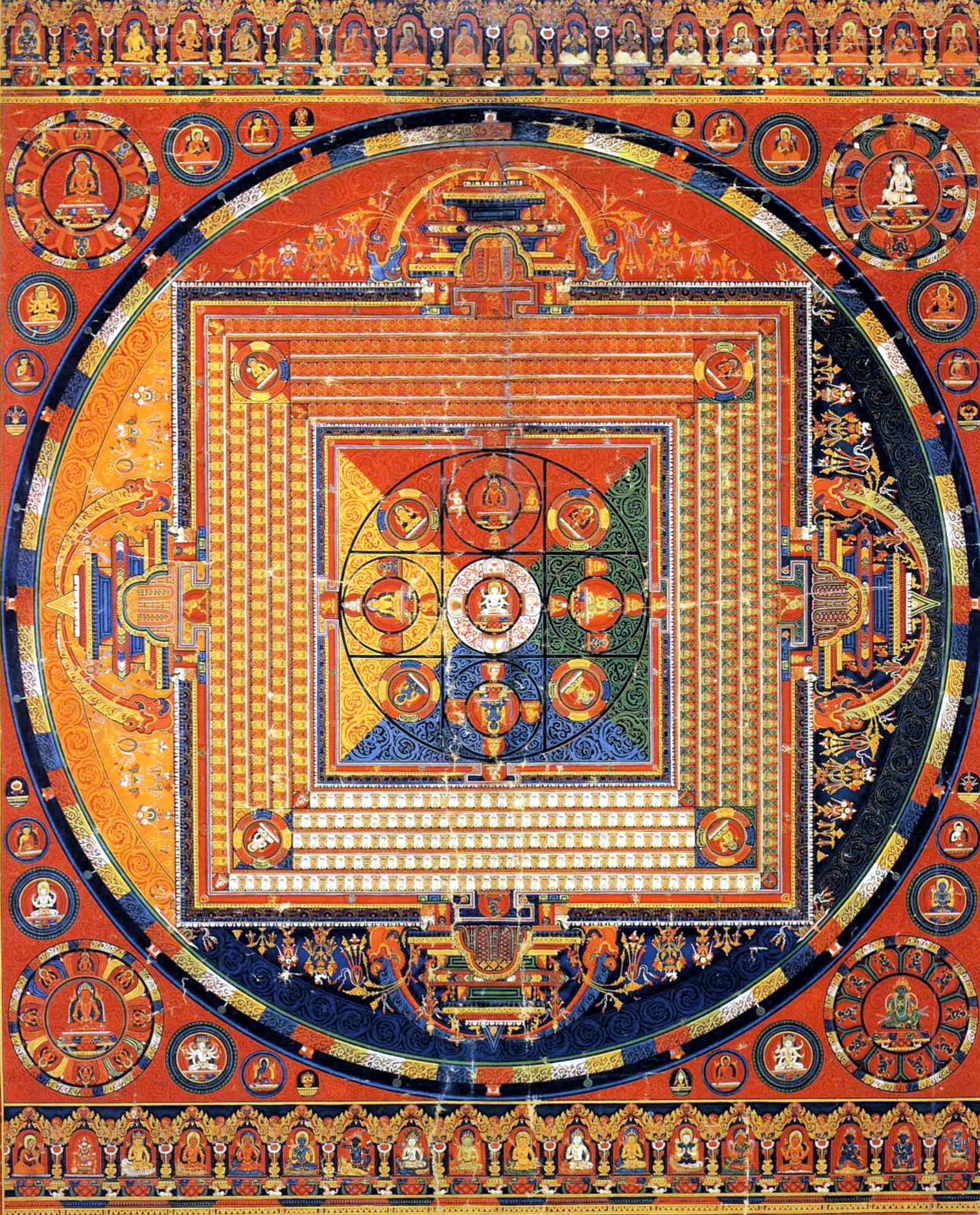


In the tantric Buddhist literature, each of the five Buddhas have extensive qualities and features, including different directions, colors, mudrā, symbol, aspects, klesha, element; consort and spiritual son, as well as different animal vehicles (elephant, lion, peacock, harpies or garuda, or dragon).
The cardinal positions of Akshobhya and Vairocana can alter depending on specific teachings. In a classic schema, Vairocana may be seen as embodying sovereignty as the lord of the mandala and thus is at the central place of the mandala. Akshobhya then may face east as the second Buddha, and embodies steadfastness. He may be seated in the Vajraparyanka (also known as Bhūmisparśa) pose, with the right hand on the right knee, palm turned inwardly, and middle finger touching the ground."The Lotus Sutra focus on Śākyamuni also fits the main Buddha figure in Zen, rather than the Buddhas Amida or Vairocana venerated in the contemporary Pure Land and Esoteric (and Kegon) movements." in "One of the two wives of Songtsen Gampo, she brought a large image of either Shakyamuni or Akshobhya Buddha (they are visually indistinguishable)..." in Amitābha embodies measureless light and faces west. A statue of Amitābha, when seated, has a samadhi mudrā with both palms face up, on top of each other, in his lap.
When these Five Buddhas are represented in mandalas of distinct Buddhist traditions, they may not always have the same colour or be related to the same direction. As mentioned, Akshobhya and Vairocana may be switched, as in the Guhyasamaja system which has Aksobhya in the center, and as in the Longchen Nyingtig tradition where Akshobhya is also in the center.
In other cases, different Buddhas may take the center place as well depending on the teaching cycle or tantra which is being depicted.
When represented in a Vairocana mandala of the Vajradhatu, the Buddhas are arranged as follows:
| Ratnasambhava (South) |
|---|
Main aspects of the Five Families
There is an expansive number of associations with each element of the Five Buddhas mandala, so that the mandala becomes a cipher and mnemonic visual thinking instrument and concept map; a vehicle for understanding and decoding the whole of the Dharma.
In numerous Vajrayana sources, each Buddha Family or Division has numerous symbols, secondary figures including bodhisattvas, protectors, etc., abilities, and aspects.
Some of the main esoteric associations of each family include:
| Family (Skt, Kula) | Buddha | Colour and Element | Skandha Aggretate | Klesha | Mudra | Throne | Bīja Syllable | jñana |
|---|---|---|---|---|---|---|---|---|
| Buddha Family | Vairocana | White, Space | Form (or Consciousness) | Aversion (or Ignorance, ávidyā) | Teaching Mudra | Lion throne | Om | suviśuddhadharmadhātujñāna Perfectly Pure Dharma sphere Jñana |
| Vajra Family | Akṣobhya | Blue, Water | Ignorance (or Aversion) | Earth-touching Mudra | Elephant throne | Hum | ||
| Ratna (Jewel) Family | Ratnasambhava | Yellow, Earth | Feeling (vedana) | Pride (or Greed) | Giving Mudra | Horse throne | Tram | |
| Padma (Lotus) Family | Amitābha | Red, Fire | Perception (saṃjñā) | Craving | Meditation Mudra | Peacock throne | Hrih | |
| Karma Family | Amoghasiddhi | Green, Wind | Volition (samkhara) | Envy | Fearlessness Mudra | Garuda throne | Ah |
Five female Buddhas and the families

Each male Buddha is paired with a female Buddha, often called mothers, prajña, vidya, or consort. Together, each family also presides over their own pure land or buddhafield. Although all five families abide in pure lands, it appears that only Sukhavati of Amitābha, and to a much lesser extent Abhirati of Akshobhya, where great masters like Vimalakirti and Milarepa are said to dwell, were popularly venerated. Some temples include all five Buddhas in their mandalas and statuary.
The Five Tathāgathas are protected by five Wisdom Kings called Vidyārājas, and in China and Japan they are frequently depicted together in the Mandala of the Two Realms. In the Shurangama Mantra revealed in the Śūraṅgama Sūtra, an especially influential dharani in the Chinese Chan tradition, the Five Tathāgathas are mentioned as the hosts of the five divisions which control the vast armies of the five directions.
In one common Five Families schema of Indian Yoga Tantra, the five prajña consorts or five mothers (Tib. ཡུམ་ལྔ་, Wyl. yum lnga), the associated bodhisattvas and their pure lands that correspond to the Five Tathagatas are:
| Buddha (Skt) | Wisdom Consort (prajña) | Consort Mantra | Bodhisattva | Vidyārāja protector | Pure land and direction |
|---|---|---|---|---|---|
| Vairocana | Ākāśadhātvīśvarī, also known as Vajradhātvisharī, Buddhaḍākinī or Sparśavajrī | oṃ sarva buddha jñāna aṃ svāhā | Vajraparamita or Vajrasattva | Acala | Akaniṣṭha-Ghanavyūha (Center) |
| Akṣobhya | Locanā, also known as Buddhalocanā, Tathāgatalocanā | According to Mañjuśrīmūlakalpa: Oṁ buddhalocane svāhā | Vajrapani or Samantabhadra | Trailokyavijaya | Abhirati (East) |
| Amitābha | Paṇḍāravāsinī, also known as Sitavāsinī | According to Mañjuśrīmūlakalpa: Oṁ kaṭe vikaṭe nikaṭe kaṭaṅkaṭe kaṭavikaṭakaṭaṅkaṭe svāhā | Avalokiteśvara | Yamāntaka | Sukhāvatī (West) |
| Ratnasaṃbhava | Māmakī | According to Mañjuśrīmūlakalpa: oṁ kulandhari bandha bandha huṁ phaṭ. | Mañjusri, Ratnapani | Kuṇḍali | Śrīmat (South) |
| Amoghasiddhi | Tara, Samayatārā | Various Tara mantras, the most widespread being: Oṃ tāre tuttāre ture svāhā | Maitreya, or Viśvapāni | Vajrayakṣa | Karmaprasiddhi or (North) |
Other tantras and commentaries provide alternative families and listings of the male and female Buddha pairings. In some systems, like the Guhyasamāja Tantra, Akṣobhya appears at the center of the mandala, with Sparśavajrī as consort.
In Japanese Esoteric Buddhism meanwhile, Buddhalocanā (Buddha's Eye, Jp. Butsugen butsumo) is the consort of Mahavairocana and is considered the mother of Buddhas. She is also associated with Prajñaparamita.
Sometimes Tara may appear as associated with the Lotus family, since one tradition states that she was born of Avalokitesvara.
Each female Buddha also has their own mantra, for example Pāṇḍaravāsinī's mantra in the Mañjuśrīmūlakalpa (ch 37) is: Oṁ kaṭe vikaṭe nikaṭe kaṭaṅkaṭe kaṭavikaṭakaṭaṅkaṭe svāhā Buddhalocanā's mantra in the Mañjuśrīmūlakalpa (found in chapter 37) is: oṁ ru ru sphuru jvala tiṣṭha siddhalocane sarvārthasādhani svāhāAccording to the Guhyasamājatantra, each Buddha family is also assigned a specific mantra:
- Vairocana - Buddha family mantra: jinajik
- Akṣobhya - Vajra family mantra: vajradhr̥k
- Ratnasambhava - Ratna family mantra: ratnadhr̥k
- Amitābha - Lotus family mantra: ārolik
- Amoghasiddhi - Karma family mantra: prajñādhr̥k
The "Sixth" Buddha, the dharma-body
The Five Buddhas may also be seen as aspects of the Dharmakāya or "dharma-body", which reflect all apparent phenomena.
Gallery
File:Jin Dynasty (1115–1234) statues of the Five Tathagathas (五方佛 Wǔfāngfó) or Five Wisdom Buddhas (五智如来 Wǔzhì Rúlái), in Shanhua Temple (善化寺) in Datong, Shanxi, China.jpg|Jin Dynasty (1115–1234) statues of the Five Tathagathas (五方佛), in Shanhua Temple (善化寺) in Datong, Shanxi, China File:Ancient painting of Pancha Maha Thathagatas (Date 1100-1200) in Nepal..png|Ancient painting of Pancha Maha Thathagatas, Amoghasiddhi (green), Akshobhya (blue), Amitabha (red), Vairocana (white), Ratnasambhava (yellow) (date 1100–1200) in Nepal. File:善化寺大雄宝殿殿内金代南方宝生佛和左右侧弟子胁侍菩萨造像.jpg|Jin Dynasty (1115–1234) statue of Ratnasambhava in Shanhua Temple in Datong, Shanxi, China File:善化寺大雄宝殿殿内金代北方不空成就佛和右侧胁侍菩萨造像.jpg|Jin Dynasty (1115–1234) statue of Amitabha in Shanhua Temple in Datong, Shanxi, China File:Murals and Buddha statues in Shanhua Temple 善化寺的壁画和佛像, Shanxi, 2024 (53956274907).jpg|Jin Dynasty (1115–1234) statue of Vairocana in Shanhua Temple in Datong, Shanxi, China File:Murals and Buddha statues in Shanhua Temple 善化寺的壁画和佛像, Shanxi, 2024 (53957487784).jpg|Jin Dynasty (1115–1234) statue of Akshobhya in Shanhua Temple in Datong, Shanxi, China File:Murals and Buddha statues in Shanhua Temple 善化寺的壁画和佛像, Shanxi, 2024 (53956272057).jpg|Jin Dynasty (1115–1234) statue of Amoghasiddhi in Shanhua Temple in Datong, Shanxi, China File:华严寺大雄宝殿殿内明代东方阿閦佛造像组.jpg|Ming dynasty (1368-1644) statue of Ratnasambhava in Huayan Temple in Datong, Shanxi, China File:华严寺大雄宝殿殿内明代南方宝生佛造像组.jpg|Ming dynasty (1368-1644) statue of Amitabha in Huayan Temple in Datong, Shanxi, China File:华严寺大雄宝殿殿内明代毗卢遮那佛造像侧面.jpg|Ming dynasty (1368-1644) statue of Vairocana in Huayan Temple in Datong, Shanxi, China File:华严寺大雄宝殿殿内明代西方阿弥陀佛造像组.jpg|Ming dynasty (1368-1644) statue of Akshobhya in Huayan Temple in Datong, Shanxi, China File:华严寺大雄宝殿殿内明代北方不空成就佛造像组.jpg|Ming dynasty (1368-1644) statue of Amoghasiddhi in Huayan Temple in Datong, Shanxi, China File:Pancha Maha Thathagata ancient painting (date 1400-1500), Himalayan art item no. 89045.png|Five Thathagatas painting (Date 1400-1500), Ratnasambhava, Akshobhya, Vairocana, Amitabha, Amoghasiddhi / Himalayan art resources foundation in Nepal File:Licheng, Quanzhou, Fujian, China - panoramio (4).jpg|Monks and a lay follower in front of statues of the Five Tathagathas at the Mahavira Hall of Kaiyuan Temple in Quanzhou, Fujian, China File:Shishoin temple shibamata Five Tathagatas 2020.jpg|Five Tathagatas in Shinshoin Temple (Shibamata, Katsushika, Tokyo) . From the right side, Akshobhya, Ratnasambhava, Vairocana, Amitābha, and Amoghasiddhi File:Korea-NT-296-Chiljangsa.Obulhoe.Gwaebul.taeng-Joseon.jpg|Painting of the Five Buddhas, circa the 6th year under Injo of Joseon Dynasty (1628), Korea File:Hat with five buddhas, Tibet, 1644-1911 AD, gilt copper - Sichuan Provincial Museum - Chengdu, China - DSC04433.jpg|Gilt copper crown with five buddhas, Tibet, 1644-1911 CE. File:Ritual Diadem with the Five Jina Buddhas- Amitabha, Vairochana, Akshobhya, Ratnasambhava, and Amoghasiddhi LACMA M.74.139.15.jpg|Ritual Diadem with the Five Jina Buddhas, Northern Nepal or Tibet, 19th century File:Five Transcendental Buddhas LACMA M.72.75.2.jpg|Five Buddhas, Nepal, 16th century File:012 Five Dhyani Buddhas (24267029857).jpg|Statues of the Five Tathagathas, Tri Ratna Buddhist Centre, Pekanbaru, Sumatra File:蓮華院多宝塔の五智如来全景.jpg|Renge-in Tanjō-ji
References
Bibliography
- Bogle, George; Markham, Clements Robert; and Manning, Thomas (1999) Narratives of the Mission of George Bogle to Tibet and of the Journey of Thomas Manning to Lhasa
- Bucknell, Roderick & Stuart-Fox, Martin (1986). The Twilight Language: Explorations in Buddhist Meditation and Symbolism. Curzon Press: London.
References
- Buddha Weekly, ''Five Female Buddhas or Mothers: Their Roles as Prajnas or Enlightened Wisdom — Inseparable Co-Equals Rather Than Consorts'', https://buddhaweekly.com/five-female-buddhas-or-mothers-their-roles-as-prajnas-or-enlightened-wisdom-inseparable-co-equals-rather-than-consorts/, ''"What is often misunderstood is the concept that even if you practice a single Buddha, for example, Amitabha, he is never separate from his Female Co-Equal Buddha Pandara. Or, if you practice Green Tara as a sole practice, she is never separate from her co-Equal Male Budddha Amoghasiddhi."''
- father and mother Buddhas. Various sources provide different names for these Buddhas, though the most common names today are: In the east, [[Akshobhya]]; in the south [[Ratnasambhava]]; in the west, [[Amitābha]]; in the north [[Amoghasiddhi]]; and in the center [[Vairocana]].Terton [[Jigme Lingpa]], "Yumka Dechen Gyalmo" (འུྃཿ ཀློང་ཆེན་སྙིང་གི་ཐིག་ལེ་ལསཿ), from the Longchen Nyingtig, 18th c.
- "香光莊嚴".
- (2007). "The Water-Land Dharma Function Platform Ritual and the Great Compassion Repentance Ritual".
- Bogle (1999) pp. xxxiv-xxxv
- Saunders, E Dale, "A Note on Śakti and Dhyānibuddha," ''History of Religions'' 1 (1962): pp. 300-06.
- Williams, Wynne, Tribe (2000). ''Buddhist Thought: A Complete Introduction to the Indian Tradition,'' p 210. Routledge.
- Tanaka, Kimiaki. (2019-05-07). "The origin of Japanese two world mandala {{!}} SOAS University of London".
- Tanaka, Kimiaki. ''An Illustrated History of the Mandala: From Its Genesis to the Kalacakratantra'', chapter 6 (6.2), Simon and Schuster (2018).
- Tanaka, Kimiaki. ''An Illustrated History of the Mandala: From Its Genesis to the Kalacakratantra'', chapter 6 (6.9), Simon and Schuster (2018).
- Sakya, p. 35, 76.
- Sakya, p. 30.
- "Who's Who of Buddhism". Vipassana Foundation.
- Nicolas Revire, Rajat Sanyal, Rolf Giebel. Avalokiteśvara of the "Three and a Half Syllables": A Note on the Heart-Mantra Ārolik in India. ''Arts Asiatiques'', 2021, Arts Asiatiques, 76, pp.5-30. ⟨10.3406/arasi.2021.2095⟩. ⟨halshs-04142356⟩
- "Myōe as Kūkai: The Buddhalocani Painting in Kōzanji and Myōe’s Image-building Strategy {{!}} The Mary Griggs Burke Center for Japanese Art".
- (2009). "The Śūraṅgama sūtra: a new translation". Buddhist Text Translation Society.
- Williams et al. ''Buddhist Thought: A Complete Introduction to the Indian Tradition'', p. 211. Routledge, Jan 4, 2002
- Kimiaki Tanaka. ''An Illustrated History of the Mandala From Its Genesis to the Kalacakratantra,'' Simon and Schuster (2018)
- ''Journey Without Goal: The Tantric Wisdom of the Buddha'', The Collected Works of Chögyam Trungpa, Volume Four (Boston & London: Shambhala, 2003), Ch. 9 'The Five Buddha Families'.
- "The Root Manual of the Rites of Mañjuśrī / 84000 Reading Room".
- "五大尊".
- (2014). "The Great Chariot".
- Abé, Ryûichi. (1999-06-28). "The Weaving of Mantra: Kûkai and the Construction of Esoteric Buddhist Discourse". Columbia University Press.
- "The Root Manual of the Rites of Mañjuśrī / 84000 Reading Room".
This article was imported from Wikipedia and is available under the Creative Commons Attribution-ShareAlike 4.0 License. Content has been adapted to SurfDoc format. Original contributors can be found on the article history page.
Ask Mako anything about Five Tathāgatas — get instant answers, deeper analysis, and related topics.
Research with MakoFree with your Surf account
Create a free account to save articles, ask Mako questions, and organize your research.
Sign up freeThis content may have been generated or modified by AI. CloudSurf Software LLC is not responsible for the accuracy, completeness, or reliability of AI-generated content. Always verify important information from primary sources.
Report