From Surf Wiki (app.surf) — the open knowledge base
Fitzpatrick scale
Classification of skin color and response to UV light
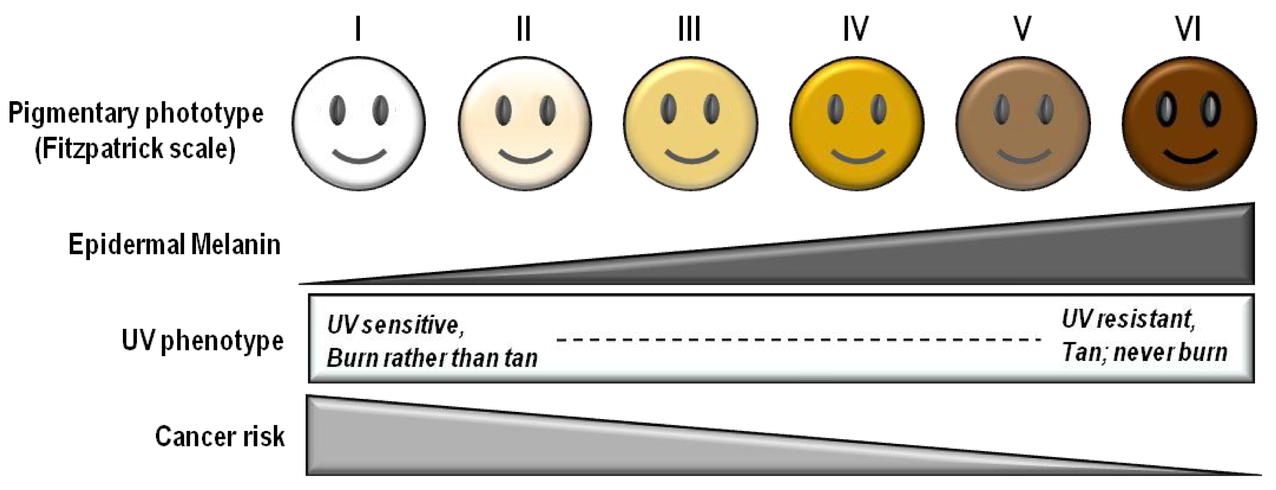
Classification of skin color and response to UV light
The Fitzpatrick scale (also Fitzpatrick skin typing test; or Fitzpatrick phototyping scale) is a numerical classification schema for human skin color. It was developed in 1975 by American dermatologist Thomas B. Fitzpatrick as a way to estimate the response of different types of skin to ultraviolet (UV) light. It was initially developed on the basis of skin color to measure the correct dose of UVA for PUVA therapy, and when the initial testing based only on hair and eye color resulted in too high UVA doses for some, it was altered to be based on the patient's reports of how their skin responds to the sun; it was also extended to a wider range of skin types. The Fitzpatrick scale remains a recognized tool for dermatological research into human skin pigmentation.
The following table shows the six categories of the Fitzpatrick scale in relation to the 36 categories of the older von Luschan scale:
| von Luschan | Fitzpatrick | Monk | Characteristics |
|---|---|---|---|
| 1 | I | 1 | |
| 2 | |||
| 3 | |||
| 4 | 2 | ||
| 5 | |||
| 6 | |||
| 7 | II | 3 | |
| 8 | |||
| 9 | 4 | ||
| 10 | |||
| 11 | |||
| 12 | |||
| 13 | 5 | ||
| 14 | III | Sometimes mild burn, tans uniformly (golden honey or olive); light intermediate, or dark-skinned European | |
| 15 | |||
| 16 | 6 | ||
| 17 | |||
| 18 | |||
| 19 | |||
| 20 | |||
| 21 | IV | 7 | |
| 22 | |||
| 23 | |||
| 24 | 8 | ||
| 25 | |||
| 26 | |||
| 27 | |||
| 28 | V | 9 | |
| 29 | |||
| 30 | 10 | ||
| 31 | |||
| 32 | |||
| 33 | |||
| 34 | |||
| 35 | VI | Never burns (deeply pigmented dark brown to darkest brown); very dark or "black" type | |
| 36 |
Emoji modifiers
Main article: Emoji#Skin color, Miscellaneous Symbols and Pictographs#Emoji modifiers
The Fitzpatrick scale is also the basis of skin color in emoji, with five modifiers according to the Fitzpatrick scale (types and merged).
Eurocentric bias
The Fitzpatrick scale has been criticized for its Eurocentric bias and insufficient representation of global skin color diversity. The scale originally was developed for classifying "white skin" in response to solar radiation, and initially included only four categories focused on white skin, with "brown" and "black" skin types (V and VI) added as an afterthought.
The scale's methodology, relying on self-reporting of skin color, sunburn, and sun tanning response, fails to capture the broad spectrum of skin reflectance. Studies demonstrate that European populations have the narrowest skin color variation, whereas groups categorized as 'brown' or 'black' exhibit a much wider range.
The efficacy of the Fitzpatrick scale even among white-skinned individuals has been argued to be questionable, since studies such as that on a Dutch student population have found it inadequate for categorizing, challenging its appropriateness for investigating the relationship between sunburn tendency and tanning ability.
The Fitzpatrick scale's Eurocentric orientation and its limitations in accurately representing global skin color diversity, along with similar biases in classifying other phenotypic traits, have been argued to require more inclusive and scientifically valid categorizations in dermatological and genetic research.
References
References
- (7 June 2013). "UV Radiation and the Skin". International Journal of Molecular Sciences.
- Fitzpatrick, T. B. (1975). "Soleil et peau" [Sun and skin]. ''Journal de Médecine Esthétique'' (in French) (2): 33–34
- Fitzpatrick, T.B.. (1988). "The validity and practicality of sun-reactive skin types i through vi". Archives of Dermatology.
- Pathak, M. A.; Jimbow, K.; Szabo, G.; Fitzpatrick, T. B. (1976). "Sunlight and melanin pigmentation". In Smith, K. C. (ed.): ''Photochemical and photobiological reviews'', Plenum Press, New York. pp. 211–39{{ISBN?
- Fitzpatrick, T. B. (1986). "Ultraviolet-induced pigmentary changes: Benefits and hazards", ''Therapeutic Photomedicine'', Karger, vol. 15 of "Current Problems in Dermatology", pp. 25–38
- (13 May 2008). "The Fitzpatrick Skin Type Classification Scale". Skin Inc..
- "Fitzpatrick Skin Type". Australian Radiation Protection and Nuclear Safety Agency.
- (9 March 2020). "What Is Golden Skin Tone? (With Pictures)".
- Lasisi, Tina. (2021-03-05). "The constraints of racialization: How classification and valuation hinder scientific research on human variation". Wiley.
- (2017-11-17). "Loci associated with skin pigmentation identified in African populations". American Association for the Advancement of Science (AAAS).
- (2017). "An Unexpectedly Complex Architecture for Skin Pigmentation in Africans". Elsevier BV.
- Rampen, Frans H. J.. (1988-06-01). "Unreliability of Self-reported Burning Tendency and Tanning Ability". American Medical Association (AMA).
This article was imported from Wikipedia and is available under the Creative Commons Attribution-ShareAlike 4.0 License. Content has been adapted to SurfDoc format. Original contributors can be found on the article history page.
Ask Mako anything about Fitzpatrick scale — get instant answers, deeper analysis, and related topics.
Research with MakoFree with your Surf account
Create a free account to save articles, ask Mako questions, and organize your research.
Sign up freeThis content may have been generated or modified by AI. CloudSurf Software LLC is not responsible for the accuracy, completeness, or reliability of AI-generated content. Always verify important information from primary sources.
Report