From Surf Wiki (app.surf) — the open knowledge base
Fiskerton, Nottinghamshire
Village in Nottinghamshire, England
Village in Nottinghamshire, England
| Field | Value |
|---|---|
| official_name | Fiskerton |
| country | England |
| region | East Midlands |
| post_town | SOUTHWELL |
| postcode_area | NG |
| postcode_district | NG25 |
| coordinates | |
| shire_district | Newark and Sherwood |
| shire_county | Nottinghamshire |
| population | 902 |
| population_ref | (2011 Census) |
| constituency_westminster | Newark |
| static_image_name | Fiskerton Mill, on the River Greet - geograph.org.uk - 1058347.jpg |
| static_image_caption | Fiskerton Mill, on the River Greet |
| civil_parish | Fiskerton cum Morton |
Fiskerton is a village in the civil parish of Fiskerton cum Morton, in the Newark and Sherwood district, in the county of Nottinghamshire, England. It is on the west bank of the River Trent about 3 miles southeast of Southwell. The waterfront is home to million-pound residential properties, previously residences of merchants and businessmen who commuted in the 1800s to nearby Nottingham by rail from Fiskerton Station.


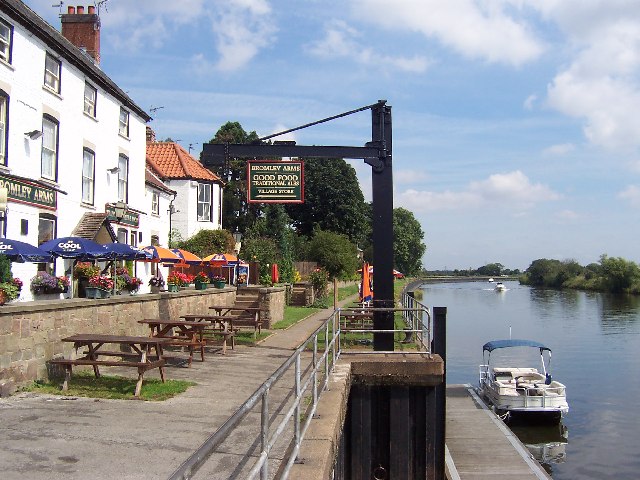
The village's location beside the Trent attracts walkers, picnickers and casual visitors in summer, centred on the riverside pub/restaurant (was called the Bromley Arms, renamed as The Bromley at Fiskerton in 2014) and used as a friendly café-type base also serving snacks and refreshments.
Toponymy
The word 'Fiskerton' contains the Old Norse word fiskari (or the Old English equivalent fiscere) meaning a fisherman, together with tun (Old English), a farmstead, resulting in 'Fishermen's farm/settlement'.
History
The 1086 Domesday entry for Fiskerton mentioned arable land enough for seven ploughs, two mills, a fishery, a ferry and 42 acres of meadow, pasture and woodland.
Fishing and agriculture remained important, but with close proximity to the River Trent, Fiskerton developed other industries. By 1842 there were wharfs, coal yards and warehouses along the river front together with a large malthouse owned by Newark brewer, James Hole. There was a watermill on the River Greet and a windmill on what is now Station Road.
An important development was the opening of the Nottingham to Lincoln railway in August 1846 with the station close to the village centre. By the end of the century, many wharfs and warehouses had disappeared, replaced by substantial residences like Fiskerton House and Fiskerton Manor on the riverside.
Fiskerton was formerly a township in the parish of Rolleston, from 1866 Fiskerton was a civil parish in its own right, on 25 March 1884 the parish was abolished to form "Fiskerton cum Morton", part also went to East Stoke. In 1881 the parish had a population of 283.
The large malthouse on The Wharf closed in 1904 when James Hole decided to concentrate business in Newark, the premises being converted into a grain-store, with the wharf used for loading and unloading materials destined for Southwell corn mill. In the 1970s it became a boat-building business and then in the 1980s a private residence.[[Image:Fiskerton 1907.jpg|right|thumb|Fiskerton Ferry from a tinted postcard c.1907 with the large redbrick building mostly-known as Bromley Arms]] Until the 1950s there was a ferry boat service over to the other side of the River Trent at Stoke Field. Fiskerton Mill lies on the River Greet a few hundred yards upstream from its junction with the River Trent.
Fiskerton Windmill was a wooden postmill with a substantial brick roundhouse, standing off Station Road. A mill was marked at this site on Chapman's map of 1774. The mill ceased working some time in the last quarter of the 19th century. Only the roundhouse now remains.
Richard Thomas Parker, who murdered his mother in Fiskerton in 1864, was the last person to be publicly hanged in Nottingham.
The village of Fiskerton is also known in Evangelical Christian circles as the homeplace of Henri and Connie Staples, who lived there from 1964 to 2000 and regularly held 'revival meetings' in the Methodist Chapel.
Residential development occurred within Fiskerton between 1960 and 2000s, including the Green Drive area in 2002, which gave the village a permanent open space known as the Village Green, culminating in Fiskerton being the commuter village of today.
Fiskerton Cell
The village may have been home to a small monastic cell of Augustinian Canons, dependent on the nearby Thurgarton Priory. It may have been founded around 1139, and Ralph D'Aincourt (son of Walter D'Aincourt) is listed as a possible founder.
Doubt has been cast, however, on whether it was truly a monastic cell or a just a chapel/church. Ralph D'Aincourt founded the nearby Thurgarton Priory circa 1119–39, and gave the village of Fiskerton to that priory as part of its endowment. It is thought, therefore, that Fiskerton was not a cell but just a village chapel, with the canons of Thurgarton Priory serving as priests. The cell/chapel was believed to be dedicated to Saint Mary. There are no remains and its location has been lost.
References
References
- [http://search.savills.com/property-detail/gbntrsnts120101 Fiskerton House was Manor Excess of £995,000] {{Webarchive. link. (19 August 2014 Savills property Retrieved 19 August 2014)
- "Bromley Arms, Fiskerton".
- [http://whatpub.com/pubs/NEK/9/bromley-at-fiskerton-fiskerton Whatpub guide] Retrieved 17 August 2014
- [http://www.newarkcamra.org.uk/spile/showPub.php?uid=9 Newark Camra Pub Guide: Bromley Arms, Fiskerton] Retrieved 17 August 2014
- J. Gover, A. Mawer & F. M. Stenton (eds.), ''Place Names of Nottinghamshire'' (Cambridge, 1940), p.164; A.D.Mills, ''Dictionary of English Place-Names'' (Oxford, 2002), p.139; E .Ekwall, ''Concise Oxford Dictionary of English Place-names'' (Oxford, 1960), p.180
- "History of Fiskerton, in Newark and Sherwood and Nottinghamshire". A Vision of Britain through Time.
- "Relationships and changes Fiskerton Tn/CP through time". A Vision of Britain through Time.
- "Southwell Registration District". UKBMD.
- "Population statistics Fiskerton Tn/CP through time". [[A Vision of Britain through Time]].
- [http://www.fiskertoncummorton.co.uk/local-history/growth-of-fiskerton Growth of Fiskerton, Fiskerton cum Morton] Retrieved 17 August 2014
- "Pub Walks in Nottinghamshire - Morton, Fiskerton, Bleasby and the River Trent".
- http://www.igreens.org.uk/fiskerton_mill.htm {{Webarchive. link. (13 November 2007 ''Fiskerton mill on the river Greet'' (pictures))
- Shaw, T. (1995). ''Windmills of Nottinghamshire''. Page 21. Nottingham: Nottinghamshire County Council. {{ISBN. 0-900986-12-3
- "Connie Staples".
- "Henri's Revivals Fiskerton - Glory Meetings in Nottinghamshire, UK - Home".
- "History".
- Cobbett, William. (1827). "A History of the Protestant "Reformation," in England and Ireland".
- [http://www.british-history.ac.uk/report.aspx?compid=40092 Houses of Austin canons: The priory of Shurgarton], ''Victoria County History: A History of the County of Nottingham: Volume 2'', William Page (ed), 1910
- [http://www.pastscape.org.uk/hob.aspx?hob_id=322463 MONUMENT NO. 322463], ''[[English Heritage]]: PastScape''
- [http://www.pastscape.org.uk/hob.aspx?hob_id=322426 ST MARYS CHAPEL], ''[[English Heritage]]: PastScape''
This article was imported from Wikipedia and is available under the Creative Commons Attribution-ShareAlike 4.0 License. Content has been adapted to SurfDoc format. Original contributors can be found on the article history page.
Ask Mako anything about Fiskerton, Nottinghamshire — get instant answers, deeper analysis, and related topics.
Research with MakoFree with your Surf account
Create a free account to save articles, ask Mako questions, and organize your research.
Sign up freeThis content may have been generated or modified by AI. CloudSurf Software LLC is not responsible for the accuracy, completeness, or reliability of AI-generated content. Always verify important information from primary sources.
Report