From Surf Wiki (app.surf) — the open knowledge base
Final Solution
Nazi plan for the genocide of Jews

Nazi plan for the genocide of Jews
| Field | Value |
|---|---|
| name | Final Solution |
| image | Heydrich-Endlosung.jpg |
| image_size | 230px |
| caption | Follow-up letter from Reinhard Heydrich to the German diplomat Martin Luther asking for administrative assistance in the implementation of the Final Solution, 26 February 1942 |
| AKA | Endlösung der Judenfrage |
| location | German-occupied Europe |
| date | 1941–1945 |
| incident_type | Genocide |
| perpetrators | |
| participants | |
| organizations | |
| camp | |
| ghetto | |
| victims | |
| survivors | |
| witnesses | |
| documentation | |
| memorials | |
| notes |
the Nazi German policy
The Final Solution or the Final Solution to the Jewish Question was a plan orchestrated by Nazi Germany during World War II for the genocide of individuals they defined as Jews. The "Final Solution to the Jewish question" was the official code name for the murder of all Jews within reach, which was not restricted to the European continent. This policy of deliberate and systematic genocide starting across German-occupied Europe was formulated in procedural and geopolitical terms by Nazi leadership in January 1942 at the Wannsee Conference held near Berlin, and culminated in the Holocaust, which saw the murder of 90% of Polish Jews, and two-thirds of the Jewish population of Europe.
The nature and timing of the decisions that led to the Final Solution is an intensely researched and debated aspect of the Holocaust. The program evolved during the first 25 months of war leading to the attempt at "murdering every last Jew in the German grasp". Christopher Browning, a historian specializing in the Holocaust, wrote that most historians agree that the Final Solution cannot be attributed to a single decision made at one particular point in time. "It is generally accepted the decision-making process was prolonged and incremental." In 1940, following the Fall of France, Adolf Eichmann devised the Madagascar Plan to move Europe's Jewish population to the French colony, but the plan was abandoned for logistical reasons, mainly the Allied naval blockade. There were also preliminary plans to deport Jews to Palestine and Siberia. Raul Hilberg wrote that, in 1941, in the first phase of the mass-murder of Jews, the mobile killing units began to pursue their victims across occupied eastern territories; in the second phase, stretching across all of German-occupied Europe, the Jewish victims were sent on death trains to centralized extermination camps built for the purpose of systematic murder of Jews.
Background
The term "Final Solution" was a euphemism used by the Nazis to refer to their plan for the annihilation of the Jewish people. Some historians argue that the usual tendency of the German leadership was to be extremely guarded when discussing the Final Solution. For example, Mark Roseman wrote that euphemisms were "their normal mode of communicating about murder". However, Jeffrey Herf has argued that the role of euphemisms in Nazi propaganda has been exaggerated, and in fact Nazi leaders often made direct threats against Jews. For example, during his speech of 30 January 1939, Hitler threatened "the annihilation of the Jewish race in Europe".
From gaining power in January 1933 until the outbreak of war in September 1939, the Nazi persecution of the Jews in Germany was focused on intimidation, expropriating their money and property, and encouraging them to emigrate. In 1936, the Bureau of Romani Affairs in Munich was renamed to the Center for Combating the Gypsy Menace. Introduced at the end of 1937, the "final solution of the Gypsy Question" entailed round-ups, expulsions, and incarceration of Romani in concentration camps built at, until this point, Dachau, Buchenwald, Flossenbürg, Mauthausen, Natzweiler, Ravensbruck, Taucha and Westerbork. After the Anschluss with Austria in 1938, Central Offices for Jewish Emigration were established in Vienna and Berlin to increase Jewish emigration, without covert plans for their forthcoming annihilation.
The outbreak of war and the invasion of Poland brought a population of 3.5 million Polish Jews under the control of the Nazi and Soviet security forces, and marked the start of the Holocaust in Poland. In the German-occupied zone of Poland, Jews were forced into hundreds of makeshift ghettos, pending other arrangements.

In April 1941, the German agriculture and interior ministries designated the SS as an authorized applier of Zyklon B, which meant they were able to use it without any further training or governmental oversight. The launch of Operation Barbarossa in June 1941 coincided with the German top echelon's newfound intent to pursue Hitler's new anti-Semitic plan to eradicate, rather than expel, Jews. Hitler's earlier ideas about forcible removal of Jews from the German-controlled territories to achieve Lebensraum were abandoned after the failure of the air campaign against Britain and the Allied naval blockade of Germany. Reichsführer-SS Heinrich Himmler became the chief architect of a new plan, which came to be called The Final Solution to the Jewish question. On 31 July 1941, Reichsmarschall Hermann Göring wrote to Reinhard Heydrich (Himmler's deputy and chief of the RSHA), authorising him to make the "necessary preparations" for a "total solution of the Jewish question" and coordinate with all affected organizations. Göring also instructed Heydrich to submit concrete proposals for the implementation of the new projected goal.
Broadly speaking, the extermination of Jews was carried out in two major operations. With the onset of Operation Barbarossa, mobile killing units of the SS, the Einsatzgruppen, and Order Police battalions were dispatched to the occupied Soviet Union for the express purpose of murdering all Jews. During the early stages of the invasion, Himmler himself visited Białystok at the beginning of July 1941, and requested that, "as a matter of principle, any Jew" behind the German-Soviet frontier was to be "regarded as a partisan". His new orders gave the SS and police leaders full authority for the mass-murder behind the front lines. By August 1941, all Jewish men, women, and children were shot. In the second phase of annihilation, the Jewish inhabitants of central, western, and south-eastern Europe were transported by Holocaust trains to camps with newly built gassing facilities. Raul Hilberg wrote: "In essence, the killers of the occupied USSR moved to the victims, whereas outside this arena, the victims were brought to the killers. The two operations constitute an evolution not only chronologically, but also in complexity." Massacres of about one million Jews occurred before plans for the Final Solution were fully implemented in 1942, but it was only with the decision to annihilate the entire Jewish population that extermination camps such as Auschwitz II Birkenau and Treblinka were fitted with permanent gas chambers to murder large numbers of Jews in a relatively short period of time.
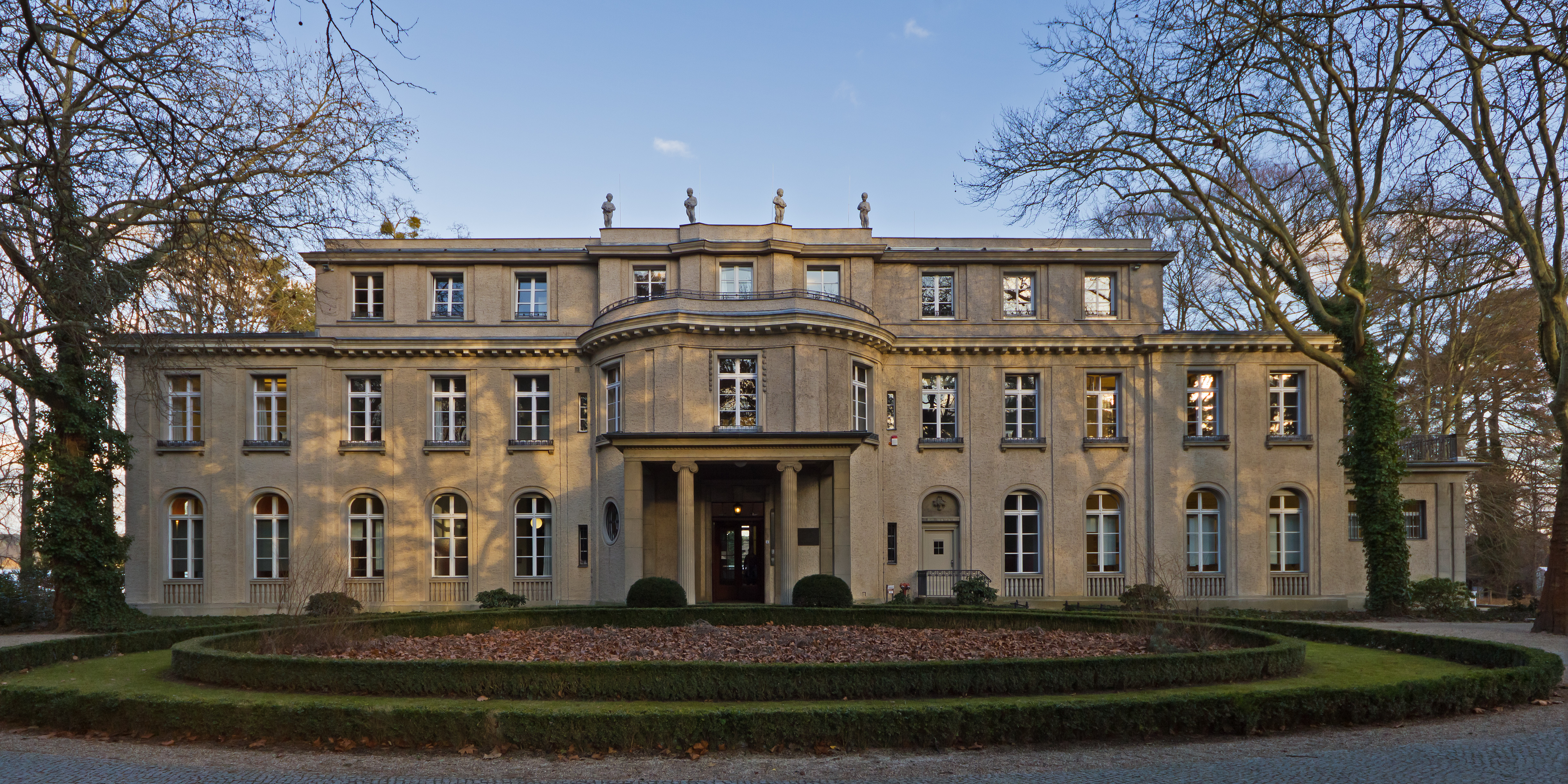
The plans to exterminate all the Jews of Europe were formalized at the Wannsee Conference, held at an SS guesthouse near Berlin, on 20 January 1942. The conference was chaired by Heydrich and attended by 15 senior officials of the Nazi Party and the German government. Most of those attending were representatives of the Interior Ministry, the Foreign Ministry, and the Justice Ministry, including Ministers for the Eastern Territories. At the conference, Heydrich indicated that approximately 11,000,000 Jews in Europe would fall under the provisions of the "Final Solution". This figure included not only Jews residing in Axis-controlled Europe, but also the Jewish populations of the United Kingdom and of neutral nations (Switzerland, Ireland, Sweden, Spain, Portugal, and European Turkey). it was too late to serve as evidence during the first Nuremberg Trial, but was used by prosecutor General Telford Taylor in the subsequent Nuremberg Trials.
After the end of World WarII, surviving archival documents provided a clear record of the Final Solution policies and actions of Nazi Germany. They included the Wannsee Conference Protocol, which documented the co-operation of various German state agencies in the SS-led Holocaust, as well as some 3,000 tons of original German records captured by Allied armies, including the Einsatzgruppen reports, which documented the progress of the mobile killing units assigned, among other tasks, to murder Jewish civilians during the attack on the Soviet Union in 1941. The evidential proof which documented the mechanism of the Holocaust was submitted at Nuremberg.
Phase one: death squads of Operation Barbarossa
Main article: Einsatzgruppen, Einsatzgruppen reports, Order Police battalions}}{{See also, War crimes of the Wehrmacht, Clean Wehrmacht
The Nazi invasion of the Soviet Union codenamed Operation Barbarossa, which commenced on 22 June 1941, set in motion a "war of annihilation" which quickly opened the door to the systematic mass murder of European Jews. For Hitler, Bolshevism was merely "the most recent and most nefarious manifestation of the eternal Jewish threat". On 3 March 1941, Wehrmacht Joint Operations Staff Chief Alfred Jodl repeated Hitler's declaration that the "Jewish-Bolshevik intelligentsia would have to be eliminated" and that the forthcoming war would be a confrontation between two completely opposing cultures. In May 1941, Gestapo leader Heinrich Müller wrote a preamble to the new law limiting the jurisdiction of military courts in prosecuting troops for criminal actions because: "This time, the troops will encounter an especially dangerous element from the civilian population, and therefore, have the right and obligation to secure themselves."
Himmler and Heydrich assembled a force of about 3,000 men from Security Police, Gestapo, Kripo, SD, and the Waffen-SS, as the so-called "special commandos of the security forces" known as the Einsatzgruppen, to eliminate both communists and Jews in occupied territories. These forces were supported by 21 battalions of Orpo Reserve Police under Kurt Daluege, adding up to 11,000 men. The explicit orders given to the Order Police varied between locations, but for Police Battalion 309 participating in the first mass murder of 5,500 Polish Jews in the Soviet-controlled Białystok (a Polish provincial capital), Major Weiss explained to his officers that Barbarossa is a war of annihilation against Bolshevism, and that his battalions would proceed ruthlessly against all Jews, regardless of age or sex.
After crossing the Soviet demarcation line in 1941, what had been regarded as exceptional in the Greater Germanic Reich became a normal way of operating in the east. The crucial taboo against the murder of women and children was breached not only in Białystok but also in Gargždai in late June. By July, significant numbers of women and children were being murdered behind all front-lines not only by the Germans but also by the local Ukrainian and Lithuanian auxiliary forces. On 29 July 1941, at a meeting of SS officers in Vileyka (Polish Wilejka, now Belarus), the Einsatzgruppen had been given a dressing-down for their low execution figures. Heydrich himself issued an order to include the Jewish women and children in all subsequent shooting operations. Accordingly, by the end of July the entire Jewish population of Vileyka, men, women and children, were murdered. Around 12 August, no less than two-thirds of the Jews shot in Surazh were women and children of all ages. In late August 1941 the Einsatzgruppen murdered 23,600 Jews in the Kamianets-Podilskyi massacre. A month later, the largest mass shooting of Soviet Jews took place on 29–30 September in the ravine of Babi Yar, near Kyiv, where more than 33,000 Jewish people of all ages were systematically machine-gunned. In mid-October 1941, HSSPF South, under the command of Friedrich Jeckeln, had reported the indiscriminate murder of more than 100,000 people.
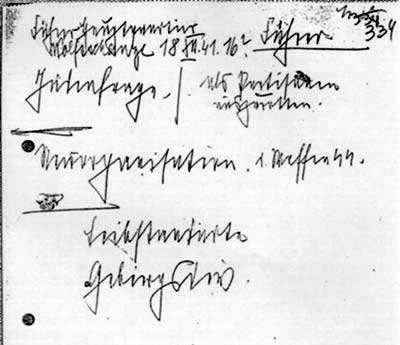
By the end of December 1941, before the Wannsee Conference, over 439,800 Jewish people had been murdered, and the Final Solution policy in the east became common knowledge within the SS. Entire regions were reported "free of Jews" by the Einsatzgruppen. Addressing his district governors in the General Government on 16 December 1941, Governor-General Hans Frank said: "But what will happen to the Jews? Do you believe they will be lodged in settlements in Ostland? In Berlin, we were told: why all this trouble; we cannot use them in the Ostland or the Reichskommissariat either; liquidate them yourselves!" Two days later, Himmler recorded the outcome of his discussion with Hitler. The result was: "als Partisanen auszurotten" ("exterminate them as partisans"). Israeli historian Yehuda Bauer wrote that the remark is probably as close as historians will ever get to a definitive order from Hitler for the genocide carried out during the Holocaust. Within two years, the total number of shooting victims in the east had risen to between 618,000 and 800,000 Jews.
''Bezirk Bialystok'' and ''Reichskommissariat Ostland''
Several scholars have suggested that the Final Solution began in the newly formed district of Bezirk Bialystok. The German army took over Białystok within days. On Friday, 27 June 1941, the Reserve Police Battalion 309 arrived in the city and set the Great Synagogue on fire with hundreds of Jewish men locked inside. The burning of the synagogue was followed by a frenzy of murders both inside the homes around the Jewish neighbourhood of Chanajki, and in the city park, lasting until night time. The next day, some 30 wagons of dead bodies were taken to mass graves. As noted by Browning, the murders were led by a commander "who correctly intuited and anticipated the wishes of his Führer" without direct orders. For reasons unknown, the number of victims in the official report by Major Weis was cut in half. The next mass-shooting of Polish Jews within the newly formed Reichskommissariat Ostland took place in two days of 5–7 August in occupied Pińsk, where over 12,000 Jews were murdered by the Waffen SS, not the Einsatzgruppen. An additional 17,000 Jews perished there in a ghetto uprising crushed a year later with the aid of Belarusian Auxiliary Police.
An Israeli historian Dina Porat claimed that the Final Solution, i.e.: "the systematic overall physical extermination of Jewish communities one after the other—began in Lithuania" during the massive German chase after the Red Army across the Reichskommissariat Ostland. The subject of the Holocaust in Lithuania has been analysed by Konrad Kweit from USHMM who wrote: "Lithuanian Jews were among the first victims of the Holocaust [beyond the eastern borders of occupied Poland]. The Germans carried out the mass executions [...] signaling the beginning of the 'Final Solution'." About 80,000 Jews were murdered in Lithuania by October (including in formerly Polish Wilno) and about 175,000 by the end of 1941 according to official reports.
''Reichskommissariat Ukraine''
Within one week from the start of Operation Barbarossa, Heydrich issued an order to his Einsatzgruppen for the on-the-spot execution of all Bolsheviks, interpreted by the SS to mean all Jews. One of the first indiscriminate massacres of men, women, and children in Reichskommissariat Ukraine took the lives of over 4,000 Polish Jews in occupied Łuck on 2–4 July 1941, murdered by Einsatzkommando 4a assisted by the Ukrainian People's Militia. Formed officially on 20 August 1941, the Reichskommissariat Ukraine—stretching from prewar east-central Poland to Crimea—had become operational theatre of the Einsatzgruppe C. Within the Soviet Union proper, between 9 July 1941 and 19 September 1941 the city of Zhytomyr was made Judenfrei in three murder operations conducted by German and Ukrainian police in which 10,000 Jews perished. In the Kamianets-Podilskyi massacre of 26–28 August 1941 some 23,600 Jews were shot in front of open pits (including 14,000–18,000 people expelled from Hungary). After an incident in Bila Tserkva in which 90 small children left behind had to be shot separately, Blobel requested that Jewish mothers hold them in their arms during mass shootings. Long before the conference at Wannsee, 28,000 Jews were shot by SS and Ukrainian military in Vinnytsia on 22 September 1941, followed by the 29 September massacre of 33,771 Jews at Babi Yar. In Dnipropetrovsk, on 13 October 1941 some 10,000–15,000 Jews were shot. In the first days of January 1942 in Kharkiv, 12,000 Jews were murdered, but smaller massacres continued in this period on daily basis in countless other locations. In August 1942 in the presence of only a few German SS men over 5,000 Jews were massacred in Polish Zofjówka by the Ukrainian Auxiliary Police leading to the town's complete sweep from existence.
''Distrikt Galizien''
Historians find it difficult to determine precisely when the first concerted effort at annihilation of all Jews began in the last weeks of June 1941 during Operation Barbarossa.
The murders continued uninterrupted. On 12 October 1941, in Stanisławów, some 10,000–12,000 Jewish men, women, and children were shot at the Jewish cemetery by the German uniformed SS-men and Ukrainian Auxiliary Police during the so-called "" (de). The shooters began firing at 12 noon and continued without stopping by taking turns. There were picnic tables set up on the side with bottles of vodka and sandwiches for those who needed to rest from the deafening noise of gunfire. It was the single largest massacre of Polish Jews in Generalgouvernement prior to mass gassings of Aktion Reinhard, which commenced at Bełżec in March 1942. Notably, the extermination operations in Chełmno had begun on 8 December 1941, one-and-a-half months before Wannsee, but Chełmno—located in Reichsgau Wartheland—was not a part of Reinhard, and neither was Auschwitz-Birkenau functioning as an extermination center until November 1944 in Polish lands annexed by Hitler and added to Germany proper.
The conference at Wannsee gave impetus to the so-called second sweep of the Holocaust by the bullet in the east. Between April and July 1942 in Volhynia, 30,000 Jews were murdered in death pits with the help of dozens of newly formed Ukrainian Schutzmannschaft. Owing to good relations with the Ukrainian Hilfsverwaltung, these auxiliary battalions were deployed by the SS also in Russia Center, Russia South, and in Byelorussia; each with about 500 soldiers divided into three companies. They participated in the extermination of 150,000 Volhynian Jews alone, or 98 percent of the Jewish inhabitants of the entire region. In July 1942 the Completion of the Final Solution in the General Government territory which included Distrikt Galizien, was ordered personally by Himmler. He set the initial deadline for 31 December 1942.
Phase two: deportations to extermination camps
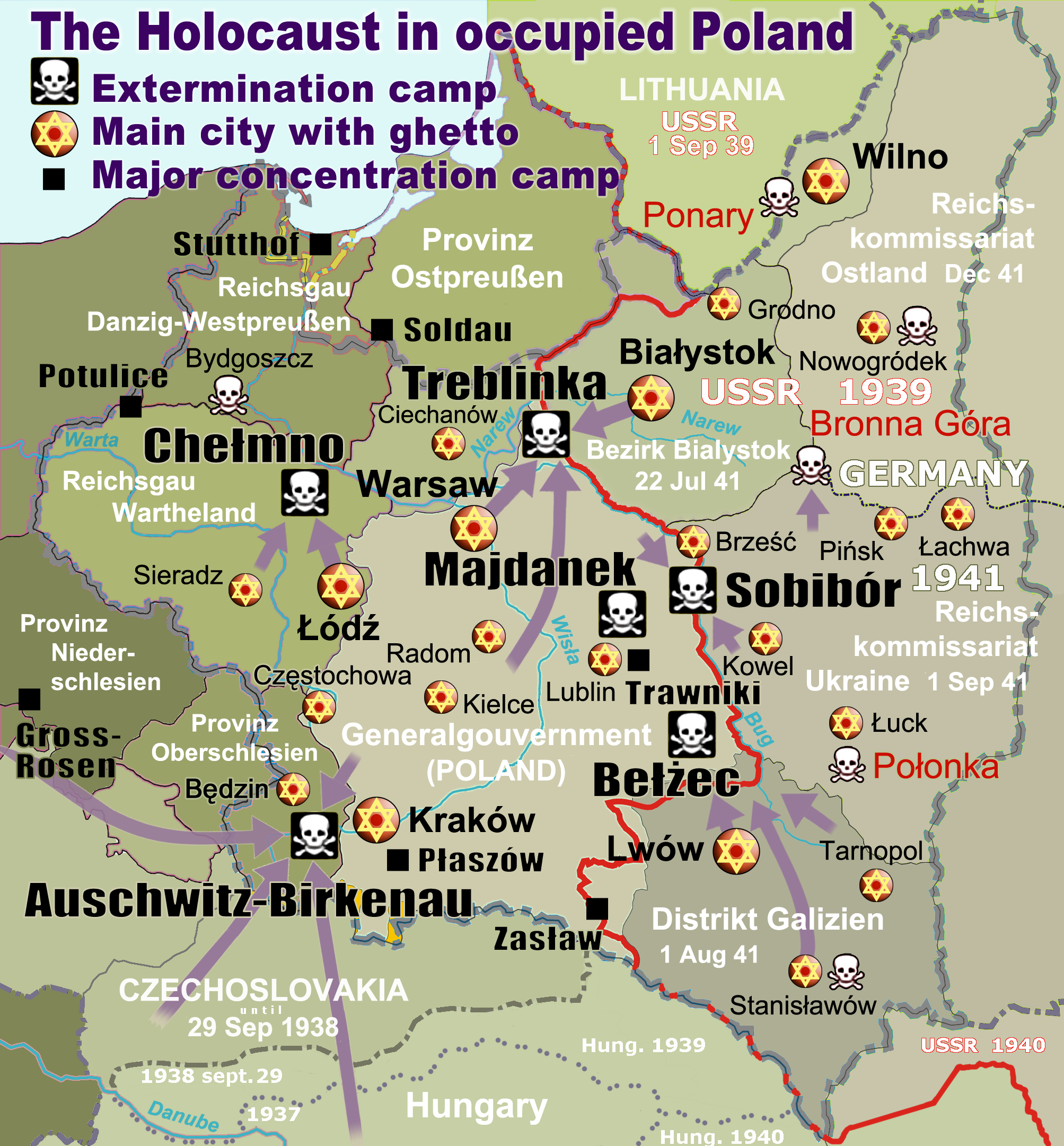
When the Wehrmacht invaded the Soviet Union in June 1941, the area of the General Government was enlarged by the inclusion of regions that had been annexed by the Soviet Union since the 1939 invasion. The murders of Jews from the Łódź Ghetto in the Warthegau district began in early December 1941 with the use of gas vans (approved by Heydrich) at the Kulmhof extermination camp. Victims were misled under the deceptive guise of "Resettlement in the East", organised by SS Commissioners, which was also tried and tested at Chełmno. By the time the European-wide Final Solution was formulated two months later, Heydrich's RSHA had already confirmed the effectiveness of industrial murder by exhaust fumes, and the strength of deception.
Construction work on the first killing centre at Bełżec in occupied Poland began in October 1941, three months before the Wannsee Conference. The new facility was operational by March the following year. By mid-1942, two more death camps had been built on Polish lands: Sobibór operational by May 1942, and Treblinka operational in July. From July 1942, the mass murder of Polish and foreign Jews took place at Treblinka as part of Operation Reinhard, the deadliest phase of the Final Solution. More Jews were murdered at Treblinka than at any other Nazi extermination camp apart from Auschwitz. By the time the mass killings of Operation Reinhard ended in 1943, roughly two million Jews in German-occupied Poland had been murdered. Their bodies were buried in mass graves initially. Both Treblinka and Bełżec were equipped with powerful crawler excavators from Polish construction sites in the vicinity, capable of most digging tasks without disrupting surfaces. Although other methods of extermination, such as the cyanic poison Zyklon B, were already being used at other Nazi killing centres such as Auschwitz, the Aktion Reinhard camps used lethal exhaust gases from captured tank engines.
The Holocaust by bullets (as opposed to the Holocaust by gas) went on in the territory of occupied Poland in conjunction with the ghetto uprisings, irrespective of death camps' quota. In two weeks of July 1942, the Słonim Ghetto revolt, crushed with the help of Latvian, Lithuanian, and Ukrainian Schutzmannschaft, cost the lives of 8,000–13,000 Jews. The second largest mass shooting (to that particular date) took place in late October 1942 when the insurgency was suppressed in the Pińsk Ghetto; over 26,000 men, women and children were shot with the aid of Belarusian Auxiliary Police before the ghetto's closure. During the suppression of the Warsaw Ghetto Uprising (the largest single revolt by Jews during World War II), 13,000 Jews were killed in action before May 1943. Numerous other uprisings were quelled without impacting the pre-planned Nazi deportations actions.
About two-thirds of the overall number of victims of the Final Solution were murdered before February 1943, which included the main phase of the extermination programme in the West launched by Eichmann on 11 June 1942 from Berlin. The Holocaust trains run by the Deutsche Reichsbahn and several other national railway systems delivered condemned Jewish captives from as far as Belgium, Bulgaria, France, Greece, Hungary, Italy, Moravia, Netherlands, Romania, Slovakia, and even Scandinavia. The cremation of exhumed corpses to destroy any evidence left behind began in early spring and continued throughout summer. The nearly completed clandestine programme of murdering all deportees was explicitly addressed by Heinrich Himmler in his Posen speeches made to the leadership of the Nazi Party on 4 October and during a conference in Posen (Poznań) of 6 October 1943 in occupied Poland. Himmler explained why the Nazi leadership found it necessary to murder Jewish women and children along with the Jewish men. The assembled functionaries were told that the Nazi state policy was "the extermination of the Jewish people" as such.
On 19 October 1943, five days after the prisoner revolt in Sobibór, Operation Reinhard was terminated by Odilo Globocnik on behalf of Himmler. The camps responsible for the murder of nearly 2,700,000 Jews were soon closed. Bełżec, Sobibór, and Treblinka were dismantled and ploughed over before spring. The operation was followed by the single largest German massacre of Jews in the entire war carried out on 3 November 1943; with approximately 43,000 prisoners shot one-by-one simultaneously in three nearby locations by the Reserve Police Battalion 101 hand-in-hand with the Trawniki men from Ukraine. Auschwitz alone had enough capacity to fulfill the Nazis' remaining extermination needs.
Auschwitz II Birkenau
Unlike Belzec, Sobibor, Treblinka, and Lublin-Majdanek, which were built in the occupied General Government territory inhabited by the largest concentrations of Jews, the killing centre at Auschwitz subcamp of Birkenau operated directly in Polish areas annexed by Nazi Germany. The new gas chambers at Bunker I were finished around March 1942 when the Final Solution was officially launched at Belzec. Until mid June, around 20,000 Silesian Jews were murdered there using Zyklon B. In July 1942, Bunker II became operational. In August, another 10,000–13,000 Polish Jews from Silesia were murdered, along with 16,000 French Jews declared 'stateless', and 7,700 Jews from Slovakia.
The infamous 'Gate of Death' at Auschwitz II for the incoming freight trains was built of brick and cement mortar in 1943, and the three-track rail spur was added. In May 1944, Auschwitz-Birkenau became the site of one of the two largest mass murder operations in modern history, after the Großaktion Warschau deportations of the Warsaw Ghetto inmates to Treblinka in 1942. It is estimated that until July 1944 approximately 320,000 Hungarian Jews were gassed at Birkenau in less than eight weeks. The entire operation was photographed by the SS. In total, between April and November 1944, Auschwitz II received over 585,000 Jews from over a dozen regions as far as Greece, Italy, and France, including 426,000 Jews from Hungary, 67,000 from Łódź, 25,000 from Theresienstadt, and the last 23,000 Jews from the General Government. Auschwitz was liberated by the Red Army on 27 January 1945, when the gassing had already stopped.
Historiographic debate about the decision
Historians disagree as to when and how the Nazi leadership decided that the European Jews should be exterminated. The controversy is commonly described as the functionalism versus intentionalism debate which began in the 1960s, and subsided thirty years later. In the 1990s, the attention of mainstream historians moved away from the question of top executive orders triggering the Holocaust and focused on factors that were overlooked earlier, such as personal initiative and ingenuity of countless functionaries in charge of the killing fields. No written evidence of Hitler ordering the Final Solution has ever been found to serve as a "smoking gun", and therefore, this one particular question remains unanswered.
Hitler made numerous predictions regarding the Holocaust of the Jews of Europe prior to the beginning of World WarII. During a speech given on 30 January 1939, on the sixth anniversary of his accession to power, Hitler said:
Raul Hilberg, in his book The Destruction of the European Jews, was the first historian to systematically document and analyse the Nazi project to murder every Jew in Europe. The book was initially published in 1961, and issued in an enlarged version in 1985.
Hilberg's analysis of the steps that led to the destruction of European Jews revealed that it was "an administrative process carried out by bureaucrats in a network of offices spanning a continent". Hilberg divides this bureaucracy into four components or hierarchies: the Nazi Party, the civil service, industry, and the Wehrmacht armed forces—but their cooperation is viewed as "so complete that we may truly speak of their fusion into a machinery of destruction". For Hilberg, the key stages in the destruction process were: definition and registration of the Jews; expropriation of property; concentration into ghettoes and camps; and, finally, annihilation. Hilberg gives an estimate of 5.1 million as the total number of Jews murdered. He breaks this figure down into three categories: Ghettoization and general privation: over 800,000; open-air shootings: over 1,300,000; extermination camps: up to 3,000,000.
With respect to the "functionalism versus intentionalism" debate about a master plan for the Final Solution, or the lack thereof, Hilberg posits what has been described as "a kind of structural determinism". Hilberg argues that "a destruction process has an inherent pattern" and the "sequence of steps in a destruction process is thus determined". If a bureaucracy is motivated "to inflict maximum damage upon a group of people", it is "inevitable that a bureaucracy—no matter how decentralized its apparatus or how unplanned its activities—should push its victims through these stages", culminating in their annihilation.
In his monograph, The Origins of the Final Solution: The Evolution of Nazi Jewish Policy, September 1939 – March 1942, Christopher Browning argues that Nazi policy toward the Jews was radicalized twice: in September 1939, when the invasion of Poland implied policies of mass expulsion and massive loss of Jewish lives; and in spring 1941, when preparation for Operation Barbarossa involved the planning of mass execution, mass expulsion, and starvation—to dwarf what had happened in Jewish Poland.
Browning believes that the "Final Solution as it is now understood—the systematic attempt to murder every last Jew within the German grasp" took shape during a five-week period, from 18 September to 25 October 1941. During this time, the sites of the first extermination camps were selected, different methods of murder were tested, Jewish emigration was forbidden, and 11 transports departed for Łódź as a temporary holding station. Of this period, Browning writes, "The vision of the Final Solution had crystallised in the minds of the Nazi leadership, and was being turned into reality." This was the peak of Nazi victories against the Soviet Army on the Eastern Front, and, according to Browning, the stunning series of German victories led to both an expectation that the war would soon be won, and the planning of the final destruction of the "Jewish-Bolshevik enemy".
Browning describes the creation of the extermination camps, which were responsible for the largest number of murders in the Final Solution, as bringing together three separate developments within Nazi Germany: the concentration camps which had been established in Germany since 1933; an expansion of the gassing technology of the Nazi euthanasia programme to provide a murder technique of greater efficiency and psychological detachment; and the creation of "factories of death" to be fed endless streams of victims by mass uprooting and deportation that utilized the experience and personnel from earlier population resettlement programmes—especially the HSSPF and Adolf Eichmann's RSHA for "Jewish affairs and evacuations".
Peter Longerich argues that the search for a finite date on which the Nazis embarked upon the extermination of the Jews is futile, in his book Holocaust: The Nazi Persecution and Murder of the Jews (2011). Longerich writes: "We should abandon the notion that it is historically meaningful to try to filter the wealth of available historical material and pick out a single decision" that led to the Holocaust.
Timothy Snyder writes that Longerich "grants the significance of Greiser's murder of Jews by gas at Chełmno in December 1941", but also detects a significant moment of escalation in spring 1942, which includes "the construction of the large death factory at Treblinka for the destruction of the Warsaw Jews, and the addition of a gas chamber to the concentration camp at Auschwitz for the murder of the Jews of Silesia". Longerich suggests that it "was only in the summer of 1942, that mass killing was finally understood as the realization of the Final Solution, rather than as an extensively violent preliminary to some later program of slave labor and deportation to the lands of a conquered USSR". For Longerich, to see mass-murder as the Final Solution was an acknowledgement by the Nazi leadership that there would not be a German military victory over the USSR in the near future.
David Cesarani emphasises the improvised, haphazard nature of Nazi policies in response to changing war time conditions in his overview, Final Solution: The Fate of the European Jews 1933–49 (2016). "Cesarani provides telling examples", wrote Mark Roseman, "of a lack of coherence and planning for the future in Jewish policy, even when we would most expect it. The classic instance is the invasion of Poland in 1939, when not even the most elementary consideration had been given to what should happen to Poland's Jews either in the shorter or longer term. Given that Poland was home to the largest Jewish population in the world, and that, in a couple of years, it would house the extermination camps, this is remarkable."
Whereas Browning places the Nazi plan to exterminate the Jews in the context of the Wehrmacht victories on the Eastern front, Cesarani argues that the German subsequent realisation that there would be no swift victory over the Soviet Union "scuppered the last territorial 'solution' still on the table: expulsion to Siberia". Germany's declaration of war on the United States on 11 December 1941, "meant that holding European Jews hostage to deter the US from entering the conflict was now pointless". Cesarani concludes, the Holocaust "was rooted in anti-Semitism, but it was shaped by war". The fact that the Nazis were, ultimately, so successful in murdering between five and six million Jews was not due to the efficiency of Nazi Germany or the clarity of their policies. "Rather, the catastrophic rate of killing was due to German persistence ... and the duration of the murderous campaigns. This last factor was largely a consequence of allied military failure."

The entry of the U.S. into the War is also crucial to the time-frame proposed by Christian Gerlach, who argued in his 1997 thesis that the Final Solution decision was announced on 12 December 1941, when Hitler addressed a meeting of the Nazi Party (the Reichsleiter) and of regional party leaders (the Gauleiter).{{Efn|Commenting on Gerlach, Christopher Browning writes: "What he interprets as Hitler's basic decision, I see as an official initiation of party leaders to a decision taken several months earlier." }} The day after Hitler's speech, on 13 December 1941, Joseph Goebbels wrote in his diary:
Cesarani notes that by 1943, as the military position of the German forces deteriorated, the Nazi leadership became more openly explicit about the Final Solution. In March, Goebbels confided to his diary: "On the Jewish question especially, we are in it so deeply that there is no getting out any longer. And that is a good thing. Experience teaches that a movement and a people who have burned their bridges fight with much greater determination and fewer constraints than those that have a chance of retreat."
When Himmler addressed senior SS personnel and leading members of the regime in the Posen speeches on 4 October 1943, he used "the fate of the Jews as a sort of blood bond to tie the civil and military leadership to the Nazi cause".
Notes
References
Bibliography
- Newer edition by Univ. of Nebraska Press / Yad Vashem 2007.
- Reitlinger, Gerald Roberts. 1953. The Final Solution: The Attempt to Exterminate the Jews of Europe 1939–1945. London: Valentine Mitchell.
References
- Browning, Christopher. (2007). "The Origins of the Final Solution: The Evolution of Nazi Jewish Policy, September 1939 – March 1942". University of Nebraska Press.
- "Wannsee Conference and the Final Solution". [[United States Holocaust Memorial Museum]].
- (1996). "The World Reacts to the Holocaust". JHU Press.
- Holocaust Encyclopedia. "'Final Solution': Overview". United States Holocaust Memorial Museum.
- {{harvp. Browning. 2004
- Ian Hancock. (2010). "The Routledge History of the Holocaust". Taylor & Francis.
- {{harvp. Browning. 2004
- {{harvp. Roseman. 2002
- (1989). "Out of the Inferno: Poles Remember the Holocaust". [[University Press of Kentucky]].
- Holocaust Encyclopedia. "German Invasion of Poland: Jewish Refugees, 1939". United States Holocaust Memorial Museum.
- Hayes, Peter. (2004). "From Cooperation to Complicity: Degussa in the Third Reich". Cambridge University Press.
- Grenke, Arthur. (2005). "God, Greed, and Genocide: The Holocaust Through the Centuries". New Academia Publishing.
- Browning, Christopher R.. (1995). "The Path to Genocide: Essays on Launching the Final Solution". Cambridge University Press.
- Browning, Christopher R.. (2007). "The Origins of the Final Solution: The Evolution of Nazi Jewish Policy, September 1939 – March 1942". University of Nebraska Press.
- Göring, Hermann. (31 July 1941). "Authorization letter of Hermann Göring to Heydrich, 31 July 1941". House of the Wannsee Conference.
- {{harvp. Hilberg. 1985
- "Protocol of Conference on the final solution (Endlösung) of the Jewish question". House of the Wannsee Conference.
- Feig, Konnilyn G.. (1981). "Hitler's death camps: the sanity of madness". Holmes & Meier.
- "Combating Holocaust Denial: Evidence of the Holocaust Presented at Nuremberg". United States Holocaust Memorial Museum.
- Kay, Alex J.. (2016). "The Making of an SS Killer". Cambridge University Press.
- Yahil, Leni. (1991). "The Holocaust: The Fate of European Jewry, 1932–1945". Oxford University Press.
- Bauer, Yehuda. (2000). "Rethinking the Holocaust". Yale University Press.
- Markiewicz, Marcin. "Bezirk Białystok (in) ''Represje hitlerowskie wobec wsi białostockiej''". Biuro Edukacji Publicznej IPN.
- "Białystok – History". [[Virtual Shtetl]] [[Museum of the History of Polish Jews]].
- Boneh, Nachum. "The Holocaust and the Destruction of the Jews of Pinsk (4 July 1941 – 23 December 1942)". The Jewish Community of Pinsk.
- "Pińsk". [[Virtual Shtetl]].
- Porat, Dina. (2002). "The Final Solution: Origins and Implementation". Routledge.
- Kwiet, Konrad. (4 December 1995}} Published under the same title, but expanded in {{cite book). "Rehearsing for Murder: The Beginning of the Final Solution in Lithuania in June 1941". Peter Lang.
- Zimmerman, Joshua D.. (2015). "The Polish Underground and the Jews, 1939–1945". Cambridge University Press.
- Braham, Randolph L.. (2000). "The Politics of Genocide". Wayne State University Press.
- Lower, Wendy. (2006). "Nazi Empire-Building and the Holocaust in Ukraine". Univ of North Carolina Press.
- Sterling, Eric. (2005). "Life In The Ghettos During The Holocaust". Syracuse University Press.
- Yad Vashem. (2016). "Goering orders Heydrich to prepare the plan for the Final Solution of the Jewish Problem". The Holocaust Martyrs' and Heroes' Remembrance Authority.
- Desbois, Patrick. (2009). "Places of Massacres by German Task Forces between 1941–1943". TOS Gemeinde Tübingen.
- Berenbaum, Michael. (2002). "The Holocaust and History: The Known, the Unknown, the Disputed, and the Reexamined". Indiana University Press.
- (1992). ["The trial of Adolf Eichmann: record of proceedings in the District Court of Jerusalem"](https://books.google.com/books?id=i-7zAAAAMAAJ&q=Dnepropetrovsk}} ''Also in:'' {{cite book). Trust for the Publication of the Proceedings of the Eichmann Trial, in co-operation with the Israel State Archives, and Yad Vashem.
- Beit Tal. (2010). "Zofiówka". [[POLIN Museum of the History of Polish Jews]].
- Weiss, Jakob. (2011). "The Lemberg Mosaic". Alderbrook Press.
- Löw, Andrea. (10 June 2013). "Stanislawów (now Ivano-Frankivsk)". [[United States Holocaust Memorial Museum]].
- Pohl, Dieter. "Hans Krueger and the Murder of the Jews in the Stanislawow Region (Galicia)".
- "Operation Reinhard (Einsatz Reinhard)". United States Holocaust Memorial Museum.
- Pohl, Dieter. (2008). "The Shoah in Ukraine: History, Testimony, Memorialization". Indiana University Press.
- Eikel, Markus. (2013). "The Holocaust in Ukraine: New Sources and Perspectives". Center for Advanced Holocaust Studies, [[United States Holocaust Memorial Museum]].
- Wendel, Marcus. (9 June 2013). "Schutzmannschaft Bataillone". Axis History Books.
- Statiev, Alexander. (2010). "The Soviet Counterinsurgency in the Western Borderlands". Cambridge University Press.
- Lower, Wendy. (2011). "The Diary of Samuel Golfard and the Holocaust in Galicia". Rowman Altamira.
- (2003). "Ethnic Groups and Population Changes in Twentieth-century Central-Eastern Europe: History, Data, Analysis". M.E. Sharpe.
- Gutman, Israel. (1994). "Resistance: The Warsaw Ghetto Uprising". Houghton Mifflin.
- Beer, Mathias. (2015). "The Development of the Gas-Van in the Murdering of the Jews". Jewish Virtual Library.
- National Bełżec Museum. "Historia Niemieckiego Obozu Zagłady w Bełżcu". Muzeum-Miejsce Pamięci w Bełżcu.
- McVay, Kenneth. (1984). "The Construction of the Treblinka Extermination Camp". Jewish Virtual Library.org.
- Berenbaum, Michael. (2016). "Treblinka". Encyclopædia Britannica, Inc..
- (2001). "The Holocaust Encyclopedia". Yale University Press.
- "Belzec". United States Holocaust Memorial Museum.
- Carol Rittner, Roth, K.. (2004). "Pope Pius XII and the Holocaust". Continuum International Publishing Group.
- [[National Geographic Channel]]. (2013). "The Holocaust by bullets". NGC Europe Limited.
- Lawrence Bush. (28 June 2010). "June 29: The Slonim Massacres".
- Virtual Shtetl. (28 May 2008). "The Shoah in Ukraine: History, Testimony, Memorialization". Indiana University Press.
- SS [[Gruppenführer]] Jürgen Stroop. (May 1943). "Stroop Report".
- The Holocaust Encyclopedia. (2013). "Resistance in Ghettos". United States Holocaust Memorial Museum}} Notable examples include the [[Łuck Ghetto#Jewish uprising and the ghetto liquidation.
- Paula Lerner. (2007). "Statistical Report on the "Final Solution", known as the Korherr Report of 23 March 1943". German History in Documents and Images, GHDI.
- Leni Yahil. (1991). "The Holocaust: The Fate of European Jewry, 1932–1945". Oxford University Press.
- Ronald J. Berger. (2002). "Fathoming the Holocaust: A Social Problems Approach". Transaction Publishers.
- (31 December 1969). "Holocaust: The Trains". Aish.com Holocaust Studies.
- Connolly, Kate. (13 March 2007). "Letter proves Speer knew of Holocaust plan". The Guardian.
- (12 March 2012). "Himmler's Speech in Posen on 6 October 1944". Holocaust Controversies Reference Section }}; also (with differing translation) in {{cite web.
- Holocaust Encyclopedia. (1981). "Hitler's death camps: the sanity of madness". Holmes & Meier Publishers.
- Oxford Journals. (2001). "A New Document on the Deportation and Murder of Jews during "Einsatz Reinhardt" 1942". Oxford University Press.
- Katz, Alfred. (1970). "The Establishment of Ghettos in [occupied] Poland". Ardent Media.
- {{harvp. Longerich. 2010
- {{harvp. Browning. 2004
- (2022). ["Im Zentrum der Endlösung – Alltag in der Todesfabrik Auschwitz"](https://www.kulturkaufhaus.de/de/detail/ISBN 9783965890022/Greif-Gideon/Im-Zentrum-der-Endl%C3%B6sung). Tuebingen, TOS Verlag.
- Andrew Rawson. (2015). "Auschwitz: The Nazi Solution". Pen and Sword.
- (1981). "The Auschwitz Album". Random House.
- (1998). "Anatomy of the Auschwitz Death Camp". Indiana University Press.
- (2008). "Holocaust Historiography in Context: Emergence, Challenges, Polemics and Achievements". Berghahn Books.
- Hitler, Adolf. (30 January 1939). "Extract from the Speech by Hitler, 30 January 1939". YadVashem.org }} ''[Also in:]'' {{cite web.
- Browning, Christopher. (10 May 1987). "The Revised Hilberg". Museumoftolerance.
- {{harvp. Browning. 2004
- Snyder, Timothy. (23 June 2011). "A New Approach to the Holocaust". The New York Review of Books.
- (10 August 2016). "The last word".
- (16 June 2016). "Final Solution by David Cesarani review – the Holocaust on the hoof". The Guardian.
- [[s:Adolf Hitler's Declaration of War against the United States. Adolf Hitler's Declaration of War against the United States]] in Wikisource.
- Gerlach, Christian. (1999). "Kalkulierte Morde: die deutsche Wirtschafts- und Vernichtungspolitik in Weissrussland 1941 bis 1944". [[Hamburger Edition]].
- Aly, Götz. "December 12, 1941". Holocaust-history.org.
- McDonough, Frank. (2008). "The Holocaust". Palgrave Macmillan.
- Gord McFee. "When did Hitler decide on the Final Solution?". Holocaust-history.org.
- {{harvp. Cesarani. 2016
This article was imported from Wikipedia and is available under the Creative Commons Attribution-ShareAlike 4.0 License. Content has been adapted to SurfDoc format. Original contributors can be found on the article history page.
Ask Mako anything about Final Solution — get instant answers, deeper analysis, and related topics.
Research with MakoFree with your Surf account
Create a free account to save articles, ask Mako questions, and organize your research.
Sign up freeThis content may have been generated or modified by AI. CloudSurf Software LLC is not responsible for the accuracy, completeness, or reliability of AI-generated content. Always verify important information from primary sources.
Report