From Surf Wiki (app.surf) — the open knowledge base
Fifth column
Group of people who undermine a larger group from within
Group of people who undermine a larger group from within
A fifth column (or internal enemy) is a group of people who undermine a larger group or nation from within, usually in favor of an enemy group or another nation. The activities of a fifth column can be overt or clandestine. Forces gathered in secret can mobilize openly to assist an external attack. The term is also applied to organized actions by military personnel. Clandestine fifth column activities can involve acts of sabotage, disinformation, espionage or terrorism executed within defense lines by secret sympathizers with an external force.
History
Origin
The term "fifth column" originated in Spain (originally quinta columna) during the early phase of the Spanish Civil War. It gained popularity in the Republican media in early October 1936 and immediately started to spread abroad.
The exact origins of the term are not clear. Its first known appearance is in a secret telegram dated 30 September 1936, that was sent to Berlin by the German chargé d'affaires in Alicante, . In the telegram, he referred to an unidentified "supposed statement by Franco" that "is being circulated" (apparently in the Republican zone or in the Republican-held Levantine zone). This "supposed statement" held that Franco had claimed that there were four Nationalist columns approaching Madrid, and a fifth column waiting to attack from the inside. The telegram was part of the secret German diplomatic correspondence and was discovered long after the civil war.
The first identified public use of the term is in the 3 October 1936 issue of the Madrid Communist daily Mundo Obrero. In a front-page article, the party propagandist Dolores Ibárruri referred to a statement very similar (or identical) to the one that Völckers had referred to in his telegram, but attributed it to General Emilio Mola rather than to Franco. On the same day, the PCE activist Domingo Girón made a similar claim during a public rally. During the next few days, various Republican papers repeated the story, but with differing detail; some attributed the phrase to General Queipo de Llano, while later some Soviet propagandists would claim it was coined by José Enrique Varela. By mid-October, the media was already warning of the "famous fifth column".
Historians have never identified the original statement referred to by Völckers, Ibárruri, Girón, de Jong, and others. The transcripts of Francisco Franco's, Gonzalo Queipo de Llano's, and Emilio Mola's radio addresses have been published, but they do not contain the term, and no other original statement containing this phrase has ever surfaced. Australian journalist Noel Monks, who took part in Mola's press conference on 28 October 1936, claimed that Mola referred to quinta columna on that day, but by that time the term had already been in use in the Republican press for more than three weeks.
Historiographic works offer differing perspectives on authorship of the term. Many scholars have no doubt about Mola's role and refer to "fifth column" as "a term coined in 1936 by General Emilio Mola", though they acknowledge that his exact statement cannot be verified. In some sources, Mola is named as a person who had used the term during an impromptu press interview, and different—though detailed—versions of the exchange are offered.One version is {{Langx |es|"¿Cómo es, general Mola, que piensa usted tomar Madrid con cuatro columnas?; no, no tengo cuatro; son cinco las columnas que tengo, porque en Madrid hay una quinta columna." |es|"No tiene usted sino cuatro columnas, general; Tengo la "Quinta Columna" en Madrid"
Some writers, mindful of the origin of the phrase, use it only in reference to military operations rather than the broader and less well-defined range of activities that sympathizers might engage in to support an anticipated attack.
Second World War
The notion of a fifth column caught the popular imagination of the public across Europe at the start of the Second World War, especially when people were faced with the rapid occupation of Norway and Denmark by the Nazis, and then the collapse of Belgium, France and the Netherlands. The fear of betrayal was heightened by the rapid fall of France in 1940, which some blamed on internal weakness and a pro-German fifth column. Reports of treachery were common, and when the French premier Paul Reynaud announced that "the bridges over the Meuse had been betrayed", a BBC employee wrote, "I have no doubt that German thoroughness has succeeded in planting a fifth column at vulnerable points." On 23 May 1940, the month after Germany invaded France, the British government under newly appointed prime minister Winston Churchill banned the British Union of Fascists under the Treachery Act 1940. A series of photos run in the June 1940 issue of Life magazine warned of "signs of Nazi Fifth Column Everywhere". In a speech to the House of Commons on 4 June, Churchill reassured MPs that "Parliament has given us the powers to put down Fifth Column activities with a strong hand." In July 1940, Time magazine referred to talk of a fifth column as a "national phenomenon".
In August 1940, The New York Times mentioned "the first spasm of fear engendered by the success of fifth columns in less fortunate countries". One report identified participants in Nazi "fifth columns" as "partisans of authoritarian government everywhere", citing Poland, Czechoslovakia, Norway, and the Netherlands. During the Nazi invasion of Norway, the head of the Norwegian fascist party, Vidkun Quisling, proclaimed the formation of a new fascist government in control of Norway, with himself as Prime Minister, by the end of the first day of fighting. The word "quisling" soon became a byword for "collaborator" or "traitor".
The New York Times on 11 August 1940, featured three editorial cartoons using the term. John Langdon-Davies, a British journalist who covered the Spanish Civil War, wrote an account called The Fifth Column which was published the same year. In November 1940, Ralph Thomson, reviewing Harold Lavine's Fifth Column in America, a study of Communist and fascist groups in the US, in The New York Times, questioned his choice of that title: "the phrase has been worked so hard that it no longer means much of anything".

Immediately following the Japanese attack on Pearl Harbor, US Secretary of the Navy Frank Knox issued a statement that "the most effective Fifth Column work of the entire war was done in Hawaii with the exception of Norway". In a column published in The Washington Post, dated 12 February 1942, the columnist Walter Lippmann wrote of imminent danger from actions that might be taken by Japanese Americans. Titled "The Fifth Column on the Coast", he wrote of possible attacks that could be made along the West Coast of the United States that would amplify damage inflicted by a potential attack by Japanese naval and air forces. Suspicion about an active fifth column on the coast led eventually to the internment of Japanese Americans.
During the Japanese invasion of the Philippines, an article in the Pittsburgh Post-Gazette in December 1941 said the indigenous Moro Muslims were "capable of dealing with Japanese fifth columnists and invaders alike". Another in the Vancouver Sun the following month alleged that the large population of Japanese immigrants in Davao in the Philippines welcomed the invasion: "the first assault on Davao was aided by numbers of Fifth Columnists–residents of the town". However, postwar analysis of both Japanese and American military records, including the interrogation of surviving Japanese officers, fail to support the claims of a Japanese fifth column existing in the Philippines prior to the outbreak of hostilities.
Later usage
- German minority organizations in Czechoslovakia formed the Sudeten German Free Corps, which aided Nazi Germany. Some claimed they were "self-defense formations" created in the aftermath of World War I and unrelated to the German invasion two decades later. More often their origins were discounted and they were defined by the role they played in 1938–39: "The same pattern was repeated in Czechoslovakia. Henlein's Free Corps played in that country the part of fifth column".
- The United Front Work Department has been used by the Chinese government to influence elite individuals and organizations especially among Taiwanese and overseas Chinese communities around the world. UFWD has been accused of promoting pro-unification sentiment in Taiwan as well as election interference in some countries. In September 2024, Linda Sun, a staffer for New York governor Kathy Hochul was arrested for accusation of being a foreign agent due to her affiliation with UFWD affiliated organization that is Henan Association of Eastern America.
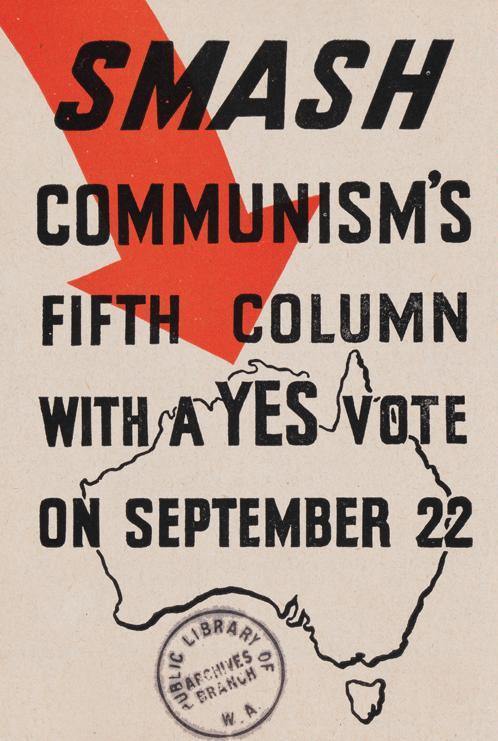
- In 1945, a document produced by the US Department of State compared the earlier efforts of Nazi Germany to mobilize the support of sympathizers in foreign nations to the superior efforts of the international communist movement at the end of World War II: "a communist party was in fact a fifth column as much as any [German] Bund group, except that the latter were crude and ineffective in comparison with the Communists". Arthur M. Schlesinger Jr., wrote in 1949: "the special Soviet advantage—the warhead—lies in the fifth column; and the fifth column is based on the local Communist parties".
- In 1979, Saddam Hussein, the President of Iraq, orchestrated a purge of political dissidents within the Ba'ath Party. Hussein claimed that he had uncovered a fifth column within the organization and ordered Muhyi Abdul-Hussein Mashhadi to confess his alleged involvement and that of 68 other politicians, who were promptly arrested. Twenty-two of the arrested, including Mashhadi, were executed.
- Zainichi Koreans living in Japan, particularly those affiliated with the organization Chongryun (which is itself affiliated with the government of North Korea) are sometimes seen as a "fifth column" by some Japanese, and have been the victims of verbal and physical attacks. These have occurred more frequently since the government of Kim Jong Il acknowledged it had abducted Japanese citizens from Japan and tested ballistic missiles near the waters of and over mainland Japan.
- A significant number of Israeli Arabs, who compose approximately 20% of Israel's population, identify more with the Palestinian cause than with the State of Israel or Zionism. As a result, many Israeli Jews, including politicians, rabbis, journalists, and historians, view them (and/or the main Israeli Arab political group, the Joint List) as a fifth column.
- Counter-jihad literature has sometimes portrayed Western Muslims as a "fifth column", collectively seeking to destabilize Western nations' identity and values for the benefit of an international Islamic movement intent on the establishment of a caliphate in Western countries. Following the 2015 attack by French-born Muslims on the offices of Charlie Hebdo in Paris, the leader of the UK Independence Party Nigel Farage said that Europe had "a fifth column living within our own countries". In 2001, Dutch politician Pim Fortuyn talked about Muslim immigrants being a "fifth column", on the night he was dismissed as leader of Liveable Netherlands.
- In 2022, Russian president Vladimir Putin called Russian citizens who are against the Russian invasion of Ukraine as fifth columnists and "national traitors".
- Members of the American and European far-right have been widely described as fifth columnists in light of Russian interference in the 2016 United States presidential election and presidency of Donald Trump leading up to the 2022 Russian invasion of Ukraine. American conservative journalist Tucker Carlson, in particular, has faced allegations of fifth columnist behavior, especially after he decided to visit Russia and interview Vladimir Putin.
- In 2024, following claims that taxpayer funds were improperly given to the UNRWA due to family interests in Gaza during the Gaza war, Humza Yousaf, the First Minister of Scotland, revealed that he had been subjected to "smears" throughout his political life including allegations he was a "fifth columnist" because of his faith and race.
- On August 25, 2025, the official Arabic-language account for the State of Israel on X, formerly known as Twitter, cited the growing number of mosques in Europe as evidence of colonization, calling for Europe to "wake up and remove this fifth column," and tagging a large anti-Muslim account.
- Donald Trump has made repeated references to perceived internal enemies, using the phrases "the enemy from within" and "the enemy within" to refer to "the crazy lunatics that we have — the fascists, the Marxists, the communists, the people that we have that are actually running the country" in general and political opponents such as Nancy Pelosi and Adam Schiff specifically. On 30 September 2025, Trump spoke before an assembly of U.S. generals, calling for the use of the military against "the enemy within."
In popular culture
The title of Ernest Hemingway's only play "The Fifth Column" (1938) is a translation of Emilio Mola's phrase la quinta columna. In early 1937, Hemingway had been in Madrid, reporting the war from the loyalist side, and helping make the film The Spanish Earth. He returned to the US to publicize the film and wrote the play, in the Hotel Florida in Madrid, on his next visit to Spain later that year.
In the US, an Australian radio play, The Enemy Within, proved to be very popular, though this popularity was due to the belief that the stories of fifth column activities were based on real events. In December 1940, the Australian censors had the series banned.
British reviewers of Agatha Christie's 1941 novel N or M? used the term to describe the plot's depiction of two British turncoats working on behalf the German government in Britain during World War II.
In Frank Capra's film Meet John Doe (1941), newspaper editor Henry Connell warns the politically naïve protagonist, John Doe, about a businessman's plans to promote his own political ambitions using the apolitical John Doe Clubs. Connell says to John: "Listen, pal, this fifth-column stuff is pretty rotten, isn't it?", identifying the businessman with anti-democratic interests in the United States. When Doe agrees, he adds: "And you'd feel like an awful sucker if you found yourself marching right in the middle of it, wouldn't you?"
In the film All Through the Night (1942), "Gloves" Donahue (Humphrey Bogart) tries to stop a secret Nazi fifth column trying to sink a battleship in New York.
Alfred Hitchcock's Saboteur (1942) features Robert Cummings asking for help against "fifth columnists" conspiring to sabotage the American war effort. The film was also released under the name Fifth Column in Dutch (Die van de 5de kolom), Finnish (Viidennen kolonnan mies) and French (Cinquième colonne). Soon the term was being used in popular entertainment.
Several World War II–era animated shorts include the term. Cartoons of Porky Pig asked any "fifth columnists" in the audience to leave the theater immediately. In Looney Tunes' Foney Fables, the narrator of a comic fairy tale described a wolf in sheep's clothing as a "fifth columnist". There was a Merrie Melodies cartoon released in 1943 titled The Fifth-Column Mouse. Comic books also contained references to the fifth column.
Graham Greene, in The Quiet American (1955), uses the phrase "Fifth Column, Third Force, Seventh Day" in the second chapter.
In the 1959 British action film Operation Amsterdam, the term "fifth columnists" is used repeatedly to refer to Nazi-sympathizing members of the Dutch Army.
The V franchise is a set of TV shows, novels and comics about an alien invasion of Earth. A group of aliens opposed to the invasion and assist the human Resistance Movement is called The Fifth Column.
In the episode "Flight Into the Future" from the 1960s TV show Lost In Space, Dr. Smith is referred to as the fifth columnist of the Jupiter 2 expedition. In the first episode, he was a secret agent sent to sabotage the mission who got caught on board at liftoff.
There is an American weekly news podcast called "The Fifth Column", hosted by Kmele Foster, Matt Welch, Michael C. Moynihan, and Anthony Fisher.
Robert A. Heinlein's 1941 story "The Day After Tomorrow", originally titled "Sixth Column", refers to a fictional fifth column that
In Foyle's War, series 2 episode 3, "War Games", one line reads: "It's the Second salvage collection I've missed, they've got me down as a fifth columnist."
In Fallout: London, a total conversion mod for the 2015 Bethesda Softworks action role-playing game Fallout 4, there is a populist faction known as the "5th Column" whose declared aim is to tear down the existing government and rebuild it. Their propaganda style and black uniforms are a likely reference to the British Union of Fascists, which was founded in 1932 by Sir Oswald Mosley and banned by the British government in 1940 after the start of World War II amid suspicion that its supporters might form a pro-Nazi "fifth column".
Notes
References
References
- In French newspapers the term first appeared on October 4, 1936, one day after its first usage in the Madrid press, ''[https://gallica.bnf.fr/ark:/12148/bpt6k7634839j/f5.item.r=Cinqui%C3%A8me%20colonne.zoom La Passionaria preche la terreur]'', [in:] ''Le Journal'' 04.10.1936. In more distant countries like Poland the term started to appear since mid-October, see e.g. ''[https://polona.pl/item/dziennik-wilenski-r-20-nr-285-18-pazdziernika-1936,MTU3NDQwNDU/0/#info:metadata Oviedo ostatecznie uwolnione]'', [in:] ''Dziennik Wileński'' 18.10.1936.
- 9781107054547, p. 187.
- 9788499891507. However, other scholars quoting Ibarruri do not refer to the broadcast detail, see e.g. Ruiz 2014, pp. 185–186.
- Domingo Girón was a Madrid mid-level Communist activist. In his speech he referred to "cierta declaración hecha por el general Mola a un periodista extranjero", ''[https://prensahistorica.mcu.es/es/catalogo_imagenes/grupo.do?path=1000207223&posicion=4&presentacion=pagina Un gran mitin del Socorro Rojo internacional]'', [in:] ''Hoja Oficial del lunes'' 04.10.1936
- Ruiz 2014, pp. 186–187
- Mijail Koltsov, ''Diario de la guerra de España'', Barcelona 2009, ISBN 9788408088707, p. 208
- ''[https://prensahistorica.mcu.es/es/catalogo_imagenes/grupo.do?path=1000145318&posicion=2&presentacion=pagina Informacion radiotelegrafica]'', [in:] ''El bien publico'' 13.10.1936.
- (1956). "The German Fifth Column in the Second World War". University of Chicago Press.
- 9780393239669.
- 9788499891507.
- ''[https://prensahistorica.mcu.es/es/consulta/resultados_ocr.do Prensa Historica]'' service, ''[https://hemerotecadigital.bne.es/ Hemeroteca Digital]'' service.
- 9780810880092, p. 199.
- 9788499920498.
- 9781108429658, p. 49.
- 9781137506672.
- 9781101201206.
- 9788488787125.
- 9788491645894.
- 9788466344821.
- Albright, Madeleine. (2012). "Prague Winter: A Personal Story of Remembrance and War, 1937–1948". HarperCollins.
- (1956). "The German Fifth Column in the Second World War". Routledge.
- Ceadel, Martin. (2000). "Semi-detached Idealists: The British Peace Movement and International Relations, 1854–1945". Oxford University Press.
- Churchill, Winston. (June 4, 1940). "We Shall Fight on the Beaches".
- Richard W. Steele, ''Free Speech in the Good War'' (St. Martin's Press, 1999, 75–76).
- ''The New York Times'': [https://timesmachine.nytimes.com/timesmachine/1940/08/25/96932000.pdf Delbert Clark, "Aliens to Begin Registering Tuesday," August 25, 1940]. Retrieved June 27, 2012.
- Polish Ministry of Information. (2014). "The German Fifth Column in Poland". Dale Street Books.
- Tolischus, Otto D.. (June 16, 1940). "How Hitler Made Ready: I – The Fifth Column". The New York Times.
- Barkley, Frederick R.. (August 11, 1940). "Nation Shapes Defense against Foes at Home". The New York Times.
- (November 27, 1940). "Books of the Times". The New York Times.
- Niiya, Brian. "Frank Knox". Densho Encyclopedia.
- Niiya, Brian. "The Fifth Column on the Coast". Densho Encyclopedia.
- (December 22, 1941). "80 Japanese Troop Ships Are Sighted Off Luzon (Continued From Page1)". Pittsburgh Post-Gazette.
- Curtis, Herbert. (January 13, 1942). "Japanese Infiltration Into Mindanao". Vancouver Sun.
- "The Fall of the Philippines-Chapter 7".
- Robert G.L. Waite, ''Vanguard of Nazism: The Free Corps Movement in Post-War Germany, 1918-1923'' (1952), 88
- Yale Law School: [https://avalon.law.yale.edu/imt/12-20-45.asp Nuremberg Trial Proceedings Volume 4, 215, December 20, 1945]. Retrieved July 19, 2012
- United Front Work Department of the CPC Central Committee, [http://www.zytzb.cn/publicfiles/business/htmlfiles/tzb2010/gathw/200911/574135.html '华侨、华人工作的基本任务] {{Webarchive. link. (2012-04-02 , March 23, 2009.)
- (July 11, 2024). "Songs, pandas and praise for Xi: how China courts young Taiwanese". [[The Economist]].
- Cooper, Sam. "Canadian intelligence warned PM Trudeau that China covertly funded 2019 election candidates: Sources".
- Areddy, James T.. (October 21, 2024). "How Beijing Recruited New York Chinatowns for Influence Campaign". [[The Wall Street Journal]].
- Thomas G. Paterson, ''Meeting the Communist Threat: Truman to Reagan'' (Oxford University Press, 1988), 10
- Arthur M. Schlesinger, Jr., ''The Politics of Freedom'' (Heinemann, 1950), 92-3
- Batatu, Hanna. (1999). "Syria's Peasantry, the Descendants of Its Lesser Rural Notables, and Their Politics". Princeton University Press.
- Bay Fang. "[https://www.usnews.com/usnews/news/articles/040719/19iraq.htm When Saddam ruled the day]." ''U.S. News & World Report''. 11 July 2004. {{webarchive. link. (16 January 2014)
- Edward Mortimer. "[http://www.nybooks.com/articles/3519 The Thief of Baghdad]." ''New York Review of Books''. 27 September 1990, citing Fuad Matar. ''Saddam Hussein: A Biography''. Highlight. 1990. {{webarchive. link. (23 July 2008)
- Greimel, Hans. (October 24, 2006). "Test sparks N. Korea backlash in Japan".
- "... they hurl accusations against us, like that we are a 'fifth column'." (Roee Nahmias, "[https://www.ynetnews.com/articles/0,7340,L-3285075,00.html Arab MK: Israel committing 'genocide' of Shiites]", [[Ynetnews]] August 2, 2006)
- (December 2016)
- "Lieberman goes after Arab Joint List: They are a fifth column". Haaretz.com.
- (18 September 2019). "Israel's Arabs poised to gain new voice after tight election". AP NEWS.
- (September 2011). "Muslims, Multiculturalism and the Question of the Silent Majority". Journal of Muslim Minority Affairs.
- Bordelon, Brendan. (January 7, 2015). "UKIP's Farage: Multiculturalism Creating 'Fifth Column' in West". National Review.
- (November 18, 2013). "Fortuyn: ramp voor politiek en vaderland".
- "Putin's warning about Russian 'fifth columns' has a long, sordid lineage". washingtonpost.com.
- (March 15, 2017). "Russia's 5th Column".
- (2019). "Who is the modern 'traitor'? 'Fifth column' accusations in US and UK politics and media". Politics.
- (August 26, 2022). "The Disturbing Return of the Fifth Column". Foreign Affairs.
- (September 26, 2022). "The Brief — Putin's fifth column in the EU – Euractiv". www.euractiv.com.
- (February 24, 2022). "This is What a Fifth Column Looks Like - Above the Law".
- (February 8, 2024). "Hillary Clinton drags "useful idiot" Tucker Carlson for Putin interview".
- (8 March 2024). "Humza Yousaf gave £250k to Gaza after overruling his officials". The Daily Telegraph.
- (9 March 2024). "Humza Yousaf: Scottish first minister denies conflict of interest over £250K Gaza donation". Sky News.
- "في العام 1980في العام 1980، كان في أوروبا أقل من مئة مسجد فقط. أما اليوم، فهناك أكثر من 20 ألف مسجد. هذا هو وجه الاستعمار الحقيقي. وهذا ما يحدث بينما أوروبا غافلة ولا تكترث للخطر. والخطر لا يكمن في وجود المساجد بحد ذاتها، فحرية العبادة هي من حقوق الانسان الأساسية ولكل شخص الحق في الايمان وعبادة ربه، ان المشكلة تكمن في المضامين التي يتم تعليمها في بعض هذه المساجد وهي لا تقتصر على التقوى والعمل الصالح، بل تركز على تشجيع العنف المتصاعد في شوارع أوروبا، ونشر الكراهية للأخر وحتى لمن يستضيفهم في بلاده والتحريض ضدهم بدلا من تعليم المحبة والوئام والسلام. على أوروبا ان تستيقظ وتبعد هذا الطابور الخامس @realMaalouf".
- (26 October 2024). "Who does Trump see as 'enemies from within'?". AP News.
- (30 September 2025). "Trump defends use of the U.S. military against the 'enemy within'". NPR News.
- Meyers, Jeffrey. (1987). "Hemingway". Paladin. Grafton Books.
- Loeffel, Robert. (2015). "The Fifth Column in World War II: Suspected Subversives in the Pacific War and Australia". Palgrave.
- ''The Times Literary Supplement,'' November 29, 1941 (p. 589); ''The Observer,'' December 7, 1941 (p. 3)
- Riskin, Robert. (1997). "Six Screenplays". University of California Press.
- "Meet John Doughboy".
- Goodnow, Trischa. (January 20, 2017). "The 10 Cent War: Comic Books, Propaganda, and World War II". Univ. Press of Mississippi.
- (August 29, 2019). "The enduring legacy, and ongoing relevance of Kenneth Johnson's "V"...".
- "The Fifth Column / Podcast".
This article was imported from Wikipedia and is available under the Creative Commons Attribution-ShareAlike 4.0 License. Content has been adapted to SurfDoc format. Original contributors can be found on the article history page.
Ask Mako anything about Fifth column — get instant answers, deeper analysis, and related topics.
Research with MakoFree with your Surf account
Create a free account to save articles, ask Mako questions, and organize your research.
Sign up freeThis content may have been generated or modified by AI. CloudSurf Software LLC is not responsible for the accuracy, completeness, or reliability of AI-generated content. Always verify important information from primary sources.
Report