From Surf Wiki (app.surf) — the open knowledge base
FIFA U-17 World Cup
| Field | Value |
|---|---|
| name | FIFA U-17 World Cup |
| image | Trophy U17.png |
| imagesize | 170 |
| caption | The trophy awarded since 2007 (with current name); since 2005 (by design) |
| organiser | FIFA |
| founded | |
| region | International |
| number of teams | 48 (finals) |
| related comps | FIFA U-17 Women's World Cup |
| FIFA U-20 World Cup | |
| current champions | (1st title) |
| most successful team | (5 titles) |
| website | |
| current | 2026 FIFA U-17 World Cup |
FIFA U-20 World Cup The FIFA U-17 World Cup, founded as the FIFA U-16 World Championship, later changed to U-17 in 1991 and to its current name in 2007, is the annual world championship of association football for male players with the age of up to 17 organized by Fédération Internationale de Football Association (FIFA). The reigning champions are Portugal, who won their first title at the 2025 tournament.
History
The tournament was inspired by the Lion City Cup that was created by the Football Association of Singapore in 1977. The Lion City Cup was the first under-16 football tournament in the world. Following FIFA's then secretary-general Sepp Blatter's recommendation after he was in Singapore for the 1982 Lion City Cup, FIFA created the FIFA U-16 World Championship.
The first edition was staged in 1985 in China, and tournaments have been played every two years since then. It began as a competition for players under the age of 16, with the age limit raised to 17 from the 1991 edition onward. The 2017 tournament, which was hosted by India, became the most attended in the history of the tournament, with the total attendance of the FIFA U-17 World Cup reaching 1,347,133.
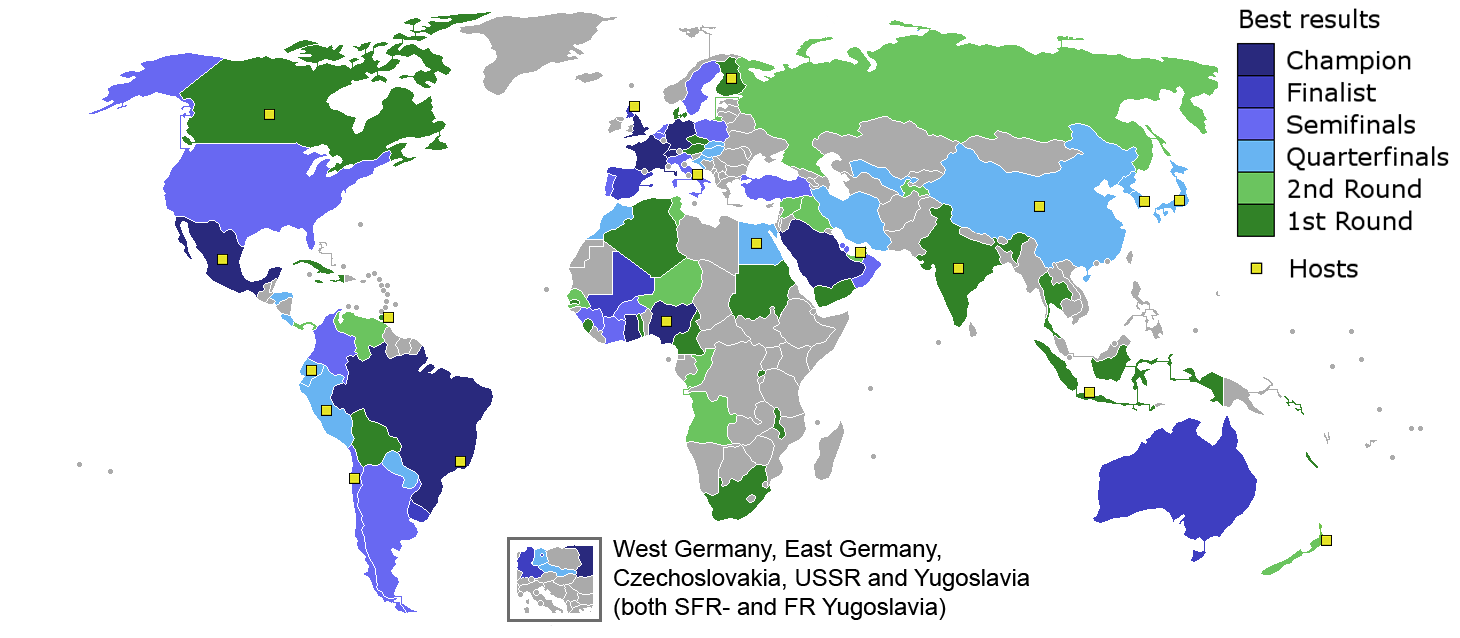
Nigeria is the most successful nation in the tournament's history, with five titles and three runners up. Brazil is the second-most successful with four titles and two runners-up. Ghana and Mexico have each won the tournament twice.
A corresponding tournament for female players, the FIFA U-17 Women's World Cup, began in 2008, with North Korea winning the inaugural tournament.
In March 2024, FIFA announced that both sexes' U-17 World Cups would be held annually, with Qatar and Morocco hosting the first five annual tournaments starting in 2025. For the U-17 World Cup, the tournament was also expanded to a 48-team format, having previously been held as a biennial 24-team tournament from 2007 to 2023.
In November 2025, Morocco recorded the largest winning margin in the history of any 11-a-side FIFA World Cup tournament, defeating New Caledonia 16–0 at the 2025 FIFA U-17 World Cup.
Structure
Each tournament consists of a group phase, in which four teams play against one another and standings in the group table decide which teams advance, followed by a knockout phase of successive matches where the winning team advances through the competition and the losing team is eliminated. This continues until two teams remain to contest the final, which decides the tournament winner. The losing semi-finalists also contest a match to decide third place.
From 1985 to 2005 there were 16 teams in the competition, divided into four groups of four teams each in the group phase. Each team played the others in its group and the group winner and runner up qualified for the knockout phase. From 2007 the tournament was expanded to 24 teams, divided into six groups of four teams each. The top 2 places in each group plus the four best third-placed teams advanced to the knockout phase.
Competition matches are played in two 45-minute halves (i.e., 90 minutes in total). In the knockout phase, until the 2011 tournament, if tied at the end of 90 minutes an additional 30 minutes of extra time were played, followed by a penalty shoot-out if still tied. Starting with the 2011 tournament, the extra time period was eliminated to avoid player burnout, and all knockout games progress straight to penalties if tied at the end of 90 minutes.
From 2025 the tournament will take place annually and will have 48 participating teams divided into 12 groups of 4 teams, with the top two teams from each group (24 teams) and the eight best third-placed teams advance to the knockout stage, starting at the round of 32 all the way to the final to decide the winners. Qatar was announced as host country from 2025 to 2029 on 14 March 2024.
Qualification
The host nation of each tournament qualifies automatically. The remaining teams qualify through competitions organised by the six regional confederations. For the first edition of the tournament in 1985, all of the teams from Europe plus Bolivia appeared by invitation of FIFA.
| Confederation | Championship |
|---|---|
| AFC (Asia) | AFC U-17 Asian Cup |
| CAF (Africa) | U-17 Africa Cup of Nations |
| CONCACAF (North, Central America and Caribbean) | CONCACAF Under-17 Championship |
| CONMEBOL (South America) | South American Under-17 Football Championship |
| OFC (Oceania) | OFC U-16 Championship |
| UEFA (Europe) | UEFA European Under-17 Football Championship |
Results
;Tournament names:
- 1985–1989: FIFA U-16 World Championship
- 1991–2005: FIFA U-17 World Championship
- 2007–present: FIFA U-17 World Cup ;Keys:
- aet: after extra time
- p: penalty shoot-out
| Ed. | Year | Host | Final | Third place game | Num. | ||||||
|---|---|---|---|---|---|---|---|---|---|---|---|
| teams | Champions | Score | Runners-up | Third place | Score | Fourth place | |||||
| 1 | 1985 | CHN | **** | 2–0 | 4–1 | 16 | |||||
| 2 | 1987 | CAN | **** | 1–1 | |||||||
| 2–1 | 16 | ||||||||||
| 3 | 1989 | SCO | **** | 2–2 | |||||||
| 3–0 | 16 | ||||||||||
| 4 | 1991 | ITA | **** | 1–0 | 1–1 | ||||||
| 16 | |||||||||||
| 5 | 1993 | JPN | **** | 2–1 | 1–1 | ||||||
| 16 | |||||||||||
| 6 | 1995 | ECU | **** | 3–2 | 2–0 | 16 | |||||
| 7 | 1997 | EGY | **** | 2–1 | 2–1 | 16 | |||||
| 8 | 1999 | NZL | **** | 0–0 | |||||||
| 2–0 | 16 | ||||||||||
| 9 | 2001 | TRI | **** | 3–0 | 2–0 | 16 | |||||
| 10 | 2003 | FIN | **** | 1–0 | 1–1 | ||||||
| 16 | |||||||||||
| 11 | 2005 | PER | **** | 3–0 | 2–1 | 16 | |||||
| 12 | 2007 | KOR | **** | 0–0 | |||||||
| 2–1 | 24 | ||||||||||
| 13 | 2009 | NGA | **** | 1–0 | 1–0 | 24 | |||||
| 14 | 2011 | MEX | **** | 2–0 | 4–3 | 24 | |||||
| 15 | 2013 | UAE | **** | 3–0 | 4–1 | 24 | |||||
| 16 | 2015 | CHI | **** | 2–0 | 3–2 | 24 | |||||
| 17 | 2017 | IND | **** | 5–2 | 2–0 | 24 | |||||
| 18 | 2019 | BRA | **** | 2–1 | 3–1 | 24 | |||||
| 19 | 2023 | IDN | **** | 2–2 | |||||||
| 3–0 | 24 | ||||||||||
| 20 | 2025 | QAT | **** | 1–0 | 0–0 | ||||||
| 48 | |||||||||||
| 21 | 2026 | 48 | |||||||||
| 22 | 2027 | 48 | |||||||||
| 23 | 2028 | 48 | |||||||||
| 24 | 2029 | 48 |
Teams reaching the top four
| Team | Titles | Runners-up | Third place | Fourth place |
|---|---|---|---|---|
| 5 (1985, 1993, 2007, 2013, 2015) | 3 (1987, 2001, 2009) | |||
| 4 (1997, 1999, 2003, 2019) | 2 (1995, 2005) | 2 (1985, 2017) | 2 (2011, 2025) | |
| 2 (1991, 1995) | 2 (1993, 1997) | 1 (1999) | 1 (2007) | |
| 2 (2005, 2011) | 2 (2013, 2019) | 1 (2015) | ||
| 1 | 1 (2023) | 1 (1985) | 2 (2007, 2011) | 1 (1997) |
| 1 (2001) | 1 (2023) | 1 (2019) | ||
| 1 (2025) | 1 (1989) | |||
| 2 | 1 (1987) | |||
| 1 (1989) | ||||
| 1 (2009) | ||||
| 1 (2017) | ||||
| 4 (1991, 2003, 2007, 2017) | 2 (1997, 2009) | |||
| 1 (2015) | 1 (2023) | 1 (2017) | ||
| 1 (1989) | ||||
| 1 (1999) | ||||
| 1 (2011) | ||||
| 1 (2025) | ||||
| 3 (1991, 1995, 2003) | 3 (2001, 2013, 2023) | |||
| 1 (2005) | 1 (2019) | |||
| 1 (2025) | 1 (1987) | |||
| 1 (1987) | ||||
| 1 (1993) | ||||
| 1 (2001) | ||||
| 1 (2013) | ||||
| 1 (2015) | ||||
| 2 (2003, 2009) | ||||
| 1 (1985) | ||||
| 1 (1989) | ||||
| 1 (1991) | ||||
| 1 (1993) | ||||
| 1 (1995) | ||||
| 1 (1999) | ||||
| 1 (2005) |
:1includes results representing West Germany :2includes results representing Soviet Union
Performances by continental zones
-- Africa is the most successful continental zone with seven tournament wins (five for Nigeria, two for Ghana) and six times as runner-up. Notably the 1993 final was contested by two African teams, which was the first time the final had been contested by two teams from the same confederation. in 2015, a pair of African teams repeated the 1993 final with Mali replacing Ghana (disqualified for age violation), when Nigeria and Mali made it to the last two standing and Nigeria got their fifth win.
South America has four tournament wins–all by Brazil—and has been runner-up three times: Argentina has finished in third place on three occasions; Chile has done so on one occasion; and Colombia has finished in fourth place twice, but neither of the latter two have ever appeared in the final.
Europe has six tournaments wins (one each for USSR, France, Switzerland, England, Germany and Portugal) and has been runner-up eight times. Spain has been runner-up on four occasions. Additionally Netherlands, Sweden and Italy have won third-place medals in 2005, 2013, and 2025 respectively.
The CONCACAF zone has two tournament wins (for Mexico in 2005 and 2011). This confederation has reached the final four times (with Mexico).
Asia has one tournament win (for Saudi Arabia in 1989), the only time that a team from this confederation has reached the final and the only time an Asian team won a FIFA tournament in the male category. (Australia was runner-up in 1999 but at that time was in the Oceania Football Confederation).
Oceania has no tournament wins and on one occasion was runner-up (for Australia in 1999). Australia has since moved to the Asian confederation.
This tournament is peculiar in that the majority of titles have gone to teams from outside the strongest regional confederations (CONMEBOL and UEFA). Of the 20 editions held so far, 10 (50 percent of the total) have been won by teams from North and Central America, Africa, and Asia.
| Confederation (continent) | Performances | Winners | Runners-up | Third | Fourth |
|---|---|---|---|---|---|
| CAF (Africa) | 7 times: Nigeria (5), Ghana (2) | 6 times: Nigeria (3), Ghana (2), Mali (1) | 4 times: Ghana (1), Ivory Coast (1), Burkina Faso (1), Mali (1) | 3 times: Ghana (1), Guinea (1), Mali (1) | |
| UEFA (Europe) | 6 times: France (1), Soviet Union (1), Switzerland (1), England (1), Germany (1), Portugal (1) | 8 times: Spain (4), Germany (1), Scotland (1), France (1), Austria (1) | 10 times: Germany (2), Spain (2), Belgium (1), France (1), Italy (1), Netherlands (1), Portugal (1), Sweden (1) | 5 times: Germany (1), Italy (1), Netherlands (1), Poland (1), Turkey (1) | |
| CONMEBOL (South America) | 4 times: Brazil (4) | 3 times: Brazil (2), Uruguay (1) | 6 times: Argentina (3), Brazil (2), Chile (1) | 7 times: Brazil (2), Argentina (3), Colombia (2) | |
| CONCACAF (North, Central America and Caribbean) | 2 times: Mexico (2) | 2 times: Mexico (2) | None | 2 times: Mexico (1), United States (1) | |
| AFC (Asia) | 1 time: Saudi Arabia (1) | None | None | 3 times: Bahrain (1), Qatar (1), Oman (1) | |
| OFC (Oceania) | None | 1 time: Australia (1) | None | None |
Awards
The following awards are now presented:
- The Golden Ball is awarded to the most valuable player of the tournament;
- The Golden Boot is awarded to the top goalscorer of the tournament;
- The Golden Glove is awarded to the most valuable goalkeeper of the tournament;
- The FIFA Fair Play Trophy is presented to the team with the best disciplinary record in the tournament.
| Tournament | Golden Ball | Golden Boot | Goals | Golden Glove | FIFA Fair Play Trophy |
|---|---|---|---|---|---|
| CHN 1985 China | William | Marcel Witeczek | 8 | Not awarded | |
| CAN 1987 Canada | Philip Osundu | Moussa Traoré | 5 | ||
| SCO 1989 Scotland | James Will | Fode Camara | 3 | ||
| ITA 1991 Italy | Nii Lamptey | Adriano | 4 | ||
| JPN 1993 Japan | Daniel Addo | Wilson Oruma | 6 | ||
| ECU 1995 Ecuador | Mohammed Al-Kathiri | Daniel Allsopp | 5 | ||
| EGY 1997 Egypt | Sergio Santamaría | David | 7 | ||
| NZL 1999 New Zealand | Landon Donovan | Ishmael Addo | 7 | ||
| TRI 2001 Trinidad and Tobago | Florent Sinama Pongolle | Florent Sinama Pongolle | 9 | ||
| FIN 2003 Finland | Cesc Fàbregas | Cesc Fàbregas | 5 | ||
| PER 2005 Peru | Anderson | Carlos Vela | 5 | ||
| KOR 2007 South Korea | Toni Kroos | Macauley Chrisantus | 7 | ||
| NGA 2009 Nigeria | Sani Emmanuel | Borja | 5 | Benjamin Siegrist | |
| MEX 2011 Mexico | Julio Gómez | Souleymane Coulibaly | 9 | Jonathan Cubero | |
| UAE 2013 United Arab Emirates | Kelechi Iheanacho | Valmir Berisha | 7 | Dele Alampasu | |
| CHI 2015 Chile | Kelechi Nwakali | Victor Osimhen | 10 | Samuel Diarra | |
| IND 2017 India | Phil Foden | Rhian Brewster | 8 | Gabriel Brazão | |
| BRA 2019 Brazil | Gabriel Veron | Sontje Hansen | 6 | Matheus Donelli | |
| IDN 2023 Indonesia | Paris Brunner | Agustín Ruberto | 8 | Paul Argney | |
| QAT 2025 Qatar | Mateus Mide | Johannes Moser | 8 | Romário Cunha | |
| QAT 2026 Qatar | |||||
| QAT 2027 Qatar | |||||
| QAT 2028 Qatar | |||||
| QAT 2029 Qatar |
Records and statistics
Main article: FIFA U-17 World Cup records and statistics
References
References
- "Youth Cup revived".
- (20 October 2017). "India could shatter Under 17 World Cup attendance record". The Times of India.
- (28 October 2017). "FIFA U-17 WC in India becomes most attended in event's history". The Times of India.
- (14 March 2024). "Qatar appointed as host of FIFA U-17 World Cup annually from 2025 to 2029". Fédération Internationale de Football Association.
- (14 March 2024). "Under-17 World Cups to be held every year from 2025, says FIFA".
- Onyeagwara, Nnamdi. (14 March 2024). "FIFA men's U17 World Cup increasing to 48 teams with next five to be held in Qatar". [[The New York Times]].
- (14 March 2024). "FIFA U-17 World Cup expands to 48 teams". Fédération Internationale de Football Association.
- Kunti, Samindra. (20 March 2024). "FIFA moved goalposts as Danish bid for U17 World Cup ignored in favour of Qatar and Morocco".
- Ravindranath, Karthik. (8 November 2025). "How Qatar will benefit from hosting five back-to-back U17 World Cups".
- (10 October 2022). "FIFA rejects Denmark's pro-human rights shirts".
- (27 November 2024). "Qatar: FIFA's Qatar World Cup Legacy Fund ignores exploited workers". Amnesty International.
- (16 January 2025). "Qatar: Events of 2024". [[Human Rights Watch]].
- (9 November 2025). "16-goal Morocco make history". Fédération Internationale de Football Association.
- (March 2025). "Regulations for the FIFA U-17 World Cup Qatar 2025–2029". Fédération Internationale de Football Association.
- (14 March 2024). "Qatar appointed as host of FIFA U-17 World Cup™ annually from 2025 to 2029". Fédération Internationale de Football Association.
This article was imported from Wikipedia and is available under the Creative Commons Attribution-ShareAlike 4.0 License. Content has been adapted to SurfDoc format. Original contributors can be found on the article history page.
Ask Mako anything about FIFA U-17 World Cup — get instant answers, deeper analysis, and related topics.
Research with MakoFree with your Surf account
Create a free account to save articles, ask Mako questions, and organize your research.
Sign up freeThis content may have been generated or modified by AI. CloudSurf Software LLC is not responsible for the accuracy, completeness, or reliability of AI-generated content. Always verify important information from primary sources.
Report