From Surf Wiki (app.surf) — the open knowledge base
Field-reversed configuration
Magnetic confinement fusion reactor
Magnetic confinement fusion reactor
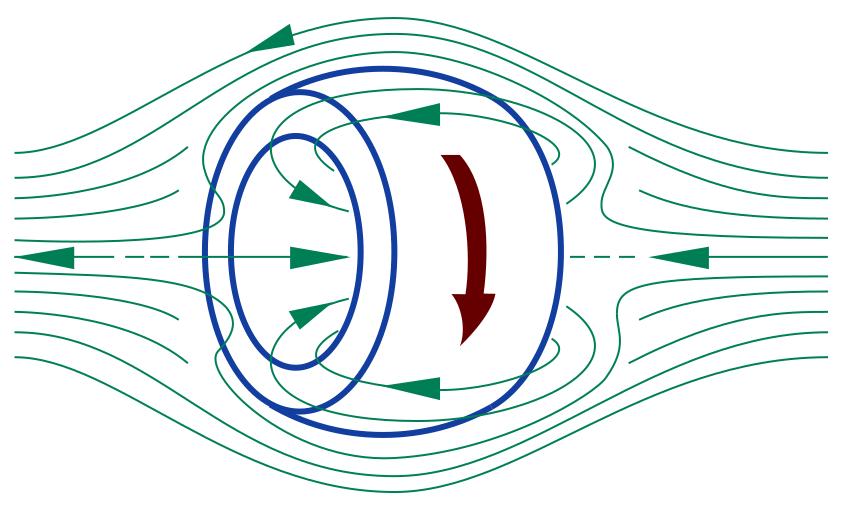
A field-reversed configuration (FRC) is a type of plasma device studied as a means of producing nuclear fusion. It confines a plasma on closed magnetic field lines without a central penetration. In an FRC, the plasma has the form of a self-stable torus, similar to a smoke ring.
FRCs are closely related to another self-stable magnetic confinement fusion device, the spheromak. Both are considered part of the compact toroid class of fusion devices. FRCs normally have a plasma that is more elongated than spheromaks, having the overall shape of a hollowed out sausage rather than the roughly spherical spheromak.
FRCs were a major area of research in the 1960s and into the 1970s, but had problems scaling up into practical fusion triple products (target combinations of density, temperature and confinement time). Interest returned in the 1990s and , FRCs were an active research area.
History
The FRC was first observed in laboratories in the late 1950s during theta pinch experiments with a reversed background magnetic field.{{Cite journal |last1=Kolb |first1=A.C. |last2=Dobbie |first2=C.B.|last3=Griem |first3=H.R. |title=Field mixing and associated neutron production in a plasma |date=1 July 1959 |others=The original idea was attributed to the Greek scientist and engineer Nicholas C. Christofilos.
The first studies were at the United States Naval Research Laboratory (NRL) in the 1960s. Considerable data were collected, with over 600 published papers. Almost all research was conducted during Project Sherwood at Los Alamos National Laboratory (LANL) from 1975 to 1990, and during 18 years at the Redmond Plasma Physics Laboratory of the University of Washington, with the large s experiment (LSX).{{Cite journal
Later research was at the Air Force Research Laboratory (AFRL),{{Cite tech report |access-date=2014-06-08 |archive-date=2020-05-16 |archive-url=https://web.archive.org/web/20200516031250/http://fti.neep.wisc.edu/research/frc
Private companies now study FRCs for electricity generation, including General Fusion, TAE Technologies, and Helion Energy.{{Cite web
The Electrodeless Lorentz Force Thruster (ELF) developed by MSNW was an attempt to design a space propulsion device. ELF was a candidate in NASA's NextSTEP advanced electric propulsion program, along with the X-3 Nested-Channel Hall Thruster and VASIMR before MSNW dissolved.
Applications
The primary application is for fusion power generation.
The FRC is also considered for deep space exploration, not only as a possible nuclear energy source, but as means of accelerating a propellant to high levels of specific impulse (Isp) for electrically powered spaceships and fusion rockets, with interest expressed by NASA.
Comparisons

Field-reversed configurations and spheromaks are together known as compact toroids. Spheromaks and FRC differ in that a spheromak has an extra toroidal field. This toroidal field can run along the same or opposite direction as the spinning plasma. In the spheromak the strength of the toroidal magnetic field is similar to that of the poloidal field. By contrast, the FRC has little to no toroidal field component and is confined solely by a poloidal field. The lack of a toroidal field means that the FRC has no magnetic helicity and that it has a high beta. The high beta makes the FRC attractive as a fusion reactor and well-suited to aneutronic fuels because of the low required magnetic field. Spheromaks have β ≈ 0.1 whereas a typical FRC has β ≈ 1.
Formation

In modern FRC experiments, the plasma current that reverses the magnetic field can be induced in a variety of ways.
When a field-reversed configuration is formed using the theta-pinch (or inductive electric field) method, a cylindrical coil first produces an axial magnetic field. Then the gas is pre-ionized, which "freezes in" the bias field from a magnetohydrodynamic standpoint, finally the axial field is reversed, hence "field-reversed configuration." At the ends, reconnection of the bias field and the main field occurs, producing closed field lines. The main field is raised further, compressing and heating the plasma and providing a vacuum field between the plasma and the wall.
Neutral beams are known to drive current in Tokamaks by directly injecting charged particles. FRCs can also be formed, sustained, and heated by application of neutral beams. In such experiments, as above, a cylindrical coil produces a uniform axial magnetic field and gas is introduced and ionized, creating a background plasma. Neutral particles are then injected into the plasma. They ionize and the heavier, positively-charged particles form a current ring which reverses the magnetic field.
Spheromaks are FRC-like configurations with finite toroidal magnetic field. FRCs have been formed through the merging of spheromaks of opposite and canceling toroidal field.
Rotating magnetic fields have also been used to drive current. In such experiments, as above, gas is ionized and an axial magnetic field is produced. A rotating magnetic field is produced by external magnetic coils perpendicular to the axis of the machine, and the direction of this field is rotated about the axis. When the rotation frequency is between the ion and electron gyro-frequencies, the electrons in the plasma co-rotate with the magnetic field (are "dragged"), producing current and reversing the magnetic field. More recently, so-called odd parity rotating magnetic fields have been used to preserve the closed topology of the FRC. It was analytically shown that at a very high critical threshold magnitude of 'odd parity' rotating magnetic field, the axisymmetric equilibrium magnetic field lines loses closure and fundamentally changes field topology.
Single particle orbits

FRCs contain an important and uncommon feature: a "magnetic null," or circular line on which the magnetic field is zero. This is necessarily the case, as inside the null the magnetic field points one direction and outside the null the magnetic field points the opposite direction. Particles far from the null trace closed cyclotron orbits as in other magnetic fusion geometries. Particles which cross the null, however, trace not cyclotron or circular orbits but betatron or figure-eight-like orbits, as the orbit's curvature changes direction when it crosses the magnetic null.
Because the particle's orbits are not cyclotron, models of plasma behavior based on cyclotron motion like magnetohydrodynamics (MHD) are inapplicable in the region around the null. The size of this region is related to the s-parameter, or the ratio of the distance between the null and separatrix, and the thermal ion gyroradius. At high-s, most particles do not cross the null and this effect is negligible. At low-s, ~2, this effect dominates and the FRC is said to be "kinetic" rather than "MHD."
Plasma stability
At low s-parameter, most ions inside an FRC follow large betatron orbits (their average gyroradius is about half the size of the plasma) which are typical in accelerator physics rather than plasma physics. These FRCs are very stable because the plasma is not dominated by usual small gyroradius particles like other thermodynamic equilibrium or nonthermal plasmas. Its behavior is not described by classical magnetohydrodynamics, hence there are no Alfvén waves and almost no MHD instabilities despite their theoretical prediction, and it avoids the typical "anomalous transport", i.e. processes in which excess loss of particles or energy occurs.{{Cite journal |url-access=subscription
, several remaining instabilities are being studied:
- The tilt and shift modes. Those instabilities can be mitigated by either including a passive stabilizing conductor, or by forming very oblate plasmas (i.e. very elongated plasmas), or by creating a self-generated toroidal field.{{Cite conference |archive-url=https://web.archive.org/web/20141216062225/https://web.gat.com/pubs-ext/sherwood00/Omelchenko.pdf |archive-date=2014-12-16
- The magnetorotational instability. This mode causes a rotating elliptical distortion of the plasma boundary, and can destroy the FRC when the distorted plasma comes in contact with the confinement chamber. Successful stabilization methods include the use of a quadrupole stabilizing field, and the effects of a rotating magnetic field (RMF).
Experiments
| Year | Device | Location | Device length | |||||
|---|---|---|---|---|---|---|---|---|
| (meter) | Device diameter | |||||||
| (meter) | B-field | |||||||
| (tesla) | Fill pressure | |||||||
| (pascal) | Confinement | |||||||
| (seconds) | Studied | |||||||
| 1959 | - | NRL | 0.10 | 0.06 | 10.00 | 13.33 | 2.E-06 | Annihilation |
| 1961 | Scylla I | LANL | 0.11 | 0.05 | 5.50 | 11.33 | 3.E-06 | Annihilation |
| 1962 | Scylla III | LANL | 0.19 | 0.08 | 12.50 | 11.33 | 4.E-06 | Rotation |
| 1962 | Thetatron | Culham | 0.21 | 0.05 | 8.60 | 13.33 | 3.E-06 | Contraction |
| 1962 | Julich | 0.10 | 0.04 | 6.00 | 30.66 | 1.E-06 | Formation, tearing | |
| 1963 | Culham | 0.30 | 0.10 | 5.00 | 6.67 | 6.E-06 | Contraction | |
| 1964 | 0-PII | Garching | 0.30 | 0.05 | 5.30 | 13.33 | 1.E-06 | Tearing, contraction |
| 1965 | Pharos | NRL | 1.80 | 0.17 | 3.00 | 8.00 | 3.E-05 | Confinement, rotation |
| 1967 | Centaur | Culham | 0.50 | 0.19 | 2.10 | 2.67 | 2.E-05 | Confinement, rotation |
| 1967 | Julietta | Julich | 1.28 | 0.11 | 2.70 | 6.67 | 2.E-05 | Tearing |
| 1971 | E-G | Garching | 0.70 | 0.11 | 2.80 | 6.67 | 3.E-05 | Tearing, rotation |
| 1975 | BN | Kurchatov | 0.90 | 0.21 | 0.45 | 0.27 - 1.07 | 5.E-05 | Formation |
| 1979 | TOR | Kurchatov | 1.50 | 0.30 | 1.00 | 0.27 - 0.67 | 1.E-04 | Formation |
| 1979 | FRX-A | LASL | 1.00 | 0.25 | 0.60 | 0.53 - 0.93 | 3.E-05 | Confinement |
| 1981 | FRX-B | LANL | 1.00 | 0.25 | 1.30 | 1.20 - 6.53 | 6.E-05 | Confinement |
| 1982 | STP-L | Nagoya | 1.50 | 0.12 | 1.00 | 1.20 | 3.E-05 | Rotation |
| 1982 | NUCTE | Nihon | 2.00 | 0.16 | 1.00 | 6.E-05 | Confinement, rotation | |
| 1982 | PIACE | Osaka | 1.00 | 0.15 | 1.40 | 6.E-05 | Rotation | |
| 1983 | FRX-C | LANL | 2.00 | 0.50 | 0.80 | 0.67 - 2.67 | 3.E-04 | Confinement |
| 1984 | TRX-1 | MSNW | 1.00 | 0.25 | 1.00 | 0.67 -2.00 | 2.E-04 | Formation, confinement |
| 1984 | CTTX | Penn S U | 0.50 | 0.12 | 0.40 | 13.33 | 4.E-05 | Confinement |
| 1985 | HBQM | U Wash | 3.00 | 0.22 | 0.50 | 0.53 - 0.93 | 3.E-05 | Formation |
| 1986 | OCT | Osaka | 0.60 | 0.22 | 1.00 | 1.E-04 | Confinement | |
| 1986 | TRX-2 | STI | 1.00 | 0.24 | 1.30 | 0.40 - 2.67 | 1.E-04 | Formation, confinement |
| 1987 | CSS | U Wash | 1.00 | 0.45 | 0.30 | 1.33 - 8.00 | 6.E-05 | Slow formation |
| 1988 | FRXC/LSM | LANL | 2.00 | 0.70 | 0.60 | 0.27 - 1.33 | 5.E-04 | Formation, confinement |
| 1990 | LSX | STI/MSNW | 5.00 | 0.90 | 0.80 | 0.27 - 0.67 | Stability, confinement |
| Device | Institution | Device type | Electron density | Max ion or electron | FRC diameter | Length/diameter |
|---|---|---|---|---|---|---|
| 1020 / Meter3 | Temperature [eV] | [Meter] | ||||
| Spheromak-3 | Tokyo University | Merging spheromak | 5.0 – 10.0 | 20 – 100 | 0.40 | 1.0 |
| Spheromak-4 | Tokyo University | Merging spheromak | 10 – 40 | 1.20 - 1.40 | 0.5 – 0.7 | |
| Compact Torus Exp-III | Nihon University | Theta-pinch | 5.0 – 400.0 | 200 – 300 | 0.10 - 0.40 | 5.0 – 10.0 |
| Field-Reversed Exp Liner | Los Alamos | Theta-pinch | 1,500.0 – 2,500.0 | 200 – 700 | 0.03 - 0.05 | 7.0 – 10.0 |
| FRC Injection Exp | Osaka University | Translation trapping | 3.0 – 5.0 | 200 – 300 | 0.30 - 0.40 | 7.0 – 15.0 |
| Swarthmore Spheromak Exp | Swarthmore | Merging spheromak | 100 | 20 – 40 | 0.40 | 1.5 |
| Magnetic Reconnection Exp | Princeton (PPPL) | Merging spheromak | 5.0 – 20.0 | 30 | 1.00 | 0.3 – 0.7 |
| Princeton field-reversed configuration experiment (PFRC) | Princeton (PPPL) | Rotating B-field | 0.05 – 0.3 | 200 – 300 | 0.06 | |
| Translation Confinement Sustainment | University of Washington | Rotating B-field | 0.1 – 2.5 | 25 – 50 | 0.70 - 0.74 | |
| Translation Confinement Sustainment-Upgrade | University of Washington | Rotating B-field | 0.4 – 1.5 | 50 – 200 | 0.70 - 0.74 | 1.5 – 3.0 |
| Plasma Liner Compression | MSNW | Translation trapping | 0.20 | |||
| Inductive Plasma Accelerator | MSNW | Merging collision | 23.0 – 26.0 | 350 | 0.20 | |
| Inductive Plasma Accelerator-C | MSNW | Merging compression | 300.0 | 1200 - 2000 | 0.2 | 10.0 |
| Colorado FRC | University of Colorado | Merging spheromak | ||||
| Irvine Field Reverse Configuration | UC Irvine | Coaxial source | 150.0 | 10 | 0.60 | |
| C-2 | Tri Alpha Energy, Inc. | Merging collision | 5.0 – 10.0 | 200 – 500 | 0.60 - 0.80 | 3.0 – 5.0 |
| STX | University of Washington | Rotating B-field | 0.5 | 40 | 0.4 | 6 |
| Prairie View Rotamak | Prairie View A&M | Rotating B-field | 0.1 | 10-30 | 0.4 | 2 |
Spacecraft propulsion
Field-reversed configuration devices have been considered for spacecraft propulsion. By angling the walls of the device outward, the plasmoid can be accelerated in the axial direction and out of the device, generating thrust.
References
References
- Freidberg, Jeffrey P.. (2007). "Plasma Physics and Fusion Energy". Cambridge University Press.
- Freidberg, Jeffrey P.. (2015). "Plasma Physics and Fusion Energy". Cambridge University Press.
- Reinders, L. J.. (2021). "The Fairy Tale of Nuclear Fusion". Springer International Publishing.
- Tuszewski, M.. (November 1988). "Field reversed configurations". [[Nuclear Fusion (journal).
- (1985). "Field-reversed configuration research at Los Alamos". [[Nuclear Fusion (journal).
- "Web page of the Redmond Plasma Physics Laboratory".
- (2012-10-31). "First operation of the PFRC-2 device". Bulletin of the American Physical Society.
- "Testimony before the Space Subcommittee of the House Committee on Science, Space, and Technology United States House of Representatives Hearing on In-Space Propulsion: Strategic Choices and Options June 29, 2017".
- (9 July 2018). "NASA's NextSTEP Advanced Electric Propulsion Activities". NASA.
- (2000). "AIP Conference Proceedings".
- (2004). "AIP Conference Proceedings".
- (November 2012). "The Fusion Driven Rocket". NASA Innovative Advanced Concepts.
- (6–10 October 2013). "Electromagnetically Driven Fusion Propulsion". George Washington University.
- . (10 April 2013). ["Nuclear Fusion Rocket Could Reach Mars in 30 Days"](http://www.space.com/20609-nuclear-fusion-rocket-mars.html).
- Ryzhkov, Sergei V.. (2002). "Features of Formation, Confinement and Stability of the Field Reversed Configuration". Problems of Atomic Science and Technology.
- Dolan, Thomas. Magnetic Fusion Technology. Vol. 2. New York City: Springer, 2012. Print.
- Ono, Y. (1999). "New relaxation of merging spheromaks to a field reversed configuration". Nuclear Fusion.
- Momita Okamoto Nomura. (1987). "Advanced Fuels in a Field-Reversed Configuration". Fusion Science and Technology.
- Slough, J. (2011). "Creation of a high-temperature plasma through merging and compression of supersonic field reversed configuration plasmoids". Nuclear Fusion.
- Taguchi, M. (1992-01-01). "Approximate expression for beam driven current in tokamak plasmas". Nuclear Fusion.
- (1996-01-01). "Fusion reactors based on colliding beams in a field reversed configuration plasma". Fusion Technology.
- (2006-12-01). "Recent Advances in the SPIRIT (Self-organized Plasma with Induction, Reconnection, and Injection Techniques) Concept". Journal of Fusion Energy.
- Jones, Ieuan R.. (1999-05-01). "A review of rotating magnetic field current drive and the operation of the rotamak as a field-reversed configuration (Rotamak-FRC) and a spherical tokamak (Rotamak-ST)". Physics of Plasmas.
- (2002-05-01). "Ion and electron acceleration in the field-reversed configuration with an odd-parity rotating magnetic field". Physics of Plasmas.
- (July 2022). "An analytical approach to evaluating magnetic-field closure and topological changes in FRC devices". Physics of Plasmas.
- (1979-01-01). "Particle orbits in field-reversed mirrors". Nuclear Fusion.
- "Colliding Beam Fusion Reactor". American Physical Society.
- (2006). "Equilibrium and stability studies of oblate field-reversed configurations in the Magnetic Reconnection Experiment". Physics of Plasmas.
- (1988). "Observation of tilt stability of field reversed configurations at large s". Nuclear Fusion.
- (1984). "Experimental study of the equilibrium of field-reversed configurations". Plasma Physics and Controlled Fusion.
- (1983). "Quadrupole Stabilization of the n=2 Rotational Instability of a Field-Reversed Theta-Pinch Plasma". Physical Review Letters.
- (1983). "Suppression of the n=2 rotational instability in field-reversed configurations". Physics of Fluids.
- (2005). "Stabilization of Interchange Modes by Rotating Magnetic Fields". Physical Review Letters.
- (2000). "Enhanced Confinement and Stability of a Field-Reversed Configuration with Rotating Magnetic Field Current Drive". Physical Review Letters.
- Steinhauer, Loren C.. (July 2011). "Review of field-reversed configurations". Physics of Plasmas.
This article was imported from Wikipedia and is available under the Creative Commons Attribution-ShareAlike 4.0 License. Content has been adapted to SurfDoc format. Original contributors can be found on the article history page.
Ask Mako anything about Field-reversed configuration — get instant answers, deeper analysis, and related topics.
Research with MakoFree with your Surf account
Create a free account to save articles, ask Mako questions, and organize your research.
Sign up freeThis content may have been generated or modified by AI. CloudSurf Software LLC is not responsible for the accuracy, completeness, or reliability of AI-generated content. Always verify important information from primary sources.
Report