From Surf Wiki (app.surf) — the open knowledge base
Fibrin
Fibrous protein involved in blood coagulation
Fibrous protein involved in blood coagulation
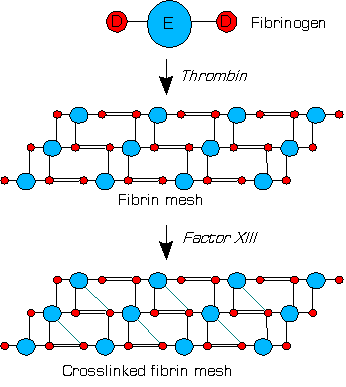
Fibrin (also called Factor Ia) is a fibrous, non-globular protein involved in the clotting of blood. It is formed by the action of the protease thrombin on fibrinogen, which causes it to polymerize. The polymerized fibrin, together with platelets, forms a hemostatic plug or clot over a wound site.
When the lining of a blood vessel is broken, platelets are attracted, forming a platelet plug. These platelets have thrombin receptors on their surfaces that bind serum thrombin molecules, which in turn convert soluble fibrinogen in the serum into fibrin at the wound site. Fibrin forms long strands of tough insoluble protein that are bound to the platelets. Factor XIII completes the cross-linking of fibrin so that it hardens and contracts. The cross-linked fibrin forms a mesh atop the platelet plug that completes the clot. Fibrin was discovered by Marcello Malpighi in 1666.
Role in disease
Excessive generation of fibrin due to activation of the coagulation cascade leads to thrombosis, the blockage of a vessel by agglutination of red blood cells, platelets, polymerized fibrin and other components. Ineffective generation or premature lysis of fibrin increases the likelihood of a hemorrhage.
Dysfunction or disease of the liver can lead to a decrease in the production of fibrin's inactive precursor, fibrinogen, or to the production of abnormal fibrinogen molecules with reduced activity (dysfibrinogenaemia). Hereditary abnormalities of fibrinogen (the gene is carried on chromosome 4) are both quantitative and qualitative in nature and include afibrinogenaemia, hypofibrinogenaemia, dysfibrinogenaemia, and hypodysfibrinogenemia.
Reduced, absent, or dysfunctional fibrin is likely to render patients as hemophiliacs.
Physiology
Fibrin from various different animal sources is generally glycosylated with complex type biantennary asparagine-linked glycans. Variety is found in the degree of core fucosylation and in the type of sialic acid and galactose linkage.
Structure

Fibrin is formed after thrombin cleavage of fibrinopeptide A (FPA) from fibrinogen A alpha-chains, thus initiating fibrin polymerization. Double-stranded fibrils form through end-to-middle domain (D:E) associations, and concomitant lateral fibril associations and branching create a clot network. Fibrin assembly facilitates intermolecular antiparallel C-terminal alignment of gamma-chain pairs, which are then covalently 'cross-linked' by factor XIII ('plasma protransglutaminase') or XIIIa to form 'gamma-dimers'. The image at the left is a crystal structure of the double-d fragment from human fibrin with two bound ligands. The experimental method used to obtain the image was X-ray diffraction, and it has a resolution of 2.30 Å. The structure is mainly made up of single alpha helices shown in red and beta sheets shown in yellow. The two blue structures are the bound ligands. The chemical structures of the ligands are Ca2+ ion, alpha-D-mannose (C6H12O6), and D-glucosamine (C6H13NO5).
References
References
- Litvinov, Rustem I.. (2020-12-01). "Fibrinogen and Fibrin". Springer International Publishing.
- Kehrel BE. (2003). "[Blood platelets: biochemistry and physiology]". Hamostaseologie.
- (31 May 2017). "Fibrin and fibrinogen". Royal Society of Chemistry.
- (23 June 2016). "350th Anniversary of the Discovery of Fibrin (1666–2016) History of Fibrin(ogen)". International Fibrinogen Research Society.
- (July 2007). "Mass + retention time
= structure: a strategy for the analysis of N-glycans by carbon LC-ESI-MS and its application to fibrin N-glycans". Anal. Chem.. - Mosesson, M. W.. (August 2005). "Fibrinogen and fibrin structure and functions". Journal of Thrombosis and Haemostasis.
- (2011-12-01). "Fibrin Clot Structure and Function". Arteriosclerosis, Thrombosis, and Vascular Biology.
- (2017). "Fibrin Formation, Structure and Properties". Springer International Publishing.
This article was imported from Wikipedia and is available under the Creative Commons Attribution-ShareAlike 4.0 License. Content has been adapted to SurfDoc format. Original contributors can be found on the article history page.
Ask Mako anything about Fibrin — get instant answers, deeper analysis, and related topics.
Research with MakoFree with your Surf account
Create a free account to save articles, ask Mako questions, and organize your research.
Sign up freeThis content may have been generated or modified by AI. CloudSurf Software LLC is not responsible for the accuracy, completeness, or reliability of AI-generated content. Always verify important information from primary sources.
Report