From Surf Wiki (app.surf) — the open knowledge base
Fibonacci sequence
Numbers obtained by adding the two previous ones

Numbers obtained by adding the two previous ones
In mathematics, the Fibonacci sequence is a sequence in which each element is the sum of the two elements that precede it. Numbers that are part of the Fibonacci sequence are known as Fibonacci numbers, commonly denoted Fn. Many writers begin the sequence with 0 and 1, although some authors start it from 1 and 1 and some (as did Fibonacci) from 1 and 2. Starting from 0 and 1, the sequence begins : 0, 1, 1, 2, 3, 5, 8, 13, 21, 34, 55, 89, 144, ...
The Fibonacci numbers were first described in Indian mathematics as early as 200 BC in work by Pingala on enumerating possible patterns of Sanskrit poetry formed from syllables of two lengths. They are named after the Italian mathematician Leonardo of Pisa, also known as Fibonacci, who introduced the sequence to Western European mathematics in his 1202 book Liber Abaci.
Fibonacci numbers appear unexpectedly often in mathematics, so much so that there is an entire journal dedicated to their study, the Fibonacci Quarterly. Applications of Fibonacci numbers include computer algorithms such as the Fibonacci search technique and the Fibonacci heap data structure, and graphs called Fibonacci cubes used for interconnecting parallel and distributed systems. They also appear in biological settings, such as branching in trees, the arrangement of leaves on a stem, the fruit sprouts of a pineapple, the flowering of an artichoke, and the arrangement of a pine cone's bracts, though they do not occur in all species.
Fibonacci numbers are also strongly related to the golden ratio: Binet's formula expresses the n-th Fibonacci number in terms of n and the golden ratio, and implies that the ratio of two consecutive Fibonacci numbers tends to the golden ratio as n increases. Fibonacci numbers are also closely related to Lucas numbers, which obey the same recurrence relation and with the Fibonacci numbers form a complementary pair of Lucas sequences.
Definition
The Fibonacci numbers may be defined by the recurrence relation F_0=0,\quad F_1= 1, and F_n=F_{n-1} + F_{n-2} for n 1.
Under some older definitions, the value F_0 = 0 is omitted, so that the sequence starts with F_1=F_2=1, and the recurrence F_n=F_{n-1} + F_{n-2} is valid for n 2. 0→1, 1→2, 2→3, ..., 12→377}}.--
The first 20 Fibonacci numbers Fn are: :{| class="wikitable" style="text-align:right" ! F0 ! F1 ! F2 ! F3 ! F4 ! F5 ! F6 ! F7 ! F8 ! F9 ! F10 ! F11 ! F12 ! F13 ! F14 ! F15 ! F16 ! F17 ! F18 ! F19 |- | 0 | 1 | 1 | 2 | 3 | 5 | 8 | 13 | 21 | 34 | 55 | 89 | 144 | 233 | 377 | 610 | 987 | 1597 | 2584 | 4181 |}
The Fibonacci sequence can be extended to negative integer indices by following the same recurrence relation in the negative direction : , , and for {{math|n {{cite book F_{-n} = (-1)^{n+1} F_n.
History
India

The Fibonacci sequence appears in Indian mathematics, in connection with Sanskrit prosody. In the Sanskrit poetic tradition, there was interest in enumerating all patterns of long (L) syllables of 2 units duration, juxtaposed with short (S) syllables of 1 unit duration. Counting the different patterns of successive L and S with a given total duration results in the Fibonacci numbers: the number of patterns of duration m units is F**m+1.
Knowledge of the Fibonacci sequence was expressed as early as Pingala ( 450 BC–200 BC). Singh cites Pingala's cryptic formula misrau cha ("the two are mixed") and scholars who interpret it in context as saying that the number of patterns for m beats (F**m+1) is obtained by adding one [S] to the F**m cases and one [L] to the F**m−1 cases. Bharata Muni also expresses knowledge of the sequence in the Natya Shastra ( 100 BC– 350 AD). However, the clearest exposition of the sequence arises in the work of Virahanka ( 700 AD), whose own work is lost, but is available in a quotation by Gopala ( 1135):
Variations of two earlier meters [is the variation] ... For example, for [a meter of length] four, variations of meters of two [and] three being mixed, five happens. [works out examples 8, 13, 21] ... In this way, the process should be followed in all mātrā-vṛttas [prosodic combinations].
Hemachandra ( 1150) is credited with knowledge of the sequence as well,
Europe

The Fibonacci sequence first appears in the book Liber Abaci (The Book of Calculation, 1202) by Fibonacci, where it is used to calculate the growth of rabbit populations.{{citation
- At the end of the first month, they mate, but there is still only 1 pair.
- At the end of the second month they produce a new pair, so there are 2 pairs in the field.
- At the end of the third month, the original pair produce a second pair, but the second pair only mate to gestate for a month, so there are 3 pairs in all.
- At the end of the fourth month, the original pair has produced yet another new pair, and the pair born two months ago also produces their first pair, making 5 pairs.
At the end of the n-th month, the number of pairs of rabbits is equal to the number of mature pairs (that is, the number of pairs in month n – 2) plus the number of pairs alive last month (month n – 1). The number in the n-th month is the n-th Fibonacci number.{{citation | last = Knott | first = Ron
The name "Fibonacci sequence" was first used by the 19th-century number theorist Édouard Lucas.

Relation to the golden ratio
Closed-form expression
Like every sequence defined by a homogeneous linear recurrence with constant coefficients, the Fibonacci numbers have a closed-form expression. It has become known as Binet's formula, named after French mathematician Jacques Philippe Marie Binet, though it was already known by Abraham de Moivre and Daniel Bernoulli:
F_n = \frac{\varphi^n-\psi^n}{\varphi-\psi} = \frac{\varphi^n-\psi^n}{\sqrt 5},
where is the golden ratio and is its conjugate,
\begin{align}
\varphi &= \tfrac12\bigl(1 + \sqrt{5}!\bigr)= \phantom{-}1.61803\ldots, \[5mu]
\psi &= \tfrac12\bigl(1 - \sqrt{5}!\bigr) = -0.61803\ldots.
\end{align}
The numbers and are the two solutions of the quadratic equation , that is, , and thus they satisfy the identities and .
Since \psi = -\varphi^{-1}, Binet's formula can also be written as
F_n = \frac{\varphi^n - (-\varphi)^{-n}}{\sqrt 5} = \frac{\varphi^n - (-\varphi)^{-n}}{2\varphi - 1}.
To see the relation between the sequence and these constants, note that \varphi and \psi are also roots of x^n = x^{n-1} + x^{n-2}, so the powers of \varphi and \psi satisfy the Fibonacci recurrence. In other words,
\begin{align} \varphi^n &= \varphi^{n-1} + \varphi^{n-2}, \[3mu] \psi^n &= \psi^{n-1} + \psi^{n-2}. \end{align}
It follows that for any values a and b, the sequence defined by
U_n=a \varphi^n + b \psi^n
satisfies the same recurrence. If a and b are chosen so that and then the resulting sequence U**n must be the Fibonacci sequence. This is the same as requiring a and b satisfy the system of equations:
\begin{align} a \varphi^0 + b \psi^0 &= 0 \ a \varphi^1 + b \psi^1 &= 1\end{align}
which has solution
a = \frac{1}{\varphi-\psi} = \frac{1}{\sqrt 5},\quad b = -a,
producing the required formula.
Taking the starting values U0 and U1 to be arbitrary constants and solving the system of equations gives the general solution \begin{align} a&=\frac{U_1-U_0\psi}{\sqrt 5}, \[3mu] b&=\frac{U_0\varphi-U_1}{\sqrt 5}. \end{align} In particular, choosing makes the n-th element of the sequence closely approximate the n-th power of for large enough values of n. This arises when and , which produces the sequence of Lucas numbers.
Computation by rounding
Since \left|\frac{\psi^{n}}{\sqrt 5}\right| for all n ≥ 0, the number F**n is the closest integer to \frac{\varphi^n}{\sqrt 5}. Therefore, it can be found by rounding, using the nearest integer function: F_n=\left\lfloor\frac{\varphi^n}{\sqrt 5}\right\rceil,\ n \geq 0.
In fact, the rounding error quickly becomes very small as n grows, being less than 0.1 for n ≥ 4, and less than 0.01 for n ≥ 8. This formula is easily inverted to find an index of a Fibonacci number F: n(F) = \left\lfloor \log_\varphi \sqrt{5}F\right\rceil,\ F \geq 1.
Instead using the floor function gives the largest index of a Fibonacci number that is not greater than F: n_{\mathrm{largest}}(F) = \left\lfloor \log_\varphi \sqrt{5}(F+1/2)\right\rfloor,\ F \geq 0, where \log_\varphi(x) = \ln(x)/\ln(\varphi) = \log_{10}(x)/\log_{10}(\varphi), \ln(\varphi) = 0.481211\ldots, and \log_{10}(\varphi) = 0.208987\ldots.
Magnitude
Since Fn is asymptotic to \varphi^n/\sqrt5, the number of digits in F**n is asymptotic to n\log_{10}\varphi\approx 0.2090, n. As a consequence, for every integer d 1 there are either 4 or 5 Fibonacci numbers with d decimal digits.
More generally, in the base b representation, the number of digits in F**n is asymptotic to n\log_b\varphi = \frac{n \log \varphi}{\log b}.
Limit of consecutive quotients
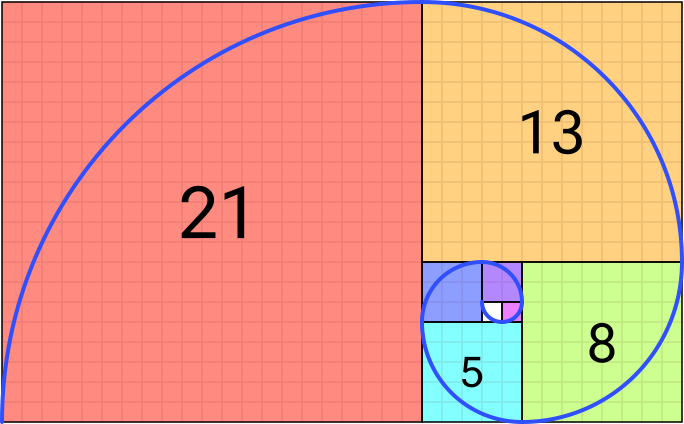
Johannes Kepler observed that the ratio of consecutive Fibonacci numbers converges. He wrote that "as 5 is to 8 so is 8 to 13, practically, and as 8 is to 13, so is 13 to 21 almost", and concluded that these ratios approach the golden ratio : \lim_{n\to\infty}\frac{F_{n+1}}{F_n}=\varphi.
This convergence holds regardless of the starting values U_0 and U_1, unless U_1 = -U_0/\varphi. This can be verified using Binet's formula. For example, the initial values 3 and 2 generate the sequence 3, 2, 5, 7, 12, 19, 31, 50, 81, 131, 212, 343, 555, ... . The ratio of consecutive elements in this sequence shows the same convergence towards the golden ratio.
In general, \lim_{n\to\infty}\frac{F_{n+m}}{F_n}=\varphi^m , because the ratios between consecutive Fibonacci numbers approaches \varphi.
: [[File:Fibonacci tiling of the plane and approximation to Golden Ratio.gif|thumb|upright=2.2|left|Successive tilings of the plane and a graph of approximations to the golden ratio calculated by dividing each Fibonacci number by the previous]]
Decomposition of powers
Since the golden ratio satisfies the equation \varphi^2 = \varphi + 1,
this expression can be used to decompose higher powers \varphi^n as a linear function of lower powers, which in turn can be decomposed all the way down to a linear combination of \varphi and 1. The resulting recurrence relationships yield Fibonacci numbers as the linear coefficients: \varphi^n = F_n\varphi + F_{n-1}. This equation can be proved by induction on n ≥ 1: \begin{align} \varphi^{n+1} &= (F_n\varphi + F_{n-1})\varphi = F_n\varphi^2 + F_{n-1}\varphi \ &= F_n(\varphi+1) + F_{n-1}\varphi = (F_n + F_{n-1})\varphi + F_n = F_{n+1}\varphi + F_n. \end{align} For \psi = -1/\varphi, it is also the case that \psi^2 = \psi + 1 and it is also the case that \psi^n = F_n\psi + F_{n-1}.
These expressions are also true for {{math|n n* is extended to negative integers using the Fibonacci rule F_n = F_{n+2} - F_{n+1}.
Identification
Binet's formula provides a proof that a positive integer x is a Fibonacci number if and only if at least one of 5x^2+4 or 5x^2-4 is a perfect square. This is because Binet's formula, which can be written as F_n = (\varphi^n - (-1)^n \varphi^{-n}) / \sqrt{5}, can be multiplied by \sqrt{5} \varphi^n and solved as a quadratic equation in \varphi^n via the quadratic formula:
\varphi^n = \frac{F_n\sqrt{5} \pm \sqrt{5{F_n}^{!2} + 4(-1)^n}}{2}.
Comparing this to \varphi^n = F_n \varphi + F_{n-1} = (F_n\sqrt{5} + F_n + 2 F_{n-1})/2, it follows that : 5{F_n}^{!2} + 4(-1)^n = (F_n + 2F_{n-1})^2,. In particular, the left-hand side is a perfect square.
Matrix form
A 2-dimensional system of linear difference equations that describes the Fibonacci sequence is
\begin{pmatrix} F_{k+2} \ F_{k+1} \end{pmatrix} = \begin{pmatrix} 1 & 1 \ 1 & 0 \end{pmatrix} \begin{pmatrix} F_{k+1} \ F_{k}\end {pmatrix} alternatively denoted \vec F_{k+1} = \mathbf{A} \vec F_{k},
which yields \vec F_n = \mathbf{A}^n \vec F_0. The eigenvalues of the matrix A are \varphi=\tfrac12\bigl(1+\sqrt5~!\bigr) and \psi=-\varphi^{-1}=\tfrac12\bigl(1-\sqrt5~!\bigr) corresponding to the respective eigenvectors \vec \mu=\begin{pmatrix} \varphi \ 1 \end{pmatrix}, \quad \vec\nu=\begin{pmatrix} -\varphi^{-1} \ 1 \end{pmatrix}.
As the initial value is \vec F_0=\begin{pmatrix} 1 \ 0 \end{pmatrix}=\frac{1}{\sqrt{5}}\vec{\mu},-,\frac{1}{\sqrt{5}}\vec{\nu}, it follows that the nth element is \begin{align} \vec F_n\ &= \frac{1}{\sqrt{5}}A^n\vec\mu-\frac{1}{\sqrt{5}}A^n\vec\nu \ &= \frac{1}{\sqrt{5}}\varphi^n\vec\mu - \frac{1}{\sqrt{5}}(-\varphi)^{-n}\vec\nu \ &= \cfrac{1}{\sqrt{5}}\left(\cfrac{1+\sqrt{5}}{2}\right)^{!n}\begin{pmatrix} \varphi \ 1 \end{pmatrix} ,-, \cfrac{1}{\sqrt{5}}\left(\cfrac{1-\sqrt{5}}{2}\right)^{!n}\begin{pmatrix}{c} -\varphi^{-1} \ 1 \end{pmatrix}. \end{align}
From this, the nth element in the Fibonacci series may be read off directly as a closed-form expression: F_n = \cfrac{1}{\sqrt{5}}\left(\cfrac{1+\sqrt{5}}{2}\right)^{!n} - , \cfrac{1}{\sqrt{5}}\left(\cfrac{1-\sqrt{5}}{2}\right)^{!n}.
Equivalently, the same computation may be performed by diagonalization of A through use of its eigendecomposition:
\begin{align}
A & = S\Lambda S^{-1}, \[3mu]
A^n & = S\Lambda^n S^{-1},
\end{align}
where
\Lambda=\begin{pmatrix} \varphi & 0 \ 0 & -\varphi^{-1}! \end{pmatrix}, \quad
S=\begin{pmatrix} \varphi & -\varphi^{-1} \ 1 & 1 \end{pmatrix}.
The closed-form expression for the nth element in the Fibonacci series is therefore given by
\begin{align}
\begin{pmatrix} F_{n+1} \ F_n \end{pmatrix} & =
A^{n} \begin{pmatrix} F_1 \ F_0 \end{pmatrix}
\ & = S \Lambda^n S^{-1} \begin{pmatrix} F_1 \ F_0 \end{pmatrix}
\ & = S \begin{pmatrix} \varphi^n & 0 \ 0 & (-\varphi)^{-n} \end{pmatrix} S^{-1}
\begin{pmatrix} F_1 \ F_0 \end{pmatrix}
\ & = \begin{pmatrix} \varphi & -\varphi^{-1} \ 1 & 1 \end{pmatrix}
\begin{pmatrix}\varphi^n & 0 \ 0 & (-\varphi)^{-n} \end{pmatrix}
\frac{1}{\sqrt{5}}\begin{pmatrix} 1 & \varphi^{-1} \ -1 & \varphi \end{pmatrix}
\begin{pmatrix} 1 \ 0 \end{pmatrix},
\end{align}
which again yields
F_n = \cfrac{\varphi^n-(-\varphi)^{-n}}{\sqrt{5}}.
The matrix A has a determinant of −1, and thus it is a 2 × 2 unimodular matrix.
This property can be understood in terms of the continued fraction representation for the golden ratio φ: \varphi = 1 + \cfrac{1}{1 + \cfrac{1}{1 + \cfrac{1}{1 + \ddots}}}. The convergents of the continued fraction for φ are ratios of successive Fibonacci numbers: is the n-th convergent, and the (n + 1)-st convergent can be found from the recurrence relation . The matrix formed from successive convergents of any continued fraction has a determinant of +1 or −1. The matrix representation gives the following closed-form expression for the Fibonacci numbers: \begin{pmatrix} 1 & 1 \ 1 & 0 \end{pmatrix}^n = \begin{pmatrix} F_{n+1} & F_n \ F_n & F_{n-1} \end{pmatrix}. For a given n, this matrix can be computed in O(log n) arithmetic operations, using the exponentiation by squaring method.
Taking the determinant of both sides of this equation yields Cassini's identity, (-1)^n = F_{n+1}F_{n-1} - {F_n}^2.
Moreover, since for any square matrix A, the following identities can be derived (they are obtained from two different coefficients of the matrix product, and one may easily deduce the second one from the first one by changing n into n + 1), \begin{align} {F_m}{F_n} + {F_{m-1}}{F_{n-1}} &= F_{m+n-1}, \[3mu] F_{m} F_{n+1} + F_{m-1} F_n &= F_{m+n} . \end{align}
In particular, with , \begin{align} F_{2 n-1} &= {F_n}^2 + {F_{n-1}}^2 \[6mu] F_{2 n\phantom &= (F_{n-1}+F_{n+1})F_n \[3mu] &= (2 F_{n-1}+F_n)F_n \[3mu] &= (2 F_{n+1}-F_n)F_n. \end{align}
These last two identities provide a way to compute Fibonacci numbers recursively in O(log n) arithmetic operations. This matches the time for computing the n-th Fibonacci number from the closed-form matrix formula, but with fewer redundant steps if one avoids recomputing an already computed Fibonacci number (recursion with memoization).
Combinatorial identities
Combinatorial proofs
Most identities involving Fibonacci numbers can be proved using combinatorial arguments using the fact that F_n can be interpreted as the number of (possibly empty) sequences of 1s and 2s whose sum is n-1. This can be taken as the definition of F_n with the conventions F_0 = 0, meaning no such sequence exists whose sum is −1, and F_1 = 1, meaning the empty sequence "adds up" to 0. In the following, |{...}| is the cardinality of a set:
: F_0 = 0 = |{}| : F_1 = 1 = |{()}| : F_2 = 1 = |{(1)}| : F_3 = 2 = |{(1,1),(2)}| : F_4 = 3 = |{(1,1,1),(1,2),(2,1)}| : F_5 = 5 = |{(1,1,1,1),(1,1,2),(1,2,1),(2,1,1),(2,2)}|
In this manner the recurrence relation F_n = F_{n-1} + F_{n-2} may be understood by dividing the F_n sequences into two non-overlapping sets where all sequences either begin with 1 or 2: F_n = |{(1,...),(1,...),...}| + |{(2,...),(2,...),...}| Excluding the first element, the remaining terms in each sequence sum to n-2 or n-3 and the cardinality of each set is F_{n-1} or F_{n-2} giving a total of F_{n-1}+F_{n-2} sequences, showing this is equal to F_n.
In a similar manner it may be shown that the sum of the first Fibonacci numbers up to the n-th is equal to the (n + 2)-th Fibonacci number minus 1. In symbols: \sum_{i=1}^n F_i = F_{n+2} - 1
This may be seen by dividing all sequences summing to n+1 based on the location of the first 2. Specifically, each set consists of those sequences that start (2,...), (1,2,...), ..., until the last two sets {(1,1,...,1,2)}, {(1,1,...,1)} each with cardinality 1.
Following the same logic as before, by summing the cardinality of each set we see that : F_{n+2} = F_n + F_{n-1} + ... + |{(1,1,...,1,2)}| + |{(1,1,...,1)}| ... where the last two terms have the value F_1 = 1. From this it follows that \sum_{i=1}^n F_i = F_{n+2}-1.
A similar argument, grouping the sums by the position of the first 1 rather than the first 2 gives two more identities: \sum_{i=0}^{n-1} F_{2 i+1} = F_{2 n} and \sum_{i=1}^{n} F_{2 i} = F_{2 n+1}-1. In words, the sum of the first Fibonacci numbers with odd index up to F_{2 n-1} is the (2n)-th Fibonacci number, and the sum of the first Fibonacci numbers with even index up to F_{2 n} is the (2n + 1)-th Fibonacci number minus 1.
A different trick may be used to prove \sum_{i=1}^n F_i^2 = F_n F_{n+1} or in words, the sum of the squares of the first Fibonacci numbers up to F_n is the product of the n-th and (n + 1)-th Fibonacci numbers. To see this, begin with a Fibonacci rectangle of size F_n \times F_{n+1} and decompose it into squares of size F_n, F_{n-1}, ..., F_1; from this the identity follows by comparing areas:
Induction proofs
Fibonacci identities often can be easily proved using mathematical induction.
For example, reconsider \sum_{i=1}^n F_i = F_{n+2} - 1. Adding F_{n+1} to both sides gives : \sum_{i=1}^n F_i + F_{n+1} = F_{n+1} + F_{n+2} - 1 and so we have the formula for n+1 \sum_{i=1}^{n+1} F_i = F_{n+3} - 1
Similarly, add {F_{n+1}}^2 to both sides of \sum_{i=1}^n F_i^2 = F_n F_{n+1} to give \sum_{i=1}^n F_i^2 + {F_{n+1}}^2 = F_{n+1}\left(F_n + F_{n+1}\right) \sum_{i=1}^{n+1} F_i^2 = F_{n+1}F_{n+2}
Binet formula proofs
The Binet formula is \sqrt5F_n = \varphi^n - \psi^n. This can be used to prove Fibonacci identities.
For example, to prove that \sum_{i=1}^n F_i = F_{n+2} - 1 note that the left hand side multiplied by \sqrt5 becomes \begin{align} 1 +& \varphi + \varphi^2 + \dots + \varphi^n - \left(1 + \psi + \psi^2 + \dots + \psi^n \right)\ &= \frac{\varphi^{n+1}-1}{\varphi-1} - \frac{\psi^{n+1}-1}{\psi-1}\ &= \frac{\varphi^{n+1}-1}{-\psi} - \frac{\psi^{n+1}-1}{-\varphi}\ &= \frac{-\varphi^{n+2}+\varphi + \psi^{n+2}-\psi}{\varphi\psi}\ &= \varphi^{n+2}-\psi^{n+2}-(\varphi-\psi)\ &= \sqrt5(F_{n+2}-1)\ \end{align} as required, using the facts \varphi\psi =- 1 and \varphi-\psi=\sqrt5 to simplify the equations.
Other identities
Numerous other identities can be derived using various methods. Here are some of them:
Cassini's and Catalan's identities
Main article: Cassini and Catalan identities
Cassini's identity states that F_n^2 - F_{n+1}F_{n-1} = (-1)^{n-1} Catalan's identity is a generalization: F_n^2 - F_{n+r}F_{n-r} = (-1)^{n-r}F_r^2
d'Ocagne's identity
F_m F_{n+1} - F_{m+1} F_n = (-1)^n F_{m-n} F_{2 n} = F_{n+1}^2 - F_{n-1}^2 = F_n \left (F_{n+1}+F_{n-1} \right ) = F_nL_n where L**n is the n-th Lucas number. The last is an identity for doubling n; other identities of this type are F_{3 n} = 2F_n^3 + 3 F_n F_{n+1} F_{n-1} = 5F_n^3 + 3 (-1)^n F_n by Cassini's identity.
F_{3 n+1} = F_{n+1}^3 + 3 F_{n+1}F_n^2 - F_n^3 F_{3 n+2} = {F_{n+1}}^3 + 3 F_{n+1}^2 F_n + F_n^3 F_{4 n} = 4 F_n F_{n+1} \left ( F_{n+1}^2 + 2F_n^2 \right ) - 3F_n^2 \left (F_n^2 + 2F_{n+1}^2 \right ) These can be found experimentally using lattice reduction, and are useful in setting up the special number field sieve to factorize a Fibonacci number.
More generally,
F_{k n+c} = \sum_{i=0}^k \binom k i F_{c-i} F_n^i F_{n+1}^{k-i}.
or alternatively
F_{k n+c} = \sum_{i=0}^k \binom k i F_{c+i} F_n^i F_{n-1}^{k-i}.
Putting in this formula, one gets again the formulas of the end of above section Matrix form.
Generating functions
Ordinary
The ordinary generating function of the Fibonacci sequence is the power series
s(z) = \sum_{k=0}^\infty F_k z^k = 0 + z + z^2 + 2z^3 + 3z^4 + 5z^5 + \cdots.
This series is convergent for any complex number z satisfying |z| and its sum has a simple closed form:
s(z)=\frac{z}{1-z-z^2}.
This can be proved by multiplying by (1-z-z^2): \begin{align} (1 - z- z^2) s(z) &= \sum_{k=0}^{\infty} F_k z^k - \sum_{k=0}^{\infty} F_k z^{k+1} - \sum_{k=0}^{\infty} F_k z^{k+2} \ &= \sum_{k=0}^{\infty} F_k z^k - \sum_{k=1}^{\infty} F_{k-1} z^k - \sum_{k=2}^{\infty} F_{k-2} z^k \ &= 0z^0 + 1z^1 - 0z^1 + \sum_{k=2}^{\infty} (F_k - F_{k-1} - F_{k-2}) z^k \ &= z, \end{align} where all terms involving z^k for k \ge 2 cancel out because of the defining Fibonacci recurrence relation.
Using z={10}^{-n} lays out the Fibonacci numbers through the second-last number with n digits in the decimal expansion of s(z). For example, s(10^{-3}) = \frac{0.001}{0.998999} = \frac{1000}{998999} = 000.,001,001,002,003,005,008,013,\ldots.
The partial fraction decomposition is given by s(z) = \frac{1}{\sqrt5}\left(\frac{1}{1 - \varphi z} - \frac{1}{1 - \psi z}\right) where \varphi = \tfrac12\left(1 + \sqrt{5}\right) is the golden ratio and \psi = \tfrac12\left(1 - \sqrt{5}\right) is its conjugate.
Exponential
The exponential generating function of the Fibonacci sequence may also be derived from the recurrence relation, giving a homogeneous linear differential equation: \begin{align}\sum_{k=0}^{\infty} F_{k+2} \frac{x^{k}}{k!} = {} & \sum_{k=0}^{\infty} F_{k+1} \frac{x^{k}}{k!} + \sum_{k=0}^{\infty} F_{k} \frac{x^{k}}{k!}\ F^{\prime\prime}(x) = {} & F^{\prime}(x) + F(x) \end{align} The characteristic polynomial of this equation is r^2 = r + 1, to which the solutions are exactly the golden ratio \varphi and its conjugate \psi. Combined with the initial values F_{0}=F(0)=0 and F_{1}=F^{\prime}(0)=1, the exponential generating function of the Fibonacci numbers is given by the entire function F(x) = \frac{e^{\varphi x} - e^{\psi x}}{\sqrt{5}} Evaluating the derivatives of the exponential generating function at x=0 gives Binet's formula: F^{(n)}(0) = F_{n} = \frac{\varphi^{n} - \psi^{n}}{\sqrt{5}}
Reciprocal sums
Borwein credits some formulae to
Infinite sums over reciprocal Fibonacci numbers can sometimes be evaluated in terms of theta functions. For example, the sum of every odd-indexed reciprocal Fibonacci number can be written as \sum_{k=1}^\infty \frac{1}{F_{2 k-1}} = \frac{\sqrt{5}}{4} ; \vartheta_2!\left(0, \frac{3-\sqrt 5}{2}\right)^2 ,
and the sum of squared reciprocal Fibonacci numbers as \sum_{k=1}^\infty \frac{1}{{F_k}^2} = \frac{5}{24} !\left(\vartheta_2!\left(0, \frac{3-\sqrt 5}{2}\right)^4 - \vartheta_4!\left(0, \frac{3-\sqrt 5}{2}\right)^4 + 1 \right).
If we add 1 to each Fibonacci number in the first sum, there is also the closed form \sum_{k=1}^\infty \frac{1}{1+F_{2 k-1}} = \frac{\sqrt{5}}{2},
and there is a nested sum of squared Fibonacci numbers giving the reciprocal of the golden ratio, \sum_{k=1}^\infty \frac{(-1)^{k+1}}{\sum_{j=1}^k {F_{j}}^2} = \frac{\sqrt{5}-1}{2} .
The sum of all even-indexed reciprocal Fibonacci numbers isLandau (1899) -- quoted according Borwein, Page 95, Exercise 3b. \sum_{k=1}^{\infty} \frac{1}{F_{2 k}} = \sqrt{5} \left(L(\psi^2) - L(\psi^4)\right) with the Lambert series \textstyle L(q) := \sum_{k=1}^{\infty} \frac{q^k}{1-q^k} , since \textstyle \frac{1}{F_{2 k}} = \sqrt{5} \left(\frac{\psi^{2 k}}{1-\psi^{2 k}} - \frac{\psi^{4 k}}{1-\psi^{4 k}} \right)!.
So the reciprocal Fibonacci constant is \sum_{k=1}^{\infty} \frac{1}{F_k} = \sum_{k=1}^\infty \frac{1}{F_{2 k-1}} + \sum_{k=1}^{\infty} \frac {1}{F_{2 k}} = 3.359885666243 \dots
Moreover, this number has been proved irrational by Richard André-Jeannin.{{citation
Millin's series gives the identity \sum_{k=0}^{\infty} \frac{1}{F_{2^k}} = \frac{7 - \sqrt{5}}{2}, which follows from the closed form for its partial sums as N tends to infinity: \sum_{k=0}^N \frac{1}{F_{2^k}} = 3 - \frac{F_{2^N-1}}{F_{2^N}}.
Primes and divisibility
Divisibility properties
Every third number of the sequence is even (a multiple of F_3=2) and, more generally, every k-th number of the sequence is a multiple of Fk. Thus the Fibonacci sequence is an example of a divisibility sequence. In fact, the Fibonacci sequence satisfies the stronger divisibility property \gcd(F_a,F_b,F_c,\ldots) = F_{\gcd(a,b,c,\ldots)}, where gcd is the greatest common divisor function. (This relation is different if a different indexing convention is used, such as the one that starts the sequence with and .)
In particular, any three consecutive Fibonacci numbers are pairwise coprime because both F_1=1 and F_2 = 1. That is, : \gcd(F_n, F_{n+1}) = \gcd(F_n, F_{n+2}) = \gcd(F_{n+1}, F_{n+2}) = 1 for every n.
Every prime number p divides a Fibonacci number that can be determined by the value of p modulo 5. If p is congruent to 1 or 4 modulo 5, then p divides F**p−1, and if p is congruent to 2 or 3 modulo 5, then, p divides F**p+1. The remaining case is that , and in this case p divides Fp.
\begin{cases} p =5 & \Rightarrow p \mid F_{p}, \ p \equiv \pm1 \pmod 5 & \Rightarrow p \mid F_{p-1}, \ p \equiv \pm2 \pmod 5 & \Rightarrow p \mid F_{p+1}.\end{cases}
These cases can be combined into a single, non-piecewise formula, using the Legendre symbol:{{citation | hdl-access = free p \mid F_{p ,-~! \left(\frac{5}{p}\right)}.
Primality testing
The above formula can be used as a primality test in the sense that if n \mid F_{n ,-~! \left(\frac{5}{n}\right)}, where the Legendre symbol has been replaced by the Jacobi symbol, then this is evidence that n is a prime, and if it fails to hold, then n is definitely not a prime. If n is composite and satisfies the formula, then n is a Fibonacci pseudoprime. When m is largesay a 500-bit numberthen we can calculate F**m (mod n) efficiently using the matrix form. Thus
\begin{pmatrix} F_{m+1} & F_m \ F_m & F_{m-1} \end{pmatrix} \equiv \begin{pmatrix} 1 & 1 \ 1 & 0 \end{pmatrix}^m \pmod n. Here the matrix power A**m is calculated using modular exponentiation, which can be adapted to matrices.
Fibonacci primes
Main article: Fibonacci prime
A Fibonacci prime is a Fibonacci number that is prime. The first few are:
: 2, 3, 5, 13, 89, 233, 1597, 28657, 514229, ...
Fibonacci primes with thousands of digits have been found, but it is not known whether there are infinitely many.{{citation | author-link = Persi Diaconis | editor1-last = Butler | editor1-first = Steve | editor1-link = Steve Butler (mathematician) | editor2-last = Cooper | editor2-first = Joshua | editor3-last = Hurlbert | editor3-first = Glenn | contribution-url = https://statweb.stanford.edu/~cgates/PERSI/papers/probabilizing-fibonacci.pdf | access-date = 2022-11-23 | archive-date = 2023-11-18 | archive-url = https://web.archive.org/web/20231118192225/https://statweb.stanford.edu/~cgates/PERSI/papers/probabilizing-fibonacci.pdf | url-status = dead
F**kn is divisible by F**n, so, apart from , any Fibonacci prime must have a prime index. As there are arbitrarily long runs of composite numbers, there are therefore also arbitrarily long runs of composite Fibonacci numbers.
No Fibonacci number greater than is one greater or one less than a prime number.
The only nontrivial square Fibonacci number is 144. Attila Pethő proved in 2001 that there is only a finite number of perfect power Fibonacci numbers. In 2006, Y. Bugeaud, M. Mignotte, and S. Siksek proved that 8 and 144 are the only such non-trivial perfect powers.
1, 3, 21, and 55 are the only triangular Fibonacci numbers, which was conjectured by Vern Hoggatt and proved by Luo Ming.
No Fibonacci number can be a perfect number. More generally, no Fibonacci number other than 1 can be multiply perfect, and no ratio of two Fibonacci numbers can be perfect.
Prime divisors
With the exceptions of 1, 8 and 144 (, F6 and F12) every Fibonacci number has a prime factor that is not a factor of any smaller Fibonacci number (Carmichael's theorem). As a result, 8 and 144 (F6 and F12) are the only Fibonacci numbers that are the product of other Fibonacci numbers.
The divisibility of Fibonacci numbers by a prime p is related to the Legendre symbol \bigl(\tfrac{p}{5}\bigr) which is evaluated as follows: \left(\frac{p}{5}\right) = \begin{cases} 0 & \text{if } p = 5\ 1 & \text{if } p \equiv \pm 1 \pmod 5\ -1 & \text{if } p \equiv \pm 2 \pmod 5.\end{cases}
If p is a prime number then F_p \equiv \left(\frac{p}{5}\right) \pmod p \quad \text{and}\quad F_{p-\left(\frac{p}{5}\right)} \equiv 0 \pmod p.
For example, \begin{align} \bigl(\tfrac{2}{5}\bigr) &= -1, &F_3 &= 2, &F_2&=1, \ \bigl(\tfrac{3}{5}\bigr) &= -1, &F_4 &= 3,&F_3&=2, \ \bigl(\tfrac{5}{5}\bigr) &= 0, &F_5 &= 5, \ \bigl(\tfrac{7}{5}\bigr) &= -1, &F_8 &= 21,&F_7&=13, \ \bigl(\tfrac{11}{5}\bigr)& = +1, &F_{10}& = 55, &F_{11}&=89. \end{align}
It is not known whether there exists a prime p such that
F_{p,-~!\left(\frac{p}{5}\right)} \equiv 0 \pmod{p^2}.
Such primes (if there are any) would be called Wall–Sun–Sun primes.
Also, if p ≠ 5 is an odd prime number then: 5 {F_{\frac{p \pm 1}{2}}}^2 \equiv \begin{cases} \tfrac{1}{2} \left (5\bigl(\tfrac{p}{5}\bigr)\pm 5 \right ) \pmod p & \text{if } p \equiv 1 \pmod 4\ \tfrac{1}{2} \left (5\bigl(\tfrac{p}{5}\bigr)\mp 3 \right ) \pmod p & \text{if } p \equiv 3 \pmod 4. \end{cases}
Example 1. , in this case and we have: \bigl(\tfrac{7}{5}\bigr) = -1: \qquad \tfrac{1}{2}\left(5 \bigl(\tfrac{7}{5}\bigr)+3 \right ) =-1, \quad \tfrac{1}{2} \left(5\bigl(\tfrac{7}{5}\bigr)-3 \right )=-4. F_3=2 \text{ and } F_4=3. 5{F_3}^2=20\equiv -1 \pmod {7};;\text{ and };;5{F_4}^2=45\equiv -4 \pmod {7}
Example 2. , in this case and we have: \bigl(\tfrac{11}{5}\bigr) = +1: \qquad \tfrac{1}{2}\left( 5\bigl(\tfrac{11}{5}\bigr)+3 \right)=4, \quad \tfrac{1}{2} \left(5\bigl(\tfrac{11}{5}\bigr)- 3 \right)=1. F_5=5 \text{ and } F_6=8. 5{F_5}^2=125\equiv 4 \pmod {11} ;;\text{ and };;5{F_6}^2=320\equiv 1 \pmod {11}
Example 3. , in this case and we have: \bigl(\tfrac{13}{5}\bigr) = -1: \qquad \tfrac{1}{2}\left(5\bigl(\tfrac{13}{5}\bigr)-5 \right) =-5, \quad \tfrac{1}{2}\left(5\bigl(\tfrac{13}{5}\bigr)+ 5 \right)=0. F_6=8 \text{ and } F_7=13. 5{F_6}^2=320\equiv -5 \pmod {13} ;;\text{ and };;5{F_7}^2=845\equiv 0 \pmod {13}
Example 4. , in this case and we have: \bigl(\tfrac{29}{5}\bigr) = +1: \qquad \tfrac{1}{2}\left(5\bigl(\tfrac{29}{5}\bigr)-5 \right)=0, \quad \tfrac{1}{2}\left(5\bigl(\tfrac{29}{5}\bigr)+5 \right)=5. F_{14}=377 \text{ and } F_{15}=610. 5{F_{14}}^2=710645\equiv 0 \pmod {29} ;;\text{ and };;5{F_{15}}^2=1860500\equiv 5 \pmod {29}
For odd n, all odd prime divisors of F**n are congruent to 1 modulo 4, implying that all odd divisors of (as the products of odd prime divisors) are congruent to 1 modulo 4.
For example, F_1 = 1,\ F_3 = 2,\ F_5 = 5,\ F_7 = 13,\ F_9 = {\color{Red}34} = 2 \cdot 17,\ F_{11} = 89,\ F_{13} = 233,\ F_{15} = {\color{Red}610} = 2 \cdot 5 \cdot 61.
All known factors of Fibonacci numbers F(i) for all {{math|i
Periodicity modulo ''n''
Main article: Pisano period
If the members of the Fibonacci sequence are taken mod n, the resulting sequence is periodic with period at most 6n. The lengths of the periods for various n form the so-called Pisano periods. Determining a general formula for the Pisano periods is an open problem, which includes as a subproblem a special instance of the problem of finding the multiplicative order of a modular integer or of an element in a finite field. However, for any particular n, the Pisano period may be found as an instance of cycle detection.
Generalizations
Main article: Generalizations of Fibonacci numbers
The Fibonacci sequence is one of the simplest and earliest known sequences defined by a recurrence relation, and specifically by a linear difference equation. All these sequences may be viewed as generalizations of the Fibonacci sequence. In particular, Binet's formula may be generalized to any sequence that is a solution of a homogeneous linear difference equation with constant coefficients.
Some specific examples that are close, in some sense, to the Fibonacci sequence include:
- Generalizing the index to negative integers to produce the negafibonacci numbers.
- Generalizing the index to real numbers using a modification of Binet's formula.
- Starting with other integers. Lucas numbers have , , and . Primefree sequences use the Fibonacci recursion with other starting points to generate sequences in which all numbers are composite.
- Letting a number be a linear function (other than the sum) of the 2 preceding numbers. The Pell numbers have . If the coefficient of the preceding value is assigned a variable value x, the result is the sequence of Fibonacci polynomials.
- Not adding the immediately preceding numbers. The Padovan sequence and Perrin numbers have .
- Generating the next number by adding 3 numbers (tribonacci numbers), 4 numbers (tetranacci numbers), or more. The resulting sequences are known as n-Step Fibonacci numbers.{{citation
Applications
Mathematics

The Fibonacci numbers occur as the sums of binomial coefficients in the "shallow" diagonals of Pascal's triangle: F_n = \sum_{k=0}^{\left\lfloor\frac{n-1}{2}\right\rfloor} \binom{n-k-1}{k}. This can be proved by expanding the generating function \frac{x}{1-x-x^2} = x + x^2(1+x) + x^3(1+x)^2 + \dots + x^{k+1}(1+x)^k + \dots = \sum\limits_{n=0}^\infty F_n x^n and collecting like terms of x^n.
To see how the formula is used, we can arrange the sums by the number of terms present: :{| | 5 | |- | | | | | |- | | | | |}
which is \textstyle \binom{5}{0}+\binom{4}{1}+\binom{3}{2}, where we are choosing the positions of k twos from n−k−1 terms.

These numbers also give the solution to certain enumerative problems, the most common of which is that of counting the number of ways of writing a given number n as an ordered sum of 1s and 2s (called compositions); there are F**n+1 ways to do this (equivalently, it's also the number of domino tilings of the 2\times n rectangle). For example, there are ways one can climb a staircase of 5 steps, taking one or two steps at a time: :{| | 5 | | | | | |- | | | | |} The figure shows that 8 can be decomposed into 5 (the number of ways to climb 4 steps, followed by a single-step) plus 3 (the number of ways to climb 3 steps, followed by a double-step). The same reasoning is applied recursively until a single step, of which there is only one way to climb.
The Fibonacci numbers can be found in different ways among the set of binary strings, or equivalently, among the subsets of a given set.
- The number of binary strings of length n without consecutive s is the Fibonacci number F**n+2. For example, out of the 16 binary strings of length 4, there are without consecutive 1s—they are , , , , , , , and . Such strings are the binary representations of Fibbinary numbers. Equivalently, F**n+2 is the number of subsets S of without consecutive integers, that is, those S for which ⊈ S for every i. A bijection with the sums to n+1 is to replace 1 with and 2 with , and drop the last zero.
- The number of binary strings of length n without an odd number of consecutive s is the Fibonacci number F**n+1. For example, out of the 16 binary strings of length 4, there are without an odd number of consecutive s—they are , , , , . Equivalently, the number of subsets S of without an odd number of consecutive integers is F**n+1. A bijection with the sums to n is to replace 1 with and 2 with .
- The number of binary strings of length n without an even number of consecutive s or s is 2F**n. For example, out of the 16 binary strings of length 4, there are without an even number of consecutive s or s—they are , , , , , . There is an equivalent statement about subsets.
- Yuri Matiyasevich was able to show that the Fibonacci numbers can be defined by a Diophantine equation, which led to his solving Hilbert's tenth problem.
- The Fibonacci numbers are also an example of a complete sequence. This means that every positive integer can be written as a sum of Fibonacci numbers, where any one number is used once at most.
- Moreover, every positive integer can be written in a unique way as the sum of one or more distinct Fibonacci numbers in such a way that the sum does not include any two consecutive Fibonacci numbers. This is known as Zeckendorf's theorem, and a sum of Fibonacci numbers that satisfies these conditions is called a Zeckendorf representation. The Zeckendorf representation of a number can be used to derive its Fibonacci coding.
- Starting with 5, every second Fibonacci number is the length of the hypotenuse of a right triangle with integer sides, or in other words, the largest number in a Pythagorean triple, obtained from the formula (F_n F_{n+3})^2 + (2 F_{n+1}F_{n+2})^2 = {F_{2 n+3}}^2. The sequence of Pythagorean triangles obtained from this formula has sides of lengths (3,4,5), (5,12,13), (16,30,34), (39,80,89), ... . The middle side of each of these triangles is the sum of the three sides of the preceding triangle.{{citation
- The Fibonacci cube is an undirected graph with a Fibonacci number of nodes that has been proposed as a network topology for parallel computing.
- Fibonacci numbers appear in the ring lemma, used to prove connections between the circle packing theorem and conformal maps.
Computer science

- The Fibonacci numbers are important in computational run-time analysis of Euclid's algorithm to determine the greatest common divisor of two integers: the worst case input for this algorithm is a pair of consecutive Fibonacci numbers.
- Fibonacci numbers are used in a polyphase version of the merge sort algorithm in which an unsorted list is divided into two lists whose lengths correspond to sequential Fibonacci numbers—by dividing the list so that the two parts have lengths in the approximate proportion φ. A tape-drive implementation of the polyphase merge sort was described in The Art of Computer Programming.
- Fibonacci TreeA Fibonacci tree is a binary tree whose child trees (recursively) differ in height by exactly 1. So it is an AVL tree, and one with the fewest nodes for a given height—the "thinnest" AVL tree. These trees have a number of vertices that is a Fibonacci number minus one, an important fact in the analysis of AVL trees.
- Fibonacci numbers are used by some pseudorandom number generators.
- Fibonacci numbers arise in the analysis of the Fibonacci heap data structure.
- A one-dimensional optimization method, called the Fibonacci search technique, uses Fibonacci numbers.
- The Fibonacci number series is used for optional lossy compression in the IFF 8SVX audio file format used on Amiga computers. The number series compands the original audio wave similar to logarithmic methods such as μ-law.
- Some Agile teams use a modified series called the "Modified Fibonacci Series" in planning poker, as an estimation tool. Planning Poker is a formal part of the Scaled Agile Framework.
- Fibonacci coding
- Negafibonacci coding
Nature

Fibonacci sequences appear in biological settings, such as branching in trees, arrangement of leaves on a stem, the fruitlets of a pineapple, the flowering of artichoke, the leaves of the spiral aloe (Aloe polyphylla), the arrangement of a pine cone, and the family tree of honeybees. Kepler pointed out the presence of the Fibonacci sequence in nature, using it to explain the (golden ratio-related) pentagonal form of some flowers. Field daisies most often have petals in counts of Fibonacci numbers. In 1830, Karl Friedrich Schimper and Alexander Braun discovered that the parastichies (spiral phyllotaxis) of plants were frequently expressed as fractions involving Fibonacci numbers.
Przemysław Prusinkiewicz advanced the idea that real instances can in part be understood as the expression of certain algebraic constraints on free groups, specifically as certain Lindenmayer grammars.
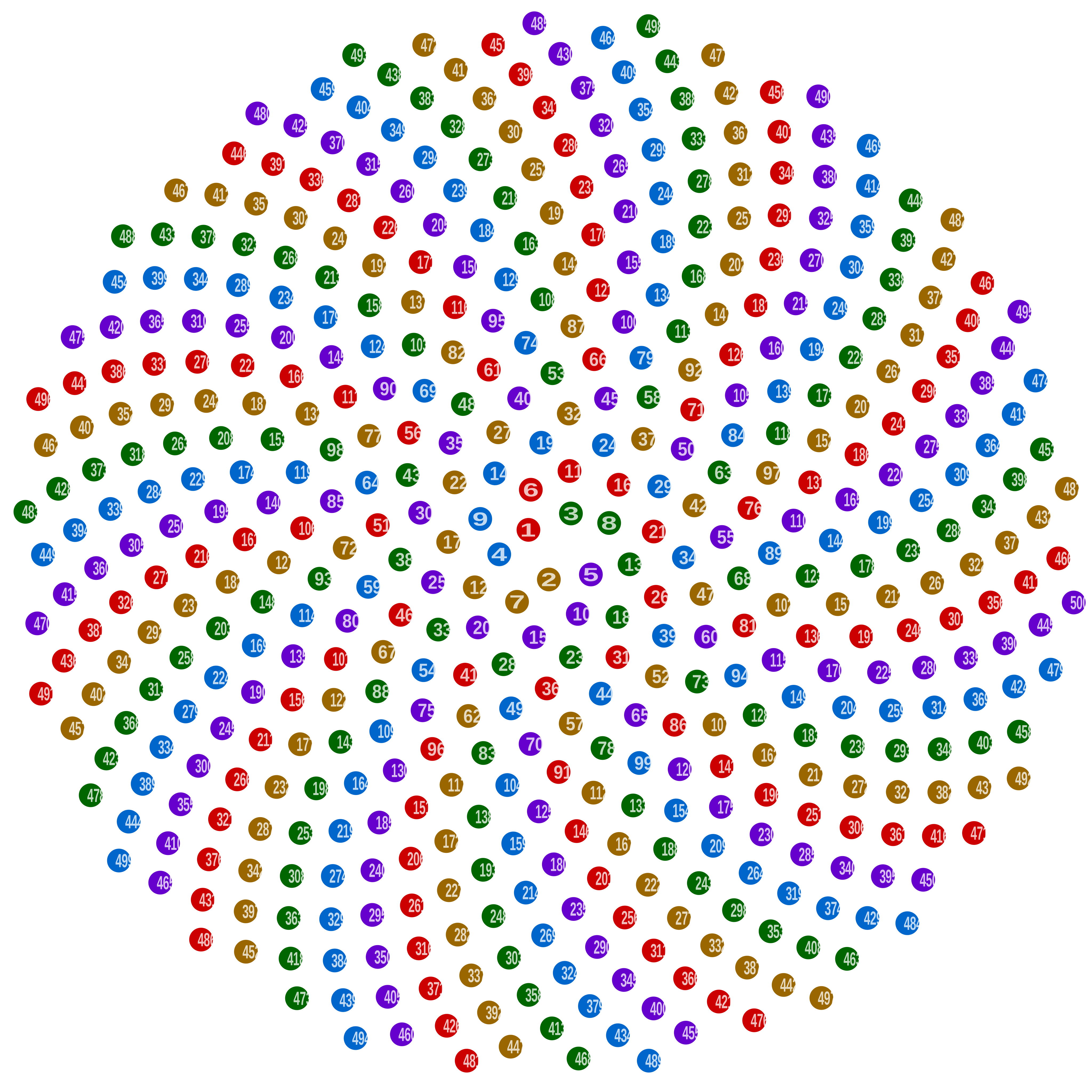
A model for the pattern of florets in the head of a sunflower was proposed by in 1979. This has the form
\theta = \frac{2\pi}{\varphi^2} n,\ r = c \sqrt{n}
where n is the index number of the floret and c is a constant scaling factor; the florets thus lie on Fermat's spiral. The divergence angle, approximately 137.51°, is the golden angle, dividing the circle in the golden ratio. Because this ratio is irrational, no floret has a neighbor at exactly the same angle from the center, so the florets pack efficiently. Because the rational approximations to the golden ratio are of the form F( j):F( j + 1), the nearest neighbors of floret number n are those at n ± F( j) for some index j, which depends on r, the distance from the center. Sunflowers and similar flowers most commonly have spirals of florets in clockwise and counter-clockwise directions in the amount of adjacent Fibonacci numbers, typically counted by the outermost range of radii.
Fibonacci numbers also appear in the ancestral pedigrees of bees (which are haplodiploids), according to the following rules:
- If an egg is laid but not fertilized, it produces a male (or drone bee in honeybees).
- If, however, an egg is fertilized, it produces a female.
Thus, a male bee always has one parent, and a female bee has two. If one traces the pedigree of any male bee (1 bee), he has 1 parent (1 bee), 2 grandparents, 3 great-grandparents, 5 great-great-grandparents, and so on. This sequence of numbers of parents is the Fibonacci sequence. The number of ancestors at each level, F**n, is the number of female ancestors, which is F**n−1, plus the number of male ancestors, which is F**n−2. This is under the unrealistic assumption that the ancestors at each level are otherwise unrelated.

It has similarly been noticed that the number of possible ancestors on the human X chromosome inheritance line at a given ancestral generation also follows the Fibonacci sequence. A male individual has an X chromosome, which he received from his mother, and a Y chromosome, which he received from his father. The male counts as the "origin" of his own X chromosome (F_1=1), and at his parents' generation, his X chromosome came from a single parent . The male's mother received one X chromosome from her mother (the son's maternal grandmother), and one from her father (the son's maternal grandfather), so two grandparents contributed to the male descendant's X chromosome . The maternal grandfather received his X chromosome from his mother, and the maternal grandmother received X chromosomes from both of her parents, so three great-grandparents contributed to the male descendant's X chromosome . Five great-great-grandparents contributed to the male descendant's X chromosome , etc. (This assumes that all ancestors of a given descendant are independent, but if any genealogy is traced far enough back in time, ancestors begin to appear on multiple lines of the genealogy, until eventually a population founder appears on all lines of the genealogy.)
Other
- In optics, when a beam of light shines at an angle through two stacked transparent plates of different materials of different refractive indexes, it may reflect off three surfaces: the top, middle, and bottom surfaces of the two plates. The number of different beam paths that have k reflections, for k 1, is the k-th Fibonacci number. (However, when , there are three reflection paths, not two, one for each of the three surfaces.)
- Fibonacci retracement levels are widely used in technical analysis for financial market trading.
- Since the conversion factor 1.609344 for miles to kilometers is close to the golden ratio, the decomposition of distance in miles into a sum of Fibonacci numbers becomes nearly the kilometer sum when the Fibonacci numbers are replaced by their successors. This method amounts to a radix 2 number register in golden ratio base φ being shifted. To convert from kilometers to miles, shift the register down the Fibonacci sequence instead.
- The measured values of voltages and currents in the infinite resistor chain circuit (also called the resistor ladder or infinite series-parallel circuit) follow the Fibonacci sequence. The intermediate results of adding the alternating series and parallel resistances yields fractions composed of consecutive Fibonacci numbers. The equivalent resistance of the entire circuit equals the golden ratio.{{citation
- Brasch et al. 2012 show how a generalized Fibonacci sequence also can be connected to the field of economics.{{Citation| first1 =T. von | last1 = Brasch | first2 = J. | last2 = Byström | first3 = L.P. | last3 = Lystad| title= Optimal Control and the Fibonacci Sequence |journal = Journal of Optimization Theory and Applications |year=2012 |issue=3 |pages= 857–78 |doi = 10.1007/s10957-012-0061-2
- Mario Merz included the Fibonacci sequence in some of his artworks beginning in 1970.
- Joseph Schillinger (1895–1943) developed a system of composition which uses Fibonacci intervals in some of its melodies; he viewed these as the musical counterpart to the elaborate harmony evident within nature. See also .
- In software development, Fibonacci numbers are often used by agile teams operating under the Scrum framework to size their product backlog items.
References
Explanatory footnotes
Citations
Works cited
- .
- .
- .
- Borwein{{Citation | author-link =Jonathan Borwein | author-link2=Peter Borwein|first2=Peter B.|last2= Borwein
- .
- .
References
- Richard A. Brualdi, ''Introductory Combinatorics'', Fifth edition, Pearson, 2005
- Peter Cameron, ''Combinatorics: Topics, Techniques, Algorithms'', Cambridge University Press, 1994
- (1202). "File:Liber abbaci magliab f124r.jpg - Wikimedia Commons".
- Singh, Parmanand. (1985). "The So-called Fibonacci numbers in ancient and medieval India". Historia Mathematica.
- Knuth, Donald. (1968). "The Art of Computer Programming". Addison Wesley.
- Knuth, Donald. (2006). "The Art of Computer Programming". Addison–Wesley.
- Agrawala, VS. (1969). "''Pāṇinikālīna Bhāratavarṣa'' (Hn.). Varanasi-I: TheChowkhamba Vidyabhawan".
- Goonatilake, Susantha. (1998). "Toward a Global Science". Indiana University Press.
- Velankar, HD. (1962). "'Vṛttajātisamuccaya' of kavi Virahanka". Rajasthan Oriental Research Institute.
- (1991). "A History of Piṅgala's Combinatorics". [[Northeastern University]].
- (13 December 2009). "Fibonacci's Liber Abaci (Book of Calculation)".
- Gardner, Martin. (1996). "Mathematical Circus". The Mathematical Association of America.
- belcastro, sarah-marie. (2018). "Discrete Mathematics with Ducks". CRC Press.
- (1996). "Der Goldene Schnitt". Vieweg+Teubner Verlag.
- {{Cite OEIS
- {{Cite OEIS
- Kepler, Johannes. (1966). "A New Year Gift: On Hexagonal Snow". Oxford University Press.
- (1611). "Strena seu de Nive Sexangula".
- (October 1972). "Fibonacci is a Square". [[The Fibonacci Quarterly]].
- "The Golden Ratio, Fibonacci Numbers and Continued Fractions.".
- Dijkstra, Edsger W.. (1978). "In honour of Fibonacci".
- (2002). "Fibonacci Numbers". Birkhäuser.
- "Fibonacci Number".
- Glaister, P. (1995). "Fibonacci power series". The Mathematical Gazette.
- {{Cite OEIS. k-th Fibonacci number
- Honsberger, Ross. (1985). "Mathematical Gems III". American Mathematical Society.
- Ribenboim, Paulo. (2000). "My Numbers, My Friends". Springer-Verlag.
- (2000). "Mudd Math Fun Facts". HMC.
- ''Prime Numbers'', Richard Crandall, Carl Pomerance, Springer, second edition, 2005, p. 142.
- {{Cite OEIS
- Honsberger, Ross. (1985). "Mathematical Gems III". AMS Dolciani Mathematical Expositions.
- Cohn, J. H. E.. (1964). "On square Fibonacci numbers". The Journal of the London Mathematical Society.
- Pethő, Attila. (2001). "Diophantine properties of linear recursive sequences II". Acta Mathematica Academiae Paedagogicae Nyíregyháziensis.
- (2006). "Classical and modular approaches to exponential Diophantine equations. I. Fibonacci and Lucas perfect powers". Ann. Math..
- Luo, Ming. (1989). "On triangular Fibonacci numbers". Fibonacci Quart..
- Luca, Florian. (2000). "Perfect Fibonacci and Lucas numbers". Rendiconti del Circolo Matematico di Palermo.
- (2011). "There are no multiply-perfect Fibonacci numbers". Integers.
- (2010). "On Perfect numbers which are ratios of two Fibonacci numbers". Annales Mathematicae at Informaticae.
- Knott, Ron. "The Fibonacci numbers". Surrey.
- {{Cite OEIS
- Ribenboim, Paulo. (1996). "The New Book of Prime Number Records". Springer.
- "Fibonacci and Lucas factorizations". Mersennus}} collects all known factors of {{math.
- "Factors of Fibonacci and Lucas numbers". Red golpe}} collects all known factors of {{math.
- (1993). "Problems and Solutions: Solutions: E3410". The American Mathematical Monthly.
- {{Cite OEIS
- Stanley, Richard. (2011). "Enumerative Combinatorics I (2nd ed.)". Cambridge Univ. Press.
- Harizanov, Valentina. (1995). "Review of Yuri V. Matiyasevich, ''Hibert's Tenth Problem''". Modern Logic.
- Stephenson, Kenneth. (2005). "Introduction to Circle Packing: The Theory of Discrete Analytic Functions". Cambridge University Press.
- Knuth, Donald E. (1997). "The Art of Computer Programming". Addison–Wesley.
- (1962). "An algorithm for the organization of information". [[Proceedings of the USSR Academy of Sciences]].
- (1966). "Optimality of the Symmetric Fibonacci Search Technique". Fibonacci Quarterly.
- (1991). "Amiga ROM Kernel Reference Manual". Addison–Wesley.
- "Multimedia Wiki".
- Dean Leffingwell. (2021-07-01). "Story". Scaled Agile Framework.
- (1996). "Phyllotaxis as a Dynamical Self Organizing Process". Journal of Theoretical Biology.
- (2006). "An Incomplete Education". Ballantine Books.
- "The Wonder of Fibonacci in our Gardens {{!}} UC Master Gardeners of San Mateo & San Francisco Counties".
- Brousseau, A. (1969). "Fibonacci Statistics in Conifers". [[Fibonacci Quarterly]].
- (18 February 2026). "Marks for the da Vinci Code: B–". Computer Science For Fun: CS4FN.
- (March 2014). "On the Origin of the Fibonacci Sequence". [[MacTutor History of Mathematics archive]], University of St Andrews.
- Varenne, Franck. (2010). "Formaliser le vivant - Lois, Théories, Modèles". Hermann.
- (1989). "Lindenmayer Systems, Fractals, and Plants (Lecture Notes in Biomathematics)". [[Springer Science+Business Media.
- Vogel, Helmut. (1979). "A better way to construct the sunflower head". Mathematical Biosciences.
- (1990). "The Algorithmic Beauty of Plants". Springer-Verlag.
- (1963). "The Fibonacci sequence as it appears in nature". The Fibonacci Quarterly.
- Yanega, D. 1996. Sex ratio and sex allocation in sweat bees (Hymenoptera: Halictidae). J. Kans. Ent. Soc. 69 Suppl.: 98-115.
- Hutchison, Luke. (September 2004). "Growing the Family Tree: The Power of DNA in Reconstructing Family Relationships". Proceedings of the First Symposium on Bioinformatics and Biotechnology (BIOT-04).
- "Encyclopedia of Math".
- "A Guide to Using the Fibonacci Sequence in Scrum".

This article was imported from Wikipedia and is available under the Creative Commons Attribution-ShareAlike 4.0 License. Content has been adapted to SurfDoc format. Original contributors can be found on the article history page.
Ask Mako anything about Fibonacci sequence — get instant answers, deeper analysis, and related topics.
Research with MakoFree with your Surf account
Create a free account to save articles, ask Mako questions, and organize your research.
Sign up freeThis content may have been generated or modified by AI. CloudSurf Software LLC is not responsible for the accuracy, completeness, or reliability of AI-generated content. Always verify important information from primary sources.
Report