From Surf Wiki (app.surf) — the open knowledge base
Fiat Argenta
Large family car produced by Fiat

Large family car produced by Fiat
| Field | Value | |
|---|---|---|
| image | Fiat Argenta argenta.jpg | |
| name | Fiat Argenta | |
| caption | Fiat Argenta (1981–1983) | |
| manufacturer | Fiat | |
| production | 1981–1985 | |
| assembly | {{ubl | |
| Chile: Rancagua{{cn | date | January 2026}} |
| predecessor | Fiat 130 | |
| Fiat 132 | ||
| successor | Fiat Croma | |
| class | Large family car (D) | |
| layout | FR layout | |
| body_style | 4-door saloon | |
| engine | {{ubl | |
| transmission | 5-speed manual | |
| 3-speed automatic | ||
| wheelbase | 2558 mm | |
| Facelift: 2563 mm | ||
| length | 4449 mm | |
| width | 1650 mm | |
| height | 1420 mm | |
| weight | 1170 kg |
| Italy: Turin | Chile: Rancagua | Poland: Warsaw (FSO) Fiat 132 | Petrol: | 1585 cc I4 | 1995 cc I4 | 1995 cc supercharged I4 | Diesel: | 2445 cc 8144.61 I4 | 2445 cc 8144.21 turbo I4 3-speed automatic Facelift: 2563 mm
The Fiat Argenta is a large family car produced by the Italian automobile company Fiat from 1981 to 1985. It was a comprehensive update of the Fiat 132 and the last mass-produced Fiat with rear-wheel drive until the 2016 124 Spider. The change to a name came about as Fiat was changing their naming strategy, changing from three-digit numbers to more meaningful names. This model was available in sedan/saloon bodystyle only.
Argenta (1981–1983)
Arriving in May 1981, the Argenta was closely based on its predecessor Fiat 132. Although all body panels and windows except the doors were new only a careful observer would have noticed (also the 132 door handles were used again, but on the opposite sides, so on the Argenta they were positioned 'backwards'). The most marked change was to the front clip, with large rectangular headlamps replacing the earlier twin round units. Bigger, square rubber bumpers made the car about 7 cm longer. The fuel tank was moved from a somewhat exposed location at the rear right and was now mounted upright behind the rear seat. This also required relocating the fuel tank filler from the fender up to the C-pillar.
Other changes included new trim, wheels, dashboard, mirrors, rectangular headlights, a shorter gear stick, and a refined suspension and brakes. Trim level was raised compared to the previous 132 and the contemporary 131 Mirafiori, with electric windows and door locking as well as power steering. Much was also made of the new Check Panel, a diagnostic panel with a diagram of the car in which LED's would light up if any safety-related function needed attention. Some markets had a large manually-sliding steel sunroof, others had the option of air conditioning.
The Argenta came with a choice of four different engines, of which one was a diesel. The diesel option has a noticeable hump on the bonnet to clear the larger engine. Not all engines were available in all of the Argenta's markets:
- Argenta 1600 1.6 litre petrol producing 96 PS
- Argenta 2000 (the sole engine available in the United Kingdom at the time of introduction) 2.0 litre petrol with 113 PS
- Argenta 2000 i.e., 2000 Injection 2.0 litre petrol with Bosch L-jetronic fuel injection producing 122 PS
- Argenta 2500 D 2.5 litre diesel with 72 PS
From spring 1982, Marelli Digiplex electronic ignition was fitted to the 2000 i.e.
Facelift (1983–1985)

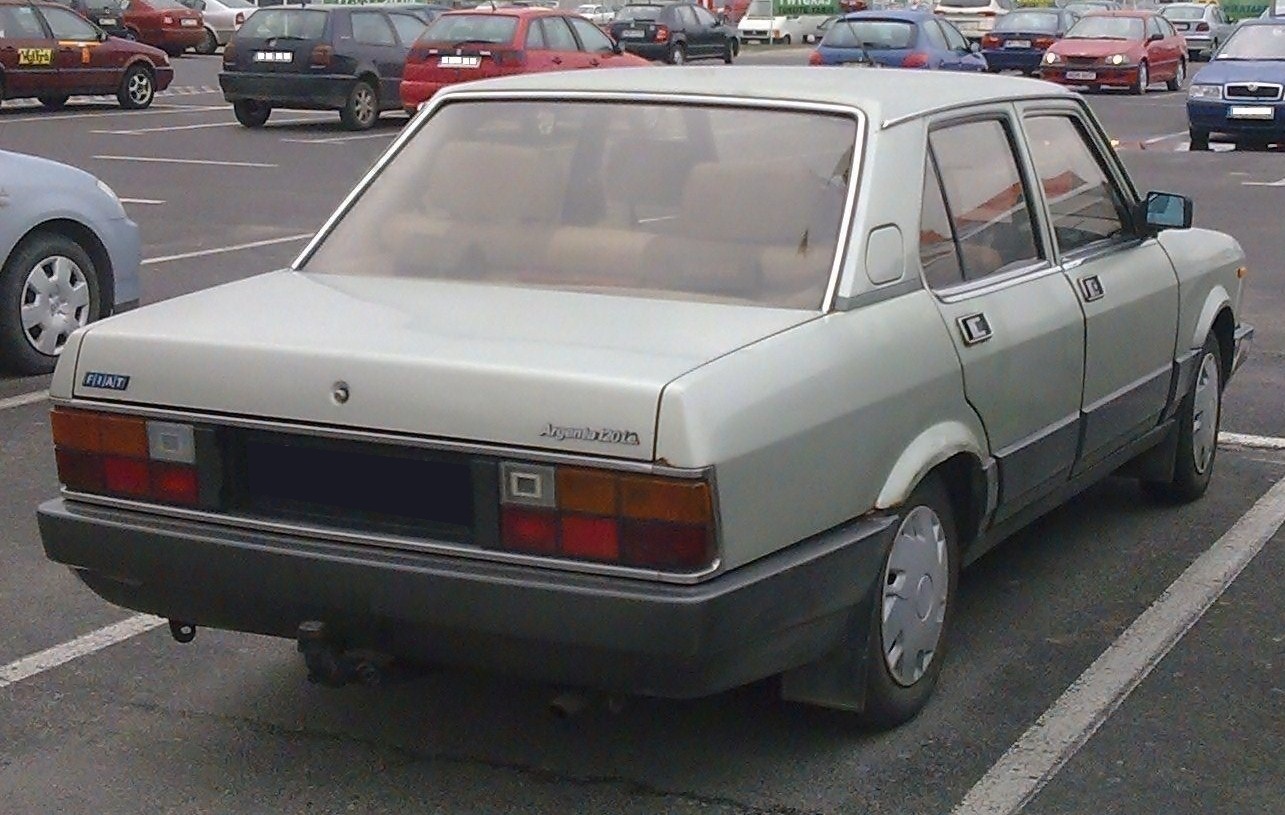
In June 1983, the Argenta was facelifted. and new wheels with flat wheel trims and chrome embellishers were used. Some minor changes were made inside the car, most notably to the seat/door/roof lining trim and a new steering wheel. The radio antenna moved from inside the windscreen to the roof. The carburetted two-liter model (Argenta 110) was only sold outside of Italy and was added to the lineup in March 1984.
The Argenta had also two new engines: Fiat's first turbodiesel, a 2.45 litre four producing 90 PS arrived as part of the facelift. In March 1984 the Argenta VX arrived, with a supercharged 2.0-liter engine with 135 PS shared with the Lancia Volumex models. Both these models had rear disc brakes and a 70-litre fuel tank instead of the usual 60 litres. The VX badge was only used in export; the Italian-market model was called the SX and went on sale in June 1984.
The new versions were named:
- Argenta 100
- Argenta 110
- Argenta 120 i.e.
- Argenta VX (SX on the Italian market)
- Argenta Diesel
- Argenta Turbo D
The car remained in production until 1985 when it was replaced by the Croma. A small number of Argentas (270 examples) was also built in Poland by FSO in 1985, after Italian production had ended. FSO had also assembled the Fiat 132 earlier.
Trivia
In February 1984, Fiat supplied 400 Argentas to the Chinese authorities, intended for use by government functionaries. All were painted dark blue and fitted with the 2-litre engine. They were shipped to the port of Tianjin. At the time, this was the largest number of cars ever in one sales agreement between a Western country and China. The press release stated they were equipped with every possible feature to highlight their robustness and comfort, even on very bumpy roads.
References
References
- Skarics, Rudolf. (February 1982). "Neusilber". Verlag Orac.
- (1985). "Quattroruote: Tutte le Auto del Mondo 1985". Editoriale Domus S.p.A.
- Hutton, Ray. (1982-06-05). "Argenta – or 132 Mk3". IPC Business Press Ltd..
- Mazzocchi Bordone, Maria Giovanna. (2010). "Fiat, tutti i modelli del novecento". Editoriale Domus.
- [[#TAM85. ''Tutte le Auto del Mondo 1985'']], p. 324
- [[#TAM85. ''Tutte le Auto del Mondo 1985'']], p. 326
- Szczerbicki, Tomasz. (8 October 2024). "Polski Fiat 132p. Klasyk z okresu PRL-u. Historia, dane techniczne, ciekawostki". Motofakty.
- (22 February 1984). "Da oggi circolano in Cina quattrocento Fiat Argenta". La Stampa.
- Bonazzi, Francesco. (2025). "Alto tradimento". Compagnia Editoriale Aliberti.
This article was imported from Wikipedia and is available under the Creative Commons Attribution-ShareAlike 4.0 License. Content has been adapted to SurfDoc format. Original contributors can be found on the article history page.
Ask Mako anything about Fiat Argenta — get instant answers, deeper analysis, and related topics.
Research with MakoFree with your Surf account
Create a free account to save articles, ask Mako questions, and organize your research.
Sign up freeThis content may have been generated or modified by AI. CloudSurf Software LLC is not responsible for the accuracy, completeness, or reliability of AI-generated content. Always verify important information from primary sources.
Report