From Surf Wiki (app.surf) — the open knowledge base
Fever (Little Willie John song)
1956 single by Little Willie John
.jpg)
1956 single by Little Willie John
| Field | Value |
|---|---|
| name | Fever |
| cover | Fever little willie john vinyl.jpg |
| caption | Label of US 78 RPM release |
| type | single |
| artist | Little Willie John |
| album | Fever |
| B-side | Letter from My Darling |
| released | May 1956 |
| genre | Rhythm and blues |
| length | 2:40 |
| label | King 4935 |
| producer | Henry Glover |
| prev_title | Need Your Love So Bad |
| prev_year | 1955 |
| next_title | Do Something for Me |
| next_year | 1956 |
| B-side = Letter from My Darling
- Eddie Cooley
- John Davenport
"Fever" is a song written by Eddie Cooley and Otis Blackwell, who used the pseudonym "John Davenport". It was originally recorded by the American R&B singer Little Willie John for his debut album, Fever (1956), and released as a single in April of the same year. The song topped the Billboard R&B Best Sellers in the US and peaked at number 24 on the Billboard pop chart. It was received positively by music critics and was included on several lists of the best songs when it was released.
It has been covered by several artists from diverse genres. Peggy Lee's 1958 rendition became the best-known version and her signature song. Lee's version contained rewritten lyrics and an altered music arrangement. It was a top-five hit in the UK and Australia in addition to making the top ten in the US and the Netherlands. "Fever" was nominated in three categories at the 1st Annual Grammy Awards in 1959, including Record of the Year and Song of the Year.
Notable versions of "Fever" were recorded by Elvis Presley, the Cramps, Madonna, Michael Bublé, the McCoys, La Lupe and Beyoncé.
Madonna released it as a single from her fifth album, Erotica (1992), in March 1993 through Warner Bros. It topped the Finnish Singles Chart and the Hot Dance Club Play chart in the US, in addition to charting in the top 50 in many other countries. Madonna filmed and released a music video directed by Stéphane Sednaoui and performed the song on several television shows as well as her 1993 The Girlie Show World Tour. "Fever" has featured in many films, plays and television shows.
Background and reception
The idea for "Fever" was presented to Otis Blackwell by an old friend, Eddie Cooley, who had a hit song called "Priscilla" in 1956. Blackwell said: "Eddie Cooley was a friend of mine from New York and he called me up and said 'Man, I got an idea for a song called 'Fever', but I can't finish it.' I had to write it under another name because, at that time, I was still under contract to Joe Davis." John Davenport, the name he used, was the name of Blackwell's stepfather. Little Willie John reportedly disliked the song, but was persuaded to record it, on March 1, 1956, by King Records owner Syd Nathan and arranger and producer Henry Glover. It became the title track for his debut album, Fever, released in 1956. "Fever" is a soul and rhythm and blues minor key opus with an arrangement consisting of low saxophones played by Ray Felder and Rufus "Nose" Gore and guitar by Bill Jennings. The vocal style of Willie John is similar to moaning and he is backed by finger snaps. Bill Dahl from the website AllMusic noted a contrast between the song's "ominous" arrangement and the vocals along with the finger snapping which "marginally lightened the mood".
"Fever" was released as a single in April 1956 and became a double-sided hit along with the top-ten R&B song "Letter from My Darling". "Fever" was number one for three weeks on the Billboard R&B Best Sellers chart in the United States, peaking at the top on July 21, 1956. It also made the pop charts, peaking at number 24 on the Billboard Best Sellers in Stores. The single sold one million copies in the US. The song won the BMI Award for Best R&B song.
The song was included in Robert Christgau's "Basic Record Library" of 1950s and 1960s recordings, published in Christgau's Record Guide: Rock Albums of the Seventies (1981). He later described it as a very "fervid" song. Bill Dahl from the website AllMusic credited "Fever" for winning the "boisterous teen an across-the-board audience" for Willie John. The writer further opined that the singer's "sweaty case of love-rooted 'Fever' was seemingly grave, judging from his riveting intensity, yet he doesn't sound like he minds at all". New Musical Express magazine listed "Fever" as the 96th best song of the 1950s. In his The 1001 Greatest Singles Ever Made list published in 1989, critic Dave Marsh ranked "Fever" at the position of 109. The song was included on the greatest hits albums Fever: The Best of Little Willie John (1993) and The Very Best of Little Willie John (2001).
Charts
| Chart (1956) | Peak |
|---|---|
| position | |
| US Billboard The Top 100 | 27 |
| US Best Sellers in Stores (Billboard) | 24 |
| US R&B Best Sellers in Stores (Billboard) | 1 |
| US Most Played R&B by Jockeys (Billboard) | 1 |
| US R&B Most Played in Juke Boxes (Billboard) | 1 |
Peggy Lee version
| B-side = You Don't Know
- Jazz
- R&B
- Peggy Lee
- Eddie Cooley
- John Davenport
- Eddie Cooley
- John Davenport
Background and composition
In May 1958, Peggy Lee recorded a cover version of "Fever" in Hollywood, which featured significantly rewritten lyrics composed by Lee herself without credit. The song was not included on Lee's album, Things Are Swingin', when it was first released in 1959, but was listed as a bonus track on its 2004 reissue release. The uncopyrighted lyrics by Lee featured historical invocations (including the verses beginning "Romeo loved Juliet", and "Captain Smith and Pocahontas") and are now generally thought of as a standard part of the song, having been included in most subsequent covers of "Fever".
Lee's cover, arranged by the singer herself with arranger/conductor Jack Marshall, was described as being in "torchy lounge" mode, accompanied only by upright bass (played by Joe Mondragon) and a very limited drum set (played in part with fingers by Shelly Manne), while the finger snaps were provided either by the singer herself, by Howard Roberts, the guitarist for the date, who set aside his guitar for this number, or possibly even by the producer, Dave Cavanaugh. Lee's rendition was further described as "smooth, sultry". It is written in the key of A Minor in a medium swing tempo with 135 beats per minute. Lee's vocals span from the musical note of G3 to B4.
Reception and accolades
A writer of the website NPR deemed "Fever" Lee's "most memorable tune" and considered it to be "slinky and inimitable". He went on to note that it displayed characteristics which were most remembered about the singer – "her playful delivery, charisma and sexuality". John Bush from the website AllMusic opined that the singer excelled in sounding "sizzling" in the song. John Fordham, writing for The Guardian, felt that the "heated" atmosphere heard on Lee's version of "Fever", "has an underlying suggestion that the person raising the temperature for her right now doesn't have to be the one doing it next week".
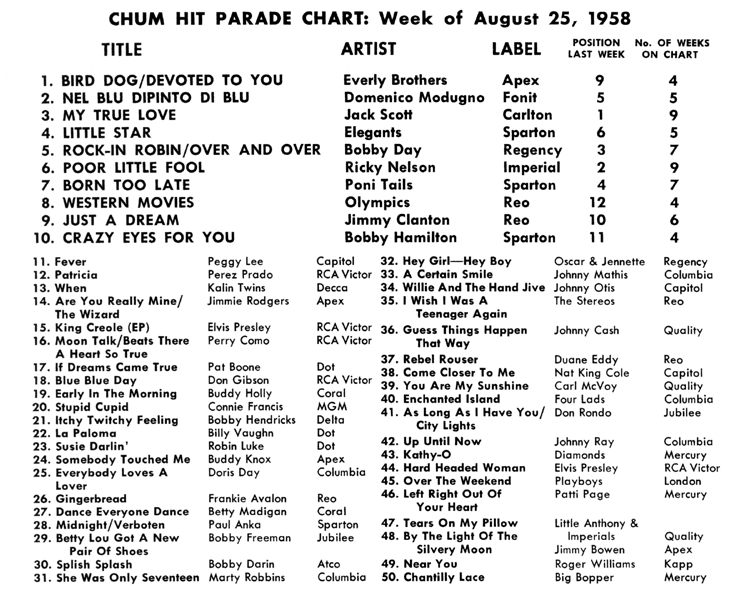
Lee's version peaked at number eight on the Billboard Hot 100 in the US and spent a total of 12 weeks on that chart. It was her only top 10 hit on the Hot 100. It reached a peak of number five on the UK Singles Chart, where it first appeared on August 15, 1958. A reissue of the single charted again in 1992, appearing at number 75 and staying for only one week. Elsewhere in Europe, Lee's "Fever" peaked at number eight on January 3, 1959, on the Dutch Singles Chart in Netherlands for five consecutive weeks before falling off the chart. The song also peaked at number two on the Australian Singles Chart compiled by Kent Music Report, and emerged as the twentieth-best-selling single of 1958 in that country.
"Fever" was nominated in the categories for Record of the Year, Song of the Year and Best Female Vocal Performance at the 1st Annual Grammy Awards held in 1959. The track became Lee's signature song and her best-known work, in addition to becoming her most successful hit. It was ranked at number 100 in the book and the accompanying list 1001 Songs You Must Hear Before You Die by Robert Dimery.
Charts
Weekly charts
| Chart (1958) | Peak | |||
|---|---|---|---|---|
| position | Australia (Kent Music Report) | Canada (CHUM Chart) | US Hot R&B/Hip-Hop Songs (Billboard) | |
| 2 | ||||
| 11 | ||||
| 5 |
| Chart (1992) | Position |
|---|
Year-end charts
| Chart (1958) | Position | Australia (Kent Music Report) | US Billboard Hot 100 |
|---|---|---|---|
| 20 | |||
| 76 |
Certifications
Madonna version
- Dance
- house
- deep house
- Maverick
- Sire
- Warner Bros.
- Eddie Cooley
- John Davenport
- Peggy Lee (uncredited)
- Madonna
- Shep Pettibone
Background and composition
In 1992, American singer and songwriter Madonna recorded a cover version of "Fever" for her fifth studio album, Erotica (1992). It was released as a single on March 22, 1993, in Europe and Australia by Maverick, Sire and Warner Bros.. Madonna served as a producer for the song along with Shep Pettibone. She was in the studio putting down tracks for the album and had just recorded a song called "Goodbye to Innocence". She was going through the final stages of production on the song and suddenly started singing the lyrics to "Fever" over "Goodbye to Innocence". Madonna liked the way it sounded so much that she recorded it. In September 2008, Madonna's version was used in television promos for the fifth season of Desperate Housewives.
According to author Rikky Rooksby, Madonna changed the composition of the original version by adding drum rhythms, accompanied by a beatbox sound like snare drums. Removing the chord progression of the original, Madonna introduces original lyrics into the song. Instrumentation of the track includes strings, marimba and finger-pops at various intervals throughout. Rooksby noticed that Madonna sang with a distant and disembodied voice, and relegated it to the dance music accompanying the lyrics.
Chart performance
In the United States, "Fever" was not released as a commercial single. It was released promotionally and became a dance hit, becoming Madonna's 15th song to hit number one on the Billboard Hot Dance Club Play chart. It topped the chart for the issue dated May 15, 1993, in its seventh week of ascending. In the United Kingdom, the song debuted at its peak position of number six on the UK Singles Chart on the issue dated April 3, 1993, and had sold 86,077 copies by August 2008. It peaked at number one on the Finnish Singles Chart on April 15, 1993. In Ireland it entered the top ten of the Irish Singles Chart, peaking at the position of six and charting for four weeks. Elsewhere, it peaked at numbers 12 in Italy, 17 in New Zealand, 22 on the Ultratop chart of the Flanders region in Belgium, 31 in France and 51 in Australia.
Critical reception
The Baltimore Sun J. D. Considine praised the song as a "sassy, house-style remake" of the original version. He noted that when Madonna and the team of producers that worked on the album "push beyond the expected... [it] really heats up, providing a sound that is body-conscious in the best sense of the term", exemplifying his statements with "Fever". A writer from Billboard called the song a "house-inflected rendition" and noted it was single-worthy. In August 2018, the magazine named it as the singer's 66th greatest single; "while most versions of this classic smolder, Madonna gets distant and detached, delivering an icy club banger that sounds less like a torch song from yesteryear and more like a soundtrack for anonymous encounters that would make Ms. Lee blush". Hunter Hauk from the Dallas Observer deemed it "subtly soulful and custom made for Madonna's pre-vocal-lesson voice". David Browne of Entertainment Weekly criticized Madonna's voice as "souless", "You and Shep sure do a bang-up job – pun intended – transforming 'Fever,' that old Peggy Lee hit, into a techno drone, but listen to the parched sound emitted from your throat on such tracks. It's cold, deadened, remote." Jude Rogers from The Guardian called it an "unnecessary trance-era update of pop's most achingly simple song about sex"; nonetheless, she placed the song at number 72 on her ranking of Madonna's singles, in honor of her 60th birthday.
In his weekly UK chart commentary, James Masterton stated that "her crown is intact." Alan Jones from Music Week gave it a score of four out of five and named it Pick of the Week, adding that "this is fairly tame in original album edit, but packs more punch and dancefloor possibilities in selection of Pettihone [sic]/Falcon/Gaeten mixes, and should maintain her now record sequence of consecutive Top 10 hits." The New York Times editor Stephen Holden wrote that "the album's softer moments include a silky hip-hop arrangement of 'Fever'". Author Rikky Rooksby, described it as "unsexy", and called it a "sterile track" which is "certainly misplaced as the second track of [Erotica]". Slant Magazine Sal Cinquemani opined that it's "Madonna's vocal performance that's the real star here [...] she may lack Peggy Lee's command, but she exudes a detached confidence and control that is the pitch-perfect embodiment of Eroticas main thesis: love hurts". Alfred Soto of Stylus Magazine felt that this song has its unique, idiosyncratic energy which he compared with material by Joni Mitchell from her album Blue (1971). The Washington Posts Richard Harrington deemed it a "cool mechanical recitation in which more attention is paid to the pulse of the music than that of the heart."
Music video and live performances
_(cropped).jpg)
The accompanying music video for "Fever", directed by French director Stéphane Sednaoui, was shot on April 10–11, 1993 at Greenwich Studios in Miami, Florida, and received its world premiere on May 11, 1993, on MTV. It has since been made commercially available on the DVD collection, The Video Collection 93:99. The music video uses the "Edit One" version of the song; it alternately features Madonna with a red wig and silver bodypaint in a variety of costumes dancing in front of funky, kaleidoscopic backgrounds. It showcases her posing like ancient goddesses. She is enveloped in a flame-like atmosphere and eventually burns up. According to Sednaoui, he wanted to portray the singer "like a provocative saint, somebody that speaks out and tells the truth, and is ready to burn for it"; he also recalled that the executives from Maverick wanted to do "something that's not the [Madonna] we know – more pop, more disco, more club [...] that's why she went all the way, like, 'OK, let's paint'". Charles Aaron writing for Spin magazine classified the clip as "dub". The music video for "Fever" was later made available on Madonna's official YouTube channel in February 2018. It was digitally remastered on November 22, 2022, and had generated more than 3.2 million views as of early 2024.
To start the promotion for Erotica, Madonna performed "Fever" and "Bad Girl" on Saturday Night Live in January 1993. During the 1000th The Arsenio Hall Show, Madonna performed the original version of "Fever" accompanied by a band, wearing a black classic dress and smoking a cigarette. Madonna also performed "Fever" on the 1993 Girlie Show World Tour as the second song from the setlist. After "Erotica", the singer partially strips and proceeds to straddle and dances suggestively with two half-naked male dancers. At the end of the song, Madonna and the two backup dancers descend into a literal ring of fire. On October 8, 2015, Madonna performed an a cappella version of "Fever" during the Saint Paul stop of her Rebel Heart Tour. She later performed the song on her 2023-2024 Celebration Tour; it was also used on one of the interludes on the show.
Formats and track listings
- UK 7" picture disc single
- "Fever" (Album Edit) – 4:27
- "Fever" (Radio Edit) – 5:11
- Australian, European, and UK CD maxi-single
- "Fever" (Album Edit) – 4:30
- "Fever" (Hot Sweat 12-inch Mix) – 7:58
- "Fever" (Extended 12-inch Mix) – 6:07
- "Fever" (Shep's Remedy Dub) – 4:31
- "Fever" (Murk Boys Miami Mix) – 7:10
- "Fever" (Murk Boys Deep South Mix) – 6:28
- Digital single – "Bad Girl / Fever" (2022)
- "Bad Girl" (Edit) – 4:35
- "Bad Girl" (Extended Mix) – 6:29
- "Fever" (Album Edit) – 4:30
- "Fever" (Edit One) – 4:05
- "Fever" (Extended 12-inch Mix) – 6:07
- "Fever" (Hot Sweat 12-inch Mix) – 7:58
- "Fever" (Murk Boys Deep South Mix) – 6:28
- "Fever" (Murk Boys Miami Mix) – 7:10
- "Fever" (Murk Boys Miami Dub) – 7:12
- "Fever" (Radio Edit/Remix) – 5:09
- "Fever" (Shep's Remedy Dub) – 4:31
- "Fever" (Oscar G's Dope Mix) – 4:55
Charts
Weekly charts
| Chart (1993) | Peak | |||||||||||
|---|---|---|---|---|---|---|---|---|---|---|---|---|
| position | Australia (ARIA) | Europe (Eurochart Hot 100) | Europe (European Hit Radio) | Finland (Suomen virallinen lista) | Iceland (Íslenski Listinn Topp 40) | Italy (Musica e dischi) | Netherlands (Dutch Top 40 Tipparade) | Netherlands (Single Top 100 Tipparade) | UK Airplay (Music Week) | UK Dance (Music Week) | UK (MRIB) | |
| 51 | ||||||||||||
| 26 | ||||||||||||
| 40 | ||||||||||||
| 1 | ||||||||||||
| 23 | ||||||||||||
| 12 | ||||||||||||
| 22 | ||||||||||||
| 5 | ||||||||||||
| 2 | ||||||||||||
| 14 | ||||||||||||
| 5 |
Year-end charts
| Chart (1993) | Position | US Hot Dance Club Play (Billboard) | US Hot Maxi-Singles Sales (Billboard) |
|---|---|---|---|
| 44 | |||
| 46 |
Beyoncé version
- R&B
- soul
- John Davenport
- Eddie Cooley
- Peggy Lee (uncredited)
- Chink Santana
- Beyoncé Knowles
Background and release
American singer Beyoncé included her version of "Fever" on multiple releases. Her original recording of the song was included on the soundtrack album for the 2003 American musical dramedy film, The Fighting Temptations, in which she also had a leading role. The song was also featured in the film itself, during a scene in which the character Beyoncé portrayed, named Lilly, sang the song in a nightclub while her eventual love interest Darrin (played by Cuba Gooding, Jr.) watches her. Beyoncé's version was produced by Damon Elliott and was recorded by her while she was still working on the 2002 film Austin Powers in Goldmember. Elliott suggested to the singer to record "Fever" as it was one of his favorite songs. When she got a role in The Fighting Temptations, the song seemed "perfect" for it as stated by Elliot. Ed Gonzalez of Slant Magazine provided a positive review for the cover, saying: "The seductive iciness of Peggy Lee's 'Fever' is successfully transplanted with a gumbo sound and sexy Southern comfort."
Beyoncé appeared on The Tonight Show with Jay Leno on September 17, 2003, to promote The Fighting Temptations with a live performance of "Fever". In November 2003, the song was included in the set list of the singer's first headlining solo Dangerously in Love Tour. Beyoncé was backed by four male dancers dressed in white, performing a choreography with her. In a review of the show, Dave Simpson from The Guardian felt that the performance of "Fever" was "a note perfect if pointless version" of the original. In 2004, the song was included on the live album Live at Wembley which was filmed during a London concert as part of the tour. Beyoncé's original recording was additionally included on the track-listing of her first mixtape Speak My Mind released in 2005.
After releasing her first fragrance Heat, Beyoncé re-recorded her version of "Fever" as promotion for the fragrance, using the song in its advertisements. The re-recorded 2010 version of the song was produced by Chink Santana and Beyoncé herself. It was released for digital download on the iTunes Store in the US on February 8, 2010. The next day, it was released in the United Kingdom. In February the following year, "Fever" was included on the track-listing of the extended play (EP) Heat, a limited CD released with the perfume.
Usage in media
As promotion for the fragrance, a TV commercial for Heat was directed by Jake Nava, who had previously worked with Beyoncé on various of her music videos. The commercial features Beyoncé in a red satin dress sweating in a steamy room while the 2010 cover version of "Fever" plays in the background. Throughout the clip, she is seen lying naked in the middle of a room, touching her body, dancing and leaving a trail of fire as she touches a wall. The commercial concludes with Beyoncé walking away from the camera and melting the floor with her footprints. During the end, she turns and says "Catch the fever", the tagline of the fragrance.
In an interview with Women's Wear Daily, the singer described the sexual tone of the video stating: "My sexiest moments are when I'm just getting out of the tub or the shower and I'm clean, so I wanted to incorporate that in the ads. The dress was this liquid-y satin. The song Fever I did years ago and always loved it. [For the commercial] I got to sing it a bit more whispery, more natural." The silky red dress she wears in the video has been noted for exposing partial cleavage. The commercial for the fragrance found controversy in the United Kingdom with the Advertising Standards Authority where it was banned from daytime TV rotation for its "sexy imagery".
Other notable versions
- Elvis Presley recorded his version on April 3, 1960, and was released in April 8, 1960, on the Elvis Is Back! album. In January 14, 1973, Presley performed the song in Honolulu International Center for the concert Aloha from Hawaii via Satellite. In 2015, the 1960 studio version was given an orchestral arrangement by the Royal Philharmonic Orchestra, in a posthumous duet with Canadian singer Michael Bublé, and was released on the album If I Can Dream.
- Helen Shapiro recorded a version of "Fever" in 1964; her cover reached number 38 on the UK Singles Chart on January 23 of the same year.
- The McCoys in 1965 released a version similar to their previous hit "Hang On Sloopy". The McCoys version of "Fever" peaked at number seven on the Billboard Hot 100 and 34 on the German Singles Chart.
- James Brown – Cold Sweat (1967). Music critic Robert Christgau opined that "Fever" placed on the album with several other cover versions "smelled a little fishy at the time".
- La Lupe – Queen of Latin Soul (1968). Her version became famous worldwide. On the web site NBCNewYork.com Elizabeth Bougerol called it one of the best versions and essential at Boogaloo parties.
- 1969 Chicago Cubs – A version of the song with the same music but different lyrics, called "Pennant Fever", was recorded by seven members of the 1969 Chicago Cubs: Billy Williams, Randy Hundley, Ron Santo, Don Kessinger, Willie Smith, Gene Oliver, and Nate Oliver.
- Rita Coolidge – for The Lady's Not for Sale (1972) and it became a minor hit in her early career.
- Suzi Quatro included her own version of "Fever" on Your Mamma Won't Like Me in 1975. Dave Thompson from AllMusic called her cover "lukewarm".
- Madleen Kane released her version in 1978, and it peaked at No. 19 on the Canadian Dance Chart.
- Indian singer Usha Uthup performed the song on various of her concerts (including those in 2010) and included it on the album Usha in Nairobi released in 1978.
- Lizzy Mercier Descloux recorded a parody of the song entitled "Tumor" on her 1979 album Press Color.
- The Cramps covered "Fever" on their debut album Songs the Lord Taught Us (1980) It was praised by Ned Raggett of AllMusic who felt that it challenged the original.
- Annabella Lwin recorded the song in 1986 for her first solo album after the breakup of Bow Wow Wow, and it provided the title for the album itself. A music video was released for the song.
- Anne Murray recorded a version of the song for her album Croonin' (1993)
- Michael Bublé released his cover of this song on his self named debut album in 2003. Aaron Latham at AllMusic considered it one of the highlights on the album, stating that Bublé "gives it a satiny sheen that the song hasn't seen in years".
- Bette Midler from her 2005 album Bette Midler Sings the Peggy Lee Songbook. In 2006 it reached No. 4 on the U.S. Billboard Dance Chart.
- Lulu Roman – At Last (2013)
- Arielle Dombasle covered the song in 2022 and is part of her 2024 release Iconics.
- Sergio George, Elena Rose, Oscar D'Leon, Skip Marley - Me Das Fever (2025)
In other media
- On January 30, 2018, reality TV star Dorit Kemsley performed a version of the song with pop star friend Boy George on The Real Housewives of Beverly Hills.
Footnotes
Sources
- {{cite book
- {{cite book | url-access = registration
References
- [http://musicvf.com/song.php?title=Fever+by+Little+Willie+John&id=26135 Little Willie John, "Fever" chart positions]. Retrieved June 20, 2015
- Dahl, Bill. "Fever – Little Willie John". [[AllMusic]].
- "EDDIE COOLEY".
- "Peggy Lee – Research About The Song Fever".
- "Little Willie John > Fever". [[AllMusic]].
- "Little Willie John – Awards". [[AllMusic]].
- Whitburn, Joel. (2004). "Top R&B/Hip-Hop Singles: 1942-2004". Record Research.
- (December 22, 1956). "BMI Best Songs".
- Christgau, Robert. (1981). "[[Christgau's Record Guide: Rock Albums of the Seventies]]". [[Ticknor & Fields]].
- "Consumer Guide Reviews: Little Willie John". [[Robert Christgau]].
- "100 Best Songs of the 1950s – #96 Little Willie John, 'Fever'". [[NME]].
- Marsh, Dave. "The 1001 Greatest Singles, by Number". Control.lth.se.
- Wynn, Ron. "Fever: The Best of Little Willie John – Little Willie John". AllMusic.
- Phares, Heather. "The Very Best of Little Willie John – Little Willie John". AllMusic.
- (August 4, 1956). "The Billboard Popularity Charts... Pop Records".
- (August 18, 1956). "The Billboard Music Popularity Charts...Pop Records & Sheet Music".
- (July 21, 1956). "The Billboard Popularity Charts... Rhythm & Blues Records".
- (September 1, 1956). "Most Played R&B in Juke Boxes".
- "Peggy Lee Discography – The Capitol Years, Part 4".
- Stanley, Bob. (2022). "Let's Do It – The Birth of Pop Music: A History". Pegasus Books.
- Richmond, Peter. (2007). "Fever: The Life and Music of Miss Peggy Lee". Macmillan.
- Santiago-Mercado, Iván. "The Peggy Lee Bio-Discography And Videography: Observations About The Song 'Fever'".
- (May 17, 2010). ""Fever" Singer Peggy Lee Is Hot Again". [[CBS News]].
- (April 16, 2012). "Peggy Lee "Fever" Sheet Music". Musicnotes.com. [[BMG Rights Management]].
- (May 6, 2006). "Delving into Peggy Lee's Steamy Mystique". [[NPR]].
- Bush, John. "The Best of Miss Peggy Lee – Peggy Lee". AllMusic.
- Fordham, John. (January 22, 2002). "Peggy Lee". [[The Guardian]].
- (January 4, 2012). "GRAMMY Rewind: 1st Annual Grammy Awards". [[Grammy Award.
- "The Grammys – Peggy Lee". Peggylee.com.
- Bush, John. "Things Are Swingin' – Peggy Lee". [[AllMusic]].
- Wiederhorn, Jon. (January 22, 2002). "Singer Peggy Lee, Who Gave The World 'Fever,' Dies at 81". MTV News.
- (2010). "1001 Songs You Must Hear Before You Die". Quintessence Editions.
- "CHUM Hit Parade – August 25, 1958".
- "Peggy Lee > Awards". [[AllMusic]].
- Kent, David. (2005). "Australian Chart Book 1940 – 1969". Australian Chart Book Pty Ltd, Turramurra, N.S.W..
- "1958 Billboard Top 100 Songs".
- (March 20, 1993). "New Singles".
- Molanphy, Chris. (March 29, 2018). "Hit Parade: the Veronica Electronica Edition". [[Slate (magazine).
- Pettibone, Shep. "Erotica Diaries – Written by Shep Pettibone". ShepPettibone.com.
- (November 22, 2008). "Sounds and Visions".
- {{harvnb. Rooksby. 2004
- "Dance Club Songs : May 15, 1993".
- Jones, Alan. (August 19, 2008). "The immaculate guide to 50 years of Madonna". Music Week.
- Considine, J. D.. (October 18, 1992). "Madonna's 'Erotica' delivers more than just sexuality". [[The Baltimore Sun]].
- (October 24, 1992). "Madonna – Erotica".
- (August 15, 2018). "The 100 Greatest Madonna Songs: Critics' Picks".
- (February 3, 2012). "The 20 Best Madonna Songs You Won't Hear at the Super Bowl". [[Dallas Observer]].
- Browne, David. (October 23, 1992). "Music Review: Erotica, by Madonna".
- (August 16, 2018). "Every one of Madonna's 78 singles – ranked!". The Guardian.
- Masterton, James. (March 28, 1993). "Week Ending April 3rd 1993".
- Jones, Alan. (March 27, 1993). "Market Preview: Mainstream – Singles – Pick of the Week".
- Holden, Stephen. (October 18, 1992). "Recordings View; Selling Sex and (Oh, Yes) a Record". The New York Times.
- (August 1, 2018). "The Beat Goes On: Every Madonna Single Ranked". [[Slant Magazine]].
- Soto, Alfred. (January 17, 2006). "Madonna – Erotica – On Second Thought". [[Stylus Magazine]].
- Harrington, Richard. (October 21, 1992). "The Madonna Pornucopia". [[The Washington Post]].
- "Madonna.com > News > Madonna's Fever" video is filmed by Stephane Sednaoui in Miami". Madonna.com.
- (1999). "The Video Collection 93:99". [[Warner Bros. Records.
- (July 7, 2016). "Strike a Pose: Madonna's 20 Greatest Videos".
- Aaron, Charles. (October 1993). "Madonna, "Rain" (Maverick/Sire/Warner Bros.)".
- (February 13, 2018). "Madonna – Fever (Official Video)".
- {{harvnb. Parish. Pitts. 2003
- (January 18, 1993). "Another 'Bad Girl' Rips Up a Photograph on 'SNL'". [[Deseret News]].
- Willman, Chris. (May 15, 1993). "Pop Music Review: Madonna Bowls Over Arsenio's Show". Los Angeles Times.
- Lenig, Stuart. (June 16, 2010). "The Twisted Tale of Glam Rock". Bloomsbury Academic.
- (1997). "Madonna: The Rolling Stone Files : The Ultimate Compendium of Interviews, Articles, Facts and Opinions from the Files of Rolling Stone".
- Bream, Jon. (October 9, 2015). "Madonna more playful than provocative in Xcel show". [[Star Tribune]].
- (October 15, 2023). "Madonna's Celebration Tour reviewed: The Queen of pop brings out her crown jewels". [[BBC News]].
- https://www.discogs.com/release/559816-Madonna-Fever?srsltid=AfmBOorZObXtCWmSgFGGofY2tXFJKM5PGpiMGwBpCkAk9F7tKn4KuaR3
- "Bad Girl / Fever by Madonna on Apple Music".
- Ryan, Gavin. (2011). "Australia's Music Charts 1988-2010". Moonlight Publishing.
- (April 17, 1993). "Eurochart Hot 100".
- (May 1, 1993). "EHR Top 40".
- Nyman, Jake. (2005). "Suomi soi 4: Suuri suomalainen listakirja". Tammi.
- (March 2023). "Íslenski Listinn Topp 40 (30.04.1993 – 06.05.1993)". [[Dagblaðið Vísir]].
- "Classifiche". [[Musica e dischi]].
- "Madonna – Fever". [[Dutch Top 40]].
- "Madonna – Fever". [[MegaCharts]].
- (April 17, 1993). "Top 50 Airplay Chart".
- (April 3, 1993). "Top 60 Dance Singles".
- (April 17, 1993). "Top 10 Sales in Europe".
- (December 31, 1993). "1993 Hot Dance Music Club Play Singles".
- (December 25, 1993). "The Year in Music: Hot Dance Music Maxi-Singles Sales".
- (2011). "Heat". [[Columbia Records]].
- (August 13, 2003). "Beyonce Tunes Lead 'Temptations' Soundtrack".
- Phares, Heather. "The Fighting Temptations". [[AllMusic]].
- Hay, Carla. (October 11, 2003). "Beyoncé Tempts Fans with More Movie Songs".
- Fuchs, Cynthia. (September 18, 2003). "The Fighting Temptations (2003)". [[PopMatters]].
- Wiederhorn, Jon. (April 12, 2002). "Damon Elliott Gives Beyonce 'Fever,' Writes Lame Raps". MTV News.
- Gonzalez, Ed. (September 14, 2003). "The Fighting Temptations Original Soundtrack". [[Slant Magazine]].
- {{cite episode
- Simpson, Dave. (November 4, 2003). "Beyoncé, Manchester Arena". [[The Guardian]].
- "Live at Wembley – Beyoncé". AllMusic.
- "Speak My Mind". AllMusic.
- (December 29, 2009). "Beyoncé Catches 'Heat' in Fragrance Ads". [[Rap-Up]].
- (February 8, 2010). "Fever – Single by Beyoncé – Download Fever – Single on iTunes". iTunes Store. Apple Inc..
- "Fever: Beyonce". Amazon.
- "Fever". Amazon.
- (2011). "Heat". [[Columbia Records]]/Coty, Inc..
- Dinh, James. (November 17, 2010). "Beyonce's Perfume Commercial Banned From Daytime Broadcast in U.K.". MTV News.
- (November 10, 2010). "Beyoncé Brings Back Sasha Fierce For Vizio Commercial". [[Rap-Up]].
- "Beyonce Discusses Launch of 'Heat' Fragrance – Beauty Industry and Products News". Ralph Erardy, Sr..
- (November 18, 2010). "Beyonce's Heat perfumer advertisement deemed too sexy for UK day-time TV". [[News.com.au]].
- Vena, Jocelyn. (November 18, 2010). "Beyonce's Banned Perfume Ad Defended By Company". [[MTV News]].
- Vena, Jocelyn. (November 22, 2010). "Beyonce Laughs Off Heat Commercial Controversy". MTV News.
- Sendra, Tim. "At Abbey Road 1961–1967". [[AllMusic]].
- "Helen Shapiro". UK Singles Chart.
- "The McCoys".
- "Ultratop.be – The McCoys – Fever". Ultratop.be. Hung Medien.
- "James Brown". robertchristgau.com.
- "Independent Lens". PBS.
- Bougerol, Elizabeth. (September 9, 2011). "My Playlist: DJ Turmix Schools Us in Boogaloo". NBCNewYork.com.
- Sullivan, Paul (June 27, 2016). [https://www.chicagotribune.com/sports/baseball/cubs/ct-cubs-1969-pennant-fever-song-spt-0628-20160627-story.html "World Series Shuffle: Unlike Bears, '69 Cubs Couldn't Back Up Boastful Song"], ''Chicago Tribune''. Retrieved June 28, 2016. "The tune was borrowed from "Fever," a song originally performed by Little Willie John in 1956 and made popular a couple of years later in a slow-tempo rendition by Peggy Lee.... It was as cheesy as you'd expect, with lyrics like "lawdy how they love to win," and included lame sound effects of a bat hitting a ball and fan applause.... Though Hundley said he couldn't sing a lick, the song was well done, mostly because Nate Oliver and Willie Smith, both good singers, carried the others."
- (July 15, 2004). "A Tribute to Miss Peggy Lee".
- "The Lady's Not for Sale". [[AllMusic]].
- "Your Mamma Won't Like Me". [[AllMusic]].
- (March 18, 1978). "Dance/Urban".
- Sen, Radhika. (October 12, 2010). "Yesterday once more". The Telegraph.
- "Songs the Lord Taught Us". [[AllMusic]].
- "Picks and Pans Review: Fever".
- "Michael Bublé". [[AllMusic]].
- "Bette Midler".
- (January 14, 2013). "Lulu Roman Recruits Dolly Parton, Georgetta Jones on New Album".
- Dombasle, Arielle. (May 26, 2022). ""Fever", le nouveau single d'Arielle Dombasle !".
- Denninger, Lindsay. (February 2018). "Dorit & Boy George's Duet On ''The Real Housewives of Beverly Hills'' Was the Highlight of PK's Birthday".

This article was imported from Wikipedia and is available under the Creative Commons Attribution-ShareAlike 4.0 License. Content has been adapted to SurfDoc format. Original contributors can be found on the article history page.
Ask Mako anything about Fever (Little Willie John song) — get instant answers, deeper analysis, and related topics.
Research with MakoFree with your Surf account
Create a free account to save articles, ask Mako questions, and organize your research.
Sign up freeThis content may have been generated or modified by AI. CloudSurf Software LLC is not responsible for the accuracy, completeness, or reliability of AI-generated content. Always verify important information from primary sources.
Report