From Surf Wiki (app.surf) — the open knowledge base
Fess
Ordinary in heraldic blazon in the form of a single, isolated horizontal band
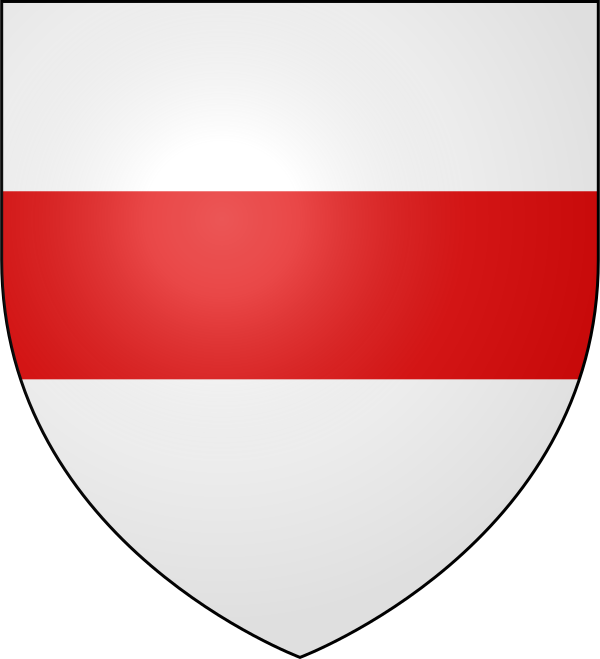
Ordinary in heraldic blazon in the form of a single, isolated horizontal band
In heraldry, a fess or fesse (from Middle English fesse, Old French faisse, and Latin fascia, "band") is a charge on a coat of arms (or flag) that takes the form of a band running horizontally across the centre of the shield. Writers disagree in how much of the shield's surface is to be covered by a fess or other ordinary, ranging from one-fifth to one-third. The Oxford Guide to Heraldry states that earlier writers including Leigh, Holme, and Guillim favour one-third, while later writers such as Edmondson favour one-fifth "on the grounds that a bend, pale, or chevron occupying one-third of the field makes the coat look clumsy and disagreeable." A fess is likely to be shown narrower if it is uncharged, that is, if it does not have other charges placed on it, and/or if it is to be shown with charges above and below it; and shown wider if charged. The fess or bar, termed fasce in French heraldry, should not be confused with fasces.
Gallery
File:Fess cotised demo.svg|Fess cottised File:Barrulet demo.svg|Two barrulets File:Bars gemelles demo.svg|Two bars gemelles File:Armoiries de Kerpen 1.svg|Fess indented File:Party per fess demo.svg|Party per fess File:Hungary Arms.svg|Barry of eight File:Blason-Rochechouart.svg|Barry wavy File:Heraldique blason ville fr rochechouart.svg|Barry nebuly
Diminutives
In English heraldry, two or more such charges appearing together on a shield are termed bars, though there are no definitive rules setting the width of the fess, the bar, nor their comparative width. A shield of (often six or eight) horizontal stripes of alternating colour is called barry. Narrower versions of the bar are called barrulets ("little bars"), and when a shield of horizontal stripes alternating colour is composed of ten or more stripes, it is called barruly or burely instead of barry. A cotise, defined as half the width of a barrulet, may be borne alongside a fess, and often two of these appear, one on either side of the fess. This is often termed "a fess cotised" (also cottised, coticed or cotticed). Another diminutive of the fess called a closet is said to be between a bar and barrulet, but this is seldom found.
Other uses
File:Tierced per fess demo.svg|Tierced per fess File:Coat of arms of Owain Gwynedd.svg|Three eagles in fess File:Stevenson arms.svg|A fleur-de-lys between two mullets in fess File:141 Signal Battalion DUI.PNG|A flaming arrow fesswise
A shield party per fess (or simply per fess) is divided in half horizontally (in the manner of a fess). A charge placed horizontally may be termed fesswise or fessways, and two or more charges arranged in a horizontal row are blazoned in fess or in bar.
Notable and unusual forms
A mural fess, that is a fess embattled and masoned of the field, can be seen in the arms of Suzanne Elizabeth Altvater.
The arms of Rennie Fritchie, Baroness Fritchie provide an example of three Barrulets fracted and there conjoined to a Chevronel.
A flag which has a central horizontal stripe that is half the height of the flag is sometimes said to have a Spanish fess. The name is based on the most well-known example of this style of flag, the flag of Spain.
Notes
References
- Fouché, Pierre. (1961). "Phonétique historique du français". Klincksieck.
- (2000). "Fess 1.". Houghton Mifflin Company.
- Woodcock & Robinson (1988), ''Oxford Guide to Heraldry'', p. 60.
- Woodcock & Robinson (1988), ''Oxford Guide to Heraldry'', p. 58.
- Parker, James. (1894). "Cottise". A Glossary of Terms Used in Heraldry.
- (1998-10-29). "Suzanne Elizabeth Altvater Grant of Arms". The Canadian Heraldic Authority.
- (2007-11-24). "Heraldry of New Life Peers". The Heraldry Society.
This article was imported from Wikipedia and is available under the Creative Commons Attribution-ShareAlike 4.0 License. Content has been adapted to SurfDoc format. Original contributors can be found on the article history page.
Ask Mako anything about Fess — get instant answers, deeper analysis, and related topics.
Research with MakoFree with your Surf account
Create a free account to save articles, ask Mako questions, and organize your research.
Sign up freeThis content may have been generated or modified by AI. CloudSurf Software LLC is not responsible for the accuracy, completeness, or reliability of AI-generated content. Always verify important information from primary sources.
Report