From Surf Wiki (app.surf) — the open knowledge base
Feret diameter
Measure of an object's size along a specified direction

Measure of an object's size along a specified direction
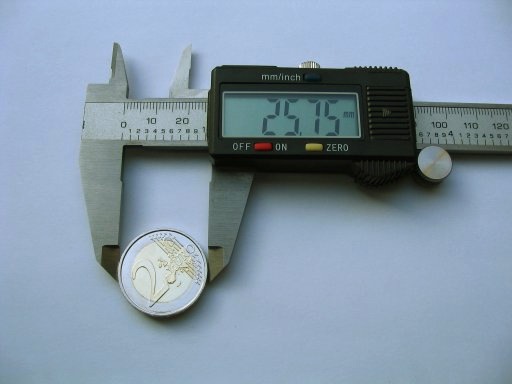

The Feret diameter or Feret's diameter is a measure of an object's size along a specified direction. In general, it can be defined as the distance between the two parallel planes restricting the object perpendicular to that direction. It is therefore also called the caliper diameter, referring to the measurement of the object size with a caliper. This measure is used in the analysis of particle sizes, for example in microscopy, where it is applied to projections of a three-dimensional (3D) object on a 2D plane. In such cases, the Feret diameter is defined as the distance between two parallel tangential lines rather than planes.
Mathematical properties
From Cauchy's theorem it follows that for a 2D convex body, the Feret diameter averaged over all directions (〈F〉) is equal to the ratio of the object perimeter (P) and pi, i.e.,〈F〉= P/. There is no such relation between〈F〉and P for a concave object.
Applications
Feret diameter is used in the analysis of particle size and its distribution, e.g. in a powder or a polycrystalline solid; alternative measures include Martin diameter, Krumbein diameter and Heywood diameter. The term first became common in scientific literature in the 1970s and can be traced to L.R. Feret (after whom the diameter is named) in the 1930s.
It is also used in biology as a method to analyze the size of cells in tissue sections.
References
References
- Henk G. Merkus. (1 January 2009). "Particle Size Measurements: Fundamentals, Practice, Quality". Springer.
- W. Pabst and E. Gregorová. [http://www.vscht.cz/sil/keramika/Characterization_of_particles/CPPS%20_English%20version_.pdf Characterization of particles and particle systems] {{Webarchive. link. (2013-07-17 . vscht.cz)
- Yasuo Arai. (31 August 1996). "Chemistry of Powder Production". Springer.
- M. R. Walter. (1 January 1976). "Stromatolites". [[Elsevier]].
- L. R. Feret La grosseur des grains des matières pulvérulentes, Premières Communications de la Nouvelle Association Internationale pour l’Essai des Matériaux, Groupe D, 1930, pp. 428–436.
This article was imported from Wikipedia and is available under the Creative Commons Attribution-ShareAlike 4.0 License. Content has been adapted to SurfDoc format. Original contributors can be found on the article history page.
Ask Mako anything about Feret diameter — get instant answers, deeper analysis, and related topics.
Research with MakoFree with your Surf account
Create a free account to save articles, ask Mako questions, and organize your research.
Sign up freeThis content may have been generated or modified by AI. CloudSurf Software LLC is not responsible for the accuracy, completeness, or reliability of AI-generated content. Always verify important information from primary sources.
Report