From Surf Wiki (app.surf) — the open knowledge base
Ferdinand I of Austria
Emperor of Austria from 1835 to 1848

Emperor of Austria from 1835 to 1848
| Field | Value |
|---|---|
| name | Ferdinand I & V |
| full name | |
| image | File:Leopold Kupelwieser - Kaiser Ferdinand I.jpg |
| caption | State portrait of Ferdinand I in the ceremonial robes of the Order of the Golden Fleece (by Leopold Kupelwieser, ) |
| succession | Emperor of Austria |
| King of Hungary | |
| moretext | (more...) |
| cor-type | Coronations |
| coronation | 28 September 1830, Pressburg |
| 7 September 1836, Prague | |
| 6 September 1838, Milan | |
| reign | 2 March 1835 2 December 1848 |
| predecessor | Francis I |
| successor | Franz Joseph I |
| succession1 | Head of the Präsidialmacht Austria |
| termstart | 2 March 1835 |
| termend | 12 July 1848 |
| predecessor | Francis I |
| successor | Franz Joseph I |
| spouse | |
| house | Habsburg-Lorraine |
| father | Francis II, Holy Roman Emperor |
| mother | Maria Theresa of Naples and Sicily |
| birth_date | |
| death_date | |
| birth_place | Vienna, Archduchy of Austria, Holy Roman Empire |
| death_place | Prague, Austria-Hungary |
| burial_place | Imperial Crypt |
| signature | Signatur Ferdinand I. (Österreich).PNG |
| religion | Roman Catholicism |
King of Hungary | cor-type = Coronations 7 September 1836, Prague 6 September 1838, Milan
Ferdinand I ( 19 April 1793 – 29 June 1875) was Emperor of Austria from March 1835 until his abdication in December 1848. He was also King of Hungary, Croatia and Bohemia (as Ferdinand V), King of Lombardy–Venetia and holder of other lesser titles (see grand title of the Emperor of Austria). Due to his passive but well-intentioned character, he gained the sobriquet The Benign () or The Benevolent (, Polish: Ferdynand Dobrotliwy).
Ferdinand succeeded his father Francis I upon his death on 2 March 1835. He was incapable of ruling the empire because of severe epilepsy, so his father, before he died, made a will promulgating that Ferdinand should consult his uncle Archduke Louis on all aspects of internal policy and urged him to be influenced by Prince Metternich, Austria's Foreign Minister.
Following the Revolutions of 1848, Ferdinand abdicated on 2 December 1848. He was succeeded by his nephew, Franz Joseph. Following his abdication, he lived in Hradčany Palace, Prague, until his death in 1875.
Ferdinand married Maria Anna of Savoy, the sixth child of Victor Emmanuel I of Sardinia. They had no children.
Biography
Early life
Ferdinand was the eldest son of Francis II, Holy Roman Emperor and Maria Theresa of Naples and Sicily. Possibly as a result of his parents' genetic closeness (they were double first cousins), Ferdinand had hydrocephalus, neurological problems including epilepsy, and a speech impediment. He was educated by Baron Josef Kalasanz von Erberg, and his wife Countess Josephine von Attems.
Reign

Although Ferdinand has been depicted as feeble-minded and incapable of ruling, he kept a coherent and legible diary and has even been said to have had a sharp wit. However, suffering as many as twenty seizures per day severely restricted his ability to rule with any effectiveness. Though he was not declared incapacitated, a Regent's Council (Archduke Louis, Count Kolowrat, and Prince Metternich) steered the government.
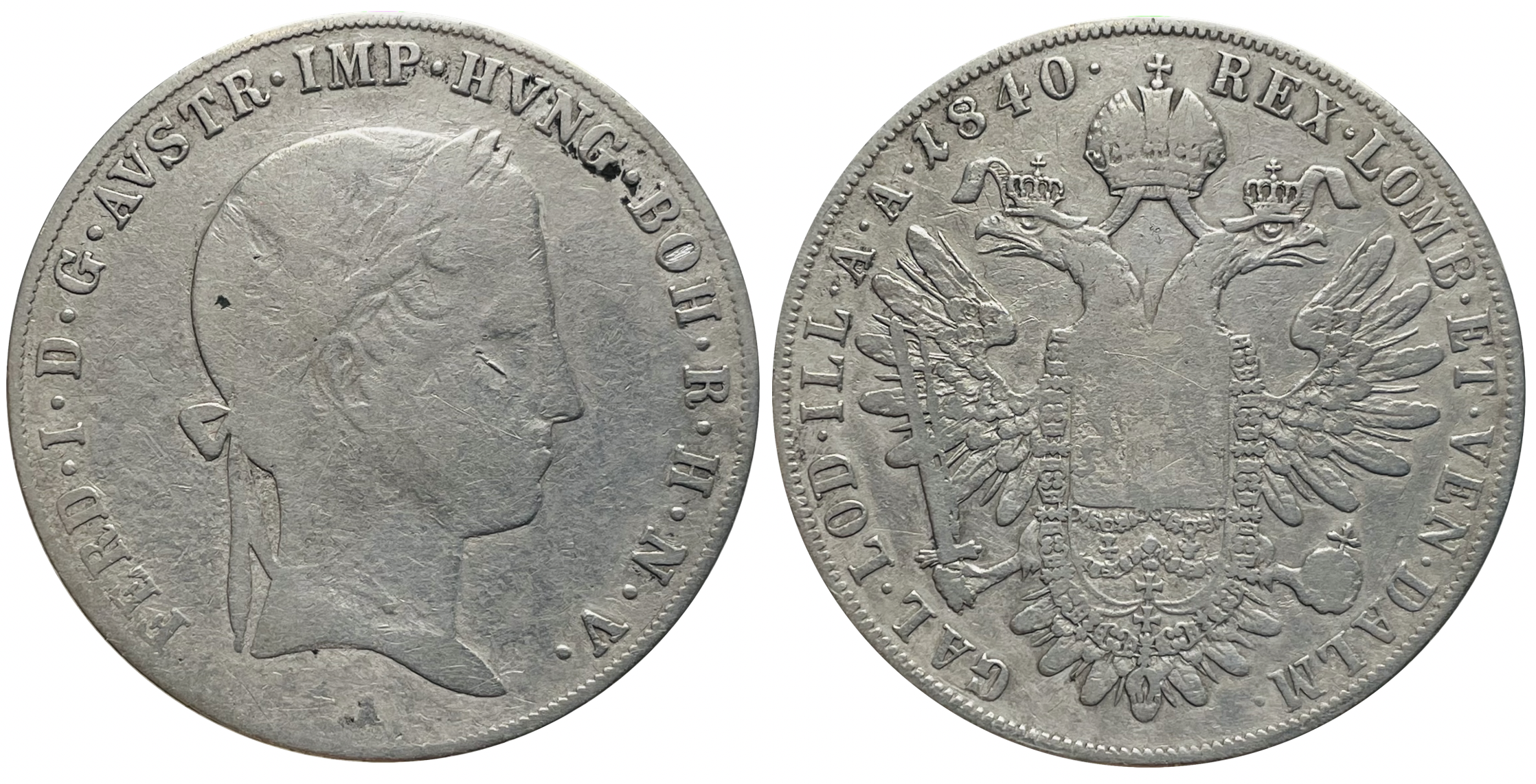
When Ferdinand married Princess Maria Anna of Savoy, the court physician considered it unlikely that he would be able to consummate the marriage. When he tried to consummate the marriage, he had five seizures. He is also remembered for his command to his cook: when told he could not have apricot dumplings (Marillenknödel) because apricots were out of season, he said "I am the Emperor, and I want dumplings!" (!).
1848 Revolution

As the revolutionaries of 1848 were marching on the palace, he is supposed to have asked Metternich for an explanation. When Metternich answered that they were starting a revolution, Ferdinand is supposed to have said "But are they allowed to do that?" (Viennese German: Ja, dürfen's denn des?). He was convinced by Prince Felix of Schwarzenberg to abdicate in favour of his nephew, Franz Joseph (the next in line was Ferdinand's younger brother Franz Karl, but he was persuaded by his wife Sophie to renounce his succession rights in favour of his son), who would occupy the Austrian throne for the next 68 years.
Ferdinand recorded the events in his diary:
The affair ended with the new Emperor kneeling before his old Emperor and Lord, that is to say, me, and asking for a blessing, which I gave him, laying both hands on his head and making the sign of the Holy Cross ... then I embraced him and kissed our new master, and then we went to our room. Afterwards I and my dear wife heard Holy Mass ... After that I and my dear wife packed our bags.
In retirement (1848–1875)


Ferdinand was the last King of Bohemia to be crowned as such. Due to his sympathy with Bohemia (where he spent the rest of his life in Prague Castle) he was given the Czech nickname "Ferdinand V, the Good" (Ferdinand Dobrotivý). In Austria, Ferdinand was similarly nicknamed "Ferdinand der Gütige" (Ferdinand the Benign), but also ridiculed as "Gütinand der Fertige" (Goodinand the Finished).
Ferdinand was also the last ruler to be crowned with the Iron Crown of Lombardy in his capacity as King of Lombardy-Venetia.
He is interred in tomb number 62 in the Imperial Crypt in Vienna.
Honours
- Austrian Empire:
- Knight of the Golden Fleece, 1793
- Grand Cross of the Royal Hungarian Order of St. Stephen, 1830
- Grand Cross of the Imperial Order of Leopold
- Knight of the Iron Crown, 1st Class
- France:
- Flag of France (1794–1815, 1830–1958).svg French Empire: Grand Eagle of the Legion of Honour
- Pavillon royal de France.svg Kingdom of France: Knight of the Holy Spirit, 1816
- Kingdom of Bavaria: Knight of St. Hubert, 1824
- Duchy of Parma: Senator Grand Cross of the Constantinian Order of St. George, with Collar, 1826
- Grand Duchy of Hesse: Grand Cross of the Ludwig Order, 11 April 1830
- Hesse Electorate of Hesse: Grand Cross of the Golden Lion, 26 December 1830
- Baden:
- Grand Cross of the House Order of Fidelity, 1830
- Grand Cross of the Zähringer Lion, 1830
- Kingdom of Saxony: Knight of the Rue Crown, 1830
- Two Sicilies:
- Knight of St. Januarius, 1830
- Grand Cross of St. Ferdinand and Merit
- Württemberg: Knight of the Golden Eagle, 1830
- Kingdom of Sardinia: Knight of the Annunciation, 12 January 1831
- Flag of the Kingdom of Prussia (1803-1892).svg Kingdom of Prussia: Knight of the Black Eagle, 24 January 1831
- Denmark: Knight of the Elephant, 1 February 1831
- Empire of Brazil: Grand Cross of the Southern Cross
- Flag of Portugal (1750).svg Kingdom of Portugal:
- Grand Cross of the Royal Military Order of Our Lord Jesus Christ
- Grand Cross of the Tower and Sword
- Russian Empire: Knight of St. Andrew, 28 February 1835
- Saxe-Weimar-Eisenach: Grand Cross of the White Falcon, 2 April 1835
- Sweden Sweden-Norway: Knight of the Seraphim, 14 April 1835
- Saxe-Coburg and Gotha Saxe-Altenburg Saxe-Meiningen Ernestine duchies: Grand Cross of the Saxe-Ernestine House Order, May 1835
- Flag of Anhalt Duchies.png Ascanian duchies: Grand Cross of Albert the Bear, 18 March 1837
- Kingdom of Hanover:
- Knight of St. George, 1847
- Grand Cross of the Royal Guelphic Order, 1847
- Spain: Grand Cross of the Order of Charles III, 23 April 1849
- Tuscany Grand Duchy of Tuscany: Grand Cross of St. Joseph
Ancestry

Ferdinand's parents were double first cousins as they shared all four grandparents (Francis' paternal grandparents were his wife's maternal grandparents and vice versa). Therefore, Ferdinand only had four great-grandparents, being descended from each of them twice. Further back in his ancestry there is more pedigree collapse due to the close intermarriage between the Houses of Austria and Spain and other Catholic monarchies.
References
References
- {{cite EB1911
- Thomas Nipperdey: Deutsche Geschichte 1800-1866. Bürgerwelt und starker Staat, C.H. Beck, broschierte Sonderausgabe 1998, S. 339.
- [[A. J. P. Taylor. Taylor, A. J. P.]]: "The Habsburg Monarchy 1809-1918" (Penguin Books, Great Britain, 1990, {{ISBN. 978-0-14-013498-8), pp 52-53
- van der Kiste, p. 16
- Grafenauer, Bogo. (1925–1991). "Erberg Jožef Kalasanc baron".
- van der Kiste, John. ''Emperor Francis Joseph'' London: Sutton Publishing, 2005 {{ISBN. 0-7509-3787-4. p 2
- According to A.J.P. Taylor, he was in fact asking for ''noodles'' - "But it is an unacceptable pun in English for a noodle to ask for noodles" - ''The Habsburg Monarchy 1809–1918''
- Regan, Geoffrey. ''Royal Blunders'' page 72
- (1834). "Hof- und Staatshandbuch des Kaiserthumes Österreich".
- Boettger, T. F.. "Chevaliers de la Toisón d'Or - Knights of the Golden Fleece".
- [http://tornai.com/rendtagok.htm "A Szent István Rend tagjai"] {{webarchive. link. (22 December 2010)
- (1863). "Liste chronologique des chevaliers de l'ordre du Saint-Esprit depuis son origine jusqu'à son extinction (1578-1830)". Annuaire-bulletin de la Société de l'Histoire de France.
- (1833). "Hof- und Staatshandbuch des Königreichs Bayern: 1833". Landesamt.
- (1858). "Almanacco di corte".
- (1858). "Hof- und Staatshandbuch des Großherzogtums Hessen: für das Jahr ... 1858".
- Hessen-Kassel. (1858). "Kurfürstlich Hessisches Hof- und Staatshandbuch: 1858". Waisenhaus.
- ''Hof- und Staats-Handbuch des Großherzogtum Baden'' (1834), "Großherzogliche Orden" [https://digital.blb-karlsruhe.de/blbihd/periodical/pageview/1866769 pp. 32], [https://digital.blb-karlsruhe.de/blbihd/periodical/pageview/1866787 50]
- Sachsen. (1866). "Staatshandbuch für den Freistaat Sachsen: 1865/66". Heinrich.
- Angelo Scordo. "Vicende e personaggi dell'Insigne e reale Ordine di San Gennaro dalla sua fondazione alla fine del Regno delle Due Sicilie".
- Württemberg. (1858). "Königlich-Württembergisches Hof- und Staats-Handbuch: 1858". Guttenberg.
- Luigi Cibrario. (1869). "Notizia storica del nobilissimo ordine supremo della santissima Annunziata. Sunto degli statuti, catalogo dei cavalieri". Eredi Botta.
- ''Liste der Ritter des Königlich Preußischen Hohen Ordens vom Schwarzen Adler'' (1851), "Von Seiner Majestät dem Könige Friedrich Wilhelm III. ernannte Ritter" [https://www.digitale-sammlungen.de/de/view/bsb10362193?page=29 p. 19]
- J ..... -H ..... -Fr ..... Berlien. (1846). "Der Elephanten-Orden und seine Ritter". Berling.
- "Grand Crosses of the Order of the Tower and Sword".
- ''Staatshandbuch für das Großherzogtum Sachsen / Sachsen-Weimar-Eisenach'' (1864), "Großherzogliche Hausorden" p. [https://web.archive.org/web/20200619060201/https://zs.thulb.uni-jena.de/rsc/viewer/jportal_derivate_00183895/Staatshandbuch_Film_Nr_13_0429.tif 11]
- (1864). "Sveriges och Norges Statskalender".
- (1843). "Adreß-Handbuch des Herzogthums Sachsen-Coburg und Gotha". Meusel.
- Anhalt-Köthen. (1851). "Staats- und Adreß-Handbuch für die Herzogthümer Anhalt-Dessau und Anhalt-Köthen: 1851". Katz.
- Staat Hannover. (1865). "Hof- und Staatshandbuch für das Königreich Hannover: 1865". Berenberg.
- (1868). "Guía Oficial de España".
- (1855). "Almanacco Toscano per l'anno 1855". Stamperia Granducale.
- {{BLKO
- {{BLKO
- {{BLKO
- {{BLKO
- (1768). "Genealogie ascendante jusqu'au quatrieme degre inclusivement de tous les Rois et Princes de maisons souveraines de l'Europe actuellement vivans". Frederic Guillaume Birnstiel.
This article was imported from Wikipedia and is available under the Creative Commons Attribution-ShareAlike 4.0 License. Content has been adapted to SurfDoc format. Original contributors can be found on the article history page.
Ask Mako anything about Ferdinand I of Austria — get instant answers, deeper analysis, and related topics.
Research with MakoFree with your Surf account
Create a free account to save articles, ask Mako questions, and organize your research.
Sign up freeThis content may have been generated or modified by AI. CloudSurf Software LLC is not responsible for the accuracy, completeness, or reliability of AI-generated content. Always verify important information from primary sources.
Report