From Surf Wiki (app.surf) — the open knowledge base
Female urination device
Device which aids a person with a vagina to urinate while standing upright

Device which aids a person with a vagina to urinate while standing upright
A female urination device (FUD{{cite web | archive-url = https://web.archive.org/web/20230215222514/https://menstrualcupreviews.net/best-female-urination-devices-pee-funnels-reviews/ | archive-date = 2023-02-15 | access-date = 2023-05-07 | url-status = live
In addition, fixed installation and relocatable urinals are available for use by females. Some designs require the user to supply their own personal female urination device, while other designs do not have this expectation.
Portable devices
Female urination devices are marketed towards many different groups. For sports and recreation they are sold for camping, traveling, snow sports, caving, rock climbing, diving, hunting/fishing, festivals, long car journeys, and any kind of outdoor pursuit where the toilet facilities are absent or less than desirable. People with physical restrictions such as recovery from hip surgery, broken bones, or those who find it challenging to sit or squat also benefit from these devices.
Since 2005, numerous personal urination devices have appeared on the market. Products come in a variety of designs and materials such as plastic, rubber, silicone and paper; some are reusable and some are disposable. Several devices have been marketed for medical applications, and are sometimes available on prescription.
Occupationally, urinary devices are used by first responders, armed forces, and other outdoor jobs. Some brands are NATO approved, and are supplied to military personnel.
Such devices are used by trans men as "stand-to-pee" devices, or STPs, often to combat gender dysphoria. More discreet solutions such as the "Snee-Kee" are specifically marketed for this purpose. Some stand-to-pee devices mimic the appearance of a penis and double as packers.
Biological males may also want a urinary funnel if they have medical conditions that make it challenging or impossible for them to stand and pee.
File:Travelmate.jpg|Travelmate File:Turquoise pStyle - Personal Urination Device.jpg|pStyle File:Paper pee.jpg|Paper pee File: Fusionella.jpg|Fusionella
Female urinals
Main article: Female urinal
Urinals for a greater variety of bodies have advantages of quick and hygienic use, water conservation, and less need for physical space. Speed of use can be especially important when there is high peak demand, such as in music festivals, theatrical events, sports stadiums, discos, dance clubs, and convention halls.
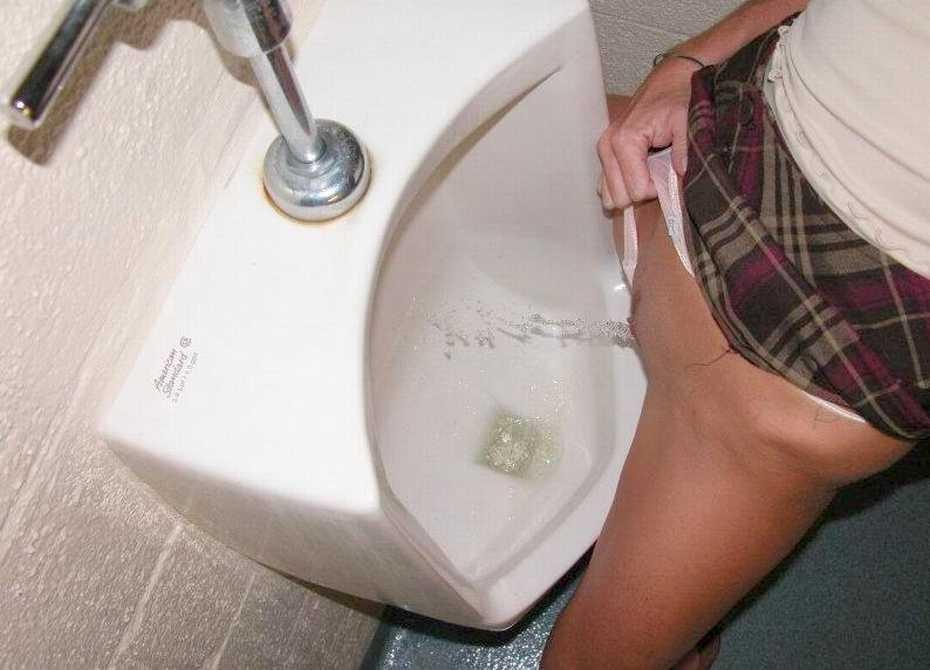
Special fixed installation designs for female urinals have long been available, supplemented more recently by portable designs. Some designs, including squat toilets, have been considered "unisex", usable by either gender. The fixed designs are typically used by women in a "hovering" posture, standing over them with knees slightly bent.
In addition, small portable urinals including sealable collection containers have been available in female-only and unisex versions. They are often used for travel when immediate disposal is difficult. Initially, medical or hospital devices were pressed into service, but designs specially made for travel eventually appeared. They are used in small aircraft, and for extended stakeouts, such as in a hunting blind or a wildlife observation station.
Conventional urinals which have been designated exclusively for female urination device users have become popular in recent years, including at some major public events where providing adequate toilet facilities is difficult, such as outdoors festivals. To expedite usage, trough urinals may be installed, which the women are expected to use while standing, with small personal female urination devices. Pinkpop 2000 was the first event to accommodate large numbers of female urination devices, and the practice has now spread to events in the Netherlands, Belgium, Switzerland, Canada, Finland, Ireland, and the UK.
File:Unisex Urinals.jpg|Unisex urinals File:Female Urinal.jpg|Female urinal at Dortmund Airport, Dortmund, Germany File:Girls Urinal - Stones to help younger girls to use the urinal (5507174199).jpg|Low-cost female urinal with stones to adjust height File:Waterless urinal for females (5880398360).jpg|Waterless urinal for women File:Girls urinal (5051362314).jpg|Girls' school urinal in Kenya File:Thiruvalluvar school orathur (5075089458).jpg|Girls' school urinal in Tamil Nadu, India File:Pollee female urinal.jpg|Pollee outdoor female urinals File:Pissing Veronika.jpg|Woman uses an outdoor portable urinal File:Mobile urinal for females in Ouagadougou (2963781021).jpg|Movable women's urinal File:Urinals Women.jpg|Women's restroom File:Female urinals.jpg|Female urinals in Mexico File:Femaleurinal.jpg|Modern urinals for women
History
It is possible for a woman to aim her urine from a standing position without using a device. This was the norm in much earlier times, and standing to urinate was commonplace in certain cultures and situations, but this practice is no longer the norm in Western society. Changes to women's clothing in the twentieth century made the use of urination aids practical for women who wanted to urinate while standing.
Disposable female urination devices were patented as far back as 1922. The "Sanitary Protector" filed for in August 1918 by Edyth Lacy, specifies a "cheap device ...[to be] used but once, being especially suitable as a sanitary device in public toilet rooms." She notes that it is "accordingly unnecessary for the user to sit upon the closet seat; and the urine is led off without danger of soiling the clothes of the user or the closet". It was to be "made of a cheap readily destructible material, such as stiff paper, which can be readily disposed of after its use".
A similar device was patented in 1956: "an efficient urine conductor for use by females eliminating all need for contacting a toilet facility...usable while in a comfortable, erect standing position".US Patent 2878486 Sanitary device (January 1956) Another half a dozen devices with the same basic purpose and form were patented by the end of the century.For example:
- US Patent 3964111 Urine conducting apparatus (June 1976)
- US Patent 3995329 Female urinary device (December 1976)
- US Patent 4756029 Feminine urinary device (July 1988)
- US Patent 5370637 Collapsible female urination aid (December 1994)
- US Patent 5408703 Female urination aid (April 1995)
- US Patent 5966748 Tinkle Safe (October 1999)
- US Patent 6434757 Female standing urination cone (October 2000)
The Urinelle, which originates from France, appeared in 1996 and was the first to have mainstream manufacturing.
File:Hetaera urinating into a skyphos at a Kylix by the Foundry Painter Antikensammlung Berlin.jpg|Greek hetaera urinates into skyphos () File:François Boucher - La Toilette intime (Une Femme qui pisse), 1760s.jpg|18th-century woman stands while urinating into chamber pot
References
References
- (2013-02-12). "Hudson's FTM Resource Guide".
- (2006-01-24). "Nieuwe kansen voor plastuit".
- Carol Olmert. ''Bathrooms Make me Nervous''. 2008. p.121
- [https://patents.google.com/patent/US1407872 US Patent 1407872] Sanitary Protector (February 1922)
- "Urinelle – the urination funnel for women".
This article was imported from Wikipedia and is available under the Creative Commons Attribution-ShareAlike 4.0 License. Content has been adapted to SurfDoc format. Original contributors can be found on the article history page.
Ask Mako anything about Female urination device — get instant answers, deeper analysis, and related topics.
Research with MakoFree with your Surf account
Create a free account to save articles, ask Mako questions, and organize your research.
Sign up freeThis content may have been generated or modified by AI. CloudSurf Software LLC is not responsible for the accuracy, completeness, or reliability of AI-generated content. Always verify important information from primary sources.
Report