From Surf Wiki (app.surf) — the open knowledge base
Federation of South Arabia
1962–67 British protectorate in southwest Arabia
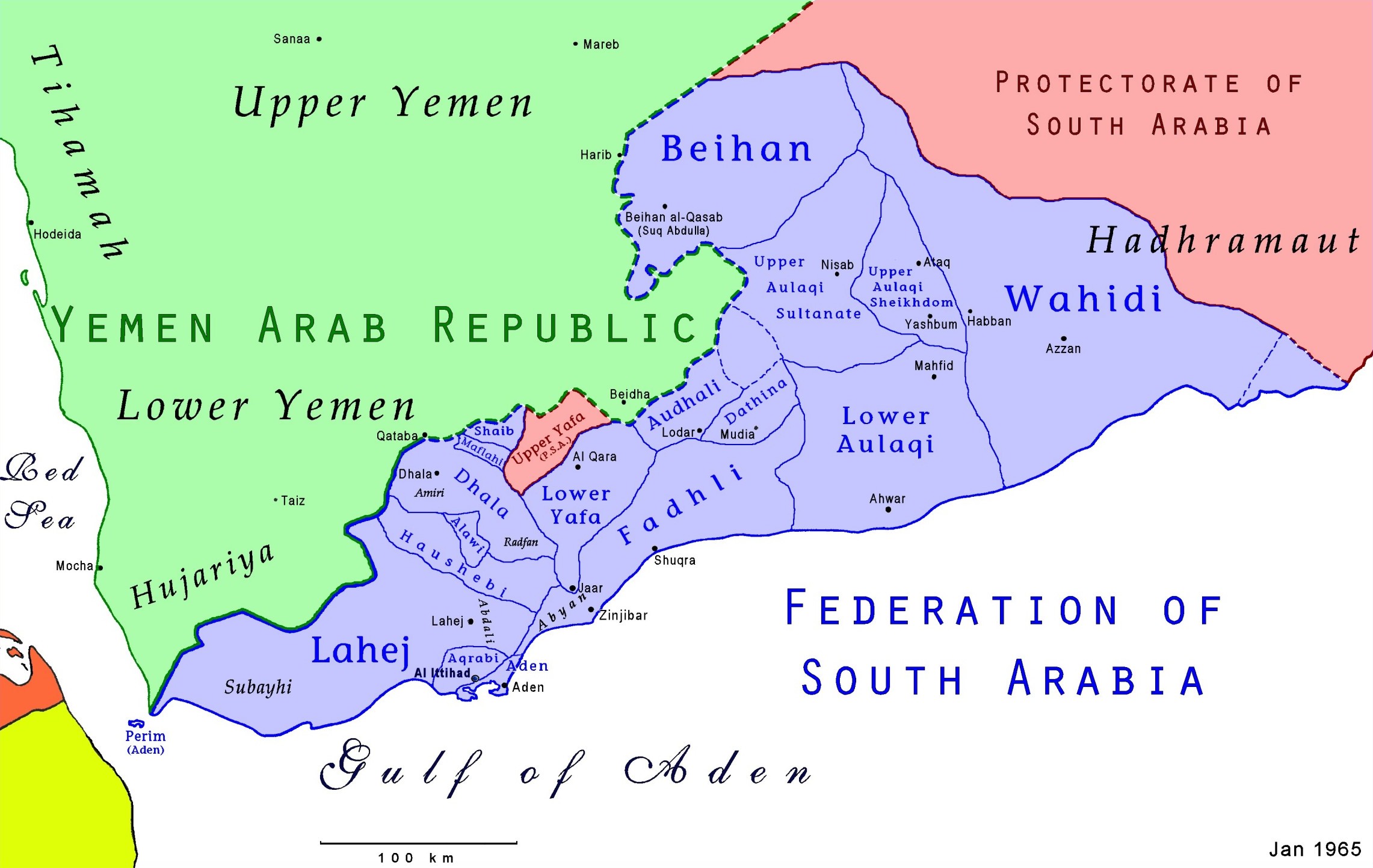
1962–67 British protectorate in southwest Arabia
| Field | Value |
|---|---|
| native_name | اتحاد الجنوب العربي |
| ar | |
| conventional_long_name | Federation of South Arabia |
| common_name | South Arabia |
| era | Cold War |
| status | British protectorate |
| empire | United Kingdom |
| government_type | Federal monarchy |
| year_leader1 | 1963–1967 |
| representative1 | Sir Charles Johnston |
| representative2 | Sir Kennedy Trevaskis |
| representative3 | Sir Richard Turnbull |
| representative4 | Sir Humphrey Trevelyan |
| year_representative1 | 1963 |
| year_representative2 | 1963–1964 |
| year_representative3 | 1964–1967 |
| year_representative4 | 1967 |
| title_representative | High Commissioner |
| title_deputy | Chief Minister |
| deputy1 | Hassan Ali Bayumi |
| year_deputy1 | 1963 |
| deputy2 | Zayn Abdu Baharun |
| year_deputy2 | 1963–1965 |
| deputy3 | Abdul-Qawi Hassan Makkawi |
| year_deputy3 | 1965 |
| deputy4 | Ali Musa al-Babakr |
| year_deputy4 | 1965–1966 |
| deputy5 | Salih al-Awadli |
| year_deputy5 | 1966–1967 |
| year_start | 1962 |
| date_start | 4 April |
| event_end | Independence |
| year_end | 1967 |
| date_end | 30 November |
| p1 | Colony of Aden |
| flag_p1 | Flag of Aden (1937–1963).svg |
| p2 | Federation of the Emirates of South Arabia |
| flag_p2 | Flag of the Federation of Arab Emirates of the South.svg |
| p3 | Upper Aulaqi Sultanate |
| s1 | South Yemen |
| flag_s1 | Flag of South Yemen.svg |
| today | Yemen |
| image_flag | Flag of the Federation of South Arabia.svg |
| flag | Flag of Yemen |
| image_coat | Coat of Arms of the Federation of South Arabia.svg |
| symbol | Emblem of Yemen#Federation of South Arabia |
| symbol_type | Emblem |
| image_map | Federation of South Arabia in its region.svg |
| map_width | 250px |
| common_languages | Arabic |
| English | |
| capital | Aden |
| currency | East African shilling (until 1 April 1965) |
| South Arabian dinar |
ar English South Arabian dinar
.jpg)
The Federation of South Arabia (FSA; ar) was a federal state under British protection in what would become South Yemen. Its capital was Aden.
History
It was formed on April 4, 1962, from 15 states of the Federation of Arab Emirates of the South. On January 18, 1963, the Royal Colony of Aden joined it. After the annexation of the Upper Aulaki Sultanate in June 1964, the federation included 17 states.
-- On July 23, 1962, negotiations began in London between the British Minister of Colonies, Duncan Sandys, and the ministers of the Federation of South Arabia and the Colony of Aden. The parties raised the issue of the constitutional status of Aden and the conditions for its entry into the federation. Numerous parties and organizations in Aden protested against these negotiations, declaring that the colonial ministers did not have the right to decide the fate of the population of Aden and that only the national government of Aden, created by general elections, would be competent to decide the question of a union with the federation. To achieve all this, it was necessary to eliminate its dependence on Britain. Representatives of the opposition, led by the Aden Trade Union Congress, said that any union concluded against the will of the people of Aden would be dissolved at the first opportunity. On the day the London negotiations began, a protest strike was declared in Aden. The Aden Trade Union Congress called for this strike, despite the fact that Aden had had a law prohibiting strikes since 1960, and violators were subject to imprisonment.
On August 16, 1962, negotiations ended with the signing of an agreement, according to which Aden, while remaining under British sovereignty, was to become part of the Federation of South Arabia on March 1, 1963. The agreement provided that the federation agreement, signed on February 11, 1959, will remain in force, and the new agreement will be only an addition to it. During these negotiations, agreement was also reached to introduce minor changes to the constitutional status of Aden once it became part of the federation.
In 1965, the British temporarily removed the government of the Federation of South Arabia and imposed direct colonial rule.
In 1966, the Federation team took part in the Commonwealth Games in Kingston, Jamaica. The Federation was dissolved following independence along with the Protectorate of South Arabia and the formation of the People's Democratic Republic of Yemen on November 30, 1967.
States
| Flag | Name | Established | Joined | Notes | ||||
|---|---|---|---|---|---|---|---|---|
| [[File:Flag of the State of Aden 1963–1967.svg | alt= | 150x150px]] | State of Aden | 1963 | ||||
| [[File:علم مشيخة العلوي.png | alt= | center | frameless | 150x150px]] | Alawi Sheikhdom | unknown | ||
| [[File:علم مشيخة العقربي.png | alt= | center | frameless | 150x150px]] | Aqrabi Sheikhdom | 1770 | ||
| [[File:Flag of .svg | alt= | 150x150px]] | Audhali Sultanate | 18th century | ||||
| [[File:Flag of Beihan.svg | alt= | 150x150px]] | Emirate of Beihan | 1680 | ||||
| [[File:علم جمهورية دثينة.png | frameless | 151x151px]] | Dathina Sheikhdom | 18th century | ||||
| [[File:Flag of Dhala.svg | alt= | 150x150px]] | Emirate of Dhala | early 19th century | ||||
| [[File:Flag of the Sultanate of Fadhli.svg | alt= | 150x150px]] | Fadhli Sultanate | 17th century | ||||
| [[File:Flag of Haushabi - Yemen.png | alt= | 150x150px]] | Haushabi Sultanate | 18th century | ||||
| [[File:Flag of the Sultanate of Lahej.svg | alt= | 150x150px]] | Sultanate of Lahej | 1728 | 1872 | formerly ruled over Aden | ||
| [[File:Lower `Awlaqi.png | alt= | center | frameless | 150x150px]] | Lower Aulaqi Sultanate | 18th century | ||
| [[File:Flag of Lower Yafa.svg | alt= | 150x150px]] | Sultanate of Lower Yafa | ca. 1800 | ||||
| [[File:Flag of .svg | alt= | 150x150px]] | Muflahi Sheikhdom | 1850 | ||||
| [[File:Flag of .svg | alt= | 150x150px]] | Sheikhdom of Shaib | 18th century | ||||
| [[File:Flag of .svg | alt= | 150x150px]] | Upper Aulaqi Sheikhdom | 18th century | ||||
| [[File:Flag of .svg | alt= | 150x150px]] | Upper Aulaqi Sultanate | 18th century | ||||
| [[File:Flag of Wahidi Balhaf.svg | alt= | 150x150px]] | Wahidi Sultanate | 1830 | consisted originally of four sub-sultanates: Wahidi Balhaf, Wahidi Azzan, Wahidi Bir Ali, Wahidi Haban |
List of rulers
| State | Last Ruler | Deposed | House | Reign | Ref(s) | Salih ibn Sayil | Mahmud ibn Muhammad | Salih ibn al-Husayn | Nasir ibn Aidrus | Awad ibn Salih | Saleh bin al-Husayn | Shafaul ibn Ali Shaif | Nasir bin Abdullah | Faisal bin Surur | Fadhl VI bin Ali | Ali ibn Muhammad | Alawi ibn Salih | Husayn ibn Abdullah | Mahmud ibn Aidrus |
|---|---|---|---|---|---|---|---|---|---|---|---|---|---|---|---|---|---|---|---|
| علم_مشيخة_العلوي.png Alawi | 28 August 1967 | Al Alawi | Last reigning Sheikh (1940–1967). | ||||||||||||||||
| علم_مشيخة_العقربي.png Aqrabi | 28 August 1967 | Al Aqrabi | Last reigning Sheikh (1957–1967). | ||||||||||||||||
| Flag of .svg Audhali | 17 September 1967 | Al Audhali | Last reigning Sultan (1928–1967). | ||||||||||||||||
| Lower_`Awlaqi.png Lower Aulaqi | 29 November 1967 | Al Awlaqi | Last reigning Sultan (1947–1967). | ||||||||||||||||
| Flag of .svg Upper Aulaqi | 29 November 1967 | Al Awlaqi | Last reigning Sultan (1935–1967). | ||||||||||||||||
| Flag of Beihan.svg Beihan | 28 August 1967 | Al Habieli | Last reigning Emir (1935–1967). | ||||||||||||||||
| Flag of Dhala.svg Dhala | 17 August 1967 | Al Amiri | Last reigning Emir (1954–1967). | ||||||||||||||||
| Flag of the Sultanate of Fadhli.svg Fadhli | 29 November 1967 | Al Fadhli | Last reigning Sultan (1964–1967). | ||||||||||||||||
| Flag of Haushabi - Yemen.png Haushabi | 29 November 1967 | Al Haushabi | Last reigning Sultan (1955–1967). | ||||||||||||||||
| Flag of the Sultanate of Lahej.svg Lahej | 17 August 1967 | Al Abdali | Last reigning Sultan (1958–1967). | ||||||||||||||||
| Flag of Wahidi Balhaf.svg Wahidi Balhaf | 17 August 1967 | Al Wahidi | Last governing Hakim (1967). | ||||||||||||||||
| Flag of Wahidi Balhaf.svg Wahidi Bir Ali | 29 November 1967 | Last reigning Sultan (1955–1967). | |||||||||||||||||
| Flag of Wahidi Haban.svg Wahidi Haban | 29 November 1967 | Last reigning Sultan (until 1967). | |||||||||||||||||
| Flag of Lower Yafa.svg Lower Yafa | 28 August 1967 | Al Afifi | Last reigning Sultan (1954–1967). |
Chief Ministers
- Hassan Ali Bayumi (18 January 1963 – 24 June 1963)
- Zayn Abdu Baharun (9 July 1963 – 23 January 1965)
- Abdul-Qawi Hassan Makkawi (7 March 1965 – 25 September 1965)
- Ali Musa al-Babakr (25 September 1965 – 30 August 1966)
- Salih al-Awadli (30 August 1966 – 30 November 1967)
High Commissioners
Main article: List of British representatives at Aden
- Sir Charles Johnston (18 January 1963 – 17 July 1963)
- Sir Kennedy Trevaskis (17 July 1963 – 21 December 1964)
- Sir Richard Turnbull (21 December 1964 – 22 May 1967)
- Sir Humphrey Trevelyan (22 May 1967 – 30 November 1967)
Postage stamps

The Federation issued its own Adeni postage stamps from 1963 to 1966. Most of its issues were part of the omnibus issues common to all the Commonwealth territories, but it did issue its own definitive stamps on 1 April 1965. The set of 14 included 10 values, from 5 to 75 fils, each depicting the arms of the Federation in a single color, while the top four values (100 fils, 250 fils, 500 fils, and 1 dinar), featured the flag of the Federation.
The stamps referred to above are those listed in the Scott Standard Postage Stamp Catalog. A number of other stamps have also been issued and are listed in Stanley Gibbons and other widely used stamp catalogs. It is possible, or even likely, that some of the stamps of South Arabia were not issued primarily for postal use.
References
References
- [https://discovery.nationalarchives.gov.uk/details/record?catid=-4503013&catln=7 Parliament Building in Al Ittihad, the capital of the Federation of South Arabia]
- "LiveJournal >> Аден / Последняя битва Империи – Нортумберлендские фузилёры в Кратере.".
- «The Times» (24.VII.1962), p. 8.
- «Aden Chronicle» (July 12, 1962), p. 1.
- «Aden Chronicle» (August 23, 1962), p. 3.
- «Aden Chronicle» (October 4, 1962), pp. 1, 28.
- Dean, Lucy (2004). "The Middle East and North Africa". Издание 2004 года. Routledge. Страница 1211. {{ISBN. 978-1-85743-184-1
- Cahoon, Ben. "States of the Aden Protectorates". World Statesmen.org.
- (1988). "A Collection of First World War Military Handbooks of Arabia, 1913–1917". Archive Editions.
This article was imported from Wikipedia and is available under the Creative Commons Attribution-ShareAlike 4.0 License. Content has been adapted to SurfDoc format. Original contributors can be found on the article history page.
Ask Mako anything about Federation of South Arabia — get instant answers, deeper analysis, and related topics.
Research with MakoFree with your Surf account
Create a free account to save articles, ask Mako questions, and organize your research.
Sign up freeThis content may have been generated or modified by AI. CloudSurf Software LLC is not responsible for the accuracy, completeness, or reliability of AI-generated content. Always verify important information from primary sources.
Report