From Surf Wiki (app.surf) — the open knowledge base
Federated Malay States
British protected state and part of British Malaya
.svg)
British protected state and part of British Malaya
| Field | Value |
|---|---|
| native_name | ms |
| conventional_long_name | Federated Malay States |
| common_name | Federated Malay States |
| empire | United Kingdom |
| status | protected state |
| status_text | Federal protected state of the British Empire |
| era | British Empire |
| life_span | 1895–1942 |
| 1942–1945 (Japanese occupation) | |
| 1945–1946 | |
| year_start | 1895 |
| event_start | Federated |
| year_end | 1946 |
| date_end | 1 April |
| event_end | Malayan Union |
| event1 | Treaty of Federation |
| date_event1 | 1 July 1896 |
| event2 | Japanese occupation |
| date_event2 | 15 February 1942 – 2 September 1945 |
| event3 | Japanese surrender |
| date_event3 | 2 September 1945 |
| p1 | Selangor |
| p2 | Perak |
| p3 | Negeri Sembilan |
| p4 | Pahang |
| flag_p1 | Flag of Selangor (pre 1965).svg |
| flag_p2 | Flag of Perak.svg |
| flag_p3 | Flag of Negeri Sembilan.svg |
| flag_p4 | Flag of Pahang (1887 - 1903).svg |
| s1 | Japanese occupation of Malaya1942: |
| Japanese occupation of Malaya | |
| flag_s1 | Flag of Japan (1870–1999).svg |
| s2 | British Military Administration (Malaya)1945: |
| British Military Administration (Malaya) | |
| flag_s2 | Flag of the United Kingdom.svg |
| s3 | Malayan Union1946: |
| Malayan Union | |
| flag_s3 | Flag of Malaya (1896–1950).svg |
| flag | Flag of Federated Malay States |
| symbol | Coat of arms of Federated Malay States |
| image_flag | Flag of Malaya (1896–1950).svg |
| image_coat | File:Coat of arms of the Federated Malay States.png |
| image_map | British Malaya circa 1922 en.svg |
| image_map_caption | British Malaya in 1922: |
| <div style | "margin: 0 auto; text-align: left; width: 15em;" |
| national_motto | Dipelihara Allah |
| () | |
| capital | Kuala Lumpur1 |
| religion | Sunni Islam |
| Christianity | |
| Buddhism | |
| Taoism (including Chinese folk religion) | |
| Hinduism | |
| legislature | Federal Legislative Council |
| type_house1 | State level |
| common_languages | |
| government_type | Constitutional monarchy |
| title_leader | Monarch |
| leader1 | Victoria |
| year_leader1 | 1895–1901 (first) |
| leader2 | George VI |
| year_leader2 | 1936–1942; 1945–1946 (last) |
| title_deputy | Resident General |
| deputy1 | Sir Frank Swettenham |
| year_deputy1 | 1896–1901 (first) |
| deputy2 | Hugh Fraser |
| year_deputy2 | 1939–1942 (last) |
| stat_pop2 | 1,597,700 |
| stat_year2 | 1933 |
| currency | Straits dollar (1898–1939) |
| Malayan dollar (1939–1942; 1945–1946) | |
| today | Malaysia |
| footnotes | 1 Also the state capital of Selangor |
| ² Malay using Jawi script, although Rumi script is commonly used as well. | |
| ³ Later Chief Secretaries to the Government and Federal Secretaries |
1942–1945 (Japanese occupation) 1945–1946 Japanese occupation of Malaya British Military Administration (Malaya) Malayan Union () Christianity Buddhism Taoism (including Chinese folk religion) Hinduism Malayan dollar (1939–1942; 1945–1946) ² Malay using Jawi script, although Rumi script is commonly used as well. ³ Later Chief Secretaries to the Government and Federal Secretaries
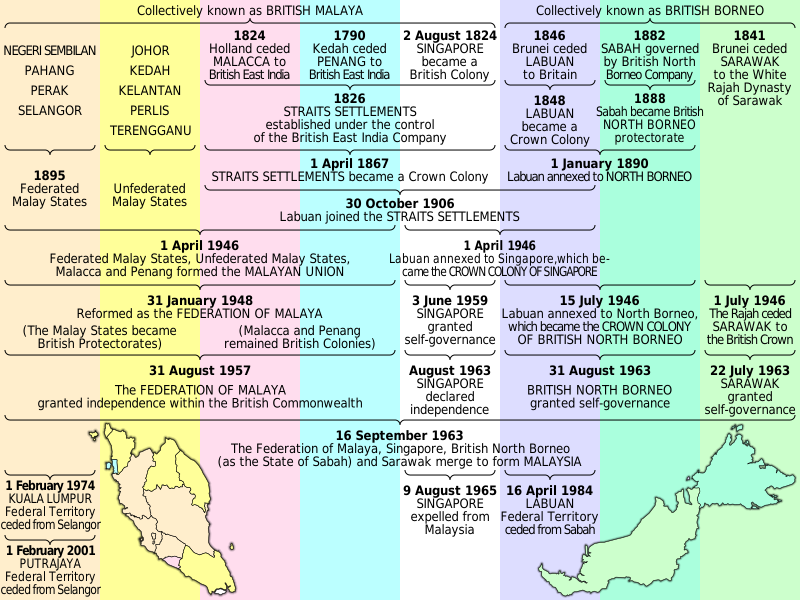
The Federated Malay States (FMS, , Jawi: نݢري٢ ملايو برسکوتو) was a federation of four integrated protectorates in the Malay Peninsula comprising Selangor, Perak, Negeri Sembilan and Pahang. It was established in 1895 by the British government and lasted until 1946. In that year, these states joined with two of the former Straits Settlements (Malacca and Penang, excluding Singapore) and the Unfederated Malay States to form the Malayan Union. The union was short-lived and in 1948 was replaced by the Federation of Malaya, which gained independence in 1957. This federation later became Malaysia in 1963 following the inclusion of North Borneo (now Sabah), Sarawak and Singapore. Singapore was eventually separated from Malaysia and became a sovereign state on 9 August 1965.
Unlike the Unfederated Malay States, which retained greater internal autonomy, the real authority in the FMS resided with the four British Residents and the Resident-General. The powers of the local rulers were significantly restricted and were largely confined to matters "touching Malay religion and customs". The administration of the FMS represented a more centralised and interventionist colonial governance model in contrast to the comparatively decentralised arrangements in the Unfederated States. Nevertheless, the FMS remained nominally more autonomous than the Straits Settlements, which were directly governed by Britain through its Governor.
During World War II, the federation, along with the Unfederated Malay States and the Straits Settlements, was invaded and occupied by Japanese forces which culminated in the Fall of Singapore. After the Japanese surrender and the liberation of Malaya, the original federation was not reinstated and was replaced by the short-lived Malayan Union. Nevertheless, the federal model it had introduced remained influential and provided the administrative framework for the Federation of Malaya formed in 1948 and for the eventual creation of Malaysia in 1963.
Formation and power structure
On 20 January 1874, Sir Andrew Clarke, governor of the Straits Settlements, concluded with the Sultan of Perak the treaty of Pangkor whereby the Sultan agreed to "receive and provide a suitable residence for a British Officer to be called Resident, who shall be accredited to his court, and whose advice must be asked and acted upon on all questions other than those touching Malay Religion and Customs". The residency system was extended the same year to Selangor and Negri Sembilan, and in 1888 to Pahang.
To promote greater administrative efficiency, these four states were brought together in 1895/1896 to form the Federated Malay States. This structure was highly centralized, with real power resting in the hands of the agents of the British Government, at first called the Resident-General, and later the Chief Secretary.
The British established the Federal Council in 1898 to administer the federation. It was headed by the High Commissioner (The Governor of the Straits Settlement), assisted by the Resident-General, the rulers, the four state Residents and four nominated unofficial members. This structure remained until the Japanese invaded Malaya on 8 December 1941.
The sultans and first durbar
Although the Resident-General was the real administrator of the federation, each of the four constituent states of the federation retained their respective hereditary rulers. At the formation of the Federated Malay States, the reigning rulers were:
- Sultan Alaiddin Sulaiman Shah of Selangor
- Sultan Idris Murshidul ‘Adzam Shah I of Perak
- Yamtuan Tuanku Muhammad Shah of Negeri Sembilan
- Sultan Ahmad Mu’adzam Shah of Pahang
In 1897 the first durbar was convened in the royal town of Kuala Kangsar, Perak as the platform for discussions for the four rulers. This formed the basis for the Conference of Rulers that was created later on under Article 38 of the Malaysian Constitution on 27 August 1957.
Flag and emblem of the Federation
Flag
The flag of the Federated Malay States consisted of four different-coloured stripes, from top to bottom: white, red, yellow and black. Different combinations of these colours represent the four states that formed the FMS — red, black and yellow are for Negeri Sembilan; black and white for Pahang; black, white and yellow for Perak; and red and yellow for Selangor. The same design concept is used in Malaysia's national emblem. In the middle is an oblong circle with a Malayan tiger in it.
The National History Museum located near the Dataran Merdeka in Kuala Lumpur, Malaysia has a replica of the federation's flag.
Coat of arms
The coat of arms of the Federated Malay States featured a shield guarded by two tigers. On the top of the shield is the crown (known as Eastern Crown in English heraldry), symbolising the federation of monarchies under the protection of the United Kingdom. A banner with the phrase "Dipelihara Allah" (Under God's Protection) written in Jawi is located underneath the shield.
The combinations of the four colours of the shield represents the colours of the flags of the states of the FMS in the same way the stripes of the FMS flag do.
- Red and yellow for Selangor
- Black, white and yellow for Perak
- Red, black and yellow for Negeri Sembilan
- Black and white for Pahang
This design forms the basis of the Federation of Malaya's national coat of arms along with the guardian tigers and a quartered shield of the same, symbolic four colours mentioned above.
The phrase "Dipelihara Allah" was also adopted as the current state motto for Selangor.
Naval Ensign

In addition to a state flag, the Federated Malay States also had a naval jack or ensign for use on government ships. The ensign, with the four colours of the FMS, was flown by HMS Malaya, commanded by Captain Boyle under the 5th Battle Squadron of the British Grand Fleet) during the Battle of Jutland in the North Sea. This was the only full-scale clash of battleships during World War I.
Government
Resident-General
From 1896 to 1936, real power lay in the hands of the Resident-General, later known as Chief Secretary of the Federation.
| Order | Residents-Generals | From | Until | Notes | 1 | 2 | 3 | 4 |
|---|---|---|---|---|---|---|---|---|
| Frank Athelstane Swettenham | 1 January 1896 | 12 December 1901 | ||||||
| William Hood Treacher | 5 October 1897 | 16 April 1898 | Acting | |||||
| 29 April 1900 | 12 December 1901 | Acting | ||||||
| 13 December 1901 | 31 December 1904 | |||||||
| William Thomas Taylor | 13 September 1904 | 31 December 1904 | Acting | |||||
| 1 January 1905 | 30 September 1910 | |||||||
| Edward Lewis Brockman | 11 May 1907 | 13 February 1908 | Acting | |||||
| Henry Conway Belfield | 4 May 1908 | 27 July 1908 | Acting | |||||
| Reginald George Watson | 26 February 1910 | 29 September 1910 | Acting | |||||
| 30 September 1910 | 31 January 1911 |
Chief Secretary to the Government

| Order | Chief Secretaries | From | Until | Notes | 1 | 2 | 3 | 4 | 5 | 6 | 7 | 8 |
|---|---|---|---|---|---|---|---|---|---|---|---|---|
| Arthur Young | 1 February 1911 | 1 September 1911 | ||||||||||
| Edward Lewis Brockman | 2 September 1911 | 12 September 1920 | ||||||||||
| Reginald George Watson | 3 April 1914 | 8 February 1915 | Acting | |||||||||
| Edward George Broadrick | 21 January 1918 | 5 February 1918 | Acting | |||||||||
| Reginald George Watson | 7 April 1918 | 25 August 1918 | Acting | |||||||||
| Frederick Seton James | 13 June 1920 | 3 October 1920 | Acting | |||||||||
| George Maxwell | 13 September 1920 | 6 May 1926 | ||||||||||
| Arthur Blennerhassett Voules | 14 October 1920 | 4 March 1921 | Acting | |||||||||
| Oswald Francis Gerard Stonor | 21 December 1921 | 9 January 1922 | Acting | |||||||||
| Edward Shaw Hose | 11 May 1923 | 24 October 1923 | Acting | |||||||||
| William Peel | 9 May 1926 | 9 April 1930 | ||||||||||
| Henry Wagstaffe Thomson | 6 May 1927 | 5 June 1927 | Acting | |||||||||
| 10 September 1927 | 31 March 1928 | Acting | ||||||||||
| Charles Walter Hamilton Cochrane | 30 November 1929 | 8 April 1930 | Acting | |||||||||
| 9 April 1930 | 24 March 1932 | |||||||||||
| Andrew Caldecott | 25 July 1931 | 23 March 1932 | Acting | |||||||||
| 24 March 1932 | 3 February 1933 | |||||||||||
| Malcolm Bond Shelley | 4 February 1933 | 4 April 1935 | ||||||||||
| Marcus Rex | 4 April 1935 | 24 February 1936 |
Federal Secretaries
After 1936 the Federal Secretaries were no more than co-ordinating officers, under the authority of the High Commissioners, which are always the Governors of the Straits Settlements
| Order | Federal Secretaries | From | Until | 1 | 2 |
|---|---|---|---|---|---|
| Christopher Dominic Ahearne | 24 February 1936 | 6 May 1939 | |||
| Hugh Fraser | 6 May 1939 | 15 February 1942 |
State Council
In the Federated Malay States, the individual state were still ruled by rulers (a yamtuan in Negeri Sembilan and sultans elsewhere) but was now advised by the State Council for the purpose of administrating the state. The State Council was made up of the Resident (or in certain cases by the Secretary to the Resident), native chiefs, and representative(s) of the Chinese community nominated by the Sultan. The council discussed matters of interest for each respective state such as legislative and administrative issues as well as revision of all sentence of capital punishment. The Resident and his staff (mostly consist of European and Malay) carried on with the administrative work.
Residents
Selangor
- 1875–1876 James Guthrie Davidson (1837–1891)
- 1876–1882 William Bloomfield Douglas (1822–1906)
- 1882–1884 Frank Athelstane Swettenham (1850–1946)
- 1884–1888 John Pickersgill Rodger (1st time, acting, 1851–1910)
- 1889–1892 William Edward Maxwell (1846–1897)
- 1892–1896 William Hood Treacher (1849–1919)
- 1896–1902 John Pickersgill Rodger (2nd time, 1851–1910)
- 1902–1910 Henry Conway Belfield (1855–1923)
- 1910–1913 Reginald George Watson (1862–1926)
- 1913–1919 Edward George Broadrick (1864–1929)
- 1919–1921 Arthur Henry Lemon (1864–1933)
- 1921–1926 Oswald Francis Gerard Stonor (1872–1940)
- 1926–1927 Henry Wagstaffe Thomson (1874–1941)
- 1927–1930 James Lornie (1876–1959)
- 1930–1933 G. E. Cater (1884–1973)
- 1933–1935 George Ernest London (1889– 1957)
- 1935–1937 Theodore Samuel Adams (1885–1961)
- 1937–1939 Stanley Wilson Jones (1888–1962)
- 1939–1941 George Montgomery Kidd
- 1941 Norman Rowlstone Jarrett (acting, 1889–1982)
Perak
- 1874–1875 James Wheeler Woodford Birch (1826–1875)
- 1876–1877 James Guthrie Davidson
- 1877–1889 Hugh Low (Sir Hugh Low from 1883, 1824–1905)
- 1889–1896 Frank Athelstane Swettenham (1850–1946)
- 1896–1902 William Hood Treacher (1849–1919)
- 1902–1903 John Pickersgill Rodger (1851–1910)
- 1905–1910 Ernest Woodford Birch (1857–1929)
- 1910–1912 Henry Conway Belfield (1855–1923)
- 1912–1913 William James Parke Hume (1st time, acting, 1866–1952)
- 1913–1919 Reginald George Watson (1862–1926)
- 1919–1920 George Maxwell (1871–1959)
- 1920–1921 William James Parke Hume (2nd time, 1866–1952)
- 1921–1926 Cecil William Chase Parr (1871–1943)
- 1926–1927 Oswald Francis Gerard Stonor (1872–1940)
- 1927–1929 Henry Wagstaffe Thomson (1874–1941)
- 1929–1930 Charles Walter Hamilton Cochrane (1876–1932)
- 1931–1932 Bertram Walter Elles (1877–1963)
- 1932–1939 G. E. Cater (1884–1973)
- 1939–1941 Marcus Rex (1886–1971)
Negeri Sembilan
- 1888–1891 Martin Lister (1st time, 1857–1897)
- 1891–1894 William Francis Bourne Paul (1844–1930)
- 1894–1895 Robert Norman Bland (1859–1948)
- 1895–1897 Martin Lister (2nd time, 1857–1897)
- 1898–1901 Ernest Woodford Birch (1857–1929)
- 1901–1902 Henry Conway Belfield (1855–1923)
- 1902–1903 Walter Egerton (1858–1947)
- 1904–1910 Douglas Graham Campbell (1867–1918)
- 1910–1911 Richard James Wilkinson (1867–1941)
- 1912–1919 Arthur Henry Lemon (1864–1933)
- 1919–1921 John Richard Oliver Aldworth (acting) (1868–1948)
- 1921–1925 Edward Shaw Hose (1871–1946)
- 1925–1928 Ernest Charteris Holford Wolff (1875–1946)
- 1928–1932 James William Simmons (1877–19XX)
- 1932–1937 John Whitehouse Ward Hughes (1883–1946)
- 1937–1939 Gordon Lupton Ham (1885–1965)
- 1939–1941 John Vincent Cowgill (1888–1959)
Pahang
- 1888–1896 John Pickersgill Rodger (1851–1910)
- 1896–1900 Hugh Clifford (1st time, 1866–1941)
- 1900–1901 Arthur Butler (18XX–1901)
- 1901–D. H. Wise (acting)
- 1901–1903 Hugh Clifford (2nd time, 1866–1941)
- 1905–1908 Cecil Wray
- 1908–1909 Harvey Chevallier (acting)
- 1909–1910 Edward Lewis Brockman (1865–1943)
- 1910–1911 Warren Delabere Barnes (1865–1911)
- 1911–1917 Edward John Brewster (1861–1931)
- 1917–1921 Cecil William Chase Parr (1871–1943)
- 1921–1923 F. A. S. McClelland (acting) (1873–1947)
- 1923–1925 Henry Wagstaffe Thomson (1874–1941)
- 1926–1928 Arthur Furley Worthington (1874–1964)
- 1928–1930 C. F. J. Green
- 1930–1935 Hugh Goodwin Russell Leonard (1880–19XX)
- 1935–1941 C. C. Brown
Administrative subdivisions

For the purpose of efficient administration, all the states of the federation were further divided into districts (Malay: Daerah). Each district was administered by a District Office (Malay: Pejabat Daerah) headed by a District Officer (Malay: Pegawai Daerah).
Perak
State capital: Ipoh, Perak
Districts:
- Hulu Perak (Upper Perak)
- Selama
- Larut
- Kerian
- Matang
- Kuala Kangsar
- Kinta
- Hilir Perak (Lower Perak)
- Batang Padang :Notes: :* Dinding and Pangkor Island were ceded to the British, administered as part of the Straits Settlements and were returned to the government of Perak in February 1935. :* The capital of Perak was moved to Ipoh in 1935.
Selangor
State capital: Kuala Lumpur (also served as the federal capital cum administrative centre)
Districts:
- Hulu Selangor
- Kuala Selangor
- Kuala Lumpur
- Klang
- Hulu Langat
- Kuala Langat
Negeri Sembilan
State capital: Seremban
Districts:
- Seremban
- Port Dickson (coastal district)
- Jelebu
- Kuala Pilah
- Rembau-Tampin
Pahang
State capital: Kuala Lipis
Districts:
- Lipis
- Raub
- Bentong
- Temerloh
- Kuantan
- Pekan
The Federated Malay States as a forerunner to Malaysia
Law
The first Supreme Court was established in 1906 and headed by the Judicial Commissioner, in whom supreme judicial authority was vested. The title of Judicial Commissioner was changed to Chief Judge in 1925.
Judicial Commissioners
- 1896–1905 Lawrence Colvile Jackson
- 1906– Sir William Henry Hyndman Jones
- 1913–1917 Sir Thomas de Multon Lee Braddell
- 1917–1919 John Robert Innes (acting)
- 1919–1920 Sir G. Aubrey Goodman
- 1920 Percy Alan Farrer Manby (acting)
- 1921–1925 Sir Lionel Mabbot Woodward
Chief Judges
- 1925–1929 Sir Henry Hessey Johnston Gompertz
- 1929–1932 Sir Lancelot Henry Elphinstone
- 1933–1937 Sir Samuel Joyce Thomas
- 1937–1939 Sir Roger Evans Hall
- 1939–1941 Sir Kenneth Elliston Poyser
- 1941–c.1945 Sir Harry Herbert Trusted
Economy
The Federated Malay States initially used the Straits dollar issued by the Board of Commissioners of Currency for the Straits Settlements. As the currency depreciated over time, it was pegged at two shillings four sterling pence in 1906. In 1939, the British government introduced a new currency, the Malayan dollar (ringgit in Malay) for used in Malaya and Brunei replacing the Straits dollar at par value. It had denominations ranging from 1 cent to 1,000 Malayan dollars.
The Federated Malay States main economic activities were agriculture and mining with emphasis on rubber and tin. The FMS and Malaya as a whole was the main supplier of these two commodities for British industrial needs. Rubber plantations were established in all four states and tin was mined primarily in the Klang valley in Selangor and the Kinta Valley in Perak. This labour-intensive economic activities prompted the British to bring in immigrant workers from southern India to work at the plantations and workers from southern China to mine the tin.
The economic condition in the period can be viewed as self-sustainable, as the income of the federation was more than what was expended in terms of maintaining the administration and economic activities. In the later period, many resources were put into the development of Kuala Lumpur, as the capital of the federation. This period also saw rapid growth in terms of communications infrastructure such as interstate roads, the expansion of the Federated Malay States Railways' narrow-gauge railway line between the Padang Besar and Singapore, and Port Swettenham (present-day Port Klang). Public schools and academic institutions were also opened along with an improvement in public health. An area in the city was also gazetted as a settlement for the Malay called Kampung Baru. Public buildings were also constructed such as the Kuala Lumpur railway station, the Government Offices of the FMS and Masjid Jamek.
The table and section below illustrated the economic growth of the federation and its member states.
| Year | Revenue | Expenditure | Import | Export | ||||
|---|---|---|---|---|---|---|---|---|
| 1875 | ||||||||
| 1880 | ||||||||
| 1885 | ||||||||
| 1890 | ||||||||
| 1895 | ||||||||
| 1900 | ||||||||
| 1905 | ||||||||
| 1910 | ||||||||
| 1915 | ||||||||
| 1920 | ||||||||
| 1921 | ||||||||
| 1922 |
Note: All values are in Straits dollars (One dollar fixed at two shillings and four pence sterling). Data for Pahang included only from 1890 onwards.
Ref: Harrison, Cuthbert Woodville. An Illustrated Guide to the Federated Malay States. 1923.
Selangor
The revenue of Selangor in 1875 amounted to $115,656; in 1905 it had increased to $8,857,793. Of this latter sum $3,195,318 was derived from duty on exported tin, $1,972,628 from finance, federal receipts, and $340,360 from land revenue. The trade balance was chiefly derived from the revenue farms, which included the right to collect import duty on opium and spirits. The expenditure for 1905 amounted to $7,186,146, of which sum $3,717,238 was on account of federal charges and $1,850,711 for public works. The value of the imports in 1905 was $24,643,619 and that of the exports was $26,683,316, making a total of $51,326,935 equivalent to £5,988,000. Tin was the principal export. The amount exported in 1905 was 17,254 tons. The total area of alienated mining land at the end of 1905 amounted to 65573 acre.
Perak
The revenue of Perak in 1874 amounted to $226,333. That for 1905 amounted to $12,242,897. Of this latter sum $4,876,400 was derived from duty on exported tin, $2,489,300 from railway receipts, $505,300 from land revenue and $142,800 from postal and telegraphic revenue. The remainder is mainly derived from the revenue farms, which are leased for a short term of years, conveying to the lessee the right to collect import duties upon opium, wine and spirits, to keep pawnbroking shops, and to keep public licensed gambling-houses for the use of non-Malay only. The expenditure for 1905 amounted to $10,141,980. Of this sum $4,236,000 was spent on railway upkeep and construction and $2,176,100 on public works. The value of the imports into Perak during 1905 was over $20,000,000, and that of the exports exceeded $40,000,000, making a total of over $60,000,000, equivalent to about seven million sterling. The output of tin from Perak ranged between 18,960 tons, valued at $23,099,506 in 1899, and 26,600 tons, valued at $35,500,000, in 1905. The fluctuating output figure was due to the uncertainty of the labour supply. The mining population was recruited exclusively from the districts of southern China, and during certain years an increased demand for labourers in China itself, in French Indo-China, in the Dutch colonies, and in South Africa temporarily and adversely affected immigration to the Straits of Malacca. The output had, moreover, been affected from time to time by the price of tin, which was $32.20 per pikul in 1896, rose to $42.96 in 1898, to $74.15 in 1900, and averaged $80.60 in 1905. Excluding tin, the principal exports were $108,000 worth of Para rubber, $181,000 of copra, $54,000 of hides, $48,000 of patchouli, and considerable quantities of timber, rattans and other jungle produce.
Negeri Sembilan
The revenue of the Negri Sembilan amounted to $223,435 in 1888. In 1898 it had increased to $701,334, in 1900 to $1,251,366, and in 1905 to $2,335,534. The revenue for 1905 was derived mainly as follows: customs $1,268,602, land revenue $145,475, land sales $21,407, while the revenue farms contributed $584,459. The expenditure in 1905 amounted to $2,214,093, of which $1,125,355 was spent on public works. The trade returns for 1905, which are not, however, complete, showed an aggregate value of about $13,000,000. The value of the tin exported during 1905 exceeded $6,900,000, and the value of the agricultural produce, of which gambier represented $211,000 and damar $80,000, amounted to $407,990.
Pahang
The revenue of Pahang in 1899 amounted to $62,077; in 1900 to $419,150. In 1905 it was $528,368. The expenditure in 1905 amounted to $1,208,176. Of this sum $736,886 was spent on public works. Pahang is still a source of expense to the federation, its progress having been slowed by the disturbances which lasted from December 1891 until 1895, with short intervals of peace, but the revenue was steadily increasing, and the ultimate financial success of the state is considered to be secure. Pahang owed something over $3,966,500 to Selangor and $1,175,000 to Perak, which had financed it for some years out of surplus revenue. The value of the imports in 1905 was $1,344,346, that of the exports was $3,838,928, thus making a total trade value of $5,183,274. The most valuable export is tin, the value of which in 1905 amounted to $2,820,745. The value of the gutta exported exceeded $140,000, that of dried and salted fish amounted to nearly $70,000, and that of timber to $325,000.
Education
Press and publications
Military history
World War I
With the threat of Germany, the British Navy was in a drive for expansion. As a contribution, the government and people of the Federated Malay States agreed to finance the commissioning of HMS Malaya; this was a motion proposed in the Federal Council by the Sultan of Perak in 1913 and supported by the Sultan of Selangor. The battleship which cost $25,000,000 (approximately £2,945,709) was one of five of the Queen Elizabeth-class battleship, displacing 31,000 tons, mounting fifteen-inch guns and capable of 25 kn. The most modern ships of their day, they formed the 5th Battle Squadron and fought as such at Jutland in 1916. HMS Malaya was also refurbished and was in service throughout World War II.
WWII – Japanese invasion and dissolution
After the Japanese landed in Malaya on 8 December 1941, the Japanese forces began their invasion of the Malay Peninsula. Japanese forces began their invasion of the FMS by crossing the Thailand–FMS border at Kroh. Ipoh, the state capital of Perak, fell on 26 December 1941. Kuala Lumpur, the capital of the Federated Malay States and the State of Selangor, was captured on 11 January 1942. Seremban, the state capital of Negeri Sembilan, was captured two days later. Kuantan, in the eastern component state of Pahang, fell on 30 December 1941, meanwhile the capital, Kuala Lipis was taken by the Japanese on 7 January 1942. With the conclusion of the Battle of Gemas on 15 January 1942, the entire FMS was now in Japanese hands.
All of Malaya including Singapore remained under Japanese occupation until the surrender of Japan on 2 September 1945.
Dissolution
The federation was formally dissolved on 1 April 1946, and was incorporated into the Malayan Union thereafter. This in turn was succeeded by the Federation of Malaya in 1948, which gained independence in 1957, and later became Malaysia in 1963.
Postage stamps

While the four states issued their own postage stamps as before, there were additional issues for the Federated States as a whole.
References
Notes
- Harrison, Cuthbert Woodville. An Illustrated Guide to the Federated Malay States. 1923
- George Palmer Putnam Collection of Amelia Earhart Papers © Purdue University
- Benfield, H. Conway. Handbook of The Federated Malay States sabrizain.org Retrieved 23 January 2018.
References
- "Annual report of the Medical Department / Federated Malay States.".
- (1992). "Rulers and Residents: Influence and Power in the Malay States, 1870–1920". [[Oxford University Press]].
- (September 1971). "British Policy in the Malay Peninsula 1880–1910, Volume I, The Southern and Central States". [[National University of Singapore]].
- Simon C. Smith, "Rulers and Residents: British Relations with the Aden Protectorate, 1937–59", ''Middle Eastern Studies'', Vol. 31, No. 3 (Jul., 1995), p. 511.
- "Map of British Malaya Including The Straits Settlements Federated Malay States and Malay States Not Included In The Federation 1924".
- "Sejarah Manjung". Manjung Municipal Council.
- (10 September 1919). "Mr J R Innes". The Singapore Free Press and Mercantile Advertiser.
- "Samuel Joyce THOMAS".
- (6 September 1937). "SIR ROGER HALL NEW F.M.S. CHIEF JUSTICE.". The Straits Times.
This article was imported from Wikipedia and is available under the Creative Commons Attribution-ShareAlike 4.0 License. Content has been adapted to SurfDoc format. Original contributors can be found on the article history page.
Ask Mako anything about Federated Malay States — get instant answers, deeper analysis, and related topics.
Research with MakoFree with your Surf account
Create a free account to save articles, ask Mako questions, and organize your research.
Sign up freeThis content may have been generated or modified by AI. CloudSurf Software LLC is not responsible for the accuracy, completeness, or reliability of AI-generated content. Always verify important information from primary sources.
Report