From Surf Wiki (app.surf) — the open knowledge base
Federal Bridge Gross Weight Formula
Formula for estimating bridge weight limits
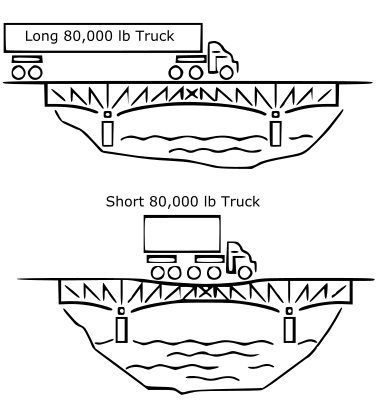
Formula for estimating bridge weight limits
The Federal Bridge Gross Weight Formula, also known as Bridge Formula B or the Federal Bridge Formula, is a mathematical formula in use in the United States by truck drivers and Department of Transportation (DOT) officials to determine the appropriate maximum gross weight for a commercial motor vehicle (CMV) based on axle number and spacing. The formula is part of federal weight and size regulations regarding interstate commercial traffic (intrastate traffic is subject to state limits). The formula is necessary to prevent heavy vehicles from damaging roads and bridges. CMVs are most often tractor-trailers or buses, but the formula is of most interest to truck drivers due to the heavy loads their vehicles often carry.
Early 20th-century weight limits were enacted to protect dirt and gravel roads from damage caused by the solid wheels of heavy trucks. As time passed, truck weight limits focused primarily on gross weight limits (which had no prescribed limits on length). By 1974, bridges received special protection from increasing truck weight limits. The bridge formula law was enacted by the U.S. Congress to limit the weight-to-length ratio of heavy trucks, and to protect roads and bridges from the damage caused by the concentrated weight of shorter trucks. The formula effectively lowers the legal weight limit for shorter trucks, preventing them from causing premature deterioration of bridges and highway infrastructure.
Compliance with the law is checked when vehicles pass through a weigh station, often located at the borders between states or on the outskirts of major cities, where the vehicle may be weighed and measured. The one exception to the formula allows a standard five-axle semi-truck configuration to weigh the maximum legal gross weight. This exception was specifically requested by the American Trucking Associations to allow tank trucks to reach the maximum legal gross weight without violating the bridge formula law.
History
The first truck weight limits were enacted by four states in 1913, ranging from 18000 lb in Maine to 28000 lb in Massachusetts. These laws were passed to protect earth and gravel-surfaced roads from damage caused by the steel and solid rubber wheels of early heavy trucks. By 1933, all states had some form of truck weight regulation. The Federal-Aid Highway Act of 1956 instituted the first federal truck weight regulation (set at 73280 lb) and authorized the construction of the Interstate Highway System.
In the late 1950s, the American Association of State Highway and Transportation Officials (AASHTO) conducted a series of extensive field tests of roads and bridges to determine how traffic contributed to the deterioration of pavement materials. In 1964, the AASHTO recommended to Congress that a bridge formula table be used instead of a single gross weight limit for trucks. The Federal-Aid Highway Act Amendments of 1974 established the bridge formula as law, along with the gross weight limit of 80000 lb. Current applications of the formula allow for up to 7 axles and 86 feet or more length between axle sets, and a maximum load of 105,500 lbs.
Usage

The formula was enacted as law to limit the weight-to-length ratio of a commercial motor vehicle (CMV). The formula is necessary to prevent the concentrated truck's axles from overstressing pavements and bridge members (possibly causing a bridge collapse). In simplified form, this is analogous to a person walking on thin ice. When standing upright, a person's weight is concentrated at the bottom of their feet, funneling all of their weight into a small area. When lying down, a person's weight is distributed over a much larger area. This difference in weight distribution would allow a person to cross an area of ice while crawling that might otherwise collapse under their body weight while standing up. For an overweight truck to comply with the formula, more axles must be added, the distance between axles must be increased, or weight must be removed.
While the Federal Motor Carrier Safety Administration (FMCSA), regulates safety for the U.S. trucking industry., the Federal Highway Administration (FHWA) oversees the State enforcement of truck the size and weight Federal limits set by Congress for the Federal Aid System as described in 23 CFR 658. The Federal size limits apply in all States to the National Network (NN) which is a network of Interstate Highways, U.S. Highways, and state highways. Provided the truck remains on the NN, in all States and a truck is not subject to State size limits. In a similar fashion, the Federal weight limits and the Federal Bridge Formula apply to the Interstate System in all States. The State truck size and weight regulations apply to the Federal Aid System routes that do not have Federal limits.
The weight and size of CMVs are restricted for practical and safety reasons. CMVs are restricted by gross weight (total weight of vehicle and cargo), and by axle weight (i.e., the weight carried by each tire). The federal weight limits for CMVs are 80000 lb for gross weight (unless the bridge formula dictates a lower limit), 34000 lb for a tandem axle, and 20000 lb for a single axle. A tandem axle is defined as two or more consecutive axles whose centers are spaced more than 40 in but not more than 96 in apart. Axles spaced less than 40 in apart are considered a single axle.
In effect, the formula reduces the legal weight limit for shorter trucks with fewer axles (see table below). For example, a 25 ft three-axle dump truck would have a gross weight limit of 54500 lb, instead of 80000 lb, which is the standard weight limit for 63 ft five-axle tractor-trailer. FHWA regulation §658.17 states: "The maximum gross vehicle weight shall be 80,000 lb except where lower gross vehicle weight is dictated by the bridge formula."
Bridge collapse

The August 2007 collapse of the Interstate 35W Mississippi River bridge in Minneapolis brought renewed attention to the issue of truck weights and their relation to bridge stress. In November 2008, the National Transportation Safety Board determined there had been several reasons for the bridge's collapse, including (but not limited to): faulty gusset plates, inadequate inspections, and the extra weight of heavy construction equipment combined with the weight of rush hour traffic. The I-35 Trade Corridor Study reported that the Federal Highway Administration (FHWA) expressed concern over bridges on the I-35 corridor due to an expected increase of international truck traffic from Canada and Mexico, with the FHWA listing it as "high-priority" in 2005.
As of 2007, federal estimates suggest truck traffic increased 216% since 1970, shortly before the federal gross weight limit for trucks was increased by 30000 lb. This is also the period during which many of the existing interstate bridges were built. Research shows that increased truck traffic (and therefore, increased stress) shortens the life of bridges.
Some smaller bridges have a weight limit (or gross weight load rating) indicated by a posted sign (hence the reference to a "posted bridge"). These are necessary when the weight limit of the bridge is lower than the federal or state gross weight limit for trucks. Driving a truck over a bridge that is too weak to support it usually does not result in an immediate collapse. The bridge may develop cracks, which over time can weaken the bridge and cause it to collapse. Most of these cracks are discovered during mandated inspections of bridges. Most bridge collapses occur in rural areas, result in few injuries or deaths, and receive relatively little media attention. While the number varies from year to year, as many as 150 bridges can collapse in a year. About 1,500 bridges collapsed between 1966 and 2007, and most of those were the result of soil erosion around bridge supports. In 1987, the Schoharie Creek Bridge collapsed in upstate New York, due to erosion of soil around the foundation, which sparked renewed interest in bridge design in inspection procedures.
In special cases involving unusually overweight trucks (which require special permits), not observing a bridge weight limit can lead to disastrous consequences. Fifteen days after the collapse of the Minneapolis bridge, a heavy truck collapsed a small bridge in Oakville, Washington.
Formula law
CMVs are required to pass through weigh stations at the borders of most states and some large cities. These weigh stations are run by state DOTs, and CMV weight and size enforcement is overseen by the FHWA. Weigh stations check each vehicle's gross weight and axle weight using a set of in-ground truck scales, and are usually where a truck's compliance with the formula is checked.

FMCSA regulation §658.17 states:
- No vehicle or combination of vehicles shall be moved or operated on any interstate highway when the gross weight on two or more consecutive axles exceeds the limitations prescribed by the following formula:
- W = the maximum weight in pounds that can be carried on a group of two or more axles to the nearest 500 lb.
- L = spacing in feet between the center of the outer axles of any two or more consecutive axles.
- N = number of axles being considered.
Two or more consecutive axles may not exceed the weight computed by the bridge formula, even the gross weight of the truck. This means that the "outer group" or axles 1-5 which comprises the entire Gross Vehicle Weight (GVW) of truck and all interior combination of axles must also comply with the bridge formula. State may not issue less than four citations when a truck violate each of the Federal weight limits on the Interstate System which are: 1) Single axle 2) Tandem axle, 3) Gross Vehicle Weight (GVW), 4) Inner Group.
Penalties for violating weight limits vary between states (bridge formula weight violations are treated as gross weight violations), as the states are responsible for enforcement and collection of fines. Some states, such as Connecticut, issue fines on a percentage basis (e.g. 20% overweight at $10 per 100 lb), which means larger trucks pay higher fines. For example, a truck with a legal gross limit of 20000 lb that violates the limit by 5000 lb would pay a fine of $500, while a truck with a legal gross limit of 60000 lb that violates the limit by 5,000 pounds would pay a fine of $250. Other states, such as New York, issue fines on a per-pound basis (e.g., 5,000 pounds overweight equals a $300 fine). Others, such as Massachusetts, impose a less complicated fine schedule whereby a vehicle that violates the limits by less than 10000 lb is fined $40 per 1000 lb, while a violation over 10,000 lb pays $80 per 1000 lb (e.g. 5,000 lb overweight equals a $200 fine).
Some states require overweight trucks to offload enough cargo to comply with the limits. In Florida, any vehicle that exceeds the limits by more than 6000 lb is required to be unloaded until the vehicle is in compliance. Florida also includes a scale tolerance, which allows for violations of less than 10% to be forgiven, and no fine issued. Florida also allows for a load to be shifted (e.g., moved from the front towards the rear of the vehicle) for the vehicle to comply with axle weight limits, without penalty.
Exception
There is one exception to the formula: two consecutive sets of tandem axles may carry 34000 lb each if the overall distance between the first and last axles of these tandems is 36 ft or more. For example, a five-axle truck may carry 34,000 pounds both on the tractor tandem axles (2 and 3) and the trailer tandem axles (4 and 5), provided axles 2 and 5 are spaced at least 36 ft apart.
This exception allows for the standard 5-axle semi-truck configuration to gross up to 80000 lb (the legal limit)
A CMV may exceed the bridge formula limits (or gross weight and its axle weight limits) by up to 550 lb if the vehicle is equipped with an auxiliary power unit (APU) or idle reduction technology. This is permitted "in order to promote reduction of fuel use and emissions because of engine idling". To be eligible, the vehicle's operator must prove the weight of the APU with written certification, or—by demonstration or certification—that the idle reduction technology is fully functional at all times. Certification of the APU's weight must be available to law enforcement officers if the vehicle is found in violation of applicable weight laws. The additional weight allowed cannot exceed 550 pounds or the weight certified, whichever is less.
Issues
The bridge formula (also referred to as Formula B) is based on research into single-span bridges, and fails to consider multiple-span bridges. Two-span bridges may not be fully protected by Formula B, depending on the truck length, span length, and other factors. Shorter wheelbase vehicles (usually specialized trucks such as garbage trucks and water trucks) have trouble complying with Formula B.
In 1987, the U.S. Congress passed the Surface Transportation and Uniform Relocation Assistance Act, requesting the Transportation Research Board (TRB) to conduct a study to develop alternatives to Formula B. The study recommended several that were never implemented. It suggested that Formula B was too strict for trucks with shorter axle lengths. One of the alternative formulas (later known as the TTI HS-20 Bridge Formula) was developed in conjunction with the Texas Transportation Institute. TTI HS-20 allowed shorter trucks to have higher weight limits than Formula B. For a 3-axle truck with an axle length of 14 ft, the weight limit increased from 46500 lb to 54000 lb. TTI HS-20 also failed to address the problem of multiple-span bridges.
| Distance in feet between any | |
|---|---|
| group of two or more axles 1 | Gross weight in pounds (kilograms) 2 |
| 2 axles | 3 axles |
| Less than 8 3 | 34,000 lb |
| More than 8 4 | 38,000 lb |
| 9 | 39,000 lb |
| 10 | 40,000 lb5 |
| 11 | 40,000 lb |
| 12 | 40,000 lb |
| 13 | 40,000 lb |
| 14 | 40,000 lb |
| 15 | 40,000 lb |
| 16 | 40,000 lb |
| 17 | 40,000 lb |
| 18 | 40,000 lb |
| 19 | 40,000 lb |
| 20 | 40,000 lb |
| 21 | 40,000 lb |
| 22 | 40,000 lb |
| 23 | 40,000 lb |
| 24 | 40,000 lb |
| 25 | 40,000 lb |
| 26 | 40,000 lb |
| 27 | 40,000 lb |
| 28 | 40,000 lb |
| 29 | 40,000 lb |
| 30 | 40,000 lb |
| 31 | 40,000 lb |
| 32 | 40,000 lb |
| 33 | 40,000 lb |
| 34 | 40,000 lb |
| 35 | 40,000 lb |
| 36 | 40,000 lb |
| 37 | 40,000 lb |
| 38 | 40,000 lb |
| 39 | 40,000 lb |
| 40 | 40,000 lb |
| 41 | 40,000 lb |
| 42 | 40,000 lb |
| 43 | 40,000 lb |
| 44 | 40,000 lb |
| 45 | 40,000 lb |
| 46 | 40,000 lb |
| 47 | 40,000 lb |
| 48 | 40,000 lb |
| 49 | 40,000 lb |
| 50 | 40,000 lb |
| 51 | 40,000 lb |
| 52 | 40,000 lb |
| 53 | 40,000 lb |
| 54 | 40,000 lb |
| 55 | 40,000 lb |
| 56 | 40,000 lb |
| 57 | 40,000 lb |
- 1 Calculated values reflect FHWA policy of rounding down when distances fall exactly between 6 in increments.
- 2 Calculated values reflect FHWA policy of rounding down when weights fall exactly between 500 lb increments.
- 3 Tandem axle by definition.
- 4 Distances between 8 ft to 8 ft may not be rounded down.
- 5 __ Maximum legal weight limit based on number of axles. Increased axle lengths beyond these do not increase maximum legal weight.
- 6 __ Exception to the formula: when the four axles under consideration are two tandem axles spaced at least 36 ft apart, a gross weight of 68000 lb is allowed.
- __ Upper blank areas represent unrealistic configurations.
References
References
- "Chapter 2: Truck Size and Weight Limits". Federal Highway Administration.
- "Booster Axle: Ultimate Weight Lifter". NRMCA.
- "Bridge Formula Weights Calculator". Federal Highway Administration.
- Woodrooffe, John. "Federal Bridge Formula: How It Influences Vehicle Dynamic Behavior". University of Michigan Transportation Research Institute.
- "2006 Montana Commercial Vehicle Size and Weight and Safety Trucker's Handbook". [[Montana Department of Transportation]].
- "FMCSA's Strategy". [[Federal Motor Carrier Safety Administration]].
- "Federal Size Regulations for Commercial Motor Vehicles". Federal Highway Administration.
- "§658.5 Definitions". Federal Motor Carrier Safety Administration.
- "Federal Bridge Gross Weight Formula". [[Rand McNally]].
- Gunderson, Dan. (August 10, 2007). "Heavy Trucks Strain Roads and Bridges". Minnesota Public Radio.
- "Highway Accident Report: Collapse of I-35W Highway Bridge". [[National Transportation Safety Board]].
- I-35 Trade Corridor Study. (Winter 1998). "I-35 Trade Corridor Study". I-35 Trade Corridor Study.
- John Merriss. (June 2003). "New Research on Pavement Damage Factors". [[Oregon Department of Transportation]].
- "Bridge Load Rating, Permitting and Posting". [[Florida Department of Transportation]].
- "Chapter 191: Authorization to Use Bridges Due to Condition of Bridge". [[Pennsylvania Department of Transportation]].
- Tolchin, Martin. (April 12, 1987). "Bridge Failures". [[The New York Times]].
- (August 3, 2007). "Many Clues to Collapse". The Daily Herald.
- (July–August 2007). "Fault Tree Analysis of Schoharie Creek Bridge Collapse". [[American Society of Civil Engineers]].
- (August 15, 2007). "Truck Collapses Bridge in Grays Harbor County". [[KOMO-TV]].
- "Commercial Vehicle Size and Weight Program". Federal Highway Administration.
- "§658.17 Weight". Federal Motor Carrier Safety Administration.
- "Questions and Answers About Vehicle Size and Weight - FHWA Freight Management and Operations, Question 10".
- Schurin, Zachary. (March 20, 2007). "Criminal Penalties for Overweight Trucks". [[Connecticut General Assembly.
- "316.545 Weight and Load Unlawful; Special Fuel and Motor Fuel Tax Enforcement; Inspection; Penalty; Review". [[Florida Legislature]].
- "Bridge Formula Weights". [[Federal Highway Administration]].
- (January 2, 2002). "Living With The 'Bridge'". Clermont County Engineers Office.
- "23 USC 127: Vehicle weight limitations-Interstate System".
- "Chapter 6: Bridge". Federal Highway Administration.
- (1990). "Truck Weight Limits: Issues and Options". [[United States National Research Council.
- "Questions and Answers about Vehicle Size and Weight". Federal Highway Administration.
This article was imported from Wikipedia and is available under the Creative Commons Attribution-ShareAlike 4.0 License. Content has been adapted to SurfDoc format. Original contributors can be found on the article history page.
Ask Mako anything about Federal Bridge Gross Weight Formula — get instant answers, deeper analysis, and related topics.
Research with MakoFree with your Surf account
Create a free account to save articles, ask Mako questions, and organize your research.
Sign up freeThis content may have been generated or modified by AI. CloudSurf Software LLC is not responsible for the accuracy, completeness, or reliability of AI-generated content. Always verify important information from primary sources.
Report