From Surf Wiki (app.surf) — the open knowledge base
Federal architecture
Architectural style in the US
Architectural style in the US


.jpg)


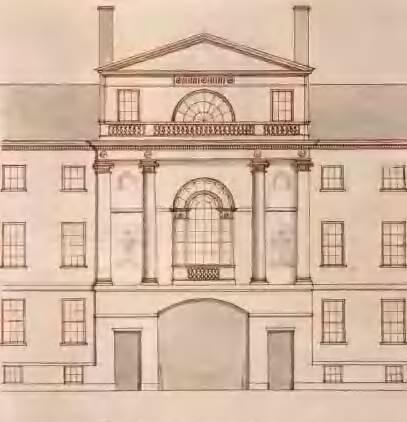
Federal-style architecture is the classical architecture built in the United States following the American Revolution between 1780 and 1830, and particularly from 1785 to 1815, which was influenced heavily by the works of Andrea Palladio with several innovations on Palladian architecture by Thomas Jefferson and his contemporaries. Jefferson's Monticello estate and several federal government buildings, including the White House, are among the most prominent examples of buildings constructed in Federal style.
Federal style is also used in association with furniture design in the United States of the same time period. The style broadly corresponds to the classicism of Biedermeier style in the German-speaking lands, Regency architecture in Britain, and the French Empire style. It may also be termed Adamesque architecture. The White House and Monticello were setting stones for what Federal architecture has become.
In the early United States, the founding generation consciously chose to associate the nation with the ancient democracies of Greece and the republican values of Rome. Grecian aspirations informed the Greek Revival, lasting into the 1850s. Using Roman architectural vocabulary, the Federal style applied to the balanced and symmetrical version of Georgian architecture that had been practiced in the American colonies' new motifs of neoclassical architecture as it was epitomized in Britain by Robert Adam, who published his designs in 1792.
Characteristics

The classicizing manner of constructions and town planning undertaken by the federal government was expressed in early federal projects of lighthouses, harbor buildings, universities, and hospitals. It can be seen in the rationalizing, urbanistic layout of L'Enfant Plan of Washington and in the Commissioners' Plan of 1811 in New York. The historic eastern part of Bleecker Street in New York, between Broadway and the Bowery, is home to Federal-style row houses at 7 to 13 and 21 to 25 Bleecker Street. The classicizing style of Federal architecture can especially be seen in the quintessential New England meeting house, with their lofty and complex towers by architects such as Lavius Fillmore and Asher Benjamin.
This American neoclassical high style was the idiom of America's first professional architects, such as Charles Bulfinch and Minard Lafever. Robert Adam and James Adam were leading influences through their books.
Legacy of Federal architecture in Salem, Massachusetts
In Salem, Massachusetts, there are numerous examples of American colonial architecture and Federal architecture in two historic districts: Chestnut Street District, which is part of the Samuel McIntire Historic District containing 407 buildings, and the Salem Maritime National Historic Site, consisting of 12 historic structures and about 9 acres of land along the waterfront.
Architects of the Federal period
- Asher Benjamin
- Charles Bulfinch
- John Holden Greene
- James Hoban
- Thomas Jefferson
- Minard Lafever
- Benjamin Latrobe
- Pierre L'Enfant
- John McComb Jr.
- Samuel McIntire
- Robert Mills
- Alexander Parris
- William Strickland
- Martin E. Thompson
- William Thornton
- Ithiel Town
- Ammi B. Young Modern reassessment of the American architecture of the Federal period began with Fiske Kimball.
References
References
- Historical marker on Elfreth's Alley
- The design vocabulary of Federal architecture is accessibly illustrated and contrasted with Greek Revival in Rachel Carley, ''The Visual Dictionary of American Domestic Architecture'', 1994, ch. 5 "Neoclassical Styles", pp. 90ff.
- For the federal government's role in Federal architectural style and its symbolism, see Lois Craig, ed. ''The Federal Presence: Architecture, Politics and Symbols in United States Government Building'' (Federal Architecture Project, Cambridge: [[MIT Press]]) 1978, chs. 1–3, with brief text and extended captions to multiple illustrations.
- "British Empire / Thirteen Colonies (USA) / Early Independence-era / Religious | Colonial Architecture Project".
- (15 September 2009). "Creating Your Architectural Style". Pelican Publishing.
- ''Domestic Architecture of the American Colonies and the Early Republic,'' 1922.
This article was imported from Wikipedia and is available under the Creative Commons Attribution-ShareAlike 4.0 License. Content has been adapted to SurfDoc format. Original contributors can be found on the article history page.
Ask Mako anything about Federal architecture — get instant answers, deeper analysis, and related topics.
Research with MakoFree with your Surf account
Create a free account to save articles, ask Mako questions, and organize your research.
Sign up freeThis content may have been generated or modified by AI. CloudSurf Software LLC is not responsible for the accuracy, completeness, or reliability of AI-generated content. Always verify important information from primary sources.
Report