From Surf Wiki (app.surf) — the open knowledge base
FC St. Pauli
German sports club

German sports club
| Field | Value |
|---|---|
| clubname | St. Pauli |
| fullname | Fußball-Club St. Pauli von 1910 e.V. |
| image | FC St. Pauli logo (2018).svg |
| upright | 0.8 |
| nickname | Kiezkicker (Neighbourhood Kickers) |
| Freibeuter der Liga (League Buccaneers) | |
| founded | |
| ground | Millerntor-Stadion |
| capacity | 29,546 |
| chrtitle | President |
| chairman | Oke Göttlich |
| manager | Alexander Blessin |
| mgrtitle | Head coach |
| league | |
| season | |
| position | |
| website | |
| pattern_la1 | _stpauli2526h |
| pattern_b1 | _stpauli2526h |
| pattern_ra1 | _stpauli2526h |
| pattern_so1 | _whitetopl |
| shorts1 | 65423a |
| socks1 | 65423a |
| pattern_la2 | _stpauli2526a |
| pattern_b2 | _stpauli2526a |
| pattern_ra2 | _stpauli2526a |
| pattern_so2 | _toponwhitel |
| socks2 | 65423a |
| pattern_la3 | _stpauli2526t |
| pattern_b3 | _stpauli2526t |
| pattern_ra3 | _stpauli2526t |
| leftarm3 | 000000 |
| body3 | 000000 |
| rightarm3 | 000000 |
| shorts3 | 000000 |
| socks3 | 000000 |
| current | 2025–26 FC St. Pauli season |
the men's team
Freibeuter der Liga (League Buccaneers) Fußball-Club St. Pauli von 1910 e.V., commonly known as simply St. Pauli (), is a German professional football club based in the St. Pauli district of Hamburg. The team plays in the Bundesliga for the 2025–26 season, their second consecutive season in the top flight following promotion from the 2. Bundesliga in 2023–24.
The football department is part of a larger sports club that also has departments in rugby (FC St. Pauli Rugby), baseball, bowling, boxing (FC St. Pauli Boxen), chess, cycling, handball, roller derby (Harbor Girls Hamburg), skittles, softball, table tennis, and since 2011, marathon. Until the end of 2013, the club also had a department in American football, but it was dissolved because it lacked the youth team required in order to hold a men's team. As of April 2023, FC St. Pauli has 30,400 members.
The men's professional football team dropped down to the Regionalliga in 2003, at that time the third highest football division in Germany and remained there for four years. In 2007, they won promotion back to the 2. Bundesliga, the German second tier. In 2010, they won promotion back to the top-flight Bundesliga, but were immediately relegated the following season. Their current tenure in the top-flight dates to their promotion in 2023–24 season.
FC St. Pauli has a cross-city rivalry with Hamburger SV, with whom they contest the Hamburg derby, the only cross-city derby currently featured in the Bundesliga. The club also has a more recent rivalry with Hansa Rostock, known as the Political derby, or even the Fear derby, reflecting the divergent political identities of the two clubs.
Although the club has been only modestly successful, it is widely recognised for its distinctive social culture and has a large popular following as one of the country's "Kult" clubs. FC St. Pauli and supporters are strongly identified with their support of left-wing politics.
History
Early years
The club began its existence in 1899 as a loose, informal group of football enthusiasts within the Hamburg-St.Pauli Turnverein 1862. This group did not play its first match until 1907, when they faced a similar side assembled from the local Aegir swimming club. Officially established on 15 May 1910, the club played as St. Pauli TV in the Kreisliga Groß-Hamburg (Alsterkreis) until 1924, when a separate football side called St. Pauli was formed. The team played as an undistinguished lower-to-mid table side until making their first appearance in 1934 in the top-flight Gauliga Nordmark, 1 of 16 premier level divisions created in the re-organization of German football that took place under the Third Reich. They were immediately relegated, but returned to the top flight in 1936. Relegated again in 1940, St. Pauli re-appeared in the Gauliga Hamburg in 1942, and played there until the end of World War II.
Post-war football
After the war, the club resumed play in the Oberliga Nord in 1947. A second-place finish in the 1947–48 season led St. Pauli to its first appearance in the national championship rounds. They advanced as far as the semi-finals, where they were knocked out 2–3 by eventual champions 1. FC Nürnberg. The club continued to play well throughout the early 1950s, but were unable to overtake rivals Hamburger SV, finishing in second place in five of the next seven seasons, and going out in the early rounds in each of their championship-round appearances from 1949 to 1951. In the late 1950s and into the early 1960s, St. Pauli were overtaken by rivals such as Werder Bremen and VfL Osnabrück, but finished fourth a number of times.
Promotion to the Bundesliga
In 1963, the Bundesliga – West Germany's new top-flight professional league – was formed. Hamburger SV, Werder Bremen, and Eintracht Braunschweig joined the new circuit as the top-finishers from the Oberliga Nord, while FC St. Pauli found themselves in the second-tier Regionalliga Nord. That year, the club signed Guy Acolatse, who became the first Black professional footballer to play in Germany.
Nearly a decade-and-a-half of frustration followed. St. Pauli won their division in 1964, but finished bottom of their group in the promotion play-off round. They won their next Regionalliga Nord title in 1966, but, while they performed far better in the play-offs, still could not advance to the top-flight, losing to Rot-Weiss Essen on goal difference, having conceded two more goals. Division championships in 1972 and 1973, and runner-up finishes in 1971 and 1974, were each followed by promotion-round play-off disappointment.
The success of the Bundesliga, and the growth of professional football in West Germany, led to the formation of the 2. Bundesliga in 1974. St. Pauli was part of the new second-tier professional circuit in the 2. Bundesliga Nord and, in 1977, they advanced to the top flight as winners of their division. The team survived for one season at the highest level in the Bundesliga.
The club's return to the 2. Bundesliga Nord was also short-lived. On the verge on bankruptcy in 1979, they were denied a license for the following season and were sent down to the Oberliga Nord (III). Strong performances that set the team atop that division in 1981 and 1983 were marred by poor financial health. By 1984, the club had recovered sufficiently to return to the 2. Bundesliga, overtaking Werder Bremen's amateur side, who, despite finishing two points ahead of St. Pauli, were ineligible for promotion.
"Kult" phenomenon
It was in the mid-1980s that St. Pauli's transition from a standard traditional club into a "Kult" club began. The club was also able to turn the location of its ground in the dock area part of town, near Hamburg's famous Reeperbahn – centre of the city's night life and its red-light district – to its advantage. An alternative fan scene slowly emerged, built around left-leaning politics, social activism and the event and party atmosphere of the club's matches. St. Pauli became the first team in Germany to officially ban right-wing nationalist activities and displays in its stadium during a period of fascist-inspired football hooliganism across Europe. In 1981, the team was averaging small crowds of only 1,600 spectators, but by the late 1990s they were frequently selling out their entire 20,000-capacity ground.

In the early 1990s, the media in Germany began to recognize the Kult-image of the club, focusing on the punk part of the fan-base in TV broadcasts of the matches. By this time, the media also started to establish nicknames like "Freibeuter der Liga" ("Buccaneers of the League") as well as the satirical "das Freudenhaus der Liga" ("Brothel of the League", literally "House of Joy"). The club itself realized the potential and in September 1999 bought the rights to Steph Braun's skull and crossbones graphic, making it an official club logo.
St. Pauli moved in and out of the Bundesliga over the course of the next dozen years: the club was narrowly relegated to the Oberliga in the 1984–85 season, but won the 1985–86 championship and returned to 2. Bundesliga. Two increasingly strong years followed, resulting in promotion and three seasons in the Bundesliga, from 1988 to 1991. Four seasons followed in 2. Bundesliga, and then another two in the Bundesliga in 1995 to 1997, before another return to the 2. Bundesliga.
Into the new millennium


Until 2010, the club's most recent appearance in the top-flight had been a single-season cameo in 2001–02. A win against Bayern Munich, the reigning Intercontinental Cup winners, led to the popular "Weltpokalsiegerbesieger" ("World Club Champion beaters") shirts. However, the team finished last in the league, partly because the management did not trust the team which surprisingly won the promotion in 2001, but rather spent the additional money from Bundesliga TV contracts and advertisements on expensive but disappointing players. After the relegation to the 2. Bundesliga, only a skeleton of the successful 2001 team remained. The 2002–03 season ended up in chaos, with the team fighting relegation (ultimately in vain) from the very beginning, various coaches departing and other problems internal to the club.
With the club almost bankrupt again and the less-lucrative Regionaliga Nord (III) looming, the club began its fund-raising activities, the so-called "Retteraktion". They printed t-shirts with the club's crest surrounded by the word Retter ("rescuer/saviour") and more than 140,000 were sold within six weeks. They also organized a lucrative benefit game, against Bayern Munich, to raise funds to save the club.
The club has also been active in terms of charity and in 2005 the club, the team and the fans initiated the Viva con Agua de Sankt Pauli campaign, which collects money for water-dispensers for schools in Cuba, for clean water in Rwanda et cetera.
During the 2005–06 season, the team enjoyed unprecedented success in the DFB-Pokal, with wins over Burghausen, VfL Bochum and, significantly, Bundesliga sides Hertha BSC and, in the quarter-finals on 25 January 2006, Werder Bremen. Their 3–1 victory in front of a sell-out Millerntor crowd, and their subsequent place in the DFB Cup semi-final, netted the club approximately €1 million in TV and sponsorship money, going a long way to saving the club from immediate financial ruin.
St. Pauli finally went out of the cup to Bayern Munich on 12 April, going down 3–0 with a goal from Owen Hargreaves and two from Claudio Pizarro. Coincidentally, Bayern were also St. Pauli's opponents and dispatchers in the first round of the following season's cup.
After success in the 2006–07 season, the team was promoted to the 2. Bundesliga. After defeating SpVgg Greuther Fürth in the 2009–10 season, the team secured promotion back to the Bundesliga for the 2010–11 season. On 16 February 2011, during the 2010–11 season and for the first time since 1977, St. Pauli defeated their cross-city rivals, Hamburger SV, away at the Volksparkstadion, courtesy of a Gerald Asamoah goal. The team, however, finished the domestic season in last place, resulting in their relegation to the 2. Bundesliga for the 2011–12 season. Since then, the club remained in the 2. Bundesliga, finishing fourth in 2011–12 but declining in results in the years to come, until they earned promotion back to the Bundesliga in the 2023–24 season.
Football Cooperative St. Pauli von 2024 eG
In order to be able to guarantee and expand financial security in professional football, the board and members of the club have decided in the End of 2024 to found the Football Cooperative St. Pauli von 2024 eG. The cooperative will enable fans and members to acquire shares for 750 euros plus a subscription and administration fee of 100 euros. The club is expecting 20,000 to 30,000 shareholders, which should raise up to 30 million euros, with the sale of shares to be discontinued once 36 million is reached. The co-operative will use these funds to acquire a majority stake in the Millerntor stadium operating company. The income is also needed to service existing loans, in particular from the new stadium construction and the coronavirus period. Members of the cooperative have co-determination rights according to the one man, one vote - principle and elect the Executive Board. The Football Cooperative St. Pauli von 2024 eG is the first cooperative in German professional football.
Colours and kit
The colours of FC St. Pauli are brown and white, and to a lesser extent red. Black is also common among fans and on third kits.
The club has worn brown and white since 1910, when it joined the Northern German Football Association (Norddeutscher Fußball-Verband). These early uniforms were made up of brown shirts and socks with white shorts. Some time between the 1920s and 30s, the club took on what would become its traditional look, namely a white shirt, brown shorts and brown socks with a white turnover. From early on in the club's history until the 1990s, the club readily wore its brown change shirts at home, even during such games as those against rivals HSV, who also wear white shirts.
During the 1960s, the club introduced white socks which regularly alternated with plain brown socks. A motif was used on the club shirt for the first time in 1968, when the club donned stripes, and, in the 1970s, various other motifs adorned the club's first and second-choice shirts. In the 1976–77 season, St. Pauli began wearing Adidas kits, marking the end of a period of often experimental shirts, and this traditional look continued when the club started wearing Puma kits in the 1980s. For the 1985–86 season, the club sported an all-white Puma kit, which would be worn for four consecutive seasons before some brown details returned to the shirt. However, the Kiezkicker would continue to wear these predominantly white kits until 1993.
At this point, the club would return to a kit based on a white-brown-white scheme, but in a more contemporary style, often incorporating patterns. The Reusch kits of 1994–96 and 1996–97 had hoops and stripes respectively, while Kappa would also produce a striped kit in 2000–01. The Italian brand would provide a set of kits for the 2001–02 and 2002–03 seasons in which the shirt, shorts, and socks were all available in white and brown, meaning that the team would wear a different combination each game, reminiscent of the club's look between the 1960s and 1980s. During the 2001–02 season, the team would frequently make recourse to the previous year's all-black away kit.
In 2003–04, the club would once again sport a white shirt with brown sleeves, manufactured by Stanno. However this is, as of the 2022–23 season, the last time the club has donned its traditional kit. While the club's uniform for the 2005–06 season would combine a light shirt and brown shorts, St. Pauli would wear an all-black kit during the following campaign (marking the first time that neither of the club's colours were present on the home kit). From the 2007–08 season, St. Pauli has worn an all-brown home kit on all but three occasions, one of which saw the team return to a striped shirt, while in the two other instances the team wore white shorts.
Between 2019–20 and 2021–22, LGBT details were integrated into the third shirt. In 2020, having sought a kit supplier who would meet their ecological and ethical requirements since 2018, St. Pauli founded their own brand, Di!Y ("Do it. Improve Yourself"). From the 2021–22 season, St. Pauli have worn kits made in-house by Di!Y.
Sponsors
| 2024– | Puma |
|---|
Stadium
The home venue of the FC St. Pauli is the Millerntor-Stadion. Work on the stadium began in 1961, but its completion was delayed until 1963 as there was initially no drainage system in place, making the pitch unplayable after rain. It originally held 32,000 supporters, but the capacity was later reduced for safety reasons.
In 1970, the stadium was renamed the Wilhelm Koch-Stadium in honour of a former club president. However, this name became highly controversial when it was discovered by historian René Martens that Wilhelm Koch had been a member of the Nazi Party from 1937 to 1945, as stated in his 1997 book "FC St. Pauli - You'll never walk alone". After protests by fans, the name was changed back to Millerntor-Stadion in 1999.
A total redevelopment began in 2006. The final phase of the redevelopment work ended with the completion of the new north stand in July 2015. The stadium is since then permitted for a capacity of 29,546 spectators of which 16,940 are standing and 12,606 are seated.
The stadium is located next to the Heiligengeistfeld, and is overlooked by the Flak Tower IV to the north and a building of the Deutsche Telekom to the south. It can be reached with the Hamburg U-Bahn line U3 (St. Pauli Station and Feldstraße Station).
Club culture and supporters
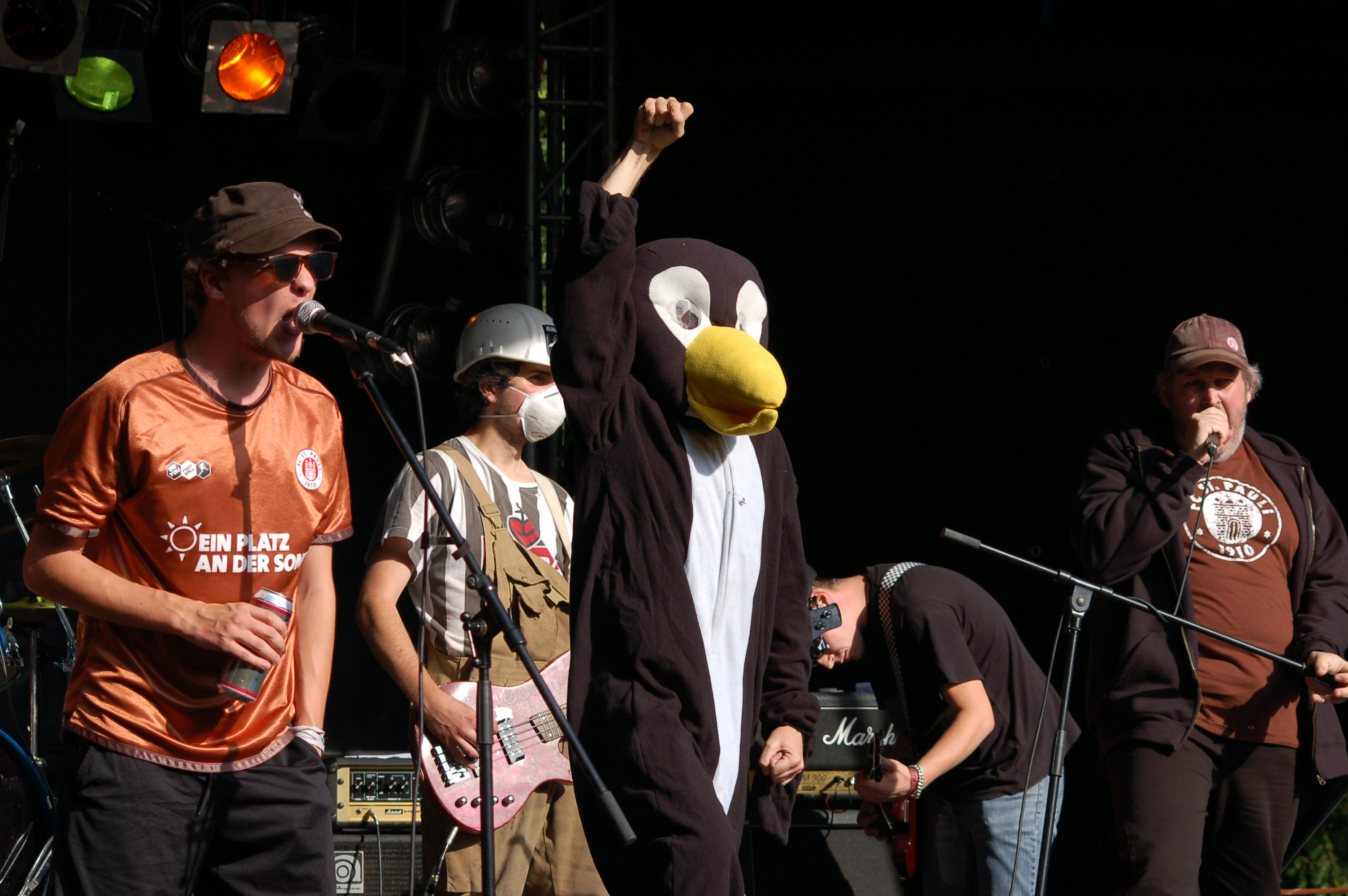
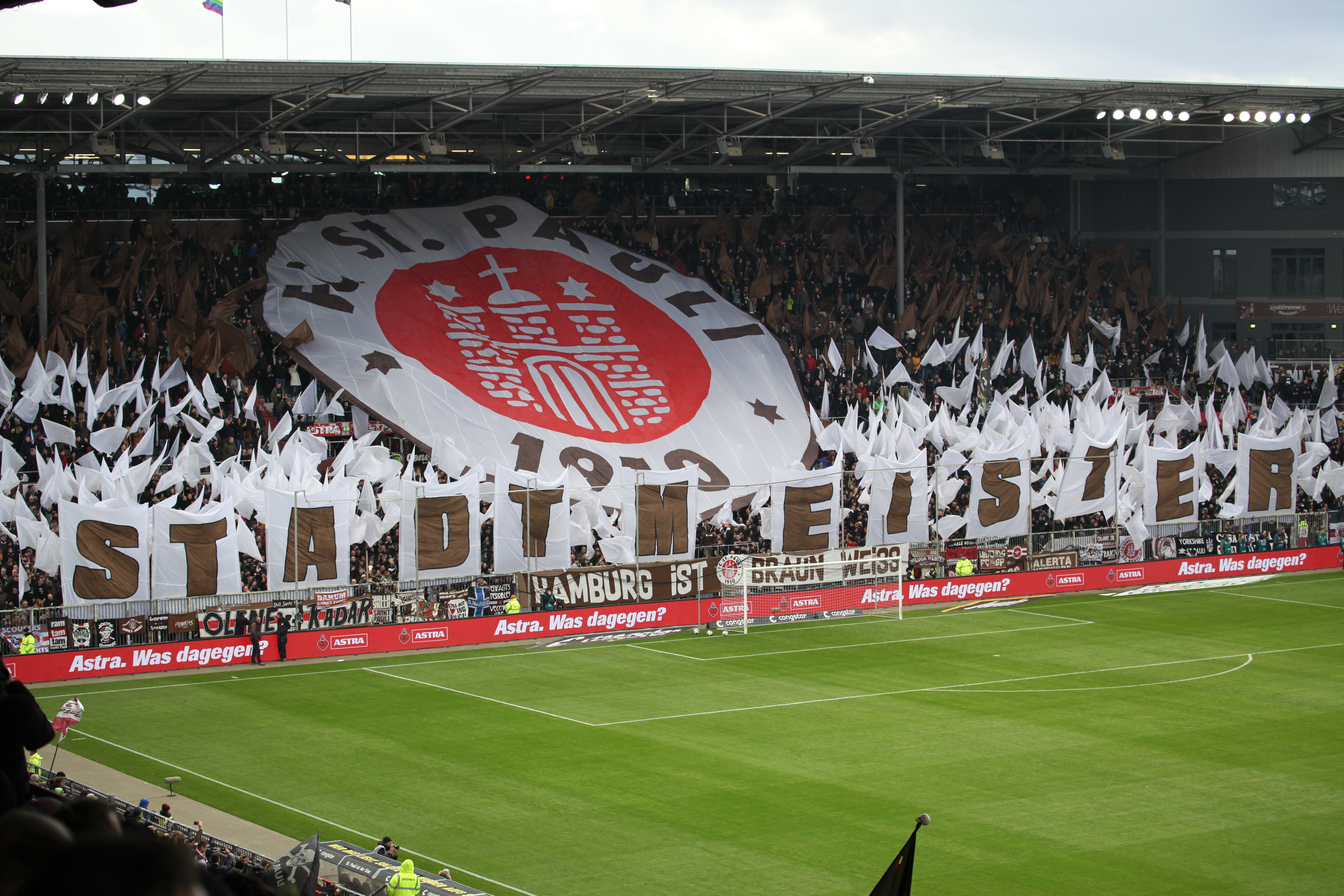
FC St. Pauli is considered one of the most left-wing football clubs in the world, with a long-standing commitment to anti-fascism, anti-racism, anti-sexism, and LGBTQ+ rights. The club’s culture is closely linked to the St. Pauli district of Hamburg, an area historically associated with alternative lifestyles and the red-light district, the Reeperbahn. Its distinct political identity began to develop in the mid-1980s, when local residents, squatters, and left-wing activists rallied behind the team in response to a growing far-right presence among rival Hamburg SV supporters, establishing St. Pauli as a refuge for fans opposed to right-wing extremism in German football. The club operates under a democratic, member-driven structure, and its fans actively engage in political and social causes, including support for refugees, marginalised groups, and local community initiatives.
The skull and crossbones, or Jolly Roger, was adopted in the late 1980s after a local punk singer, Doc Mabuse, displayed the flag at a match. Originally a symbol of the club's underdog status, it became associated with St. Pauli's anti-establishment values. By the end of the 1980s, attendances at Millerntor Stadium increased significantly, aided by the club's promotion from the third division to the Bundesliga in 1988.
St. Pauli emphasises inclusivity and social responsibility, and these principles are central to both its operations and its fan culture. Fans frequently display banners opposing fascism, racism, homophobia, and sexism, while the club operates under a democratic, membership-driven structure that allows supporters to vote on major decisions. In 1989, St. Pauli fans staged a boycott that successfully blocked plans to integrate the stadium into a sports dome featuring a hotel and shopping centre, reinforcing the club’s commitment to prioritising social and political values over financial gain. Throughout the 1990s and 2000s, St. Pauli formalised its political commitments; on 28 October 1991, at the football club’s annual general meeting, the decision was made to ban neo-Nazis from the stadium and to make anti-fascism club policy. The club also promotes multicultural engagement and grassroots activism, supporting refugees, marginalised youth, and local squatter communities. It has hosted initiatives such as the FIFI Wild Cup, an alternative to the 2006 World Cup for nations not recognised by FIFA, and during the European refugee crisis of the mid-2010s, the club allowed refugees to stay overnight at the Millerntor Stadium and supported fundraising efforts for organisations assisting migrants in the Mediterranean. St. Pauli has also acted in response to fan protests over sexism. In 2002, advertisements for the men's magazine Maxim were removed from the Millerntor-Stadion due to their depictions of women. In 2011, the club banned lap dancers from performing for guests in a corporate suite belonging to a local lap dance club, following complaints from supporters. These actions, along with the club’s broader social and political initiatives, have contributed to the establishment of over 400 official supporter clubs worldwide.
The club's footballing performance has varied, including relegation to the third division in 2003 and near relegation in 2015. Despite this, the fanbase remains engaged, prioritising the club's social and cultural values over purely sporting success. During the 2010–2011 Bundesliga season, fans protested commercial practices that they felt compromised the club's identity, including VIP boxes and corporate sponsorships.
FC St. Pauli has been supported by both local and international musicians. Local contributors include Dave Doughman and his band Swearing at Motorists, who released the song St. Pauli 'til I die and established a music school at the Millerntor Stadium. Other international musicians seen supporting the club include Ed Sheeran, Blink 182, Fontaines D.C., Green Day, Bad Religion, and the Kaiser Chiefs. Songs linked to the club include AC/DC's Hells Bells and Blur's Song 2. In 2017, FC St. Pauli collaborated with the Boston-based punk band Dropkick Murphys on a limited release of a cover of the song You'll Never Walk Alone, and jointly designed a scarf and an exclusive T-shirt featuring the song title. The band has long been associated with St. Pauli and frequently visits the club’s local pub, the Jolly Roger.
In February 2025, St. Pauli suspended the use of the song Das Herz von St. Pauli by fans after research revealed that its original creators, including Hans Albers, Michael Jary, and Josef Ollig, had ties to Nazi propaganda. The club emphasised that an anthem must unify fans, and the historical associations prevented this. Following publication of the findings and member discussions, no plans were made to reinstate the song, and alternative matchday music has been introduced to maintain fan engagement while addressing ethical concerns.
Friendships and rivalries
St. Pauli's politics and values have earned them admiration from other teams around the footballing world, such as Celtic FC and Bohemian FC. Celtic supporters, particularly segments like the Green Brigade, have developed a longstanding friendship with St. Pauli fans, rooted in shared left-wing and anti-fascist outlooks. Connections between the supporters date back to the 1990s, and there is mutual influence in chants, tifos, and political expression. Bohemian FC in Dublin has drawn inspiration from St Pauli’s left‑wing stance, incorporating similar political values into its own club culture and community work, including anti‑racism, LGBT and refugee advocacy.
Main article: Hamburg derby
FC St. Pauli's primary rivals are Hamburger SV. Their meetings are known as the Hamburg derby or Stadtderby and are the most significant local fixture in the city. The rivalry stretches back over a century, with the two clubs first meeting in competitive fixtures in the early 20th century and maintaining a long history of encounters. HSV became Hamburg's larger, traditionally wealthier club with a long tenure in the Bundesliga and a more establishment profile, while St. Pauli developed in the port quarter with a distinct identity and supporter culture. The social contrast between the clubs adds to the derby’s intensity; Hamburger SV's supporter base and institutional image have often been associated with more conventional sporting culture and, historically, a less politicised fan environment. In contrast to St. Pauli's politically engaged fan culture, HSV's terraces have at times been sites of right-wing fan presence, contributing to the ideological tensions that accompany the fixture. Head‑to‑head records show HSV with more wins across over 100 matches, but St. Pauli have taken notable victories that carry symbolic weight for their supporters. A prominent example was St. Pauli’s 1–0 win at HSV’s Volksparkstadion in February 2011, their first away derby win there in many years. Another intensification of the rivalry followed HSV’s relegation to the 2. Bundesliga in 2018, increasing the frequency of derby matches. Matches attract heightened attention and occasionally elevated security measures because of the derby’s atmosphere and local importance. Media coverage routinely highlights both the competitive stakes and the cultural symbolism of the fixture, reflecting deep civic loyalties across Hamburg and the broader social identities of each club’s supporters.
FC St. Pauli has a rivalry with Hansa Rostock; when the two face off, it is known as the "Fear Derby". Hansa Rostock is associated with a region that has experienced a rise in right-wing extremism, particularly following the fall of East Germany. Matches between the two frequently involve violent confrontations, heavy police deployment, and disorder both inside and outside the stadium.
Fundamental Principles
St. Pauli were the first club in Germany to integrate a set of Fundamental Principles (Leitlinien) to dictate how the club is run, passed by an overwhelming majority at the club's annual general meeting in 2009.
The first five Principles states that:
- In its totality, consisting of members, staff, fans and honorary officers, St Pauli FC is a part of the society by which it is surrounded and so is affected both directly and indirectly by social changes in the political, cultural and social spheres.
- St Pauli FC is conscious of the social responsibility this implies, and represents the interests of its members, staff, fans and honorary officers in matters not just restricted to the sphere of sport.
- St Pauli FC is the club of a particular city district, and it is to this that it owes its identity. This gives it a social and political responsibility in relation to the district and the people who live there.
- St Pauli FC aims to put across a certain feeling for life and symbolises sporting authenticity. This makes it possible for people to identify with the club independently of any sporting successes it may achieve. Essential features of the club that encourage this sense of identification are to be honoured, promoted and preserved.
- Tolerance and respect in mutual human relations are important pillars of the St Pauli philosophy.
Players
Current squad
Out on loan
FC St. Pauli II
Notable players
International players
The following international players have also played for St. Pauli:
- NGA Yakubu Adamu
- BEN Moudachirou Amadou
- GER Gerald Asamoah
- BIH Zlatan Bajramović
- TUR Deniz Barış
- CAN Jonathan Beaulieu-Bourgault
- GER Alfred Beck
- NOR Morten Berre
- MAR Mourad Bounoua
- USA Paul Caligiuri
- PAN Armando Cooper
- USA Cory Gibbs
- CMR Marc Gouiffe à Goufan
- USA Joe Gyau
- DEN Heino Hansen
- FIN Ari Hjelm
- CAN Junior Hoilett
- TUR Uğur İnceman
- NGA Henry Isaac
- CRO Ivan Klasnić
- CRO Ante Budimir
- CSK Ivo Knoflíček
- CSK Ján Kocian
- GER Max Kruse
- WAL James Lawrence
- IRN Alireza Mansourian
- USA Michael Mason
- HAI Frantz Mathieu
- ALB Artur Maxhuni
- COD Michél Mazingu-Dinzey
- GER Karl Miller
- JPN Kazuo Ozaki
- NOR Tore Pedersen
- ANG Miguel Francisco Pereira
- AUT Michael Gregoritsch
- HAI Fafà Picault
- RUS Nikolai Pisarev
- UKR Andriy Polunin
- GER Ingo Porges
- GER Christian Rahn
- RUS Yuri Savichev
- GER Helmut Schön
- LIB Feiz Shamsin
- CUW Rocky Siberie
- POL Waldemar Sobota
- CAN Ive Sulentic
- GHA Charles Takyi
- COG Jean-Clotaire Tsoumou-Madza
- DEN Niels Tune-Hansen
- CHN Yang Chen
- PER Carlos Zambrano
- JPN Ryo Miyaichi
- ALB Hysen Zmijani
Greatest ever team
In 2010, as part of the club's celebration of its 100th anniversary, fans voted the following players as the best in the club's history:
- GER Klaus Thomforde
- GER André Trulsen
- GER Walter Frosch
- GER Karl Miller
- GER Dirk Dammann
- COD Michél Mazingu-Dinzey
- GER Thomas Meggle
- GER Jürgen Gronau
- GER Harald Stender
- GER Peter Osterhoff
- GER Franz Gerber
Coaching staff

| Position | Name |
|---|---|
| Head coach | GER Alexander Blessin |
| Assistant coach | SVK Peter Németh |
| Goalkeeping coach | BEL Sven Van Der Jeugt |
| Athletic coach | ENG Karim Rashwan |
| GER Thomas Barth | |
| GER Frederic Bokelmann | |
| Match analyst | GER Sami Pierau |
| Performance Manager | NZL Dr. James Morgan |
| Club Doctor | GER Dr. Sebastian Schneider |
| GER Dr. Volker Carrero | |
| Physiotherapists | GER Dominik Körner |
| GER Jan Altmeyer | |
| Osteopath | GER Florian Lechner |
| Kit Manager | GER Siegmar Krahl |
| GER Thorge Düwer | |
| JPN Kenta Kambara | |
| Team Manager | GER Jonas Wömmel |
Managerial history
- Germany Josef Müller (1937–38)
- Germany Richard Sump (1938–39)
- Germany Hans Sauerwein (1945–47)
- Germany Woldemar Gerschler (1948)
- Germany Fred Harthaus (1948–50)
- Germany Walter Risse (1950–52)
- Germany Hans Appel (1952)
- Germany Otto Westphal (1963–64)
- Germany Jockel Krause (1964–65)
- Germany Erwin Türk (1970–71)
- Germany Edgar Preuß (1971–72)
- Germany Karl-Heinz Mülhausen (1972–74)
- Germany Jockel Krause (1974–76)
- Germany Diethelm Ferner (1976–78)
- Germany Sepp Piontek (1978–79)
- Germany Werner Pokropp (1979)
- Germany Kuno Böge (1979–1982)
- Germany Michael Lorkowski (1982–86)
- Germany Willi Reimann (1986–87)
- Germany Helmut Schulte (1987–91)
- Germany Horst Wohlers (1991–92)
- Germany Josef Eichkorn (1992)
- Germany Michael Lorkowski (1992)
- Germany Josef Eichkorn (1992–94)
- Germany Uli Maslo (1994–97)
- Germany Klaus-Peter Nemet (1997)
- Germany Eckhard Krautzun (1997)
- Germany Gerhard Kleppinger (1997–99)
- Germany Willi Reimann (1999–00)
- Germany Dietmar Demuth (2000–02)
- Germany Joachim Philipkowski (2002)
- Germany Franz Gerber (2002–04)
- Germany Andreas Bergmann (2004–06)
- Germany Holger Stanislawski (2006–07)
- Germany André Trulsen (2007–08)
- Germany Holger Stanislawski (2008–11)
- Germany André Schubert (2011–12)
- Germany Michael Frontzeck (2012–13)
- Germany Roland Vrabec (2013–14)
- Germany Thomas Meggle (2014)
- Germany Ewald Lienen (2014–2017)
- Germany Olaf Janßen (2017)
- Germany Markus Kauczinski (2017–19)
- Netherlands Jos Luhukay (2019–20)
- Germany Timo Schultz (2020–22)
- Germany Fabian Hürzeler (2022–24)
- Germany Alexander Blessin (2024–)
Honours
League
- 2. Bundesliga (II)
- Regionalliga Nord (II)
- Regionalliga Nord (III)
- Champions : 2007
- Oberliga Nord (III)
- Champions : 1981, 1983, 1986
- Stadtliga Hamburg (I)
- Champions : 1947
Cup
- Hamburger Pokal
- Winners: 1986, 1998, 2001, 2004, 2005, 2006, 2008
Reserve team
- Oberliga Hamburg/Schleswig-Holstein (IV)
- Champions: 1995, 1999, 2003
- Oberliga Hamburg (V)
- Champions: 2011
- Hamburger Pokal
- Winners: 1998, 2001, 2008, 2009, 2010
Records
Note: FC St. Pauli did not play in the Bundesliga or the 2. Bundesliga until 1974, 1979–1984, 1985–86 and 2003–2007.
Statistics are correct as of 22 June 2022.
Most appearances overall
BL = Bundesliga, 2.BL = 2. Bundesliga, OLN = Oberliga Nord (1947–1963), RLN = Regionalliga Nord (1963–1974) OtL = Other leagues: Oberliga Nord (1974–1994), Regionalliga Nord (since 1994) Cup = DFB-Pokal, OtC = Other competitions: German championship (1947–1951), Relegation play-offs, Hamburg Cup
| Rank | Name | First | Last | BL | 2.BL | OLN | RLN | OtL | Cup | OtC | Total |
|---|---|---|---|---|---|---|---|---|---|---|---|
| 1 | GER Jürgen Gronau | 1981 | 1997 | 117 | 202 | – | – | 112 | 21 | 24 | 476 |
| 2 | GER André Trulsen | 1986 | 2005 | 177 | 206 | – | – | 1 | 20 | 5 | 409 |
| 3 | GER Klaus Thomforde | 1983 | 1998 | 100 | 217 | – | – | 42 | 17 | 13 | 389 |
| 4 | GER Harald Stender | 1947 | 1960 | – | – | 336 | – | – | 5 | 15 | 356 |
| 5 | GER Ingo Porges | 1956 | 1968 | – | – | 166 | 147 | – | 3 | 12 | 328 |
| 6 | GER Peter Osterhoff | 1958 | 1970 | – | – | 138 | 170 | – | 3 | 9 | 320 |
| 7 | GER Werner Pokropp | 1960 | 1970 | – | – | 78 | 223 | – | 3 | 11 | 315 |
| 8 | GER André Golke | 1983 | 1991 | 98 | 107 | – | – | 62 | 10 | 16 | 293 |
| 9 | GER Fabian Boll | 2003 | 2014 | 28 | 141 | – | – | 103 | 19 | 1 | 292 |
| 10 | GER Michael Dahms | 1982 | 1991 | 65 | 97 | – | – | 97 | 8 | 22 | 289 |
Most appearances in Bundesliga and 2. Bundesliga
| Rank | Name | Years | Bundesliga | 2. Liga | Total |
|---|---|---|---|---|---|
| 1 | GER André Trulsen | 1986–1991, 1994–2002 | 177 | 206 | 383 |
| 2 | GER Jürgen Gronau | 1984–1997 | 117 | 202 | 319 |
| 3 | GER Klaus Thomforde | 1984–2000 | 100 | 217 | 317 |
| 4 | GER Dirk Dammann | 1990–1999 | 81 | 179 | 260 |
| 5 | GER Holger Stanislawski | 1993–2003 | 80 | 178 | 258 |
| 6 | GER Dietmar Demuth | 1974–1979, 1984–1988 | 34 | 192 | 226 |
| 7 | GER André Golke | 1984–1991 | 98 | 107 | 205 |
| 8 | GER Daniel Buballa | 2014–2021 | – | 191 | 191 |
| 9 | GER Christopher Buchtmann | 2012–2022 | – | 190 | 190 |
| 10 | GER Stephan Hanke | 1994–2000 | 61 | 119 | 180 |
Top goalscorers in Bundesliga and 2. Bundesliga
Numbers in brackets indicate appearances made.
| Rank | Name | Years | Bundesliga | 2. Liga | Total | Ratio |
|---|---|---|---|---|---|---|
| 1 | GER Rüdiger Wenzel | 1974–1975, 1984–1990 | 4 (27) | 59 (137) | 63 (164) | 0.38 |
| 2 | GER Franz Gerber | 1976–1978, 1986–1988 | 16 (32) | 42 (73) | 58 (105) | 0.55 |
| 3 | GER Dirk Zander | 1986–1991 | 20 (80) | 31 (90) | 51 (170) | 0.30 |
| 4 | GER André Golke | 1984–1991 | 25 (98) | 24 (107) | 49 (205) | 0.24 |
| 5 | GER Marius Ebbers | 2008–2013 | 3 (31) | 43 (107) | 46 (138) | 0.33 |
| 6 | GER Marcus Marin | 1994, 1997–2000 | – | 40 (102) | 40 (102) | 0.39 |
| 7 | GER Martin Driller | 1991–1997 | 10 (49) | 29 (103) | 39 (152) | 0.26 |
| 8 | GER Horst Neumann | 1974–1979 | 3 (25) | 33 (132) | 36 (157) | 0.23 |
| 9 | GER Jens Scharping | 1993–1998 | 12 (46) | 20 (55) | 32 (101) | 0.32 |
| 10 | GER Rolf Höfert | 1974–1979 | 3 (23) | 28 (118) | 31 (141) | 0.22 |
Recent seasons
The club's recent seasons:
| Year | Division | Position |
|---|---|---|
| 1999–2000 | 2. Bundesliga (II) | 13th |
| 2000–01 | 2. Bundesliga | 3rd (promoted) |
| 2001–02 | Bundesliga (I) | 18th (relegated) |
| 2002–03 | 2. Bundesliga (II) | 17th (relegated) |
| 2003–04 | Regionalliga Nord (III) | 8th |
| 2004–05 | Regionalliga Nord | 7th |
| 2005–06 | Regionalliga Nord | 6th |
| 2006–07 | Regionalliga Nord | 1st (promoted) |
| 2007–08 | 2. Bundesliga (II) | 9th |
| 2008–09 | 2. Bundesliga | 8th |
| 2009–10 | 2. Bundesliga | 2nd (promoted) |
| 2010–11 | Bundesliga | 18th (relegated) |
| 2011–12 | 2. Bundesliga | 4th |
| 2012–13 | 2. Bundesliga | 10th |
| 2013–14 | 2. Bundesliga | 8th |
| 2014–15 | 2. Bundesliga | 15th |
| 2015–16 | 2. Bundesliga | 4th |
| 2016–17 | 2. Bundesliga | 7th |
| 2017–18 | 2. Bundesliga | 12th |
| 2018–19 | 2. Bundesliga | 9th |
| 2019–20 | 2. Bundesliga | 14th |
| 2020–21 | 2. Bundesliga | 10th |
| 2021–22 | 2. Bundesliga | 5th |
| 2022–23 | 2. Bundesliga | 5th |
| 2023–24 | 2. Bundesliga | 1st (promoted) |
| 2024–25 | Bundesliga | 14th |
| 2025–26 | Bundesliga |
Other sports
Main article: FC St. Pauli Rugby
The St. Pauli rugby section has several teams, both in the men's and women's leagues.
The men's rugby department has not been as successful as its female counterpart, reaching the German final only once, in 1964. In 2008–09, St. Pauli was the only club to have a team in both the rugby and football 2nd Bundesliga. In 2008–09, the men's team finished fourth in the second division.
The women's team have won the German rugby union championship eight times (1995, 2000, 2001, 2003, 2005–08) and the sevens championship 3 times (2000, 2001 and 2002). Several of their players play in the national squad.
St. Pauli has a blind football team which plays in the Blindenfussball Bundesliga.
St. Pauli also has a Roller Derby team known as Harbor Girls Hamburg.
The club's chess section competes in the German Chess Bundesliga. In 2024, the section landed a coup when they were able to recruit five-time World Champion Magnus Carlsen to play in Bundesliga matches for them. Carlsen made his debut for St. Pauli on 11 January 2025.
Notable presidents
- 1990–00: Heinz Weisener
- 2002–10: Corny Littmann
References
References
- (9 August 2023). "Kiezkicker trennen sich ohne Tore von Fortuna Düsseldorf".
- . ["FC St. Pauli – Fakten zum Millerntor"](http://fcstpauli.com/home/stadion/millerntor/fakten). *Fußball-Club St. Pauli v. 1910 e.V.*.
- Krause, Stefan. (17 July 2024). "Im Sinne eines gerechten Fußballs".
- "Die Boxabteilung des FC St. Pauli". st-pauli-boxen.de.
- "About". harbourgirls.de.
- Fabian Balicki: Więcej niż piłka nożna? St. Pauli jest tą możliwością. Poligraf, 2015, {{ISBN. 978-83-7856-321-1.
- (27 November 2013). "Harmonische Mitgliederversammlung". FC St. Pauli.
- "FC St. Pauli". Olympia-Verlag GmbH.
- . (8 March 2012). ["Für die Fans: St. Pauli klagt für Hansa Rostock"](http://www.mopo.de/st-pauli/untersagungsverfuegung-fuer-die-fans--st--pauli-klagt-fuer-hansa-rostock,5067040,11805190.html). *Morgenpost Verlag GmbH*.
- Peter, Erik. (18 November 2011). "Hansa Rostock gegen St. Pauli: Das gefährlichste Spiel des Jahres". 11FREUNDE Verlag GmbH & Co. KG.
- "Midfield Dynamo Football Site". Midfielddynamo.com.
- "Offizielle Homepage des FC St. Pauli von 1910 e. V. – Mannschaft". FC St. Pauli.
- (7 February 2019). "It's an Anti-Fascist Thing: How an Obscure German Soccer Team Gained a Brooklyn Cult".
- (18 June 2010). "ak 551: Die hatten noch nie einen Schwarzen gesehen". [[analyse & kritik]].
- (28 April 2020). "Guy Acolatse: Die Geschichte von Deutschlands erstem schwarzen Profifußballer".
- (16 June 2010). "St Pauli: Pirates of the League". Freedom Press.
- "History of FC St.Pauli".
- (6 September 2015). "St Pauli: the club that stands for all the right things ... except winning".
- (14 July 2019). "KIEZQUAKE STORIES: THE DOUBLE INVENTION OF THE SKULL". FC St. Pauli.
- "St. Pauli skull and crossbones". Texmen.
- "CLUB HISTORY".
- "History".
- "St. Pauli feiert den Bundesliga-Aufstieg". NDR.
- "Hamburg vs. St. Pauli 0 - 1".
- (12 May 2024). "St. Pauli earn Bundesliga promotion after 13 years".
- Läsker, Kristina. (5 November 2024). "FCSP-Genossenschaft: Anstoß, Genossen!". Die Zeit.
- Hürner, Thomas. (24 September 2024). "Genossenschaft in St. Pauli: "Wir spüren die finanzielle Schere am eigenen Leib"".
- "Club History". FC St. Pauli.
- "DIIY – Alles muss man selber machen!". FC St. Pauli.
- Gerlach, Clemens. (27 October 1997). "Braune Soße im Wilhelm-Koch-Studio". Die Tageszeitung.
- Jacques, Juliet. (17 November 2020). "Yes, Politics Do Belong in Sports".
- "FC St. Pauli Timeline".
- Briggs, Billy. (22 November 2018). "FC St Pauli: Football fans unite against fascism and the rise of the far right".
- Foster, Richard. (27 October 2016). "How a German football club inspired fans in Yorkshire to unite and help refugees". [[The Guardian]].
- . (20 January 2011). ["St. Pauli strippers get sent off"](https://www.thelocal.de/20110120/32557). *The Local Europe AB*.
- Poole, Harry. (23 June 2020). "St Pauli: The cult German football club that wants to change the game forever". [[BBC Sport]].
- Braun, Stuart. (23 August 2023). "St. Pauli injects subculture into the Bundesliga". [[Deutsche Welle]].
- . (11 January 2017). ["St. Pauli & die Dropkick Murphys: You'll Never Walk Alone!"](https://www.fcstpauli.com/news/kooperation-mit-dropkick-murphys/). *Fußball-Club St. Pauli v. 1910 e.V.*.
- Stafford-Bloor, Sebastian. (5 November 2025). "A left-wing German football club’s anthem and an ‘uncomfortable’ Nazi connection". [[New York Times]].
- (19 March 2013). "Kicking from the left: the friendship of Celtic and FC St. Pauli supporters". Soccer & Society.
- (12 June 2025). "Profile: Daniel Lambert".
- (3 November 2018). "Germany's most intriguing derby is back – in the second division". [[The Guardian]].
- Clover, Tom. (10 December 2011). "Hansa Rostock v St Pauli contest the fear-derby".
- "Principles – FC St. Pauli".
- "Unsere Profis ☠ FC St. Pauli". FC St. Pauli.
- "Unsere U23 ☠ FC St. Pauli". FC St. Pauli.
- Jankowski/Pistorius/Prüß, Fußball im Norden (Barsinghausen 2005), p. 100
- (23 March 2010). "FC St. Pauli Jahr100Elf steht offiziell fest".
- "FC St. Pauli » Manager history". worldfootball.net.
- "Germany " Bundesliga " All-time appearances " FC St. Pauli".
- "Germany " 2. Bundesliga " All-time appearances " FC St. Pauli".
- "Germany " Bundesliga " All-time topscorers " FC St. Pauli".
- "Germany " 2. Bundesliga " All-time topscorers " FC St. Pauli".
- (6 December 2024). "Magnus Carlsen to make St. Pauli chess debut in January 2025".
This article was imported from Wikipedia and is available under the Creative Commons Attribution-ShareAlike 4.0 License. Content has been adapted to SurfDoc format. Original contributors can be found on the article history page.
Ask Mako anything about FC St. Pauli — get instant answers, deeper analysis, and related topics.
Research with MakoFree with your Surf account
Create a free account to save articles, ask Mako questions, and organize your research.
Sign up freeThis content may have been generated or modified by AI. CloudSurf Software LLC is not responsible for the accuracy, completeness, or reliability of AI-generated content. Always verify important information from primary sources.
Report