From Surf Wiki (app.surf) — the open knowledge base
Faulhaber's formula
Expression for sums of powers

Expression for sums of powers
In mathematics, Faulhaber's formula, named after the early 17th century mathematician Johann Faulhaber, expresses the sum of the pth powers of the first n positive integers \sum_{k=1}^{n} k^p = 1^p + 2^p + 3^p + \cdots + n^p as a polynomial in n. In modern notation, Faulhaber's formula is \sum_{k=1}^{n} k^{p} = \frac{1}{p+1} \sum_{r=0}^p \binom{p+1}{r} B_r^+n^{p+1-r} . Here, \binom{p+1}{r} is the binomial coefficient "p + 1 choose r", and the B_r^+ are the second Bernoulli numbers, identical to the first ones except for B_1^+ = \frac12.
The result: Faulhaber's formula
Faulhaber's formula concerns expressing the sum of the pth powers of the first n positive integers \sum_{k=1}^{n} k^p = 1^p + 2^p + 3^p + \cdots + n^p as a (p + 1)th-degree polynomial function of n.
The first few examples are well known. For p = 0, we have \sum_{k=1}^n k^0 = \sum_{k=1}^n 1 = n . For p = 1, we have the triangular numbers \sum_{k=1}^n k^1 = \sum_{k=1}^n k = \frac{n(n+1)}{2} = \frac12(n^2 + n) . For p = 2, we have the square pyramidal numbers \sum_{k=1}^n k^2 = \frac{n(n+1)(2n+1)}{6} = \frac13(n^3 + \tfrac32 n^2 + \tfrac12n) .
The coefficients of Faulhaber's formula in its general form involve the second Bernoulli numbers B_j^+ which coincide with the first Bernoulli numbers denoted B_j^- or simply B_j=B_j^-=B_j^+ except for j=1 being B_1^-=B_1=-\tfrac12 opposite of B_1^+=\tfrac12. The Bernoulli numbers begin \begin{align} B_0 &= 1 & B_1^+ &= \tfrac12 & B_2 &= \tfrac16 & B_3 &= 0 \ B_4 &= -\tfrac{1}{30} & B_5 &= 0 & B_6 &= \tfrac{1}{42} & B_7 &= 0 , \end{align}
Then Faulhaber's formula is that \sum_{k=1}^n k^{p} = \frac{1}{p+1} \sum_{r=0}^p \binom{p+1}{r} B_r^+ n^{p+1-r} . Here, the B_j are the Bernoulli numbers as above, and \binom{p+1}{r} = \frac{(p+1)!}{(p-r+1)!,r!} = \frac{(p+1)p(p-1) \cdots (p-r+3)(p-r+2)}{r(r-1)(r-2)\cdots2\cdot 1} is the binomial coefficient "p + 1 choose r".
Examples
So, for example, one has for p = 4, \begin{align} 1^4 + 2^4 + 3^4 + \cdots + n^4 &= \frac{1}{5} \sum_{j=0}^4 {5 \choose j} B_j^+ n^{5-j}\ &= \frac{1}{5} \left(B_0 n^5+5B_1^+n^4+10B_2n^3+10B_3n^2+5B_4n\right)\ &= \frac{1}{5} \left(n^5 + \tfrac{5}{2}n^4+ \tfrac{5}{3}n^3- \tfrac{1}{6}n \right) .\end{align}
The first seven examples of Faulhaber's formula are \begin{align} \sum_{k=1}^n k^0 &= \frac{1}{1} , \big(n \big) \ \sum_{k=1}^n k^1 &= \frac{1}{2} , \big(n^2 + \tfrac{2}{2} n \big) \ \sum_{k=1}^n k^2 &= \frac{1}{3} , \big(n^3 + \tfrac{3}{2} n^2 + \tfrac{ 3}{6} n \big) \ \sum_{k=1}^n k^3 &= \frac{1}{4} , \big(n^4 + \tfrac{4}{2} n^3 + \tfrac{ 6}{6} n^2 + 0n \big) \ \sum_{k=1}^n k^4 &= \frac{1}{5} , \big(n^5 + \tfrac{5}{2} n^4 + \tfrac{10}{6} n^3 + 0n^2 - \tfrac{ 5}{30} n \big) \ \sum_{k=1}^n k^5 &= \frac{1}{6} , \big(n^6 + \tfrac{6}{2} n^5 + \tfrac{15}{6} n^4 + 0n^3 - \tfrac{15}{30} n^2 + 0n \big) \ \sum_{k=1}^n k^6 &= \frac{1}{7} , \big(n^7 + \tfrac{7}{2} n^6 + \tfrac{21}{6} n^5 + 0n^4 - \tfrac{35}{30} n^3 + 0n^2 + \tfrac{7}{42}n \big) . \end{align}
History
Ancient period
The history of the problem begins in antiquity, its special cases arising as solutions to related inquiries. The case p = 1 coincides historically with the problem of calculating the sum of the first n terms of an arithmetic progression. In chronological order, early discoveries include: : 1+2+\dots+n=\frac{1}{2}n^2+\frac{1}{2}n , a formula known by the Pythagorean school for its connection with triangular numbers. : 1+3+\dots+2n-1=n^2, a result showing that the sum of the first n positive odd numbers is a perfect square. This formula was likely also known to the Pythagoreans, who in constructing figurate numbers realized that the gnomon of the n th perfect square is precisely the n th odd number. :1^2+2^2+\ldots+n^2=\frac{1}{3}n^3+\frac{1}{2}n^2+\frac{1}{6}n, a formula that calculates the sum of the squares of the first n positive integers, as demonstrated in Spirals, a work of Archimedes. : 1^3+2^3+\ldots+n^3=\frac{1}{4}n^4+\frac{1}{2}n^3+\frac{1}{4}n^2, a formula that calculates the sum of the cubes of the first n positive integers, discovered as a corollary of a theorem of Nicomachus of Gerasa.
Middle period
Over time, many other mathematicians became interested in the problem and made various contributions to its solution. These include Aryabhata, Al-Karaji, Ibn al-Haytham, Thomas Harriot, Johann Faulhaber, Pierre de Fermat and Blaise Pascal who recursively solved the problem of the sum of powers of successive integers by considering an identity that allowed to obtain a polynomial of degree m + 1 already knowing the previous ones.
Faulhaber's formula is also called Bernoulli's formula. Faulhaber did not know the properties of the coefficients later discovered by Bernoulli. Rather, he knew at least the first 17 cases, as well as the existence of the Faulhaber polynomials for odd powers described below.
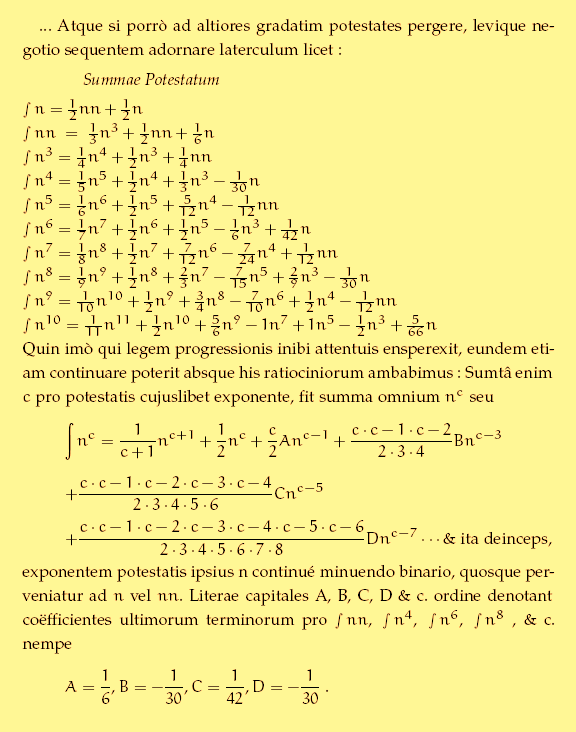
In 1713, Jacob Bernoulli published under the title Summae Potestatum an expression of the sum of the p powers of the n first integers as a (p + 1)th-degree polynomial function of n, with coefficients involving numbers B_j, now called Bernoulli numbers: : \sum_{k=1}^n k^{p} = \frac{n^{p+1}}{p+1}+\frac{1}{2}n^p+{1 \over p+1} \sum_{j=2}^p {p+1 \choose j} B_j n^{p+1-j}.
Introducing also the first two Bernoulli numbers (which Bernoulli did not), the previous formula becomes \sum_{k=1}^n k^p = {1 \over p+1} \sum_{j=0}^p {p+1 \choose j} B_j^+ n^{p+1-j}, using the Bernoulli number of the second kind for which B_1^+=\frac{1}{2}, or \sum_{k=1}^n k^p = {1 \over p+1} \sum_{j=0}^p (-1)^j{p+1 \choose j} B_j n^{p+1-j}, using the Bernoulli number of the first kind B_j=B_j^- for which B_1=-\frac{1}{2}.
A rigorous proof of these formulas and Faulhaber's assertion that such formulas would exist for all odd powers took until , two centuries later. Jacobi benefited from the progress of mathematical analysis using the development in infinite series of an exponential function generating Bernoulli numbers.
Modern period
In 1982, A.W.F. Edwards published an article showing that Pascal's identity can be expressed by means of triangular matrices containing a modified Pascal's triangle:
:\begin{pmatrix} n\ n^2\ n^3\ n^4\ n^5\ \end{pmatrix}=\begin{pmatrix} 1 &0 &0 &0 &0\ 1&2&0 &0 &0 \ 1&3&3&0 &0 \ 1&4&6&4 &0 \ 1&5&10&10&5 \end{pmatrix}\begin{pmatrix} n\ \sum_{k=0}^{n-1} k^1\ \sum_{k=0}^{n-1} k^2\ \sum_{k=0}^{n-1} k^3\ \sum_{k=0}^{n-1} k^4\ \end{pmatrix}
This example is limited by the choice of a fifth-order matrix, but the underlying method is easily extendable to higher orders. Writing the equation as \vec{N}=A\vec{S} and multiplying the two sides of the equation to the left by A^{-1} , we obtain A^{-1}\vec{N}=\vec{S} , thereby arriving at the polynomial coefficients without directly using the Bernoulli numbers. Expanding on Edwards' work, some authors researching the power-sum problem have taken the matrix path, leveraging useful tools such as the Vandermonde vector. Other researchers continue to explore through the traditional analytic route, generalizing the problem of the sum of successive integers to any arithmetic progression.{{cite journal|first=Do|last=Tan Si|title=Obtaining Easily Sums of Powers on Arithmetic Progressions and Properties of Bernoulli Polynomials by Operator Calculus
Polynomials calculating sums of powers of arithmetic progressions
They are polynomials in function of a variable which, when the variable coincides with the number of summands, calculate the sum of powers with bases in arithmetic progression and an exponent equal to the number preceding its degree. The problem is therefore to find polynomials such that: : S_{h,d}^p(n)=\sum_{k=0}^{n-1}(h+kd)^p = h^p+(h+d)^p+\cdots+(h+(n-1)d)^p,
with variable n and parameters p,h,d of the polynomial S_{h,d}^p(n); \quad n and p non-negative integers, h first term of an arithmetic progression and d\ne 0 difference of the same progression, where h and d are any real or complex number
S_{1,1}^p(n)=\sum_{k=0}^{n-1}(1+k)^p= \sum_{k=1}^{n}k^p=1^p+2^p+\dots+n^p ~ are the polynomials identified by the Faulhaber's formula presented posthumously by Jacob Bernoulli in 1713;
S_{0,1}^p(n)=\sum_{k=0}^{n-1}k^p=0^p+1^p+\dots+(n-1)^p ~ are the polynomials differing from the previous ones only in the sign of a monomial of degree 'p';
S_{1,2}^p(n)=\sum_{k=0}^{n-1}(1+2k)^p=1^p+3^p+\dots+(2n-1)^p ~ are the polynomials by sums of powers of successive odd numbers.
Matrix method
For any positive integer m, the general case is solved using the following formula: :\quad\vec{S_{h,d}}(n)=T(h,d)A^{-1}\vec{N_n}\quad, where
: [\vec{S_{h,d}}(n)]{r}=S{h,d}^{r-1}(n),\quad [\vec{N_n}]r=n^{r}, :[T(h,d)]{r,c}=\begin{cases}0, &\text{if } cr,\ \binom{r-1}{c-1}h^{r-c}d^{c-1}&\text{if } c\leq r.\end{cases}, \quad [A]_{r,c}=\begin{cases} 0, &\text{if }cr,\ \binom{r}{c-1}, &\text{if }c\leq r,\end{cases}, \quad with \quad 1\le r\le m \quad and \quad 1\le c\le m \quad where r (row), c (column) and m (matrix ordre) are integers.
Example
The formula in the particular case m=5~ (p=0,1,...,m-1) becomes:
: \begin{pmatrix} S_{h,d}^0({n})\ S_{h,d}^1(n)\ S_{h,d}^2(n)\ S_{h,d}^3(n)\ S_{h,d}^4(n) \end{pmatrix}= \begin{pmatrix} 1& 0& 0& 0&0\ h& d& 0& 0&0\ h^2& 2hd& d^2& 0&0\ h^3& 3h^2d& 3hd^2& d^3&0\ h^4& 4h^3d& 6h^2d^2& 4hd^3& d^4\ \end{pmatrix} \begin{pmatrix} 1& 0& 0& 0&0\ 1& 2& 0& 0&0\ 1& 3& 3& 0&0\ 1& 4& 6& 4&0\ 1& 5& 10& 10&5\ \end{pmatrix}^{-1} \begin{pmatrix} n\ n^2\ n^3\ n^4\ n^5 \end{pmatrix}
Calculating the matrix T(h,d), whose elements follow the binomial theorem with the assigned values, that is, T(1,2), and finding the inverse matrix of the lower triangular matrix A obtained from the Pascal's triangle without the last element of each row (matrix formed from the Bernoulli numbers of first kind, shown in red), we have:
T(1,2)=\begin{pmatrix} 1& 0& 0& 0& 0\ 1& 2& 0& 0& 0 \ 1& 4& 4& 0& 0\ 1& 6& 12& 8& 0 \ 1& 8& 24& 32& 16 \ \end{pmatrix}, \qquad A^{-1}=\begin{pmatrix} \color{red}1 \color{black}&0 &0 &0 &0\ \color{red}-\frac{1}{2}\color{black}&\frac{1}{2}&0 &0 &0\ \color{red}\frac{1}{6}\color{black}&-\frac{1}{2}&\frac{1}{3} &0 &0\ \color{red}0\color{black}&\frac{1}{4}&-\frac{1}{2}&\frac{1}{4} &0\ \color{red}-\frac{1}{30}\color{black}&0&\frac{1}{3}&-\frac{1}{2}&\frac{1}{5} \end{pmatrix}
Multiplying the rows by the columns of the two matrices, we obtain:
: \begin{pmatrix} S_{1,2}^0({n})\ S_{1,2}^1({n})\ S_{1,2}^2({n})\ S_{1,2}^3({n})\ S_{1,2}^4({n}) \end{pmatrix}= \begin{pmatrix} 1 &0 &0 &0 &0\ 0&1&0 &0 &0 \ -\frac{1}{3}&0&\frac{4}{3} &0 &0 \ 0&-1&0&2 &0 \ \frac{7}{15}&0&-\frac{8}{3}&0&\frac{16}{5} \end{pmatrix} \begin{pmatrix} n\ n^2\ n^3\ n^4\ n^5\ \end{pmatrix}=\begin{pmatrix} n\ n^2\ -\frac{1}{3}n+\frac{4}{3}n^3\ -n^2+2n^4\ \frac{7}{15}n-\frac{8}{3}n^3+\frac{16}{5}n^5\ \end{pmatrix}. and therefore:
S_{1,2}^0(n)=n, \quad S_{1,2}^1(n)=n^2, \quad S_{1,2}^2(n))=-\frac{1}{3}n+\frac{4}{3}n^3, \quad S_{1,2}^3(n)=-n^2+2n^4, \quad S_{1,2}^4(n)=\frac{7}{15}n-\frac{8}{3}n^3+\frac{16}{5}n^5. . Finally, if you are interested in the sums of the first three addends
S_{1,2}^0(3)=3, \quad S_{1,2}^1(3)=9, \quad S_{1,2}^2(3))=35, \quad S_{1,2}^3(3)=153, \quad S_{1,2}^4(3)=707=1^4+3^4+5^4.
Bernoulli's polynomial method
The following formula implicitly solves the problem using Bernoulli polynomials: S_{h,d}^p(n)=\frac{d^p}{p+1}(B_{p+1}(n+\frac{h}{d})-B_{p+1}(\frac{h}{d}))~~ {{cite journal|first1 = András|last1=Bazsó|first2=István|last2=Mező|title=On the coefficients of power sums of arithmetic progressions
In particular: :S_{1,1}^p(n)=\frac{B_{p+1}(n+1)-B_{p+1}(1)}{p+1} :S_{0,1}^p(n)=\frac{B_{p+1}(n)-B_{p+1}(0)}{p+1} :S_{1,2}^p(n)=2^p\frac{B_{p+1}(n+\frac{1}{2})-B_{p+1}(\frac{1}{2})}{p+1}
Faulhaber polynomials
The term Faulhaber polynomials is used by some authors to refer to another polynomial sequence related to that given above.
Write a = \sum_{k=1}^n k = \frac{n(n+1)}{2} . Faulhaber observed that if p is odd then \sum_{k=1}^n k^p is a polynomial function of a.

For p = 1, it is clear that \sum_{k=1}^n k^1 = \sum_{k=1}^n k = \frac{n(n+1)}{2} = a. For p = 3, the result that \sum_{k=1}^n k^3 = \frac{n^2(n+1)^2}{4} = a^2 is known as Nicomachus's theorem.
Further, we have \begin{align} \sum_{k=1}^n k^5 &= \frac{4a^3 - a^2}{3} \ \sum_{k=1}^n k^7 &= \frac{6a^4 -4a^3 + a^2}{3} \ \sum_{k=1}^n k^9 &= \frac{16a^5 - 20a^4 +12a^3 - 3a^2}{5} \ \sum_{k=1}^n k^{11} &= \frac{16a^6 - 32a^5 + 34a^4 - 20a^3 + 5a^2}{3} \end{align} (see , , , , ).
More generally, \sum_{k=1}^n k^{2m+1} = \frac{1}{2^{2m+2}(2m+2)} \sum_{q=0}^m \binom{2m+2}{2q} (2-2^{2q})~ B_{2q} ~\left[(8a+1)^{m+1-q}-1\right].
Some authors call the polynomials in a on the right-hand sides of these identities Faulhaber polynomials. These polynomials are divisible by a^2 because the Bernoulli number B_j is 0 for odd j 1.
Inversely, writing for simplicity S_m: = \sum_{k=1}^n k^m, we have \begin{align} 4a^3 &= 3S_5 + S_3 \ 8a^4 &= 4S_7 + 4S_5 \ 16a^5 &= 5S_9 + 10S_7 + S_5 \end{align} and generally 2^{m-1} a^m = \sum_{j0} \binom{m}{2j-1} S_{2m-2j+1}.
Faulhaber also knew that if a sum for an odd power is given by \sum_{k=1}^n k^{2m+1} = c_1 a^2 + c_2 a^3 + \cdots + c_m a^{m+1} then the sum for the even power just below is given by \sum_{k=1}^n k^{2m} = \frac{n+\frac12}{2m+1}(2 c_1 a + 3 c_2 a^2+\cdots + (m+1) c_m a^m). Note that the polynomial in parentheses is the derivative of the polynomial above with respect to a.
Since a = n(n + 1)/2, these formulae show that for an odd power (greater than 1), the sum is a polynomial in n having factors n^2 and (n + 1)^2, while for an even power the polynomial has factors n, n + 1/2 and n + 1.
Expressing products of power sums as linear combinations of power sums
Products of two (and thus by iteration, several) power sums S_m:=\sum_{k=1}^n k^m can be written as linear combinations of power sums with either all degrees even or all degrees odd, depending on the total degree of the product as a polynomial in n , e.g. 30 S_2S_4=-S_3+15S_5+16S_7 . The sums of coefficients on both sides must be equal, which follows by letting n = 1. Some general formulae include: \begin{align} (m+1)S_m^{;2} &= 2\sum_{j=0}^{\lfloor\frac{m}2\rfloor}\binom{m+1}{2j}(2m+1-2j)B_{2j}S_{2m+1-2j}.\ m(m+1)S_mS_{m-1}&=m(m+1)B_mS_m+\sum_{j=0}^{\lfloor\frac{m-1}2\rfloor}\binom{m+1}{2j}(2m+1-2j)B_{2j}S_{2m-2j}.\ 2^{m-1} S_1^{;m} &= \sum_{j=1}^{\lfloor\frac{m+1}2\rfloor} \binom{m}{2j-1} S_{2m+1-2j}.\end{align} The latter formula may be used to recursively compute Faulhaber polynomials. Note that in the second formula, for even m the term corresponding to j=\dfrac m2 is different from the other terms in the sum, while for odd m , this additional term vanishes because of B_m=0 . Beardon has published formulas for powers of S_m, including a 1996 paper which demonstrated that integer powers of S_1 can be written as a linear sum of terms in the sequence S_3,; S_5,; S_7,;...:
:S_1^{;N} = \frac{1}{2^N}\sum_{k=0}^{N} {N \choose k}S_{N+k}\left(1-(-1)^{N+k}\right)
The first few resulting identities are then
:S_1^{;2} = S_3 :S_1^{;3} = \frac{1}{4}S_3 + \frac{3}{4}S_5 :S_1^{;4} = \frac{1}{2}S_5 + \frac{1}{2}S_7 .
Although other specific cases of S_m^{;N} – including S_2^{;2} = \frac{1}{3}S_3 + \frac{2}{3}S_5 and S_2^{;3} = \frac{1}{12}S_4 + \frac{7}{12}S_6+ \frac{1}{3}S_8 – are known, no explicit formula for S_m^{;N} for positive integers m and N has yet been reported. A 2019 paper by Derby proved that:
:S_m^{;N} = \sum_{k=1}^{N}(-1)^{k-1} {N \choose k}\sum_{r=1}^{n}r^{mk}S_m^{;;N-k}(r).
This can be calculated in matrix form, as described below. The m = 1 case replicates Beardon's formula for S_1^{;N} and confirms the above-stated results for m = 2 and N = 2 or 3. Results for higher powers include:
:S_2^{;4} = \frac{1}{54}S_5 + \frac{5}{18}S_7 + \frac{5}{9}S_9 + \frac{4}{27}S_{11} :S_6^{;3} = \frac{1}{588}S_8 - \frac{1}{42}S_{10} + \frac{13}{84}S_{12} - \frac{47}{98}S_{14} + \frac{17}{28}S_{16} + \frac{19}{28}S_{18} + \frac{3}{49}S_{20} :S_7^{;3} = \frac{1}{48}S_{11} - \frac{7}{48}S_{13} + \frac{35}{64}S_{15} - \frac{23}{24}S_{17} + \frac{77}{96}S_{19} + \frac{11}{16}S_{21} + \frac{3}{64}S_{23}.
Further generalization is possible by considering the arbitrary power-sum product P := S_{m_1}S_{m_2}S_{m_3} \cdots S_{m_r} given positive integers m_1, \ldots, m_r. For convenience define q := \sum_{k=1}^r{m_k}, and let p_0, \ldots, p_{q+r} be the Maclaurin coefficients of P — i.e. P(n) = \sum_{k=0}^{q+r}{p_kn^k}. It can be shown that
:\prod_{k=1}^r{S_{m_k}} = \sum_{k=1}^{q+r-1}{\left(1-(-1)^{q+r+k}\right)p_kS_k}.
In particular, the product S_1^{;r} has trivially retrievable coefficients:
:S_1^{;r}(n) = \left(\frac{n(n+1)}{2}\right)^r = \sum_{k=r}^{2r}{\frac{1}{2^r}\binom{r}{k-r}n^k}.
Combining with the above gives
:S_1^{;r} = \frac{1}{2^r}\sum_{k=r}^{2r-1}{\left(1-(-1)^k\right)\binom{r}{k-r}S_k}
which is an indexical restatement of Beardon's formula. More generally,
:S_m^{;r} = \sum_{k=1}^{r(m+1)-1}{\left(1-(-1)^{r(m+1)+k}\right)p_kS_k}.
Compared to Derby's approach, this formula only requires knowledge of the coefficients of S_m^{;r}.
Matrix form
Faulhaber's formula can also be written in a form using matrix multiplication.
Take the first seven examples \begin{align} \sum_{k=1}^n k^0 &= \phantom{-}1n \ \sum_{k=1}^n k^1 &= \phantom{-}\tfrac{1}{2}n+\tfrac{1}{2}n^2 \ \sum_{k=1}^n k^2 &= \phantom{-}\tfrac{1}{6}n+\tfrac{1}{2}n^2+\tfrac{1}{3}n^3 \ \sum_{k=1}^n k^3 &= \phantom{-}0n+\tfrac{1}{4}n^2+\tfrac{1}{2}n^3+\tfrac{1}{4}n^4 \ \sum_{k=1}^n k^4 &= -\tfrac{1}{30}n+0n^2+\tfrac{1}{3}n^3+\tfrac{1}{2}n^4+\tfrac{1}{5}n^5 \ \sum_{k=1}^n k^5 &= \phantom{-}0n-\tfrac{1}{12}n^2+0n^3+\tfrac{5}{12}n^4+\tfrac{1}{2}n^5+\tfrac{1}{6}n^6 \ \sum_{k=1}^n k^6 &= \phantom{-}\tfrac{1}{42}n+0n^2-\tfrac{1}{6}n^3+0n^4+\tfrac{1}{2}n^5+\tfrac{1}{2}n^6+\tfrac{1}{7}n^7 . \end{align} Writing these polynomials as a product between matrices gives \begin{pmatrix} \sum k^0 \ \sum k^1 \ \sum k^2 \ \sum k^3 \ \sum k^4 \ \sum k^5 \ \sum k^6 \end{pmatrix} = G_7 \begin{pmatrix} n \ n^2 \ n^3 \ n^4 \ n^5 \ n^6 \ n^7 \end{pmatrix} , where G_7 = \begin{pmatrix} 1& 0& 0& 0& 0&0& 0\ {1\over 2}& {1\over 2}& 0& 0& 0& 0& 0\ {1\over 6}& {1\over 2}&{1\over 3}& 0& 0& 0& 0\ 0& {1\over 4}& {1\over 2}& {1\over 4}& 0&0& 0\ -{1\over 30}& 0& {1\over 3}& {1\over 2}& {1\over 5}&0& 0\ 0& -{1\over 12}& 0& {5\over 12}& {1\over 2}& {1\over 6}& 0\ {1\over 42}& 0& -{1\over 6}& 0& {1\over 2}&{1\over 2}& {1\over 7} \end{pmatrix} .
Surprisingly, inverting the matrix of polynomial coefficients yields something more familiar: G_7^{-1}=\begin{pmatrix} 1& 0& 0& 0& 0& 0& 0\ -1& 2& 0& 0& 0& 0& 0\ 1& -3& 3& 0& 0& 0& 0\ -1& 4& -6& 4& 0& 0& 0\ 1& -5& 10& -10& 5& 0& 0\ -1& 6& -15& 20& -15& 6& 0\ 1& -7& 21& -35& 35& -21& 7\ \end{pmatrix} = \overline{A}_7
In the inverted matrix, Pascal's triangle can be recognized, without the last element of each row, and with alternating signs.
Let A_7 be the matrix obtained from \overline{A}7 by changing the signs of the entries in odd diagonals, that is by replacing a{i,j} by (-1)^{i+j} a_{i,j}, let \overline{G}7 be the matrix obtained from G_7 with a similar transformation, then A_7=\begin{pmatrix} 1& 0& 0& 0& 0& 0& 0\ 1& 2& 0& 0& 0& 0& 0\ 1& 3& 3& 0& 0& 0& 0\ 1& 4& 6& 4& 0& 0& 0\ 1& 5& 10& 10& 5& 0& 0\ 1& 6& 15& 20& 15& 6& 0\ 1& 7& 21& 35& 35& 21& 7\ \end{pmatrix} and A_7^{-1}=\begin{pmatrix} 1& 0& 0& 0& 0&0& 0\ -{1\over 2}& {1\over 2}& 0& 0& 0& 0& 0\ {1\over 6}& -{1\over 2}&{1\over 3}& 0& 0& 0& 0\ 0& {1\over 4}& -{1\over 2}& {1\over 4}& 0&0& 0\ -{1\over 30}& 0& {1\over 3}& -{1\over 2}& {1\over 5}&0& 0\ 0& -{1\over 12}& 0& {5\over 12}& -{1\over 2}& {1\over 6}& 0\ {1\over 42}& 0& -{1\over 6}& 0& {1\over 2}&-{1\over 2}& {1\over 7} \end{pmatrix}=\overline{G}7 . Also \begin{pmatrix} \sum{k=0}^{n-1} k^0 \ \sum{k=0}^{n-1} k^1 \ \sum_{k=0}^{n-1} k^2 \ \sum_{k=0}^{n-1} k^3 \ \sum_{k=0}^{n-1} k^4 \ \sum_{k=0}^{n-1} k^5 \ \sum_{k=0}^{n-1} k^6 \ \end{pmatrix} = \overline{G}7\begin{pmatrix} n \ n^2 \ n^3 \ n^4 \ n^5 \ n^6 \ n^7 \ \end{pmatrix} This is because it is evident that \sum{k=1}^{n}k^m-\sum_{k=0}^{n-1}k^m=n^m and that therefore polynomials of degree m+ 1 of the form \frac{1}{m+1}n^{m+1}+\frac{1}{2}n^m+\cdots subtracted the monomial difference n^m they become \frac{1}{m+1}n^{m+1}-\frac{1}{2}n^m+\cdots .
This is true for every order, that is, for each positive integer m, one has G_m^{-1} = \overline{A}_m and \overline{G}_m^{-1} = A_m. Thus, it is possible to obtain the coefficients of the polynomials of the sums of powers of successive integers without resorting to the numbers of Bernoulli but by inverting the matrix easily obtained from the triangle of Pascal.. .
Variations
- Replacing k with p-k, we find the alternative expression: \sum_{k=1}^n k^p= \sum_{k=0}^p \frac1{k+1}{p \choose k} B_{p-k} n^{k+1}.
- Subtracting n^p from both sides of the original formula and incrementing n by 1, we get \begin{align} \sum_{k=1}^n k^{p} &= \frac{1}{p+1} \sum_{k=0}^p \binom{p+1}{k} (-1)^kB_k (n+1)^{p-k+1} \ &= \sum_{k=0}^p \frac{1}{k+1} \binom{p}{k} (-1)^{p-k}B_{p-k} (n+1)^{k+1}, \end{align} : where (-1)^kB_k = B^-_k can be interpreted as "negative" Bernoulli numbers with B^-_1=-\tfrac12.
- We may also expand G(z,n) in terms of the Bernoulli polynomials to find \begin{align} G(z,n) &= \frac{e^{(n+1)z}}{e^z -1} - \frac{e^z}{e^z -1}\ &= \sum_{j=0}^{\infty} \left(B_j(n+1)-(-1)^j B_j\right) \frac{z^{j-1}}{j!}, \end{align} which implies \sum_{k=1}^n k^p = \frac{1}{p+1} \left(B_{p+1}(n+1)-(-1)^{p+1}B_{p+1}\right) = \frac{1}{p+1}\left(B_{p+1}(n+1)-B_{p+1}(1) \right). Since B_n = 0 whenever n 1 is odd, the factor (-1)^{p+1} may be removed when p 0.
- It can also be expressed in terms of Stirling numbers of the second kind and falling factorials as \sum_{k=0}^n k^p = \sum_{k=0}^p \left{k+1}, \sum_{k=1}^n k^p = \sum_{k=1}^{p+1} \left{{p+1\atop k}\right}\frac{(n)_k}{k}. This is due to the definition of the Stirling numbers of the second kind as monomials in terms of falling factorials, and the behaviour of falling factorials under the indefinite sum.
Interpreting the Stirling numbers of the second kind, \left{{p+1\atop k}\right}, as the number of set partitions of \lbrack p+1\rbrack into k parts, the identity has a direct combinatorial proof since both sides count the number of functions f:\lbrack p+1\rbrack \to \lbrack n\rbrack with f(1) maximal. The index of summation on the left hand side represents k=f(1), while the index on the right hand side is represents the number of elements in the image of f.
- There is also a similar (but somehow simpler) expression: using the idea of telescoping and the binomial theorem, one gets Pascal's identity: \begin{align}(n+1)^{k+1}-1 &= \sum_{m = 1}^n \left((m+1)^{k+1} - m^{k+1}\right)\ &= \sum_{p = 0}^k \binom{k+1}{p} (1^p+2^p+ \dots + n^p).\end{align} :This in particular yields the examples below – e.g., take to get the first example. In a similar fashion we also find \begin{align}n^{k+1} = \sum_{m = 1}^n \left(m^{k+1} - (m-1)^{k+1}\right) = \sum_{p = 0}^k (-1)^{k+p}\binom{k+1}{p} (1^p+2^p+ \dots + n^p).\end{align}
- A generalized expression involving the Eulerian numbers A_n(x) is :\sum_{n=1}^\infty n^k x^n=\frac{x}{(1-x)^{k+1}}A_k(x).
- Faulhaber's formula was generalized by Guo and Zeng to a q-analog.
Relationship to Riemann zeta function
Using B_k=-k\zeta(1-k), one can write \sum\limits_{k=1}^n k^p = \frac{n^{p+1}}{p+1} - \sum\limits_{j=0}^{p-1}{p \choose j}\zeta(-j)n^{p-j}.
If we consider the generating function G(z,n) in the large n limit for \Re (z), then we find \lim_{n\rightarrow \infty}G(z,n) = \frac{1}{e^{-z}-1}=\sum_{j=0}^{\infty} (-1)^{j-1}B_j \frac{z^{j-1}}{j!} Heuristically, this suggests that \sum_{k=1}^{\infty} k^p=\frac{(-1)^{p} B_{p+1}}{p+1}. This result agrees with the value of the Riemann zeta function \zeta(s)=\sum_{n=1}^{\infty}\frac{1}{n^s} for negative integers s=-p on appropriately analytically continuing \zeta(s).
Faulhaber's formula can be written in terms of the Hurwitz zeta function:
\sum\limits_{k=1}^n k^p = \zeta(-p) - \zeta(-p, n+1)
Umbral form
In the umbral calculus, one treats the Bernoulli numbers B^0 = 1, B^1 = \frac{1}{2}, B^2 = \frac{1}{6}, ... as if the index j in B^j were actually an exponent, and so as if the Bernoulli numbers were powers of some object B.
Using this notation, Faulhaber's formula can be written as \sum_{k=1}^n k^p = \frac{1}{p+1} \big( (B+n)^{p+1} - B^{p+1} \big) . Here, the expression on the right must be understood by expanding out to get terms B^j that can then be interpreted as the Bernoulli numbers. Specifically, using the binomial theorem, we get \begin{align} \frac{1}{p+1} \big( (B+n)^{p+1} - B^{p+1} \big) &= {1 \over p+1} \left( \sum_{k=0}^{p+1} \binom{p+1}{k} B^k n^{p+1-k} - B^{p+1} \right) \ &= {1 \over p+1} \sum_{k=0}^{p} \binom{p+1}{j} B^k n^{p+1-k} . \end{align}
A derivation of Faulhaber's formula using the umbral form is available in The Book of Numbers by John Horton Conway and Richard K. Guy.
Classically, this umbral form was considered as a notational convenience. In the modern umbral calculus, on the other hand, this is given a formal mathematical underpinning. One considers the linear functional T on the vector space of polynomials in a variable b given by T(b^j) = B_j. Then one can say \begin{align} \sum_{k=1}^n k^p &= {1 \over p+1} \sum_{j=0}^p {p+1 \choose j} B_j n^{p+1-j} \ &= {1 \over p+1} \sum_{j=0}^p {p+1 \choose j} T(b^j) n^{p+1-j} \ &= {1 \over p+1} T\left(\sum_{j=0}^p {p+1 \choose j} b^j n^{p+1-j} \right) \ &= T\left({(b+n)^{p+1} - b^{p+1} \over p+1}\right). \end{align}
Notes
References
- With Bernoulli's first numbers, on the other hand, we have \sum_{k=0}^{n-1} k^{p} = \frac{1}{p+1} \sum_{r=0}^p \binom{p+1}{r} B_r^-n^{p+1-r} .
- Beery, Janet. (2009). "Sum of powers of positive integers". MAA Mathematical Association of America.
- Donald E. Knuth. (2010-12-01). "Johann Faulhaber and sums of powers". Mathematics of Computation.
- Edwards, Anthony William Fairbank. (1982). "Sums of powers of integers: A little of the History". The Mathematical Gazette.
- The first element of the vector of the sums is n and not \sum_{k=0}^{n-1}k^0 because of the first addend, the indeterminate form 0^0 , which should otherwise be assigned a value of 1
- Edwards, A.W.F.. (1987). "Pascal's Arithmetical Triangle: The Story of a Mathematical Idea". Charles Griffin & C..
- Kalman, Dan. (1988). "Sums of Powers by matrix method". Semantic scholar.
- Helmes, Gottfried. (2006). "Accessing Bernoulli-Numbers by Matrix-Operations". Uni-Kassel.de.
- Howard, F.T. (1994). "Sums of powers of integers via generating functions".
- Lang, Wolfdieter. (2017). "On Sums of Powers of Arithmetic Progressions, and Generalized Stirling, Eulerian and Bernoulli numbers".
- (1713). "Ars Conjectandi".
- This depends on the fact that\ sum_{k=0}^{n-1}k^p=\sum_{k=1}^{n}k^p-n^p, which, for p \ge 0, transforms \frac{n^p}{2} into -\frac{n^p}{2}.
- Pietrocola, Giorgio. (2019). "Binomial matrices for polynomials calculating sums of powers with bases in arithmetic progression".
- (March 4, 2010). "Nicomachus's Theorem". Matlab Central.
- Beardon, A. F.. (1996). "Sums of Powers of Integers". [[The American Mathematical Monthly]].
- Derby, Nigel M.. (2019). "The continued search for sums of powers". [[The Mathematical Gazette]].
- [[Concrete Mathematics]], 1st ed. (1989), p. 275.
- Kieren MacMillan, Jonathan Sondow. (2011). "Proofs of power sum and binomial coefficient congruences via Pascal's identity". [[American Mathematical Monthly]].
- (30 August 2005). "A q-Analogue of Faulhaber's Formula for Sums of Powers". The Electronic Journal of Combinatorics.
- [[John H. Conway]], [[Richard K. Guy. (1996). "The Book of Numbers". Springer.
This article was imported from Wikipedia and is available under the Creative Commons Attribution-ShareAlike 4.0 License. Content has been adapted to SurfDoc format. Original contributors can be found on the article history page.
Ask Mako anything about Faulhaber's formula — get instant answers, deeper analysis, and related topics.
Research with MakoFree with your Surf account
Create a free account to save articles, ask Mako questions, and organize your research.
Sign up freeThis content may have been generated or modified by AI. CloudSurf Software LLC is not responsible for the accuracy, completeness, or reliability of AI-generated content. Always verify important information from primary sources.
Report