From Surf Wiki (app.surf) — the open knowledge base
Fascism in the United States
none

none
Fascism in the United States is an expression of fascist political ideology that dates back over a century in the United States, with roots in white supremacy, nativism, xenophobia and violent far-right political extremism. Although it has received less scholarly attention than fascism in Europe, particularly Nazi Germany and Italy, scholars say that far-right authoritarian movements have been a part of the politics of the United States for a long time.
Scholars believe that early 20th-century groups such as the Ku Klux Klan and domestic proto-fascist organizations that existed during the Great Depression were the originators of fascism in the U.S. These groups flourished during periods of social and political unrest. Alongside homegrown movements, German-backed political organizations worked to influence U.S. public opinion towards the Nazi cause during World War II. After the U.S.'s formal declaration of war against Germany, the U.S. Treasury Department raided the German American Bund's headquarters and arrested its leaders. Both during and after World War II, Italian anti-fascist activists and other anti-fascist groups played a role in confronting these ideologies.
Events such as the 2017 Charlottesville rally have exposed the persistence of racism, antisemitism, and white supremacy within U.S. society. The resurgence of fascist rhetoric in contemporary U.S. politics, particularly under the administration of President Donald Trump, has highlighted the persistence of far-right ideologies, and it has also rekindled questions and debates about the history of fascism in the United States.
Early origins
The origins of fascism in the United States date back to the 19th century with roots in slavery in the Antebellum South and the Confederate States of America, the subsequent passage of Black Codes and Jim Crow laws in the American South, the rise of the eugenics movement in the U.S., and the intensification of nativist and xenophobic hostility towards immigrants. During the early 20th century, several groups that have been classified as fascist organizations by contemporary historians were formed in the United States—a prominent organization is the Ku Klux Klan.
Early Proto-Fascist Movements
While it is impossible to classify early nativist movements in the United States, such as the Native American Party of 1845 and the Know Nothings, as being outright fascist because their existence predated the invention of the term "fascism" by decades, many of their beliefs strongly align with the tenets of fascism. Furthermore, the Know Nothing movement's heavy-handed approach to intimidation, often through the use of violence, mirrored the methods which fascists would employ in the future.
Ku Klux Klan

The Ku Klux Klan (KKK), or "the Klan," is an American Protestant-led Christian extremist, white supremacist, far-right hate group founded in 1865 during the post-Civil War Reconstruction era in the American South.
Scholars have characterized the Klan as America's first terrorist group, comparing its emergence to the rise of fascist trends in Europe. Historian Peter Amann argued that "Undeniably, the Klan had some traits in common with European fascism—chauvinism, racism, a mystique of violence, an affirmation of a certain kind of archaic traditionalism—yet their differences were fundamental. ... [The KKK] never envisioned a change of political or economic system."
The first Klan, founded by Confederate veterans, assaulted and murdered politically active Black people and their white political allies in the Southern United States. The second Klan was formed in 1915 as a small group in Georgia and it flourished nationwide by the mid-1920s.
Inter-war period
The rise of fascism in Europe during the interwar period raised concerns in the U.S.; however, European fascist regimes were largely viewed positively by the American ruling class. This was because fascist interpretations of ultranationalism allowed a nation to gain a significant amount of economic influence in the Western world and permitted a nation's government to destroy leftists and labor movements.
Supporters of Italian fascism

During the 1920s, American scholars frequently wrote about the rise of Italian fascism under Benito Mussolini, but few of them supported it; however, Mussolini's fascist policies initially gained widespread support among Italian Americans.
William Phillips, who served as the American ambassador to Italy, was "greatly impressed by the efforts of Benito Mussolini to improve the conditions of the masses" and found "much evidence" in support of the fascist argument that "they represent a true democracy in as much as the welfare of the people is their principal objective."
Phillips found Mussolini's achievements "astounding [and] a source of constant amazement" and greatly admired his "great human qualities." United States Department of State officials enthusiastically agreed with Phillips' assessment, praising Italian fascism for having "brought order out of chaos, discipline out of license, and solvency out of bankruptcy," as well as Mussolini's "magnificent" achievements in Ethiopia during the Second Italo-Ethiopian War.
The American poet Ezra Pound moved from the United States to Italy in 1924, becoming a loyal supporter of Benito Mussolini, the founder of a fascist state. He wrote articles and produced radio broadcasts that were critical of the United States, international bankers, Franklin Roosevelt, and the Jews. His propaganda was poorly received in the U.S.
In November 1925, the Order Sons of Italy in America helped organize the first U.S. Fascist convention in Philadelphia. The goal of the convention was "setting up Fascist infiltration into political organizations and mutual aid societies so as to create friendly ties and spiritual agreement". After World War II, the organization faced criticism for the "heavy involvement by the OSIA in Mussolini's Fascist propaganda campaign in the 1920s and 1930s".
American Legion
While one would be remiss to paint the contemporary American Legion as a bastion of fascism, its early history is proof that it shared a strong feeling of solidarity with early fascist movements. Initially founded in Paris in 1919 by American soldiers who were returning to the United States after the First World War, it became an advocacy group which lobbied on behalf of veterans.
However, in 1922, the year Mussolini seized power in Italy, Alvin Owsley, the National Commander of the American Legion, proclaimed that the Legion was a staunch opponent of communist and socialist movements. While he was claiming that he was defending American values such as liberty and freedom, Owsley also stated that, “Should the day ever come when they menace the freedom of our representative government, the Legion would not hesitate to take things into its own hands - to fight the 'reds' as the Fascisti of Italy fought them.” While the statement itself does not declare the Legion as outright fascist, his subsequent comment that, “ …the Fascisti are to Italy what the American Legion is to the United States. And that Mussolini, the new premier, was the commander of the Legion - the ex-servicemen of Italy…” served as an endorsement and unofficial outreach to Mussolini.
Years later, Commander John McQuigg (1925-26) doubled down on the Legion’s support of Italian Fascist ideology when he stated, “The Fascisti are the Legionnaires of Italy. Their aims and ideals, though not their methods, are identical with those of the American Legionnaires.” While these comments could potentially be dismissed as overly enthusiastic personal opinions of prominent individuals within the Legion, it is crucial to note that the American Legion extended numerous invitations to Mussolini to address its conventions.
The American Legion was unable to receive support from Mussolini, however, it enticed the Italian government to send Ambassador Giacomo De Martino to represent Italy at a Legion convention in 1931, where the National Executive passed a resolution in which it conveyed its support of Mussolini’s policies. Its admiration for Mussolini carried well into the decade when its national vice commander, Colonel William Esterwood, visited Italy to bestow an honorary American Legion membership upon him in 1935. By this point, however, fascism’s initial allure had begun to wane, and this move by the Legion proved unpopular with many members, leading to the Legion's cancellation of the membership. The mid-1930s proved to be a turning point for the American Legion’s flirtation with fascism, because it soon abandoned its support of fascist regimes.
Black Legion

Main article: Black Legion (political movement)
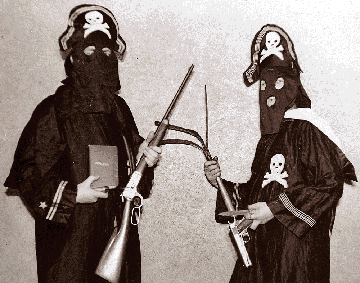
In 1925, Virgil Effinger established the paramilitary Black Legion, a violent white supremacist offshoot of the KKK that sought to establish fascism in the United States by launching a revolution against the federal government. The Black Legion was active in the Midwestern United States in the 1920s and the 1930s and grew to prominence during the Great Depression. The FBI estimated its membership numbered "at 135,000, including a large number of public officials, including Detroit's police chief." Historians have suggested lower estimates.
The Black Legion is widely viewed as having been an even more violent and radical offshoot of the Klan. In 1936, the group was suspected of having killed as many as 50 people, according to the Associated Press, including Charles Poole, an organizer for the federal Works Progress Administration. Eleven men were found guilty of Poole's murder. The Associated Press described the organization as "a group of loosely federated night-riding bands operating in several States without central discipline or common purpose beyond the enforcement by lash and pistol of individual leaders' notions of 'Americanism.'" Nearly 50 Legionnaires were ultimately convicted of murder, conspiracy to commit murder, kidnapping, arson, and perjury. Although it was responsible for numerous attacks, the Black Legion remained limited in size and ultimately petered out.
Father Charles Coughlin

Father Charles Coughlin was a Roman Catholic priest who hosted a prominent radio program in the late 1930s, on which he often ventured into politics. In 1932, he backed and welcomed the election of President Franklin Roosevelt, but the two had a falling out after 1934. His radio program and his newspaper, "Social Justice," denounced Roosevelt, as well as the "big banks" and "the Jews." When the United States entered World War II, the U.S. government took his radio broadcasts off the air and blocked his newspaper from the mail. He abandoned politics but remained a parish priest until he died in 1979.
The American architect-to-be Philip Johnson was a correspondent (in Germany) for Coughlin's newspaper between 1934 and 1940 (before beginning his architectural career). He wrote articles that were favorable to the Nazis and critical of "the Jews," as well as taking part in a Nazi-sponsored press tour, in which he covered the 1939 Nazi invasion of Poland. He quit the newspaper in 1940, was investigated by the FBI, and was cleared for army service in World War II. Years later, he would refer to these activities as "the stupidest thing[sic] I ever did... [which] I never can atone for."
Rise of Hitler
Adolf Hitler became chancellor of Germany on January 30, 1933. In the years that followed, before the outbreak of World War II, some German-Americans attempted to create pro-Nazi movements in the U.S., often bearing swastikas and wearing uniforms. These groups had little to do with Nazi Germany, and they lacked support from the wider German-American community.
Across the U.S., so many small groups sprang up wearing uniforms and identifying as fascist that in 1934, the American Civil Liberties Union released a pamphlet titled "Shirts! A Survey of the New 'Shirt' Organizations in the United States Seeking a Fascist Dictatorship" detailing the gold, silver, brown, black, gray, white and blue-colored shirt liveries of the different emergent fascist groups.
In May 1933, Heinz Spanknöbel, a German immigrant to America, received authority from Rudolf Hess, the deputy führer of Germany, to form an official American branch of the Nazi Party. The branch was known as the Friends of New Germany in the U.S. The Nazi Party referred to it as the National Socialist German Workers' Party of the U.S.A. Though the party had a strong presence in Chicago, it remained based in New York City, having received support from the German consul in the city. Spanknöbel's organization was openly pro-Nazi. Members stormed the German-language newspaper New Yorker Staats-Zeitung and demanded that the paper publish articles sympathetic to Nazis. Spanknöbel's leadership was short-lived, as he was deported in October 1933 following revelations that he had not registered as a foreign agent.
Some American corporations had branches in neutral countries that traded with Germany after the U.S. declared war in late 1941.
German American Bund

The German American Bund was the most prominent and well-organized fascist organization in the United States. It was founded in 1936, following the model of Hitler's Nazi Germany. It appeared shortly after the founding of several smaller groups, including the Friends of New Germany and the Silver Legion of America, founded in 1933 by William Dudley Pelley and the Free Society of Teutonia. The Friends of New Germany dissolved in December 1935 when Hess ordered all German citizens to leave the group after realizing that the organization was not beneficial to advancing their cause.
The German American Bund, led by Fritz Kuhn, was formed in 1936 and lasted until America formally entered World War II in 1941. The Bund existed with the goal of a united America under ethnic German rule and following Nazi ideology. It proclaimed communism as its main enemy and expressed anti-Semitic attitudes. After March 1, 1938, membership in the German-American Bund was only open to American citizens of German descent. Its main goal was to promote a favorable view of Nazi Germany. The Bund was active, providing its members with uniforms and encouraging participation in "training camps."
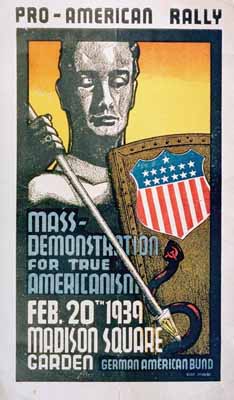
Inspired by the Hitler Youth, the Bund created its youth division, where members "took German lessons, received instructions on how to salute the swastika, and learned to sing the 'Horst Wessel Lied' and other Nazi songs." The Bund continued to justify and glorify Hitler and his movements in Europe during the outbreak of World War II. After Germany invaded Poland in 1939, Bund leaders released a statement demanding that America stay neutral in the ensuing conflict and expressed sympathy for Germany's war effort. The Bund reasoned that this support for the German war effort was not disloyal to the United States, as German-Americans would "continue to fight for a Gentile America free of all atheistic Jewish Marxist elements."
The Bund held rallies with Nazi insignia and procedures such as the Hitler salute. Its leaders denounced the administration of President Franklin D. Roosevelt, Jewish-American groups, communism, "Moscow-directed" trade unions, and American boycotts of German goods. They claimed that George Washington was "the first Fascist" because he did not believe that democracy would work.
The high point of the Bund's activities was their rally at Madison Square Garden in New York City on February 20, 1939, with around 20,000 people in attendance. The anti-Semitic speakers repeatedly referred to President Roosevelt as "Frank D. Rosenfeld," calling his New Deal the "Jew Deal," as well as denouncing the supposed Bolshevik-Jewish American leadership. The rally ended with violence between protesters and the Bund's "storm-troopers." In 1939, America's top fascist, the Bund's leader Fritz Julius Kuhn, was investigated by the city of New York and was found to be embezzling the Bund's funds for his personal use. He was arrested, his citizenship was revoked, and he was deported.
The U.S. Army organized a draft in 1940 to bring citizens into military service. The Bund advised its members not to submit to the draft. Based on this advice, the U.S. government outlawed the Bund, and Kuhn fled to Mexico.
After many internal and leadership disputes, the Bund's executive committee agreed to disband the party on December 8, 1941, the day after the attack on Pearl Harbor. On December 11, 1941, the United States formally declared war on Germany, and Treasury Department agents raided Bund headquarters. The agents seized all records and arrested 76 Bund leaders.
World War II
Canada and the United States battled the Axis powers during World War II. As part of the war effort, they suppressed the fascist movements within their borders, which were already weakened by the widespread public perception that they were fifth columns. This suppression consisted of the internment of fascist leaders, the disbanding of fascist organizations, the censorship of fascist propaganda, and pervasive government propaganda against fascism. In the U.S., this campaign of suppression culminated in "The Great Sedition Trial" of November 1944, in which George Sylvester Viereck, Lawrence Dennis, Elizabeth Dilling, William Dudley Pelley, Joe McWilliams, Robert Edward Edmondson, Gerald Winrod, William Griffin, and, in absentia, Ulrich Fleischhauer were all put on trial for aiding the Nazi cause, supporting fascism and isolationism. However, after the judge's death, a mistrial was declared, and all charges were dropped.
Post-World War II

In the 1980s, the Office of Special Investigations estimated around ten thousand Nazi war criminals entered the United States from Eastern Europe after the conclusion of World War II, although the number has since been determined to have been much smaller.
Some were brought in Operation Paperclip, a project to bring German scientists and engineers to the U.S. Most Nazi collaborators entered the United States through the 1948 and 1950 Displaced Persons Acts and the Refugee Relief Act of 1953. Supporters of the acts exhibited only slight awareness that Nazi war criminals would exploit the legislation to enter the United States. Most of the supporters' concern was about disallowing known communists from entering. Similarly, after the defeat of Nazi Germany in World War II, the global focus shifted from fascism to communism as the next perceived ideological threat. The pressures of the Cold War in the years after World War II, when the United States focused on countering Soviet communism rather than Nazism, contributed to this shift in focus. The totalitarian nature of Nazism had already demonstrated how dangerous centralized, authoritarian regimes could be. As the Soviet Union expanded its influence across Eastern Europe and supported communist movements worldwide, many Americans began to fear a similar form of totalitarianism taking root at home. This anxiety was intensified by events such as the Soviet Union’s successful atomic bomb test in 1949 and the communist revolution in China. These developments, combined with revelations of Soviet espionage in the U.S., fueled widespread suspicion and led to the Second Red Scare, during which government officials, educators, and entertainers were investigated for alleged communist ties.
During the 1950s, the Immigration and Naturalization Service conducted several investigations into suspected Nazi war criminals. No official trials came from these investigations. The Holocaust and the possibility of Nazi collaborators living in the country entered the national discussion in the 1960s with the trial of Adolf Eichmann, accusations of war criminals during Soviet war crimes trials, and a series of articles published by Charles R. Allen detailing the presence of Nazi war criminals living in the U.S. The federal government began to focus on uncovering Nazi war criminals remaining in the country.
Public awareness of the Holocaust and remaining Nazi war criminals increased in the 1970s. Many cases made headline news. The case of Hermine Braunsteiner, the first Nazi war criminal to be extradited from the United States, received widespread media coverage. The case triggered the Immigration and Naturalization Service to locate Nazi collaborators further. By the late 1970s, INS addressed thousands of cases, and the U.S. government formed the Office of Special Investigations, which was dedicated to locating Nazi war criminals in the United States.
Neo-Nazism
Neo-Nazism began to emerge as an ideology in the 1970s, seeking to revive and implement Nazi ideology. In the United States, organizations such as the American Nazi Party, the National Alliance, and White Aryan Resistance were formed during the second half of the 20th century. While initially composed of distinctive movements, in the 21st century, many U.S. Neo-Nazi groups have moved towards more decentralized organization and online social networks with a terroristic focus.
American Nazi Party
.jpg)
In 1959, the American Nazi Party was founded by George Lincoln Rockwell, a former U.S. Navy commander, who was dismissed from the Navy due to his espousal of fascist political views.
Headquartered in Arlington, Virginia, the organization was initially named the World Union of Free Enterprise National Socialists, intended to denote opposition to state ownership of property. The same year, it was renamed the American Nazi Party to attract 'maximum media attention.'
The party was based primarily upon the ideals and policies of Adolf Hitler's Nazi Party in Germany during the Nazi era and embraced its uniforms and iconography. Since the late 1960s, several small groups had used the name "American Nazi Party," with most being independent of each other and disbanding before the 21st century.
On August 25, 1967, Rockwell was shot and killed in Arlington by John Patler, a former party member who Rockwell had previously expelled due to his espousal of his alleged "Bolshevik leanings." The party was dissolved in 1983.
National Alliance
.jpg)
The National Alliance was a neo-Nazi, white supremacist political organization founded by William Luther Pierce, author of The Turner Diaries, in 1974 and based in Mill Point, West Virginia. It was the largest and most active neo-Nazi group in the United States in the 1990s. In 2002, its membership was estimated at 2,500 with an annual income of $1 million.
Its membership declined after Pierce died in 2002, and after a split in its ranks in 2005, it largely became defunct. According to the Southern Poverty Law Center, the National Alliance had lost most of its members by 2020 but is still visible in the U.S. Other groups, such as Atomwaffen Division, have taken its place.
National Socialist Movement

The National Socialist Movement (NSM or NSM88) is a US-based Neo-Nazi organization that was founded in 1974. The Anti-Defamation League has described the NSM as "one of the more explicitly neo-Nazi groups in the United States." It seeks the transformation of the United States into a white ethnostate from which Jews, non-Whites, and members of the LGBTQ community would be expelled and barred from citizenship.
Once considered the largest and most prominent neo-Nazi organization in the United States, its membership has plummeted since the late 2010s. It is a part of the Nationalist Front and is classified as a hate group by the Southern Poverty Law Center.
Atomwaffen Division
The Atomwaffen Division was a neo-Nazi and Satanist terrorist group which was founded in the United States in 2015, and it was responsible for at least 11 murders. Atomwaffen adhered to the ideology of accelerationism, waging a war against the government to overthrow it and install an all-white fascist state. As of November 10, 2024, the Atomwaffen Division has been disbanded, according to reports which have been published by several news outlets.
2017 Charlottesville rally
Main article: Unite the Right rally
_crop.jpg)
From 11 to 12 August 2017, the Unite the Right rally, a white-nationalist event, took place in Charlottesville, Virginia. It was organized by Richard B. Spencer and Jason Kessler, both Neo-Nazism adherents. Marchers included members of the alt-right, neo-Confederates, neo-fascists, white nationalists, neo-Nazis, Klansmen, and far-right militias.
Some groups chanted racist and antisemitic slogans and carried weapons, Nazi and neo-Nazi symbols, the valknut, Confederate battle flags, Deus vult crosses, flags, and other symbols of various past and present antisemitic and anti-Islamic groups. The organizers' stated goals included the unification of the American white nationalist movement and opposing the proposed removal of the statue of General Robert E. Lee from Charlottesville's former Lee Park. The rally sparked a national debate over Confederate iconography, racial violence, and white supremacy.
Patriot Front

Patriot Front is an American white supremacist and neo-fascist hate group.Multiple sources:
- Part of the broader alt-right movement, the group split off from the neo-Nazi organization Vanguard America in the aftermath of the Unite the Right rally in 2017.
Patriot Front's aesthetic combines traditional Americana with fascist symbolism. Internal communications within the group indicated it had approximately 200 members as of late 2021. According to the Anti-Defamation League, the group generated 82% of reported incidents in 2021 involving the distribution of racist, antisemitic, and other hateful propaganda in the United States, comprising 3,992 incidents in every continental state.
Aryan Freedom Network
The Aryan Freedom Network is a Klan-affiliated Christian Identity neo-Nazi group founded in Texas in 2018. According to the Terrorism Research and Analysis Consortium, the Aryan Freedom Network has as many as 1,500 members as of late 2025, which would make it the biggest neo-Nazi group in the US, rest of the neo-Nazi groups having only some hundreds of members.
Donald Trump and fascism
Main article: Donald Trump and fascism
New York Times White House correspondents wrote that "Mr. Trump’s assessment... was the most blunt acknowledgment yet of his worldview. At its core is the concept that national strength, rather than laws, treaties and conventions, should be the deciding factor as powers collide." |align = left |width = 40% |border = 1px |fontsize = 100% |bgcolor = #fafafa |title_bg = #fafafa |title_fnt = #202060 |qalign = left |salign = right
.jpg)
A growing number of political scientists, historians, journalists, and former officials have increasingly characterized Donald Trump, the 45th and 47th president of the United States, as a fascist, especially during his 2024 presidential campaign and second term as president. Trumpism has been likened to Benito Mussolini's Italian fascism and significant academic research suggests the prevalence of fascism and neo-fascism within Trumpism. Some historians and election experts have further compared Trump's anti-democratic tendencies and egotistical personality to the sentiments and rhetoric of Benito Mussolini and Italian fascism. Similarly, many have characterized Trump as authoritarian and populist.

Madeleine Albright, the former secretary of state, warned in a book about fascism in 2018. Some scholars have drawn comparisons between the political stylings of Donald Trump and fascist leaders. Such assessments began during Trump's 2016 presidential campaign, continuing throughout the first Trump presidency as he appeared to court far-right extremists, including his attempts to overturn the 2020 United States presidential election after losing to Joe Biden, and culminating in the 2021 United States Capitol attack.
.jpg)
_(retouched).jpg)
The attack on the United States Capitol by supporters of Donald Trump on January 6, 2021, has been compared by some to the Beer Hall Putsch, a failed coup attempt in Germany by Nazi Party leader Adolf Hitler against the Weimar government in 1923.
In "Trump and the Legacy of a Menacing Past", Henry Giroux argued that understanding the rise of "fascist politics" in the U.S. necessitates examining the power of language, social media, and public spectacle in fostering American-style fascism. Jason Stanley argued in 2018 that Trump employed "fascist techniques" to mobilize his base and weaken liberal democratic institutions. Trump has also been compared to Indian Prime Minister Narendra Modi, while former aide Anthony Scaramucci compared Trump to Benito Mussolini and Augusto Pinochet.
Since Trump was elected to office in 2016, many academics have compared Trump's politics to fascism. Several have pointed out that contrasts exist between historical fascism and Trump's politics. Some also argued that "fascist elements" have operated within and around Trump's movement. Following the January 6 attack, some voices within the academic community felt that things had changed and that Trump's politics and connections with fascism deserved greater scrutiny. According to an October 2024 poll held by ABC News and Ipsos, 49% of American registered voters considered Trump to be a fascist, defined in the poll as "a political extremist who seeks to act as a dictator, disregards individual rights and threatens or uses force against their opponents." Another YouGov survey from the same year reported that about 20% of Americans believed that Trump saw Hitler as completely bad; among Republican respondents, four in ten believed that Trump held such a position. The same poll reported that nearly half of Trump voters would continue to support a political candidate even if they said Hitler had done some good things, a position held by a quarter of all respondents.
During the second presidency of Trump, numerous experts of fascism (Jason Stanley, Marci Shore, Timothy Snyder, Johann Chapoutot, Paul Lerner, Anne Berg, Diana Garvin, Tiffany Florvil, Claudia Koonz and Asma Mhalla) denounced its authoritarianism which they explicitly linked to fascism. However experts Christopher R. Browning and Roger Griffin contested this comparison, although Browning noted "uncanny resemblances" between Trump and Hitler.
Anti-fascism

During World War II
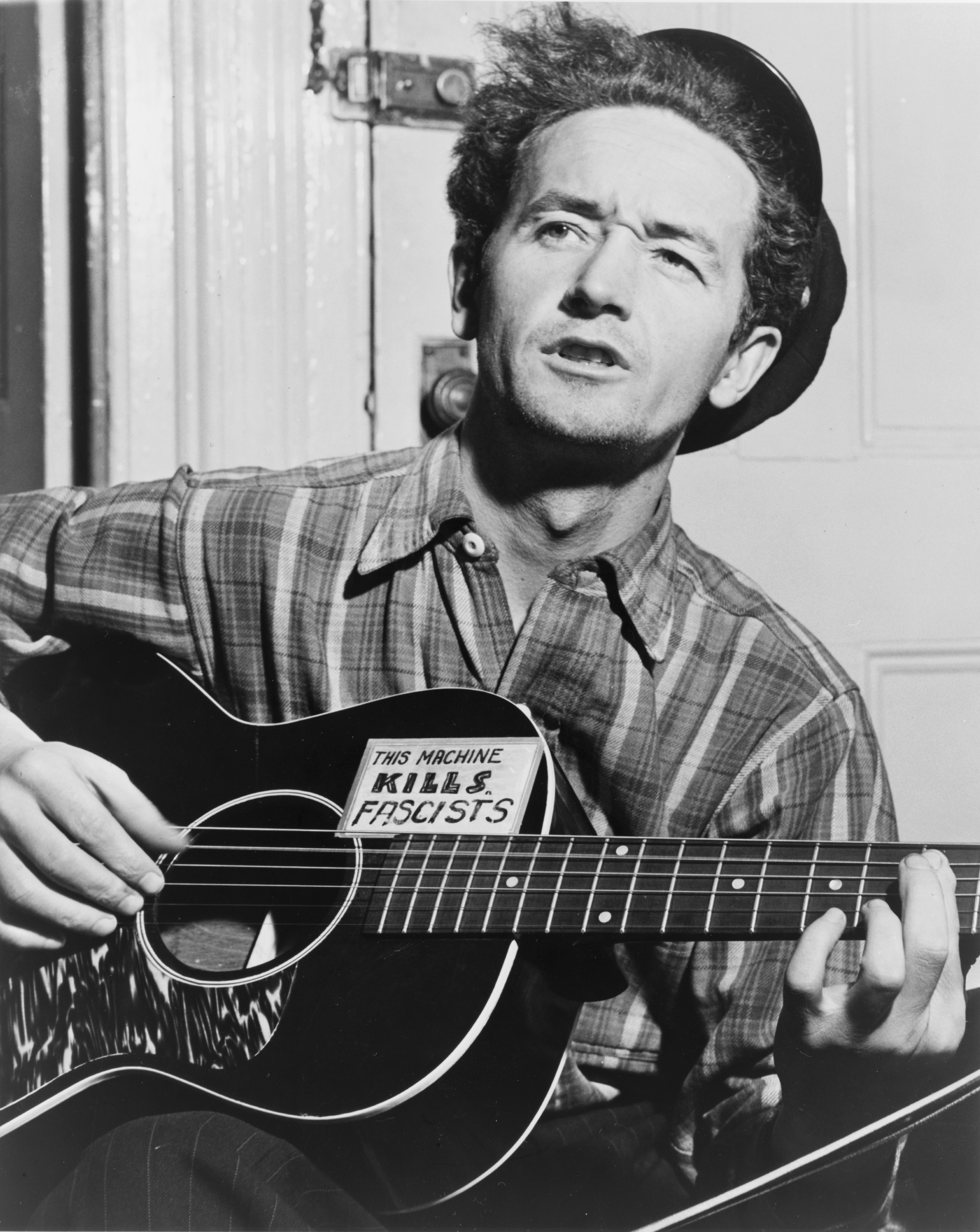
Anti-fascist Italian expatriates in the United States founded the Mazzini Society in Northampton, Massachusetts, in September 1939 to work toward ending Fascist rule in Italy. As political refugees from Mussolini's regime, they disagreed among themselves on whether to ally with communists and anarchists or to exclude them. In 1942, the Mazzini Society joined other anti-Fascist Italian expatriates in the Americas at a conference in Montevideo, Uruguay. They unsuccessfully promoted one of their members, Carlo Sforza, to become the post-Fascist leader of a republican Italy. The Mazzini Society dispersed after the overthrow of Mussolini as most of its members returned to Italy.
Post-World War II

During the Second Red Scare, which occurred in the United States in the years that immediately followed the end of World War II, the term "premature anti-fascist" came into currency. It was used to describe Americans who had actively agitated or worked against fascism, such as Americans who had fought for the Republicans during the Spanish Civil War before fascism was seen as a proximate and an existential threat to the United States (which only occurred generally after the invasion of Poland by Nazi Germany and only occurred universally after the attack on Pearl Harbor). The implication was that such persons were either communists or communist sympathizers whose loyalty to the United States was suspect. However, the historians John Earl Haynes and Harvey Klehr have written that no documentary evidence of the U.S. government's references to American members of the International Brigades as "premature antifascists" has been found: instead, all of the records of the FBI, the OSS, and the United States Army contained terms such as "Communist," "Red," "subversive," and "radical". Indeed, Haynes and Klehr indicate that they have found many examples of members of the XV International Brigade and their supporters sardonically referring to themselves as "premature antifascists."
Since the 1980s
Main article: Antifa (United States)
.jpg)
.jpg)

Modern antifa politics can be traced back to opposition to the infiltration of Britain's punk scene by white power skinheads in the 1970s and 1980s and the emergence of neo-Nazism in Germany following the fall of the Berlin Wall. In Germany, young leftists, including anarchists and punk fans, renewed the practice of street-level anti-fascism. Columnist Peter Beinart writes that "in the late '80s, left-wing punk fans in the United States began following suit, though they initially called their groups Anti-Racist Action (ARA) on the theory that Americans would be more familiar with fighting against racism than they would be with fighting against fascism".
Dartmouth College historian Mark Bray, author of Antifa: The Anti-Fascist Handbook, credits the ARA as being the precursor to modern antifa groups in the United States. In the late 1980s and 1990s, ARA activists toured with popular punk rock and skinhead bands to prevent Klansmen, neo-Nazis, and other assorted white supremacists from recruiting. Their motto was "We go where they go," meaning that they would confront far-right activists in concerts and they would actively remove their materials from public places. In Pennsylvania in 2002, the ARA disrupted a speech by Matthew F. Hale, the head of the white supremacist group World Church of the Creator, resulting in a fight and twenty-five arrests. In 2007, Rose City Antifa, likely the first group to utilize the name Antifa, was formed in Portland, Oregon. Other antifa groups in the United States have other genealogies. In 1987, in Boise, Idaho, the Northwest Coalition Against Malicious Harassment (NWCAMH) was created in response to the annual Aryan Nations meeting near Hayden Lake, Idaho. The NWCAMH brought together over 200 affiliated public and private organizations and it also helped people across six states--Colorado, Idaho, Montana, Oregon, Washington, and Wyoming. In Minneapolis, Minnesota, a group which called itself the Baldies was formed in 1987 for the purpose of directly fighting against neo-Nazi groups. In 2013, the "most radical" chapters of the ARA formed the Torch Antifa Network, which has chapters throughout the United States. Other antifa groups are parts of different associations, such as NYC Antifa, or they operate independently.
Modern anti-fascism in the United States is a highly decentralized leaderless resistance movement. Antifa political activists are anti-racists who engage in protest tactics, seeking to combat fascists and racists such as neo-Nazis, white supremacists, and other far-right extremists. This may involve digital activism, harassment, physical violence, and property damage against those whom they identify as belonging to the far-right. According to antifa historian Mark Bray, most antifa activity is nonviolent, involving poster and flyer campaigns, delivering speeches, marching in protest, and community organizing on behalf of anti-racist and anti-white nationalist causes.
A June 2020 study by the Center for Strategic and International Studies of 893 terrorism incidents in the United States since 1994 found one attack staged by an anti-fascist that led to a fatality (the 2019 Tacoma attack, in which the attacker, who self-identified as an anti-fascist, was killed by police), while attacks by white supremacists or other right-wing extremists resulted in 329 deaths. Since the study was published, one homicide has been connected to anti-fascism. A DHS draft report from August 2020 similarly did not include "Antifa" as a considerable threat while noting white supremacists as the top domestic terror threat.
There have been multiple efforts to discredit Antifa groups via hoaxes on social media, many of them false flag attacks originating from alt-right and 4chan users posing as Antifa backers on Twitter. Some hoaxes have been picked up and reported as fact by right-leaning media.
During the George Floyd protests in May and June 2020, the Trump administration blamed Antifa for orchestrating the mass demonstrations. Analysis of federal arrests did not find links to Antifa. There had been repeated calls by the Trump administration to designate Antifa as a terrorist organization, a move that academics, legal experts, and others argued would both exceed the authority of the presidency and violate the First Amendment.
On September 22, 2025, Trump signed an executive order intended to designate Antifa as a domestic terrorist organization. Academics, legal experts, and others have argued such an action exceeds the authority of the presidency and violates the First Amendment. Several analyses, reports, and studies have concluded that Antifa is not a major domestic terrorism risk.
Notes
References
Sources
References
- Stefan Roel Reyes. (2021-11-24). "'Christian Patriots': The Intersection Between Proto-fascism and Clerical Fascism in the Antebellum South". International Journal for History, Culture and Modernity.
- Tenorio, Rich. (September 30, 2023). "Fascism in America: a long history that predates Trump". The Guardian.
- Steigmann-Gall, Richard. (February 2017). "Star-spangled fascism: American interwar political extremism in comparative perspective". Taylor & Francis.
- Ramet, Sabrina P.. (September 2013). "The Know Nothing Party: Three Theories about its Rise and Demise". Cambridge University Press.
- Fergus Bordewich. (2023). ''Klan War: Ulysses S Grant and the Battle to Save Reconstruction''. Penguin Random House
- (November 17, 2023). "The Untold Story of Grant vs. the KKK: A Deep Dive with Historian Fergus M. Bordewich".
- (1998). "The Ku Klux Klan: A History of Racism and Violence". DIANE Publishing.
- (2006). "Ku Klux Klan: America's First Terrorists Exposed : the Rebirth of the Strange Society of Blood and Death". Idea Men Productions.
- (1986). "A 'Dog in the Nighttime' Problem: American Fascism in the 1930s". The History Teacher.
- (1865). "Ku Klux Klan Established". Digital History, Kansas City Public Library.
- "See the rise of the KKK in the U.S., 1915–1940".
- John P. Diggins, ''Mussolini and Fascism: The View from America'' (Princeton University Press, 1972).
- Francesca De Lucia, "The Impact of Fascism and World War II on Italian-American Communities." ''Italian Americana'' 26.1 (2008): 83–95 [https://www.jstor.org/stable/41353771 online].
- Victor C. Ferkiss, "Ezra Pound and American Fascism." ''Journal of politics'' 17.2 (1955): 173–197.
- "The Sons of Italy". [[Wiley Online Library]].
- link. (2012-02-27 ''Multiculturalism in the United States : A Comparative Guide to Acculturation and Ethnicity''. Westport, CT: GREENWOOD PRESS, 2005.)
- Steigmann-Gall, Richard. (February 2017). "Star-spangled fascism: American interwar political extremism in comparative perspective". Social History.
- Steigmann-Gall, Richard. (February 2017). "Star-spangled fascism: American interwar political extremism in comparative perspective". Social History.
- Hopely, Gregory S. (2020). Against the Class and the Masses: The American Legion, The American Federation of Labor, and Square Deal Americanism in the 1920s [Master's thesis]. Rowan University. {Link: Retrieved from [https://rdw.rowan.edu/cgi/viewcontent.cgi?article=3793&context=etd Against the classes and the masses: The American Legion, the American Federation of Labor, and Square Deal Americanism in the 1920s]}
- Diggins, John P.. (1972). "Mussolini and Fascism: The View from America". Princeton University Press.
- Michael E. Birdwell. (2001). "Celluloid Soldiers".
- (1983). "Vigilante Fascism: The Black Legion as an American Hybrid". Comparative Studies in Society and History.
- "Red Scare or Red Menace? American Communism and Anticommunism in the Cold War Era".
- Programming, Station. (2016-06-23). ""Terror In The City Of Champions" Explores Violence in Depression-Era Detroit".
- Perlstein, Rick. (2017-04-11). "I Thought I Understood the American Right. Trump Proved Me Wrong.". The New York Times.
- (31 May 1936). "Declared Organization Doomed". [[The New York Times]].
- (1937-05-12). "Black Legion convictions". The Escanaba Daily Press.
- Stanley G. Payne. (2001). "A History of Fascism 1914–45".
- New York Times obituary, January 27, 2005, accessed March 16, 2022
- Diamond, Sander A.. (1970). "The Years of Waiting: National Socialism in the United States, 1922–1933". American Jewish Historical Quarterly.
- Taylor, Alan. "American Nazis in the 1930s – The German American Bund".
- "American Bund – The Failure of American Nazism: The German-American Bund's Attempt to Create an American 'Fifth Column'. Traces. Retrieved May 2nd 2019.".
- (17 January 2024). "What Is the History of Fascism in the United States?". The Nation.
- Friedman, John S.. (March 8, 2001). "Kodak's Nazi Connections".
- (1970). "The Failure of Nazism in America: The German American Bund, 1936-1941". Political Science Quarterly.
- (August 2007). "Americans for Hitler – The Bund". America in WWII.
- "German-American Bund". Encyclopædia Britannica.
- Bell, Leland V.. (1970). "The Failure of Nazism in America: The German American Bund, 1936–1941". Political Science Quarterly.
- Patricia Kollander. (2005). ""I must be a part of this war": a German American's fight against Hitler and Nazism". Fordham Univ Press.
- (March 7, 1938). "Nazis Hail George Washington as First Fascist".
- (February 26, 1939). "Bund Activities Widespread. Evidence Taken by Dies Committee Throws Light on Meaning of the Garden Rally". [[The New York Times]].
- "When Nazis Rallied at Madison Square Garden". WNYC Archives.
- (October 10, 2017). "When 20,000 American Nazis Descended Upon New York City". The Atlantic.
- Piper, Michael Collins, and Ken Hoop. "A Mockery of Justice—The Great Sedition Trial of 1944." ''The Barnes Review'' 5 (1999): 5–20 [http://www.watcherpkcd.com/Centuries/Michael%20Collins%20Piper%20Ken%20Hoop%20A%20Mockery%20of%20Justice%20The%20Great%20Sedition%20Trial%20of%201944.pdf online] {{Webarchive. link. (July 18, 2022 .)
- Schiessl, Christoph. ''Alleged Nazi Collaborators in the United States after World War II''. Lanham: Lexington Books, 2016.
- Lichtblau, Eric. (November 13, 2010). "Nazis Were Given 'Safe Haven' in U.S., Report Says". The New York Times.
- "Red Scare".
- "Red Scare".
- "Anticommunism in Postwar America, 1945–1954: Witch Hunt or Red Menace?".
- (November 9, 2007). "The Danish Center for Holocaust and Genocide Studies".
- "Neo-Nazism".
- (August 23, 1975). "Killer of American Nazi Chief Paroled". [[St. Joseph News-Press]].
- [[George Lincoln Rockwell. Rockwell, George Lincoln]]. [http://www.americannaziparty.com/rockwell/materials/articles/tower.php ''From Ivory Tower to Privy Wall: On The Art of Propaganda''] {{Webarchive. link. (August 3, 2014 c.1966)
- (August 29, 2001). "The Nazi International". [[Southern Poverty Law Center]].
- Hilliard, Robert L.. (1999). "National Alliance For Law Enforcement". M. E. Sharpe.
- Quarles, Chester A.. (1999). "The Ku Klux Klan and Related American Racialist and Antisemitic Organizations: A History and Analysis". McFarland.
- Richie, Warren. (December 20, 2011). "Failed Martin Luther King Day parade bomber gets 32-year sentence". Christian Science Monitor.
- (March 10, 2011). "Bomb suspect tied to supremacist group". Boston Globe.
- "National Alliance".
- (Winter 1999). "William Pierce: A Political History". [[Southern Poverty Law Center]].
- Darby, Seward. (March 31, 2021). "The father, the son and the racist spirit: being raised by a white supremacist". [[The Guardian]].
- "Neo-Nazi".
- "Atomwaffen Division".
- (2006). "Overview of U.S. White Supremacist Groups". Journal of Political & Military Sociology.
- (4 January 2021). "White Supremacist Terrorism in Charlottesville: Reconstructing 'Unite the Right'". Studies in Conflict & Terrorism.
- "The National Socialist Movement".
- "The Nationalist Front Limps into 2017". [[Southern Poverty Law Center]].
- "National Socialist Movement".
- (December 20, 2019). "Transnational White Terror: Exposing Atomwaffen And The Iron March Networks".
- (October 13, 2021). "Telegram is crawling with antisemitism".
- Makuch, Ben. (2024-11-10). "Terrorist groups embrace chance of weakened US hegemony under Trump". The Guardian.
- (2025-03-21). "Neo-Nazi network 'Terrorgram' goes to court over planned attack on substation".
- Haag, Matthew. (2018-07-21). "'White Civil Rights Rally' Planned Near White House by Charlottesville Organizer". [[The New York Times]].
- Lind, Dara. (2017-08-12). "Unite the Right, the violent white supremacist rally in Charlottesville, explained". [[Vox (website).
- (2017-08-15). "Trump Gives White Supremacists an Unequivocal Boost". The New York Times.
- Alridge, Derrick P.. (2017-10-20). "The Events of August 11th and 12th: A Historian's Brief Reflections on Charlottesville". [[University of Virginia]].
- (2017-08-13). "Far-Right Groups Surge Into National View In Charlottesville". The New York Times.
- (2017-08-13). "Charlottesville: One killed in violence over US far-right rally". [[BBC News]].
- (August 16, 2018). "Neo-Nazi Jason Kessler Lives With Parents, Gets Scolded By Dad During Livestream".
- McDermott, Stephen. (August 16, 2018). "'Get out of my room': 35-year-old neo-Nazi censured by father in livestream with fellow white supremacist".
- "Jason Kessler's anti-Jewish screed was interrupted by his father: 'Hey, you get out of my room'". Washington Post.
- Spellings, Sarah. (May 22, 2017). "White Nationalist Richard Spencer Loses Gym Membership After Being Confronted".
- (2017-08-14). "'This is a huge victory.' Oakdale white supremacist revels after deadly Virginia clash". [[The Modesto Bee]].
- Weill, Kelly. (2018-03-27). "Neo-Confederate League of the South Banned From Armed Protesting in Charlottesville". [[The Daily Beast]].
- Gunter, Joel. (2017-08-13). "A reckoning in Charlottesville". BBC News.
- Kelkar, Kamala. (2017-08-12). "Three dead after white nationalist rally in Charlottesville". [[PBS NewsHour]].
- Wootson, Cleve R. Jr.. (2017-08-13). "Here's what a neo-Nazi rally looks like in 2017 America". [[The Washington Post]].
- (2017-08-12). "Why white nationalists are drawn to Charlottesville". [[CNN]].
- (2018-05-16). "3 Militia Groups Connected to Unite the Right Rally Settle Lawsuits". [[WVIR-TV]].
- (2017-08-18). "Deconstructing the symbols and slogans spotted in Charlottesville". The Washington Post.
- (2017-08-12). "Flags and Other Symbols Used By Far-Right Groups in Charlottesville". Southern Poverty Law Center.
- (2017-08-13). "One dead as car strikes crowds amid protests of white nationalist gathering in Charlottesville; two police die in helicopter crash". [[The Washington Post]].
- Green, Emma. (2017-08-15). "Why the Charlottesville Marchers Were Obsessed With Jews". [[The Atlantic]].
- (2017-08-12). "Man Charged After White Nationalist Rally in Charlottesville Ends in Deadly Violence". [[The New York Times]].
- Franklin, Sekou. (2020-06-01). "Charlottesville 2017: The Legacy of Race and Inequity". [[Journal of American History]].
- "Patriot Front".
- "Meet 'Patriot Front': Neo-Nazi network aims to blur lines with militiamen, the alt-right". [[Southern Poverty Law Center]].
- Roman, Gabriel San. (2017-12-13). "New Fascist Group Appeared at Laguna Beach Anti-Immigrant Rally". [[OC Weekly]].
- McNamara, Neal. (2017-11-20). "White Nationalist Group Targets Bellevue, Gig Harbor". Bellevue, WA Patch.
- (July 7, 2021). "Trump told chief of staff Hitler 'did a lot of good things', book says".
- (4 March 2022). "US white supremacist propaganda was at historically high levels in 2021". The Guardian.
- (9 August 2025). "American Nazis: The Aryan Freedom Network is riding high in Trump era". [[Reuters]].
- (January 8, 2026). "Trump Lays Out a Vision of Power Restrained Only by ‘My Own Morality’". The New York Times.
- Lachmann, Richard. (January 1, 2019). "Trump: authoritarian, just another neoliberal republican, or both?". Sociologia, Problemas e Práticas.
- (November 19, 2016). "Trump's world: The new nationalism". [[The Economist]].
- (February 15, 2024). "The growing peril of national conservatism". [[The Economist]].
- (September 25, 2020). "Historians and election experts warn Trump is behaving like Mussolini and despots that the US usually condemns".
- Boucher, Geoff M.. (October 28, 2024). "Is Donald Trump a fascist? No – he's a new brand of authoritarian".
- Zeitz, Joshua. (October 29, 2024). "Trump and Fascism: A Pair of Historians Tackle the Big Question". [[Politico]].
- (2018). "Fascism: A Warning". Harper Collins.
- Kagan, Robert. (May 18, 2016). "This is how fascism comes to America". The Washington Post.
- McGaughey, Ewan. (2018). "Fascism-Lite in America (or the Social Ideal of Donald Trump)". British Journal of American Legal Studies.
- Stanley, Jason. (October 15, 2018). "If You're Not Scared About Fascism in the U.S., You Should Be". The New York Times.
- Snyder, Timothy. (October 30, 2018). "Donald Trump borrows from the old tricks of fascism". The Guardian.
- Gordon, Peter. (January 7, 2020). "Why Historical Analogy Matters". The New York Review of Books.
- Szalai, Jennifer. (June 10, 2020). "The Debate Over the Word Fascism Takes a New Turn". The New York Times.
- (January 6, 2021). "By the numbers: President Donald Trump's failed efforts to overturn the election". USA Today.
- Matthews, Dylan. (January 14, 2020). "The F Word: The debate over whether to call Donald Trump a fascist, and why it matters". Vox.
- (2022). "A Reusable Past: The Meaning of the Third Reich in Recent U.S. Discourse". [[Central European History]].
- (2015). "Munich 'beer-hall' putsch". [[Oxford University Press]].
- Trump and the legacy of a menacing past. Giroux, Henry A., Cultural Studies, 09502386, July 2019, Vol. 33, Issue 4
- Rosenfeld, Gavriel D.. (2019). "An American Führer? Nazi Analogies and the Struggle to Explain Donald Trump". Central European History.
- "The neo-fascist discourse and its normalisation through mediation". By: Cammaerts, Bart, Journal of Multicultural Discourses, 17447143, Sep2020, Vol. 15, Issue 3
- Homans, Charles. (October 21, 2020). "Donald Trump's Strongman Act, and Its Limits". The New York Times.
- {{harvnb. Bump. 2024b: "... poll respondents were asked what they would do if a candidate they supported said that Hitler had done some good things.... Among those who said they plan to vote for Trump this year, just under half said they would vote for the candidate anyway.... On the other hand, only a fifth of Americans think that Trump sees Hitler as completely bad{{snda percentage that's pushed up by the just under 4 in 10 Republicans who believe that's his position."
- New York Times Opinion. (2025-05-18). "We’re Experts in Fascism. We’re Leaving the U.S.".
- France Culture. (2025-03-10). "Fascisme en 2025 : comment en est-on arrivé là ?".
- (2025-03-07). "What parallels do historians see between the Trump administration and the Nazi regime?".
- Matei, Adrienne. (2025-09-21). "From Nazi Germany to Trump’s America: why strongmen rely on women at home". The Guardian.
- HugoDécrypte - Grands formats. (2025-10-01). "Vous n'avez rien vu, Trump a déjà changé votre monde (avec Asma Mhalla)".
- Cambridge Union. (2025-02-16). "This House Believes Trump is a 21st Century Fascist".
- (1984–1985). "Enemy Aliens or Loyal Americans?: the Mazzini Society and the Italian-American Communities". Rivista di Studi Anglo-Americani.
- (June 1943). "Washington's Plans for Italy". Fourth International.
- link. (31 December 2013, Abraham Lincoln Brigade Archives Bill Susman Lecture Series. King Juan Carlos I of Spain Center at [[New York University]], 1998. Retrieved 9 August 2009.)
- Knox, Bernard. (Spring 1999). "Premature Anti-Fascist". Antioch Review.
- John Nichols. (26 October 2009). "Clarence Kailin: 'Premature Antifascist' – and proudly so". Capital Times (Madision, Wisconsin).
- (2005). "In Denial: Historians, Communism & Espionage". Encounter Books.
- Beinart, Peter. (August 16, 2017). "What Trump Gets Wrong About Antifa". The Atlantic.
- Stein, Perry. (August 16, 2017). "Anarchists and the antifa: The history of activists Trump condemns as the 'alt-left'". Chicago Tribune.
- Snyders, Matt. (February 20, 2008). "Skinheads at Forty". City Pages.
- Bray, Mark. (August 16, 2017). "Who are the antifa?". The Washington Post.
- Bogel-Burroughs, Nicholas. (July 2, 2019). "What Is Antifa? Explaining the Movement to Confront the Far Right". The New York Times.
- Sacco, Lisa N.. (June 9, 2020). "Are Antifa Members Domestic Terrorists? Background on Antifa and Federal Classification of Their Actions InFocus IF10839". Congressional Research Service.
- (September 28, 2020). "What Is Antifa, the Movement Trump Wants to Declare a Terror Group?". The New York Times.
- "One America - Northwest Coalition Against Malicious Harassment".
- Enzinna, Wes. (April 27, 2017). "Inside the Underground Anti-Racist Movement That Brings the Fight to White Supremacists". Mother Jones.
- Strickland, Patrick. (February 21, 2017). "US anti-fascists: 'We can make racists afraid again'".
- Lennard, Natasha. (January 19, 2017). "Anti-Fascists Will Fight Trump's Fascism in the Streets". The Nation.
- (23 June 2020). "What Antifa Is, What It Isn't, and Why It Matters".
- (June 2, 2020). "Designating Antifa as Domestic Terrorist Organization Is Dangerous, Threatens Civil Liberties". Southern Poverty Law Center.
- (June 16, 2017). "Fact Check: Is Left-Wing Violence Rising?". NPR.org.
- Maida, Adam. (January 16, 2018). "Meet Antifa's Secret Weapon Against Far-Right Extremists". Wired.
- Beauchamp, Zack. (June 8, 2020). "Antifa, explained".
- (27 July 2020). "Anti-fascists linked to zero murders in the US in 25 years".
- Jones, Seth G.. (June 4, 2020). "Who Are Antifa, and Are They a Threat?". Center for Strategic and International Studies.
- Pasley, James. "Trump frequently accuses the far-left of inciting violence, yet right-wing extremists have killed 329 victims in the last 25 years, while antifa members haven't killed any, according to a new study".
- Swan, Betsy Woodruff. (September 4, 2020). "DHS draft document: White supremacists are greatest terror threat". Politico.
- (September 28, 2017). "A Fake Antifa Account Was 'Busted' for Tweeting from Russia".
- (August 24, 2017). "Far-right smear campaign against Antifa exposed by Bellingcat".
- Feldman, Brian. (August 21, 2017). "How to Spot a Fake Antifa Account". New York.
- Glaun, Dan. (September 14, 2017). "Fake Boston Antifa group, which claimed credit for anti-racism banner at Red Sox game, is actually run by right wing trolls". The Republican.
- (June 11, 2020). "Federal Arrests Show No Sign That Antifa Plotted Protests". The New York Times.
- Peiser, Jaclyn. (August 10, 2020). "'Their tactics are fascistic': Barr slams Black Lives Matter, accuses the left of 'tearing down the system'". The Washington Post.
- (May 31, 2020). "Trump, Lacking Clear Authority, Says U.S. Will Declare Antifa a Terrorist Group". The New York Times.
- (May 31, 2020). "Trump tweets Antifa will be labeled a terrorist organization but experts believe that's unconstitutional".
- Bray, Mark. (June 1, 2020). "Antifa isn't the problem. Trump's bluster is a distraction from police violence". The Washington Post.
- (September 23, 2025). "Trump signs order designating Antifa as a 'domestic terrorist' group". Le Monde.
- Sobhan, Shakeel. (September 23, 2025). "Trump labels Antifa as 'domestic terrorist organization'".
- (2020). "Violence and Restraint within Antifa: A View from the United States". Perspectives on Terrorism.
- (2021). "Far-Left versus Far-Right Fatal Violence: An Empirical Assessment of the Prevalence of Ideologically Motivated Homicides in the United States". Criminology, Criminal Justice, Law & Society.
This article was imported from Wikipedia and is available under the Creative Commons Attribution-ShareAlike 4.0 License. Content has been adapted to SurfDoc format. Original contributors can be found on the article history page.
Ask Mako anything about Fascism in the United States — get instant answers, deeper analysis, and related topics.
Research with MakoFree with your Surf account
Create a free account to save articles, ask Mako questions, and organize your research.
Sign up freeThis content may have been generated or modified by AI. CloudSurf Software LLC is not responsible for the accuracy, completeness, or reliability of AI-generated content. Always verify important information from primary sources.
Report