From Surf Wiki (app.surf) — the open knowledge base
Farringdon station
National rail and London Underground station

National rail and London Underground station
| Field | Value |
|---|---|
| name | Farringdon |
| symbol | underground |
| symbol2 | rail |
| symbol3 | elizabeth |
| manager | London Underground |
| owner | Transport for London |
| owner1 | Network Rail |
| locale | Clerkenwell |
| borough | London Borough of Islington |
| platforms | 6 (2 Thameslink) |
| (2 London Underground) | |
| (2 Elizabeth line) | |
| fare_zone | 1 |
| railcode | ZFD |
| dft_category | E |
| image_name | Farringdon station Elizabeth Line 26th May 2022 15.jpg |
| caption | Thameslink and Elizabeth line station entrance seen in May 2022 |
| coordinates | |
| map_type | Central London |
| years1 | 10 January 1863 |
| events1 | Opened as Farringdon Street |
| years2 | 23 December 1865 |
| events2 | Resited |
| years3 | 26 January 1922 |
| events3 | Renamed Farringdon & High Holborn |
| years4 | 21 April 1936 |
| events4 | Renamed Farringdon |
| years5 | 1 July 1936 |
| events5 | Goods yard closed |
| years6 | 1982 |
| events6 | Electrified |
| years7 | May 1988 |
| events7 | Thameslink started |
| years8 | 21 March 2009 |
| events8 | Thameslink services to Moorgate discontinued |
| years9 | 24 May 2022 |
| events9 | Elizabeth line opened |
| listing_detail | Underground station |
| listing_grade | II |
| listing_start | |
| listing_entry | 1298047 |
| listing_reference | {{NHLE |
| num | 1298047 |
| desc | Farringdon |
| access-date | 12 November 2012}} |
| railexits1516 | 12.185 |
| railexits1617 | 12.046 |
| railint1617 | 0.146 |
| railexits1718 | 12.618 |
| railint1718 | 0.168 |
| railexits1819 | 15.087 |
| railint1819 | 0.383 |
| railexits1920 | 16.497 |
| railint1920 | 0.399 -- |
| railexits2021 | 2.643 |
| railint2021 | 0.118 |
| railexits2122 | 6.865 |
| railint2122 | 0.245 |
| railexits2223 | 31.460 |
| railint2223 | 0.640 |
| railexits2324 | 46.050 |
| railint2324 | 9.607 |
| railexits2425 | 50.171 |
| railint2425 | 9.342 |
| tubeexits05 | 15.255 |
| tubeexits06 | 16.805 |
| tubeexits07 | 18.285 |
| tubeexits08 | 18.840 |
| tubeexits09 | 15.675-- |
| access | yes |
| access_note |
(2 London Underground) (2 Elizabeth line) |access-date = 12 November 2012}}
Farringdon () is an interchange station located in Clerkenwell in the London Borough of Islington, just outside the boundary of the City of London for London Underground, Elizabeth line and National Rail services. It is in London fare zone 1.
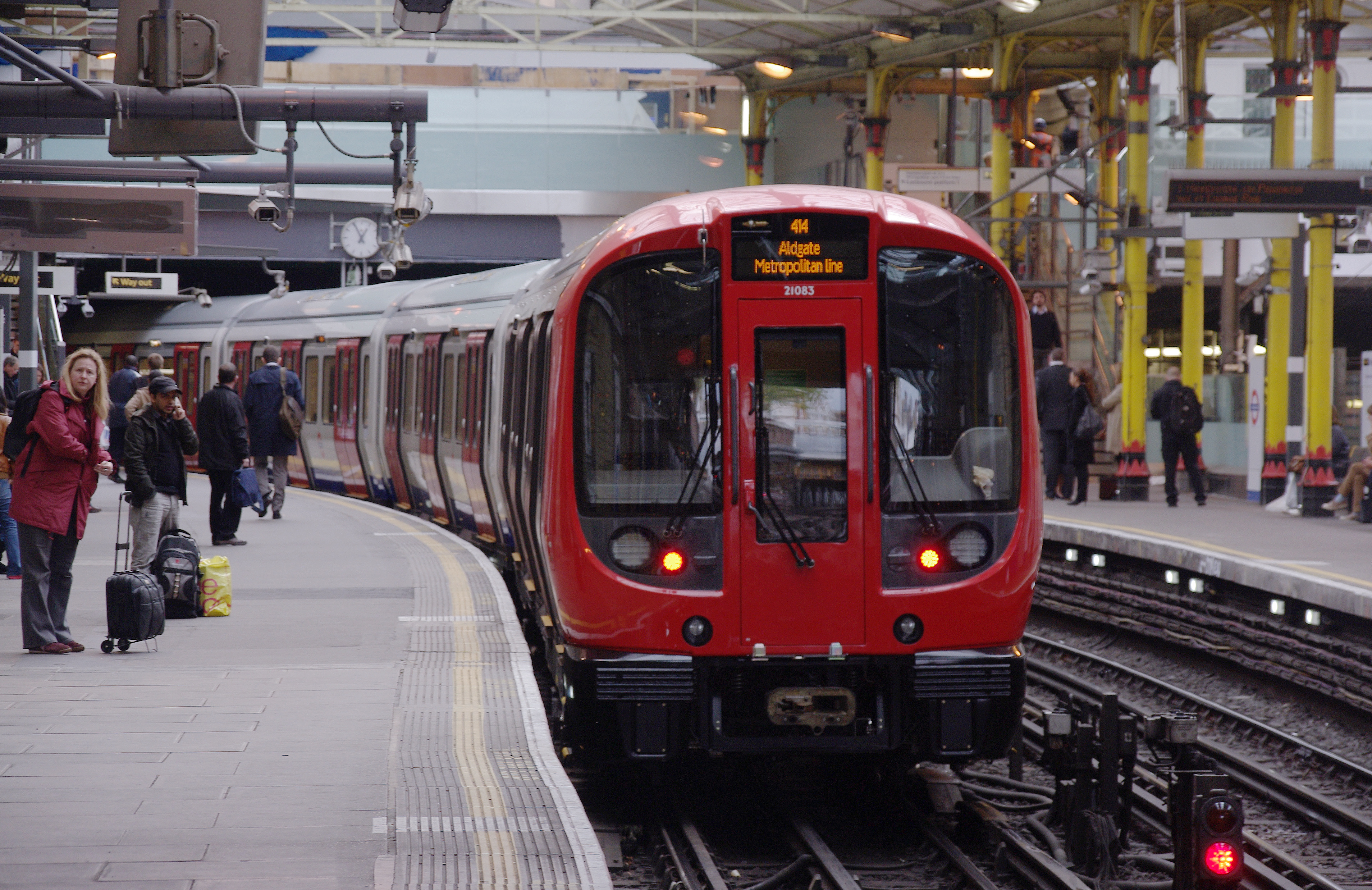
The London Underground station is on the Circle, Hammersmith & City, and Metropolitan lines, between King's Cross St Pancras and Barbican stations. The Elizabeth line station is between Tottenham Court Road and Liverpool Street stations. The National Rail station is on the Thameslink route between and .
Opened in 1863 as the terminus of the Metropolitan Railway, the world's first underground passenger railway, Farringdon is one of the oldest surviving underground railway stations in the world.
History
The station was opened on 10 January 1863 as the terminus of the original Metropolitan Railway, the world's first underground metro line. The station, initially named Farringdon Street, was originally a short distance from the present station building. The line ran from the Farringdon area to , a distance of 4 mi.
The station was relocated on 23 December 1865 when the Metropolitan Railway opened an extension to Moorgate. It was renamed Farringdon & High Holborn on 26 January 1922 when the new building by the architect Charles Walter Clark facing Cowcross Street was opened, and its present name was adopted on 21 April 1936. It was built in conjunction with a freight station to take livestock to a slaughterhouse to its south-east to supply Smithfield Market; remains of cattle ramps on a street outside the market, West Smithfield. Smithfield was redesignated as a wholesale 'deadmeat' market in the 19th century and the freight station was last used in the 1920s.

The lines from Farringdon towards King's Cross St. Pancras run alongside the Fleet ditch, culverted since 1734. The station building is unusually well-preserved early 20th-century London Underground architecture. It retains indications of the Metropolitan Railway's main-line style operation such as a sign for a parcel office on the outer wall and some original signage, with the 1922–1936 name on the facade.
After the bay platforms at closed on 21 March 2009, Southeastern services that previously terminated at Blackfriars were extended to , St. Albans, Luton or Bedford, calling at this station. Thameslink trains to Moorgate ceased at the same time.
Recent and current developments
Farringdon has recently received significant upgrades to allow it to meet the needs of a series of major rail upgrade projects: The Thameslink Programme was a major upgrade to the existing north-south Thameslink route, enabling longer and more frequent trains, completed in 2018; and the Four Lines Modernisation involves the wholesale resignalling of the London Underground's sub-surface lines bringing a major boost in capacity to Circle, Hammersmith & City and Metropolitan line services calling at Farringdon. In addition the station has been significantly expanded to serve as a stop on the new east-west Elizabeth line providing interchange between Thameslink and the Elizabeth line.
Once all these projects have been completed, Farringdon will be one of the country's busiest stations with approximately 200 tph, an average of one departure every 20 seconds. A new building, housing a dedicated ticket hall, has been constructed to serve these extra passengers. The new building is to the immediate south of the original station, which itself has been upgraded as part of the programme.
An additional entrance has also been built at the north end of the original station, onto Turnmill Street.
Thameslink upgrade

Farringdon Station has been rebuilt to accommodate longer Thameslink trains and to make other improvements to the station. The existing station building has been refurbished with a new roof canopy covering the north end of all four platforms and a new entrance and concourse facing Turnmill Street. An additional ticket hall has been built on the south side of Cowcross Street providing access to the Thameslink platforms, which have been extended southwards underneath this building, allowing the station to handle 240 m (12-carriage) trains. Platforms have been widened to accommodate increased passenger numbers. This process required the bridge that formed Cowcross Street to be demolished and rebuilt. Cowcross Street is now pedestrianised. Lifts have been provided throughout.
The existing listed ticket hall and concourse have been remodelled, for use by London Underground and Thameslink passengers. Interchange within the station has been improved by removing the interchange bridge and installing new stairs and lifts with access to all four platforms, allowing passengers with impaired mobility to use the station.
It was necessary to build the Thameslink platform extensions to the south, since there is a sharp gradient to the immediate north of the station. This resulted in the two-station branch to Moorgate being permanently closed. The platform extensions cross the former Moorgate line and reach within a few metres of the entrance of the Snow Hill Tunnel. The alternative of realigning both the Thameslink and Circle/Hammersmith & City/Metropolitan lines was impractical as the latter crosses over the former on a bridge almost immediately to the north of the station.
Elizabeth line


The Farringdon Elizabeth line station was built as part of the Crossrail project. It lies between Farringdon and Underground stations and has interchanges with both of them. Access at the Farringdon end is via the new Thameslink ticket hall. Work was anticipated to be completed in 2018, but the scheduled opening date was delayed.
From 24 May 2022 the new railway line linked Farringdon to Abbey Wood via Canary Wharf in the east and Paddington, in the west. The station is also a hub for cross-London travel, being the only station to be on both the north-south Thameslink service and the east-west Elizabeth line service.
Direct Elizabeth line services between Reading/Heathrow in the west and Shenfield (via Whitechapel and Stratford) started in late 2022.
Dual traction current supply

Thameslink trains switch between the 25 kV AC overhead supply used to the north of London and the 750 V DC third rail supply used to the south whilst standing at the platform. The trains that formerly ran to Moorgate used 25 kV AC throughout their journeys. This project was installed by the Network SouthEast sector of British Rail in May 1988.

Until the start of the Thameslink Programme southbound trains that were unable to switch to DC were taken out of service at Farringdon and stabled at Moorgate to prevent them from blocking the core section of the Thameslink route. As this option is no longer possible the catenary has been extended to City Thameslink to enable these trains to continue to the southbound platform at City Thameslink using AC and then return northwards using the new crossover in Snow Hill Tunnel. The pantograph on southbound trains is normally lowered at Farringdon.
Underground trains serving Farringdon use the four-rail 630 V DC system.
Artwork
On the London Underground concourse, a memorial to Edward Johnston (the creator of the eponymous London Underground typeface) was designed by Fraser Muggeridge. Consisting of the letters of the alphabet in wood type set in Johnston, the memorial was unveiled by Sir Peter Hendy in 2019.
As part of the Crossrail Art Programme, two artworks were commissioned from British artist Simon Periton. At the eastern entrance, the exterior glass of the station is printed with patterns echoing the Victorian ironmongery of the Smithfield Market located opposite the station entrance. At the western entrance, the glazing alongside the escalators are printed with giant diamonds, referencing the jewellers located nearby in Hatton Garden.
Accidents and incidents
- On 5 January 1867, 16 people were injured at Farringdon Street station in a rear-end collision caused by a signaller's error.
- On 5 January 1892, a defective axlebox resulted in the derailment of part of a train shortly after it had departed Farringdon Street. Five passengers were injured.
- On 26 November 1907, a train in the process of departing Farringdon Street was rear-ended by a second train entering the station.
- On 1 May 1939, a total of 31 people were injured when a Circle line train was involved in a minor collision with a railway engine. Seventeen passengers reported they had suffered shock and injury while a further nine subsequently complained that they had incurred minor injuries. Five crew members were also injured.
- On 22 May 1954, three people in a lorry were killed when it fell from a bridge on to the tracks near Farringdon. A goods train collided with the lorry shortly after departing Farringdon.
Services
London Underground

The London Underground part of the station is directly next to the Thameslink platforms and is served by the Circle, Hammersmith & City and Metropolitan lines, between King's Cross St Pancras to the west and Barbican to the east. All three lines share the same pair of tracks from Baker Street Junction to Aldgate Junction making this section of track one of the most intensely used on the London Underground network.
Circle line
The typical service in trains per hour (tph) is:
- 6 tph Clockwise via Liverpool Street and Tower Hill
- 6 tph To Hammersmith via King's Cross St Pancras and Paddington
Hammersmith & City line
The typical service in trains per hour (tph) is:
- 6 tph Eastbound to Barking
- 6 tph Westbound to Hammersmith via Paddington
Metropolitan line
The Metropolitan line is the only line to operate express services, though this is only during peak times (Eastbound 06:30–09:30 / Westbound 16:00–19:00). Fast services run non-stop between Wembley Park, Harrow-on-the-Hill and Moor Park. Semi-fast services run non-stop between Wembley Park and Harrow-on-the-Hill.
The typical off-peak service in trains per hour (tph) is:
- 12 tph Eastbound to Aldgate
- 2 tph Westbound to Amersham (all stations)
- 2 tph Westbound to Chesham (all stations)
- 8 tph Westbound to Uxbridge (all stations) Off-peak services to/from Watford terminate at Baker Street
The typical peak time service in trains per hour (tph) is:
- 14 tph Eastbound to Aldgate
- 2 tph Westbound to Amersham (fast in the evening peak only)
- 2 tph Westbound to Chesham (fast in the evening peak only)
- 4 tph Westbound to Watford (semi-fast in the evening peak only)
- 6 tph Westbound to Uxbridge (all stations)
Farringdon is in London fare zone 1.
Thameslink
All Thameslink services at Farringdon serve between St Pancras International and City Thameslink using part of the City Widened Lines and Snow Hill Tunnel respectively. Services are operated using EMUs.
The typical off-peak service in trains per hour is:
- 4 tph to via
- 2 tph to via and Gatwick Airport
- 2 tph to Three Bridges via Redhill
- 2 tph to via , , and
- 4 tph to (2 of these run via and 2 run via )
- 4 tph to (all stations)
- 2 tph to (all stations except , and )
- 4 tph to (semi-fast)
- 2 tph to via
- 2 tph to via Stevenage
The station is also served by a half-hourly night service between Bedford and Three Bridges.
Prior to 2009, Thameslink services also ran to Moorgate via Barbican with trains diverging from the core route east of the platforms at Farringdon. This section of line was closed as part of the Thameslink Programme which involved the construction of a new ticket hall and the lengthening of platforms at Farringdon to enable platform extensions to accommodate longer 12 carriage trains which covered over the junction in the process.
Farringdon is in London fare zone 1.
Elizabeth line
Elizabeth line services began calling at Farringdon on 24 May 2022 and all services are operated using EMUs.
The typical off-peak service in trains per hour is:
- 8 tph to
- 8 tph to
- 6 tph to
- 4 tph to
- 2 tph to
- 2 tph to
- 2 tph to
These services combine to give a service of 16 tph in each direction. During the peak hours, the service is increased to 20 tph in each direction.
On Sundays, the services between Shenfield and London Paddington are reduced to 4 tph, with another 4 tph terminating instead at Gidea Park.
|note-row4= |note-row9= |note-row11=
Connections
London Buses day and night routes serve the station.
References
References
- (March 2011). "How it used to be – freight on The Underground 50 years ago". London Underground Railway Society.
- {{citation step free tube map
- {{citation step free south east rail
- Rose, Douglas. (1999). "The London Underground: A diagrammatic history". Capital Transport Publishing.
- "The Farringdon Wards of the City of London ... some notes on their history" p5: T Sharp 2000
- "Train times 22 March – 16 May 2009 Thameslink route". First Capital Connect.
- "Four Lines Modernisation".
- Londonist Ltd. (9 April 2015). "New Thameslink Trains Revealed".
- "Whats happening at Farringdon?". Network Rail.
- "The new Farringdon station". Network Rail.
- Network Rail (2004a) – pg.27, paragraph 2.6.5
- (1 July 2005). "Thameslink 2000 Environmental Statement: Addendum". Network Rail.
- Network Rail (2004a) – page 27, paragraph 2.6.3
- Network Rail (2004a) – pg.27, paragraph 2.6.4
- Network Rail (2005a) – pg.9, paragraph 2.1.1
- Network Rail (2005a) – pg.9, paragraph 2.1.5
- (28 October 2006). "Farringdon". Crossrail.
- (11 May 2016). "Crossrail project: New Elizabeth line stations revealed".
- "Elizabeth line: Delayed £18bn Crossrail finally opens". BBC News.
- "Farringdon Station". Crossrail.
- Aplin, Lucy. (24 May 2022). "Why you need to switch Crossrail trains and when Elizabeth line opens in full".
- Network Rail – 'Kent & Sussex [[Sectional Appendix]]', LOR S0280, Seq 001, "Farringdon to City Thameslink" (last updated 31 December 2010)
- "City Thameslink ('Powered Up' section)". Thameslink Programme FAQ.
- Finch, Emily. (23 February 2018). "Farringdon station memorial for creator of London Underground typeface".
- "Johnston Memorial at Farringdon station".
- Gregory, Elizabeth. (2022-05-26). "Art on the Elizabeth Line: travel on London's newest public gallery".
- Mata, William. (4 April 2022). "New art unveiled at Farringdon ahead of Elizabeth Line".
- "Accident at Farringdon Street on 5th January 1867".
- "Accident at Farringdon Street – Kings Cross on 5th January 1892".
- "Accident at Farringdon Street on 26th November 1907".
- "Accident at Farringdon on 1st May 1939".
- (24 May 1954). "Three Killed in Crash – Lorry Falls from Bridge to Railway". [[The Times]].
- "Accident at Farringdon on 22nd May 1954".
- "Circle and Hammersmith & City line WTT".
- "CULG – Metropolitan Line".
- "Metropolitan line WTT".
- {{NRtimes. May 2022. 24, 25, 26, 52, 173, 175, 179, 180, 181, 182, 183, 184, 185, 188, 195, 196, 201
- "First Capital Connect timetables".
- "Elizabeth Line Timetable". Transport for London.
- (1 May 2022). "Buses from Farringdon".
This article was imported from Wikipedia and is available under the Creative Commons Attribution-ShareAlike 4.0 License. Content has been adapted to SurfDoc format. Original contributors can be found on the article history page.
Ask Mako anything about Farringdon station — get instant answers, deeper analysis, and related topics.
Research with MakoFree with your Surf account
Create a free account to save articles, ask Mako questions, and organize your research.
Sign up freeThis content may have been generated or modified by AI. CloudSurf Software LLC is not responsible for the accuracy, completeness, or reliability of AI-generated content. Always verify important information from primary sources.
Report