From Surf Wiki (app.surf) — the open knowledge base
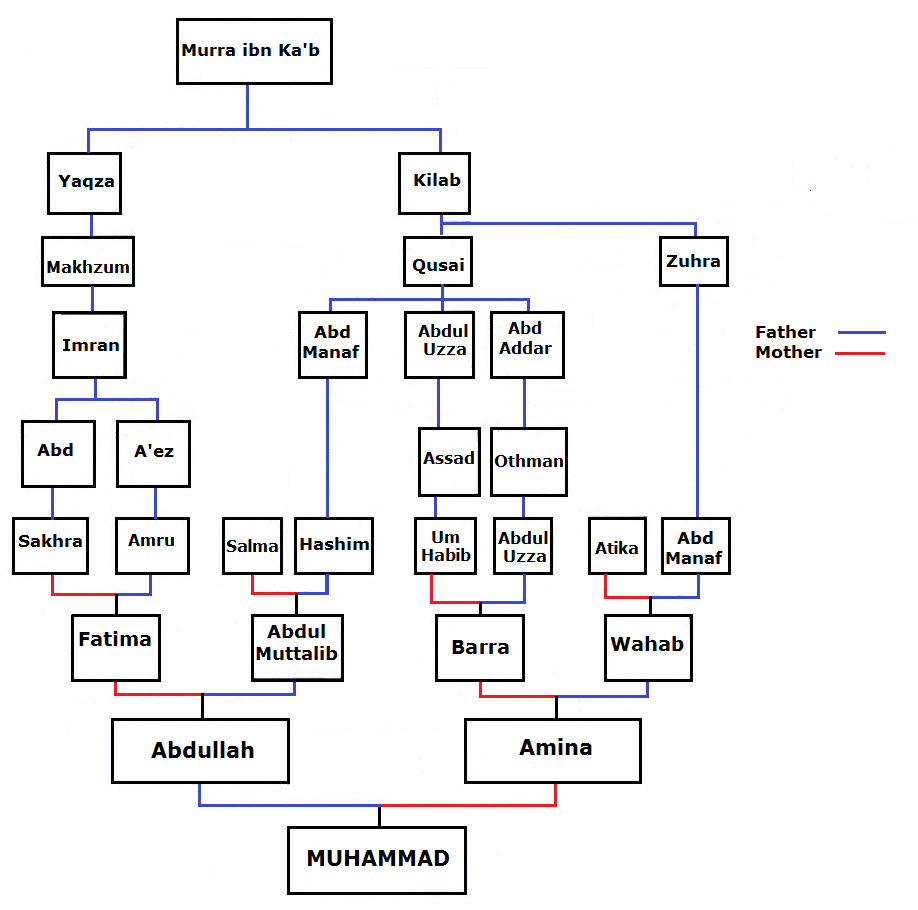
Family tree of Muhammad
none
none
This family tree is about the relatives of the Islamic prophet Muhammad as a family member of the family of Hashim and the Quraysh tribe which is ‘Adnani. According to Islamic tradition, Muhammad descends from the Islamic prophet Ishmael through the Hashem tribe.
Prophet Muhammad's family tree
paternal great-great-grandmother}}
-
- indicates that the marriage order is disputed
- Note that direct lineage is marked in bold.
Genealogy
Muhammad to Adnan
According to Islamic prophetic tradition, Muhammad descended from Adnan. Tradition records the genealogy from Adnan to Muhammad comprises 21 generations. The following is the list of chiefs who are said to have ruled the Hejaz and to have been the patrilineal ancestors of Muhammad. His Ancestors were generally referred to by their laqabs or titles, names will be mentioned alongside each title.
Adnan ibn Ismail ≈ c. 1200 BCE Sources: Ibn Hishām, Ibn Kathīr Ma‘add ibn Adnan ≈ c. 1100 BCE Sources: Ibn Hishām Nizar ibn Ma‘add ≈ c. 1000 BCE Sources: Ibn Kathīr Mudar ibn Nizar ≈ c. 900 BCE Sources: Ibn Hishām Ilyas ibn Mudar ≈ c. 800 BCE Sources: Ibn Kathīr Mudrikah ibn Ilyas ≈ c. 700 BCE Sources: Ibn Hishām Khuzaymah ibn Mudrikah ≈ c. 600 BCE Sources: Ibn Kathīr Kinanah ibn Khuzaymah ≈ c. 500 BCE Sources: Al-Balādhurī An-Nadr ibn Malik ≈ c. 450 BCE Sources: Ibn Hishām Malik ibn An-Nadr ≈ c. 400 BCE Sources: Ibn Kathīr Fihr ibn Malik (Quraysh) ≈ c. 350 BCE Sources: Ibn Hishām, Al-Balādhurī Ghalib ibn Fihr ≈ c. 300 BCE Lu’ayy ibn Ghalib ≈ c. 250 BCE Ka‘b ibn Lu’ayy ≈ c. 200 BCE Murrah ibn Ka‘b ≈ c. 150 BCE Kilab ibn Murrah ≈ c. 100 BCE Qusayy ibn Kilab (Zayd) ≈ c. 50 BCE Sources: Ibn Hishām, Al-Azraqī Abd Manaf ibn Qusayy (Al-Mughirah) ≈ c. 30 BCE Hashim ibn Abd Manaf (‘Amr) ≈ c. 20 BCE Abd al-Muttalib ibn Hashim (Shaybah) ≈ c. 497–578 CE Sources: Ibn Hishām, Ibn Kathīr Abdullah ibn Abd al-Muttalib ≈ c. 545–570 CE Sources: Ibn Hishām Prophet Muhammad ibn Abdullah ﷺ 570–632 CE Sources: Ibn Hishām (Sīrah), Ibn Kathīr, Al-Ṭabarī, Muslim & Bukhārī (biographical context)
Adnan to Isma'il
Islamic tradition and Arabic oral genetic tradition agree that the lineage from Adnan to Isma'il is lost. Nevertheless, there are records that survived, although they are deemed mere speculations by most scholars.
'Adnan was the ancestor of the 'Adnani Arabs of northern, central and western Arabia and a direct descendant of Isma'il. It is not confirmed how many generations are between them; however, Adnan was fairly close to him. According to the Hebrew Bible, Isma'il had twelve sons who are said to have become twelve tribal chiefs throughout the regions from Havilah to Shur (from Assyria to the border of Egypt).
Genealogists differ from which son of Isma'il the main line of descent came, either his eldest son Nabeet or Al-Nabt (Nebaioth), or his second son Qidar (Kedar) was the father of the North Arabian people that controlled the region between the Persian Gulf and the Sinai Peninsula.
Ibrahim to Adam
Scholars, both Islamic and Secular, agree that the narrations considering Ibrahim's lineage to Adam are mythology. Most of the lineage is borrowed from Hebrew tradition or Isra'iliyyat.
Prophet Adam (عليه السلام) ≈ c. 6000–5000 BCE Sources: Ibn Kathīr (Al-Bidāyah wa’n-Nihāyah), Al-Ṭabarī (Tārīkh al-Rusul wa’l-Mulūk) Prophet Sheeth ibn Adam (عليه السلام) ≈ c. 5000 BCE Sources: Ibn Kathīr, Al-Tha‘labī Anush ibn Sheeth ≈ c. 4800 BCE Sources: Al-Ṭabarī, Ibn Kathīr Kenan ibn Anush ≈ c. 4600 BCE Sources: Al-Ṭabarī Mahalil ibn Kenan ≈ c. 4400 BCE Sources: Ibn Kathīr Yarid ibn Mahalil ≈ c. 4200 BCE Sources: Al-Ṭabarī Prophet Idris ibn Yarid (عليه السلام) ≈ c. 4000 BCE Sources: Ibn Kathīr, Tafsīr al-Qurṭubī (Surah Maryam) Mathushalakh ibn Idris ≈ c. 3800 BCE Sources: Al-Ṭabarī Lamikh ibn Mathushalakh ≈ c. 3600 BCE Sources: Ibn Kathīr Prophet Nuh ibn Lamikh (عليه السلام) ≈ c. 3300–3000 BCE Sources: Ibn Kathīr, Al-Ṭabarī, Tafsīr Ibn ‘Ashūr Saam ibn Nuh ≈ c. 3000 BCE Sources: Al-Ṭabarī Arfakshad ibn Saam ≈ c. 2900 BCE Sources: Ibn Kathīr Shalikh ibn Arfakshad ≈ c. 2800 BCE Sources: Al-Ṭabarī Abir ibn Shalikh ≈ c. 2700 BCE Sources: Ibn Kathīr Falikh ibn Abir ≈ c. 2600 BCE Sources: Al-Ṭabarī Ra’u ibn Falikh ≈ c. 2500 BCE Sources: Ibn Kathīr Sarugh ibn Ra’u ≈ c. 2400 BCE Sources: Al-Ṭabarī Nahur ibn Sarugh ≈ c. 2300 BCE Sources: Ibn Kathīr Azar ibn Nahur ≈ c. 2200 BCE Sources: Ibn Kathīr, Tafsīr al-Baghawī Prophet Ibrahim ibn Azar (عليه السلام) ≈ c. 2000–1800 BCE Sources: Ibn Kathīr, Al-Ṭabarī, Ibn al-Athīr Prophet Ismail ibn Ibrahim (عليه السلام) ≈ c. 1900 BCE Sources: Ibn Kathīr, Al-Azraqī (Akhbār Makkah)
These dates are ijtihādī (scholarly estimates) based on classical Islamic histories such as Al-Bidāyah wa’n-Nihāyah, Tārīkh al-Ṭabarī, and Sīrah Ibn Hishām. Exact dates before Prophet Ibrahim (عليه السلام) are not definitively established in Islam.
Family tree linking Prophets to Imams
Ancestry
Notes
Dates mentioned are approximate scholarly estimates (taqrībī) derived from classical Sunni historical and genealogical works. Early chronology is based on traditional Islamic historiography rather than modern archaeological dating.
References
Dawat-e-Islami – Prophets & Islamic History https://www.dawateislami.net/islamic-history World Muslim Directory Association (WMDA) – Ancestry of Prophet Muhammad ﷺ https://www.wmda.net/ancestry-of-prophet-muhammad
Sources Ibn Kathīr (d. 774 AH / 1373 CE) Al-Bidāyah wa’n-Nihāyah fī al-Tārīkh Classical Sunni historical chronicle detailing the prophets, early generations, and Arab genealogy. Muḥammad ibn Jarīr al-Ṭabarī (d. 310 AH / 923 CE) Tārīkh al-Rusul wa’l-Mulūk One of the earliest and most authoritative Sunni historical works on prophetic and human genealogy. Ibn Hishām (d. 218 AH / 833 CE) Al-Sīrah al-Nabawiyyah Primary Sunni source for the lineage of Prophet Muhammad ﷺ from Adnan to Abdullah ibn Abd al-Muttalib. Aḥmad ibn Yaḥyā al-Balādhurī (d. 279 AH / 892 CE) Ansāb al-Ashrāf Classical work on Arab genealogies, including Quraysh and the Prophet’s ancestors. Muḥammad ibn Aḥmad al-Azraqī (d. 250 AH / 864 CE) Akhbār Makkah Early Sunni source for Meccan history and the descendants of Ismail (عليه السلام). Al-Tha‘labī (d. 427 AH / 1035 CE) Qiṣaṣ al-Anbiyā’ Traditional Sunni narratives of the prophets and early generations. Al-Qurṭubī (d. 671 AH / 1273 CE) Al-Jāmi‘ li-Aḥkām al-Qur’ān Tafsīr source discussing Prophet Idris and early prophetic history. Al-Baghawī (d. 516 AH / 1122 CE) Ma‘ālim al-Tanzīl Sunni tafsīr used for genealogical references related to Prophet Ibrahim (عليه السلام).
References
- Maqsood, Ruqaiyyah Waris. (August 2017). "The Prophet's Line Family No 3 – Qusayy, Hubbah, and Banu Nadr to Quraysh". Ruqaiyyah Waris Maqsood Dawah.
- Ibn Hisham. "The Life of the Prophet Muhammad".
- Parolin, Gianluca P.. (2009). "Citizenship in the Arab World: Kin, Religion and Nation-State". Amsterdam University Press.
- Hughes, Thomas Patrick. (1995). "A Dictionary of Islam: Being a Cyclopaedia of the Doctrines, Rites, Ceremonies, and Customs, Together With the Technical and Theological Terms, of the Muhammadan Religion". Asian Educational Services.
- Muslim ibn al-Ḥajjāj. "[[Sahih Muslim]]".
- al-Tirmidhī. "[[Sunan al-Tirmidhi]]".
- Muhammad ibn Jarir al-Tabari. "The History of al-Tabari".
- Mackintosh-Smith, Tim. (2019-04-30). "Arabs". Yale University Press.
- Kaltner, John. (2017-06-15). "Ishmael Instructs Isaac: An Introduction to the Qur'an for Bible Readers". Liturgical Press.
- 'Uyoon Al-Ma'aarif; Al-Qudaa'i
This article was imported from Wikipedia and is available under the Creative Commons Attribution-ShareAlike 4.0 License. Content has been adapted to SurfDoc format. Original contributors can be found on the article history page.
Ask Mako anything about Family tree of Muhammad — get instant answers, deeper analysis, and related topics.
Research with MakoFree with your Surf account
Create a free account to save articles, ask Mako questions, and organize your research.
Sign up freeThis content may have been generated or modified by AI. CloudSurf Software LLC is not responsible for the accuracy, completeness, or reliability of AI-generated content. Always verify important information from primary sources.
Report