From Surf Wiki (app.surf) — the open knowledge base
False equivalence
Logical fallacy of inconsistency
Logical fallacy of inconsistency
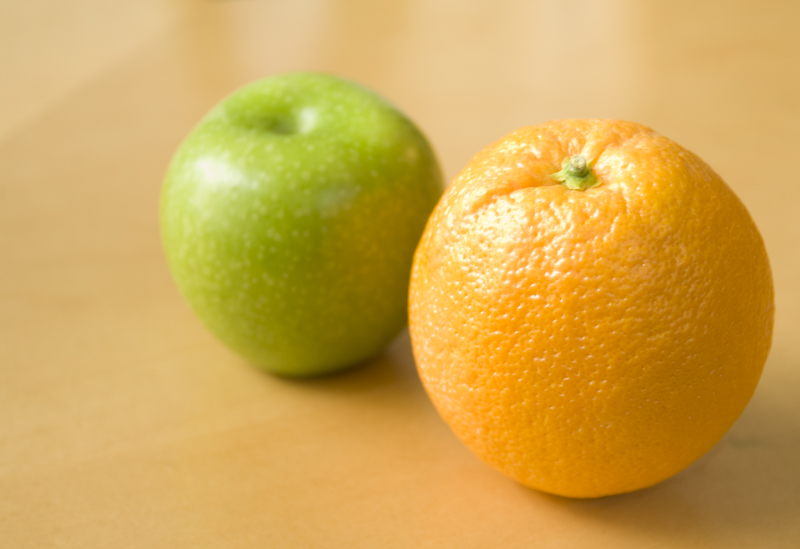
A false equivalence or false equivalency is an informal fallacy in which an equivalence is drawn between two subjects based on flawed, faulty, or false reasoning. This fallacy is categorized as a fallacy of inconsistency. Colloquially, a false equivalence is often called "comparing apples and oranges."
Characteristics
This fallacy is committed when one shared trait between two subjects is assumed to show equivalence, especially in order of magnitude, when equivalence is not necessarily the logical result. False equivalence is a common result when an anecdotal similarity is pointed out as equal, but the claim of equivalence does not bear scrutiny because the similarity is based on oversimplification or ignorance of additional factors. The pattern of the fallacy is often as such:
If A is the set containing c and d, and B is the set containing d and e, then since they both contain d, A and B are equal.
In an even more fallacious version, d is not required to exist in both sets; merely a similarity of two items d in set A and d in set B is cited to assert equivalence among the sets.
Example:
Examples
The following statements are examples of false equivalence:
; "The Deepwater Horizon oil spill is no more harmful than when your neighbor drips some oil on the ground when changing his car's oil." :The "false equivalence" is the comparison between things differing by many orders of magnitude: Deepwater Horizon spilled 210 e6USgal of oil; one's neighbor might spill perhaps 1 USpt. ; "They are both Felidae, mammals in the order Carnivora, therefore there's little difference between having a pet cat and a pet jaguar." :The "false equivalence" is in an oversimplification of the factors that make an animal a suitable pet. ; "Consuming marijuana can lead to consuming and acquiring a psychological dependence on heroin later in life by acting as a gateway drug, so taking marijuana is like taking heroin." :The "false equivalence" is not considering the difference in likelihood. Consuming heroin is more likely to lead to future heroin dependence than taking marijuana, even given the assumption that one who begins using marijuana is more likely at some later time to try heroin, than someone who has never used marijuana.
Negative consequence
False equivalence arguments are often used in journalism and in politics, where flaws of one politician may be compared to flaws of a wholly different nature of another.
Thomas Patterson of the Shorenstein Center on Media, Politics and Public Policy at Harvard University wrote about the false equivalency used by the media during the 2016 United States presidential election:
References
References
- (2014). "The Purposeful Argument: A Practical Guide, Brief Edition". Cengage Learning.
- (2013-08-16). "False Equivalence".
- Bennett, Robert "Bo". "False Equivalence".
- (September 2011). "On Scene Coordinator Report on Deepwater Horizon Oil Spill".
- Salles, L. O.. (1992). "Felid phylogenetics: extant taxa and skull morphology (Felidae, Aeluroidea)". American Museum Novitates.
- (2017-02-16). "Cat or Lion: Differences Between Wild and Domestic Cats".
- "Distinguishing Cougars, Bobcats, and Domestic Cats". State of Michigan.
- Finocchiaro, Maurice A.. (1981). "Fallacies and the Evaluation of Reasoning". American Philosophical Quarterly.
- Krugman, Paul. (2016-09-16). "The Falsity of False Equivalence". [[The New York Times]].
- Phillips, Ari. (2016-08-26). "Welcome to the maddening world of false equivalence journalism (from a climate reporter who knows)".
- Buchanan, Neil H.. (2016-06-22). "The False Equivalence of Clinton and Trump's Negatives". Newsweek.
- Patterson, Thomas E.. (2016-12-07). "News Coverage of the 2016 General Election: How the Press Failed the Voters". Shorenstein Center.
This article was imported from Wikipedia and is available under the Creative Commons Attribution-ShareAlike 4.0 License. Content has been adapted to SurfDoc format. Original contributors can be found on the article history page.
Ask Mako anything about False equivalence — get instant answers, deeper analysis, and related topics.
Research with MakoFree with your Surf account
Create a free account to save articles, ask Mako questions, and organize your research.
Sign up freeThis content may have been generated or modified by AI. CloudSurf Software LLC is not responsible for the accuracy, completeness, or reliability of AI-generated content. Always verify important information from primary sources.
Report