From Surf Wiki (app.surf) — the open knowledge base
Fajr-5
Iranian long-range multiple launch rocket system
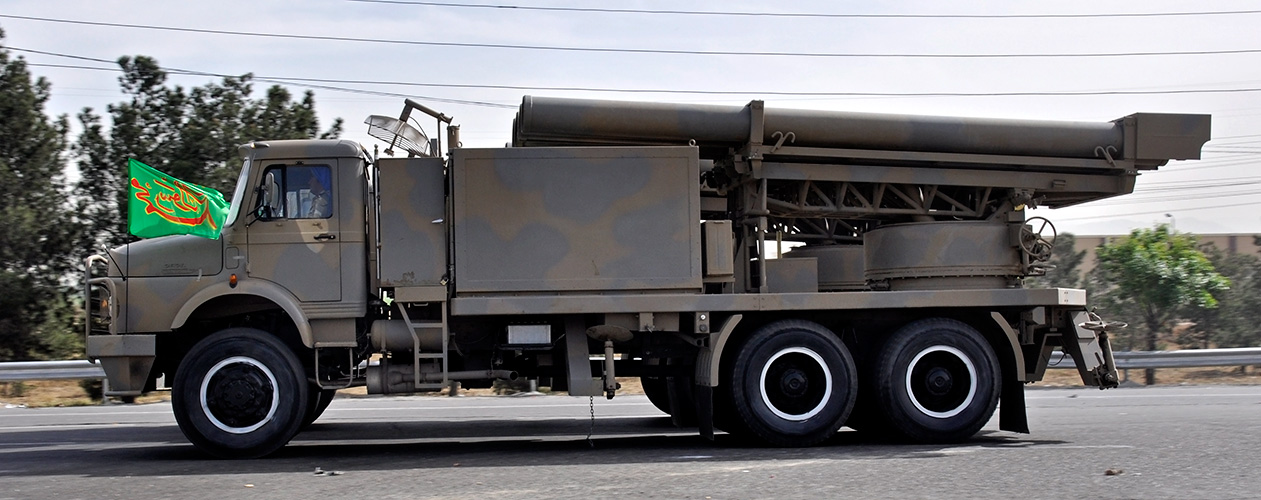
Iranian long-range multiple launch rocket system
| Field | Value | |
|---|---|---|
| name | Fajr-5 | |
| image | Iranian Fajr-5 Rocket by tasnimnews.jpg | |
| image_size | 300 | |
| origin | Iran | |
| type | Rocket artillery | |
| <!-- Type selection --> | is_ranged | yes |
| is_artillery | yes | |
| is_vehicle | yes | |
| is_UK | ||
| used_by | See Operators | |
| wars | Gaza–Israel conflict | |
| Syrian Civil War | ||
| number | Roughly 100 systems | |
| variants | ||
| weight | 15,000 kg (launcher, empty) | |
| 90 kg (HE content) | ||
| 175 kg (warhead) | ||
| 915 kg (rocket) | ||
| length | 10.00 m (launcher) | |
| 6.485 m (rocket) | ||
| width | 2.5 m (launcher) | |
| height | 3.34 m (launcher) | |
| caliber | 333 mm | |
| rate | 4–8 seconds | |
| speed | 1,100 m/s (max) | |
| range | 40–130 km | |
| sights | ||
| elevation | 0 to 57 degrees | |
| traverse | 45 degrees left and right | |
| haft_type | ||
| yield |
Syrian Civil War 90 kg (HE content) 175 kg (warhead) 915 kg (rocket) 6.485 m (rocket) The Fajr-5 (rarely Fadjr-5, , "Dawn") is an Iranian 333 mm long-range multiple launch rocket system (MLRS). The Fajr-5 was developed during the 1990s and has since been exported to various armed actors in the Middle East.
The Fajr-5 launcher fires four 6.48 meter long, 333 millimeter-calibre Fajr-5 artillery rockets, with a range of 75 kilometers (50 mi), weighing 915 kilograms each and carrying 175-kg fragmentation warheads with 90 kg of high explosive (HE). Most Fajr-5 rockets are unguided; in 2017 Iran introduced a variant, the Fajr-5C, which adds GPS guidance.
The Fajr-5 is primarily used by the Iranian Army Ground Force to attack large, fixed, high-value targets, like airfields and military bases. In addition, the system is also used by militant groups to target Israel. Finally, the system has a niche role in use by the IRGC-N as an unguided anti-ship rocket system for the Persian Gulf.
Design
MLRS
The Fajr-5 artillery rocket system is installed on a Mercedes Benz 2631 6×6 forward control chassis. To provide a stable firing platform, four hydraulically operated stabilizers are lowered to the ground before firing. Another fully enclosed cabin to the immediate rear of the cab houses the remainder of the crew. This new chassis was unveiled in 2006; some systems have not been upgraded and are still on older chassis.
The Fajr-5 is normally fired from this truck launcher, but it can also be fired individually. The primary role of this artillery rocket system is the engagement of land targets. A naval surface search radar can be added to allow the system to be used in an anti-shipping role.
Fajr-5 MLRS can be networked together, and have a remote-fire capability in which the command vehicle can fire all nearby Fajr-5 systems.
The Fajr-5's circular error probable (CEP) is not known. The Fajr-5's reliability, cost or production status is not known.
In 2019, the Defense Intelligence Agency described the Fajr-5 as the "most capable" multiple rocket launcher in Iranian service.
Rocket
Basic rocket
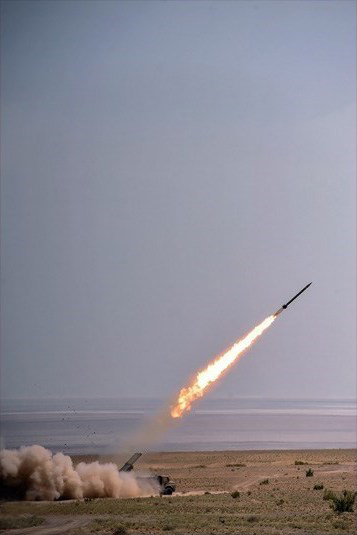
The rocket is solid fueled and has a fragmentation high explosive warhead. The rocket is 6.485 meters long, 333mm in diameter, and weighs 907 kg. It has wraparound fins for stabilization in flight, which reach a diameter of 710 mm when extended. The rocket's double base propulsion burns for an average time of 5.3 seconds, reaching a peak velocity of 1100 m/s. The rocket's motor has nine launch nozzles arranged in a circle, which are slanted to help create spin-stabilization in flight. The Fajr-5 rocket carries a 175 kg warhead with a fragmentation radius of 500m.
One source reports that Fajr-5 rockets can likely carry (plain) high explosive, submunitions, incendiary, smoke, or chemical payloads as well. The shelf life of a basic Fajr-5 rocket is 15 years.
Two-stage rocket
Iran produces a two-stage Fajr-5 rocket with extended range. The two-stage Fajr-5 rocket has a length of 9.4 m and a maximum range of 180 km at sea level. This variant has a diameter of 333 mm, like other Fajr-5 rockets, but has fixed fins, which have a diameter of 561 mm. The two-stage Fajr-5 can reach a maximum altitude of 85 km and carries the same 175 kg warhead with a 500m fragmentation radius. This variant is launched from TELs similar to those used for Zelzal rockets, which only have the capacity for a single rocket.
The shelf life of a two stage Fajr-5 rocket is 15 years.
Fajr-5C
It has a firing accuracy of 250 m when using INS and 50 m using GNSS, with range from 40-130 km.
The guided Fajr-5 rocket was briefly mentioned, and believed to be under development, in 2014. The missile has been delivered to the IRGC Ground Force units as of May 2023.
GR110/GF5LR1
In August 2023, Iran revealed a new version of the Fajr-5 at the Ministry of Defense Industry Authority Exhibition 1402.
It has a maximum range of 110km and a weight of 902kg with a warhead weighing 115kg while achieving an accuracy of 25m CEP.
Reloading
When the Fajr-5 is reloaded, the launch tubes (in two groups of two) are detached from the launcher and laid on the ground by a crane (an Italian Effer 155-25). Then, a machine called a "Loading machine" is used to mechanically press the heavy Fajr-5 rockets into their launch tubes one by one. When all the tubes are filled, the crane is used to reattach the launch tubes to the vehicle. Because of the long reload time and large size of the "Loading machine" (12m), the Fajr-5 MLRS is supposed to retreat after firing to safer rear battle areas to reload. A reload takes 2 minutes per rocket.
History

The first Fajr-5 were created when China exported WS-1 MLRS to Iran in the late 1980s/early 1990s. They were then subsequently created and produced by Iran's Aerospace Industries Organization.
Operational history
Iran
As of 2011, the best estimate for the number of Fajr-5 pieces manufactured was "somewhere around 100" or less.
Lebanon
Iran supplied a number of Fajr-5s to Hezbollah in Lebanon beginning in 2002 or 2001. Sources disagree on whether Hezbollah used Fajr-5 rockets in the 2006 Lebanon War, in part because at the time they were confused with similar Khaibar-1 rockets.
Palestinian territories
Fajr-5 rockets are held in the Gaza Strip by Palestinian militant groups. The first was fired by Hamas in November 2012. It is believed that manufacture of some sub-components and final assembly may take place in Gaza, but that the critical components of the rocket are furnished by Iran. Iran denied transferring any rockets to Gaza but said they instead transferred technology to manufacture the rocket.
Some Palestinians have named their children after the Fajr-5.
Pillar of Defense
In November 2012 during Operation Pillar of Defense, Hamas and Palestinian Islamic Jihad fired Fajr-5 rockets towards Tel Aviv and Jerusalem. At least 14 rockets were fired in total.
Syria

On May 10, 2018, the IRGC's Quds Force fired 20 rockets into the Israeli-occupied Golan Heights from Syrian territory. Some of these were Fajr-5s.
In December 2018 some Fajr-5 rockets were destroyed in an IAF airstrike.
Iraq
Sporadically, during the US occupation of Iraq (between 2003 and 2011), Iranian Backed militias fired the 333 Fajr-5 at US forces from fabricated rails. In 2015, Iran sent Fajr-5 rockets and launcher systems to Iraq to be used in the War against the Islamic State. It is unknown if they were fired, and the quantity sent is also unknown.
Yemen
The Houthis have unveiled a rocket with similarities to the Fajr-5.
Operators

Current
-
- Iranian Army
- Iranian Army Ground Force
- 840th Missile Group
- Iranian Army Ground Force
- IRGC
- IRGC-N
- Iranian Army
-
- Syrian Armed Forces
- Syrian Arab Army
- Syrian Armed Forces
Non-state operators
- Flag of al-Qassam Brigades.svg Hamas (Izz al-Din al-Qassam Brigades)
- InfoboxHez.PNG Hezbollah
- Flag of Palestine.svg Islamic Jihad Movement in Palestine (Al-Quds Brigades)
Former
- Libyan Arab Jamahiriya
Notes
References
References
- [http://www.globalsecurity.org/military/world/iran/images/fadjr-image01.jpg Fajr-3 & Fajr-5 brochure.] {{Webarchive. link. (2008-01-14 Retrieved on May 13, 2008.)
- "Fadjr-5 Two-Stage".
- Foss, Christopher F. (8 May 2006). "Fadjr-5 artillery rocket system gets new chassis". Jane's Information Group.
- Anthony H. Cordesman, Martin Kleiber. ''Iran's Military Forces and Warfighting Capabilities'' (2007) {{ISBN. 978-0-89206-501-1 p.60–61
- . (2019). ["Iran Military Power"](https://www.dia.mil/Portals/110/Images/News/Military_Powers_Publications/Iran_Military_Power_LR.pdf). *Defense Intelligence Agency*.
- (Jul 9, 2014). "Hamas' Rocket of Choice".
- "Defense Industries Organization 2013 Catalog, Section 3: Rocket Industries Group.".
- (7 February 2017). "Iran unveils new Fajr 5 300mm MLRS Multiple Launch Rocket System using guided rockets 10702171".
- (14 July 2014). "IRGC unveils new tactical ballistic missiles developments - IHS Jane's 360".
- "IRGC Tests Homegrown Rocket with Thermobaric Warhead - Politics news".
- (Jul 18, 2006). "Military Briefing on Hezbollah's Missile Capabilities: Examining the Fajr, Zelzal".
- Galen Wright (March 15th 2011) ''Iranian Military Capability 2011 - Ground Forces''
- Devenny, Patrick. (1 January 2006). "Hezbollah's Strategic Threat to Israel". Middle East Quarterly.
- Gordon, Michael (September 27, 2002) "Militants Are Said to Amass Missiles in South Lebanon". The New York Times.
- (May 4, 2006). "Iran Tests Missiles for Domestic and Foreign Audiences; Origins of One Advanced System Remain Murky". James Martin Center for Nonproliferation Studies.
- Lambeth, B. S. (2011). ''Air Operations in Israel's War Against Hezbollah: Learning from Lebanon and Getting it Right in Gaza''. Santa Monica, CA, United States: RAND. {{ISBN. 978-0-8330-5146-2
- Jean-Loup Samaan. (April 2015). "Another Brick in the Wall: The Israeli Experience in Missile Defense". U.S. Army War College, Strategic Studies Institute.
- (21 November 2012). "Iran transferred Fajr-5 missile technology to Gaza: IRGC chief".
- (9 December 2012). "Gazans naming newborns after Iran's Fajr-5 missiles".
- Spyer, Jonathan. (7 September 2018). "Israel's Secret War Against Iran Is Widening".
- Anna Ahronheim. (December 27, 2018). "Satellite shows damage to Iranian bases after Israeli Syria strike - Arab-Israeli Conflict - Jerusalem Post".
- Schmitt, Eric. (16 March 2015). "Iran Sent Arms to Iraq to Fight ISIS, U.S. Says". New York Times.
- (20 November 2018). "Iran-Backed Houthis Launch Ballistic Missile at Saudi Forces".
- (2024). "Military Balance 2024". IISS.
- (8 May 2023). "Iran successfully tests home- made rocket with thermobaric warhead".
- Mark Pyruz. (March 2, 2014). "President Rouhani tours Iran Navy and IRGC Navy bases".
- "Iran supplies improved rockets to Syria and Hizbullah - Jane's Missil…".
- (16 November 2012). "Rockets aim at Tel Aviv as conflict escalates".
- "Missiles and Rockets of Hezbollah".
- Black, Ian. (2012-11-16). "Fajr-5 missile gives Palestinians rare if short-lived advantage". The Guardian.

This article was imported from Wikipedia and is available under the Creative Commons Attribution-ShareAlike 4.0 License. Content has been adapted to SurfDoc format. Original contributors can be found on the article history page.
Ask Mako anything about Fajr-5 — get instant answers, deeper analysis, and related topics.
Research with MakoFree with your Surf account
Create a free account to save articles, ask Mako questions, and organize your research.
Sign up freeThis content may have been generated or modified by AI. CloudSurf Software LLC is not responsible for the accuracy, completeness, or reliability of AI-generated content. Always verify important information from primary sources.
Report