From Surf Wiki (app.surf) — the open knowledge base
Faggot
Homophobic slur

Homophobic slur
| Field | Value |
|---|---|
| name | Faggot |
| type | Homophobic slur |
| part_of_speech | Noun |
| pronunciation | |
| etymology | From French fagot, faget |
| meaning | Queer or homosexual people (pejorative) |
Faggot, often shortened to fag, is a slur in the English language used to refer to gay men. The slur is also sometimes indiscriminately used against other members of the LGBTQ community, and has also seen extended use in American youth culture beginning around the turn of the 21st century as a broader reaching insult more related to masculinity and group power structure. In a case of linguistic reclamation, many LGBTQ people have reclaimed it as a neutral or positive term for describing themselves, as well as reinforcing in-group solidarity.
By extension, faggotry (or rarely, faggotism or faggotness) are pejoratively used to refer to homosexuality.
Etymology
The first recorded use of faggot as a pejorative term for gay men was in the 1914 A Vocabulary of Criminal Slang, while the shortened form fag first appeared in 1923 in The Hobo by Nels Anderson.
Its association with homosexuality likely stems from linguistic patterns that use feminizing terms, such as nancy, sissy, and queen,{{Citation to demean homosexual or effeminate men. The application of the term to old women is possibly a shortening of the term "faggot-gatherer", applied in the 19th century to people, especially older widows, who made a meager living by gathering and selling firewood. It may also derive from the sense of "something awkward to be carried" (compare the use of the word baggage as a pejorative term for old people in general).
An alternative possibility is that the word is connected with the practice of fagging in British public schools, in which younger boys performed (potentially sexual) duties for older boys, although the word faggot was never used in this context, only fag. There is a reference to the word faggot being used in 17th-century Britain to refer to a "man hired into military service simply to fill out the ranks at muster", but there is no known connection with the word's modern usage.
The Yiddish word yi (), itself a pejorative term for a gay man, has been claimed by some to be related to the American usage. yi () is the nickname for a young girl named Faigie ('bird') after Moses's wife Zipporah (Hebrew for 'bird'). The similarity between the two words makes it possible that it might at least have had a reinforcing effect.
There is an urban legend, called an "oft-reprinted assertion" by Douglas R. Harper, creator of the Online Etymology Dictionary, that the modern slang meaning developed from the standard meaning of faggot as "bundle of sticks for burning" with regard to burning at the stake. Homosexuals were burned at the stake during the late Middle Ages as sexual intercourse between same-sex people was considered to be sodomy and therefore punished. The emergence of the slang term in 20th-century American English is unrelated to any historical death penalties for homosexuality; moreover, homosexuality in England and its colonies was never punished by immolation but instead by the accused being hanged and their property taken.
Use
Early printed use
The word faggot with regard to homosexuality was used as early as 1914, in Jackson and Hellyer's A Vocabulary of Criminal Slang, with Some Examples of Common Usages which listed the following example under the word "drag": "All the fagots (sissies) will be dressed in drag at the ball tonight."
The word fag is used in 1923 in The Hobo: The Sociology of the Homeless Man by Nels Anderson: "Fairies or Fags are men or boys who exploit sex for profit."
The word was also used together with another homophobic slur, bulldyke, by a character in Claude McKay's 1928 novel Home to Harlem, indicating that it was used during the Harlem Renaissance. Specifically, one character says that he cannot understand: "a bulldyking woman and a faggoty man".
Use in the United Kingdom
Originally confined to the United States,
Use of fag and faggot as the term for an effeminate man has become understood as an Americanism in British English, primarily due to entertainment media use in films and television series imported from the United States. When Labour MP Bob Marshall-Andrews was overheard supposedly using the word in a bad-tempered informal exchange with a straight colleague in the House of Commons lobby in November 2005, it was considered to be homophobic abuse.
Usage by youth
Faggot, used as a discriminatory term, has expanded beyond gay men. It is often used by the youth in online communities to describe any queer person or someone who differs from the norm. In some cases, the term is completely unrelated to homosexuality and simply used as an insult due to its negative connotation, similar to gay.
Through ethnographic research in a high school setting, C. J. Pascoe examined how American high school boys used the term fag during the early 2000s. Pascoe's work, culminating in a 2007 book titled Dude, You're a Fag: Masculinity and Sexuality in High School, suggested that these boys used the fag slur as a way to assert their own masculinity, by claiming that another boy is less masculine; this, in their eyes, makes him a fag, and its usage suggests that it is less about sexual orientation and more about gender. One-third of the boys in Pascoe's study claimed that they would not call a homosexual peer a fag, leading Pascoe to argue that fag is used in this setting as a form of gender policing, in which boys ridicule others who fail at masculinity, heterosexual prowess, or strength. Because boys do not want to be labeled a fag, they hurl the insult at another person. Pascoe felt the fag identity does not constitute a static identity attached to the boy receiving the insult. Rather, fag is a fluid identity that boys strive to avoid, often by naming another as the fag. As Pascoe asserts, "[the fag identity] is fluid enough that boys police their behaviors out of fear of having the fag identity permanently adhere and definitive enough so that boys recognize fag behavior and strive to avoid it."
In the 1990s and early 2000s, the word faggot became somewhat removed from its original meaning when used by youth, who commonly used it as a synonym for the word stupid. In a 2018 study completed by the Anti-Defamation League surveying Generation Z from Grade 6 and up, youth perspectives on the phrase "that's so gay" and homophobic slurs highlight concerns over its use as a synonym for "stupid," which respondents viewed as offensive and insensitive. Some believe it reflects a lack of awareness rather than intent to harm, yet it still evokes frustration and discomfort, pointing to a need for more thoughtful language.
Use in popular culture
There is a long history of using both fag and faggot in popular culture, usually in reference to gay and bisexual men. Rob Epstein and Jeffrey Friedman's 1995 documentary The Celluloid Closet, based on Vito Russo's book of the same name, notes the use of fag and faggot throughout Hollywood film history. The Think Before You Speak campaign has sought to stop fag and gay being used as generic insults.
Theater
In 1973, a Broadway musical called The Faggot was praised by critics but condemned by gay liberation proponents.{{cite news
Larry Mitchell and Ned Asta's 1977 cult book The Faggots and Their Friends Between Revolutions inspired a musical by composer Philip Venables and director Ted Huffman reinterprets world history from a queer perspective. The term is used in a sense of reclamation.
Books and magazines
Larry Kramer's 1978 novel Faggots discusses the gay community including the use of the word within and towards the community. A description of Pamela Moore's 1956 novel Chocolates for Breakfast in the Warner Books 1982 culture guide The Catalog of Cool reads: "Her fifteen-year-old heroine first balls a fag actor in H'wood, then makes it with some hermetic, filthy rich, hotel-bound Italian count."
In its November 2002 issue, the New Oxford Review, a Catholic magazine, caused controversy by its use and defense of the word in an editorial. During the correspondence between the editors and a gay reader, the editors clarified that they would only use the word to describe a "practicing homosexual". They defended the use of the word, saying that it was important to preserve the social stigma of gays and lesbians.
Music
1960s
Arlo Guthrie uses the slur in his 1967 signature song "Alice's Restaurant", noting it as a potential way to avoid military induction at the time (Guthrie had removed the word from live performances of the song in the 21st century).
Phil Ochs uses the slur in his 1969 song "I Kill Therefore I Am". In the song, which is written from the point of view of a hateful police officer, he uses the slur to describe the student activists who protested the Vietnam War.
1980s
The Dire Straits 1985 song "Money for Nothing" makes notable use of the slur faggot, although the lines containing it are often excised for radio play, and in live performances by singer/songwriter Mark Knopfler. The song was banned from airplay by the Canadian Broadcast Standards Council in 2011 but the ban was reversed later the same year. Ironically, the song in context makes it clear he is actually mocking the jealous and homophobic nature of the antagonist in the song by adopting a third-person point of view to show the irony, bigotry, and ignorance of the character.
In 1989, Sebastian Bach, lead singer of the band Skid Row, created a controversy when he wore a T-shirt with the parody slogan "AIDS: Kills Fags Dead".
2000s
The 2001 song "American Triangle" by Elton John and Bernie Taupin uses the phrase, "God hates fags where we come from." The song is about Matthew Shepard, a gay man from Wyoming whose 1998 murder brought national and international attention to hate crime legislation at both the state and federal level.
In December 2007, BBC Radio 1 caused controversy by editing the word faggot from their broadcasts of the Kirsty MacColl and The Pogues song "Fairytale of New York", deeming it potentially homophobic; however, the edit did not extend to other BBC stations, such as BBC Radio 2. Following widespread criticism and pressure from listeners, the decision was reversed and the original unedited version of the song was reinstated, with clarification from Andy Parfitt, the station controller, that in the context of the song the lyrics had no "negative intent".
2010s–2020s
Eminem used the word in numerous works, such as "Rap God" (2013), along with an inflammatory lyric containing the term being removed from "Fall".
A number of rappers have also used the slur in songs supporting the LGBT community. In 2012, Macklemore used the word faggot in the song "Same Love" in reference to the use of the homophobic slur in cyberbullying. Kendrick Lamar's 2022 song "Auntie Diaries" is also supportive of the LGBT community; however, it sparked controversy for its repeated use of the slur, as well as for deadnaming his transgender uncle.
Television
In November 2009, the South Park episode "The F Word" dealt with the overuse of the word fag. The boys use the word to insult a group of bikers, saying that their loud motorcycles ruined everyone else's nice time. Officials from the dictionary, including Emmanuel Lewis, visit the town and agree that the meaning of the word should no longer insult homosexuals but instead be used to describe loud motorcycle riders who ruin others' nice times. The episode is a satire on the taboo of using the term, as it goes against political correctness.{{cite news |author=Genevieve Koski |date=November 4, 2009 |title=The F Word |url=https://www.avclub.com/south-park-the-f-word-1798207343 |work=The A.V. Club |access-date=November 7, 2009}}
Reclamation
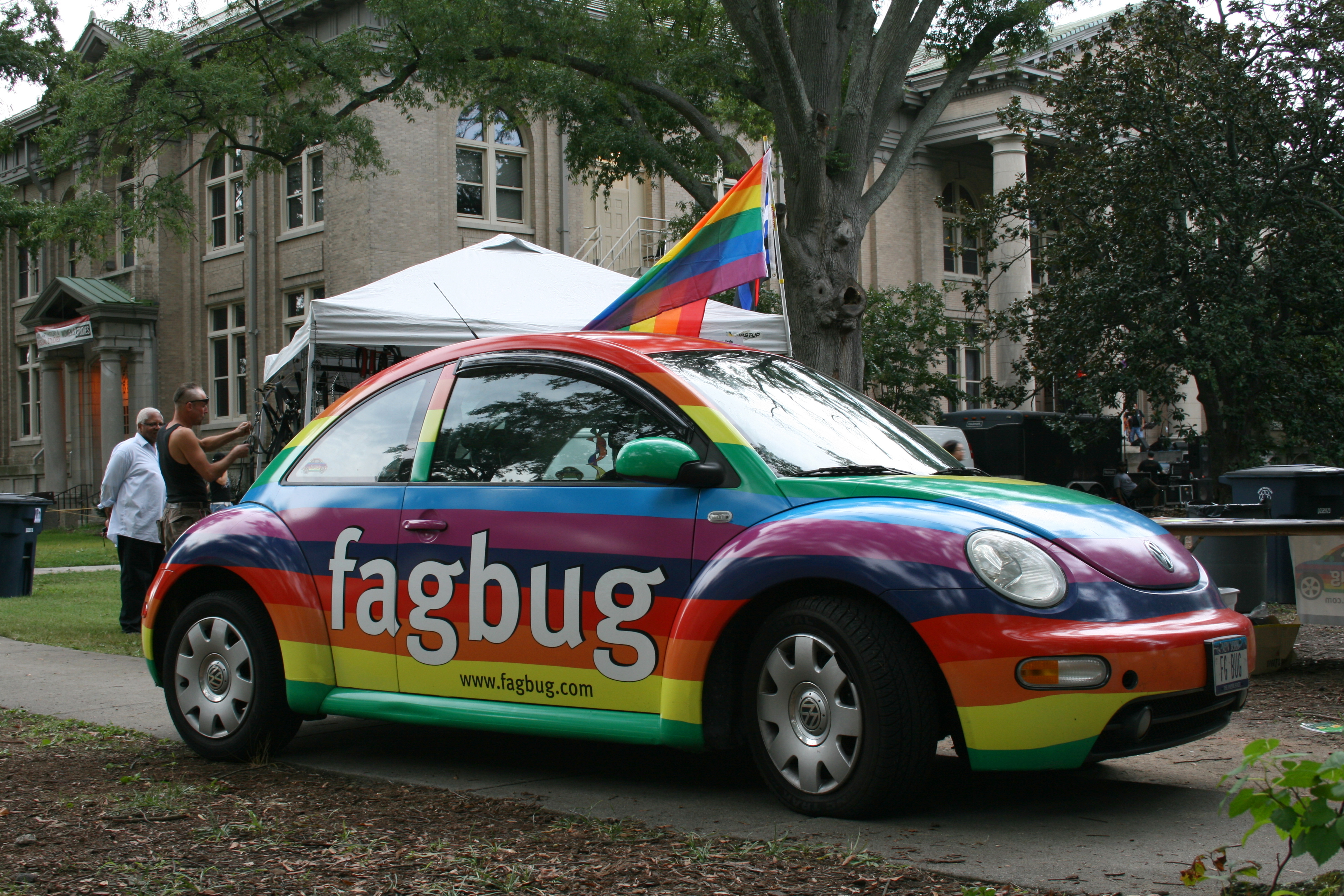
Some LGBTQ+ individuals have reclaimed the term as a neutral or positive term of self-description. The reclamation of slurs focuses on reinforcing in-group solidarity, restricting the use of the reclaimed slur to members of the targeted group.
In 2009, Erin Davies' car, displaying a Pride flag, was defaced with homophobic slurs resulting in a 58-day tour across the U.S. and Canada, keeping the graffiti as a conversation starter about LGBTQ+ experiences with intolerance. This journey led to her documentary Fagbug, an 80-minute film highlighting homophobia and the LGBTQ+ community's resilience in reclaiming and addressing derogatory terms. Davies' work exemplifies LGBTQ+ culture's longstanding efforts to transform slurs into tools for education and empowerment.
References
References
- "faggot".
- "Faggot". The Oxford English Dictionary.
- (2000). "The American Heritage Dictionary of the English Language, Fourth Edition". Houghton Mifflin.
- 2008, Paul Ryan Brewer, Value war: public opinion and the politics of gay rights, page 60
- Davis, Chloe O.. (2024). "The Queens' English: The Young Readers' LGBTQIA+ Dictionary of Lingo and Colloquial Phrases". Simon & Schuster Books For Young Readers.
- "faggotry - NOUN".
- "Definition of Faggotism".
- (June 13, 2021). "Encyclopedia of Lesbian and Gay Histories and Cultures". [[Taylor & Francis]].
- Harper, Douglas. "Faggot". The Online Etymological Dictionary.
- Wells, Catharine. (Fall 2017). "Microaggressions: What They Are and Why They Matter". [[The University of Texas School of Law]].
- Roelens, Jonas. (April 9, 2020). "The Sodom of the North. Homosexuals Were Burned at the Stake in Medieval Bruges".
- (February 13, 2018). "1533: 25 Henry 8 c.6: The Buggery Act".
- David Wilton. (2004). "Word myths". Oxford University Press.
- (1923). "The hobo : the sociology of the homeless man". Chicago : University Press.
- Spencer, Suzette A.. (December 1998). "Swerving at a Different Angle and Flying in the Face of Tradition: Excavating the Homoerotic Subtext in ''Home to Harlem''". [[CLA Journal]].
- "MP's 'faggot' abuse 'disgraceful'". LGBTGreens.
- Helm, Toby. (November 11, 2005). "Panic and a punch-up as Blair tumbles to defeat at the hands of his own party". [[The Daily Telegraph]].
- Pascoe, C. J.. (2007). "[[Dude, You're a Fag". University of California Press.
- "The History and Impact of Anti-LGBT Slurs".
- (2016-02-23). "A Former Teacher's Perspective: Homophobia Shaped Public Schools in the 1990s and 2000s".
- (2020). "Responding to Bias Incidents in Middle and High Schools: Resources and Best Practices for School Administrators & Educators". [[Anti-Defamation League]].
- ''The Bible Exposition Commentary: New Testament: Volume 1'' (1992), Warren W. Wiersbe, David C. Cook, {{ISBN. 1-56476-030-8, {{ISBN. 978-1-56476-030-2
- ''The Celluloid Closet''; (1995) Rob Epstein and [[Jeffrey Friedman (filmmaker). Jeffrey Friedman]].
- [https://abcnews.go.com/m/screen?id=7328091&pid=26 'That's So Gay': Words That Can Kill] Susan Donaldson James, ''ABC News'', April 20, 2009.
- "The Faggots and Their Friends Between Revolutions".
- Larry Kramer. (2000). "Faggots". [[Grove Press]].
- Nedelkoff, Robert. (1997). "Pamela Moore Plus Forty". [[The Baffler]].
- Sculatti, Gene. (October 1982). "The Catalog of Cool". [[Warner Books]].
- "Sodom & the City of God". Cityofgod.net.
- Guthrie, Arlo (1967). "[http://www.arlo.net/resources/lyrics/alices.shtml Alice's Restaurant Massacree] {{webarchive. link. (May 21, 2007 " (lyrics). ''[[Alice's Restaurant (album)). Alice's Restaurant]]''. Retrieved from the [http://www.arlo.net/ official Arlo Guthrie web site] November 26, 2013. "And if two people, two people do it, in harmony, they may think they're both faggots and they won't take either of them."
- (2008-07-01). "Mark Knopfler a Bigger Gay Icon Than George Michael?".
- "Canada Lifts Ban on Dire Straits' 'Money for Nothing'".
- (2011-01-14). "Dire Straits' 'Money for Nothing' is not homophobic {{!}} Xtra Magazine".
- Scocca, Tom. (2011-01-14). ""Money for Nothing" Is Not Really Insulting to Homosexuals, Unless They Are Unlucky Enough to Be Working-Class Homosexuals". Slate.
- Michael Musto. [http://www.villagevoice.com/nyclife/0022,musto,15284,15.html "La Dolce Musto"] {{webarchive. link. (March 22, 2007 , village voice, 2000.)
- (December 18, 2007). "Radio 1 censors Pogues' Fairytale". BBC News.
- (September 2024). "Radio 1 reverses decision to censor Pogues hit"3071042.ece". Times Online.
- "Eminem - Rap God Lyrics | Lyrics.com".
- "billboard Eminem criticism".
- "Eminem – Fall".
- "Macklemore & Ryan Lewis - Same Love lyrics".
- (May 18, 2022). "The Impossible Ambition of Kendrick Lamar's New Album".
- (May 16, 2022). "Why Kendrick Lamar's "Auntie Diaries" Has Polarized the LGBTQ+ Community".
- (November 2, 2009). "South Park episode guide". South Park Studios.
- (November 5, 2009). "GLAAD protests 'South Park' f-bomb episode". James Hibberd's The Live Feed.
- Berk, Brett. (January 8, 2009). "The Heartwarming Story of Fagbug".
- Raymundo, Oscar. (December 19, 2007). "Driven to Spread Awareness".
- (July 6, 2019). "Want to reclaim 'faggot'? Great, but be careful how you use it".
- (August 2, 2017). "21 Words the Queer Community Has Reclaimed (and Some We Haven't)".
- Gordon, Zach. [https://scripties.uba.uva.nl/document/674812 "Who Can Say Faggot? A Two Part Study on Online Slur Reclamation"]. ''Universiteit van Amsterdam'', 2019.
- Jeshion, Robin. (2020-03-04). "Pride and Prejudiced". Grazer Philosophische Studien.
This article was imported from Wikipedia and is available under the Creative Commons Attribution-ShareAlike 4.0 License. Content has been adapted to SurfDoc format. Original contributors can be found on the article history page.
Ask Mako anything about Faggot — get instant answers, deeper analysis, and related topics.
Research with MakoFree with your Surf account
Create a free account to save articles, ask Mako questions, and organize your research.
Sign up freeThis content may have been generated or modified by AI. CloudSurf Software LLC is not responsible for the accuracy, completeness, or reliability of AI-generated content. Always verify important information from primary sources.
Report