From Surf Wiki (app.surf) — the open knowledge base
Facing and trailing
Orientations of railway turnouts
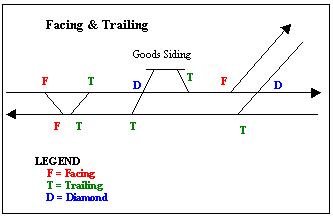
Orientations of railway turnouts

Facing or trailing are railway turnouts (or 'points' in the UK) in respect to whether they are divergent or convergent. When a train traverses a turnout in a facing direction, it may diverge onto either of the two routes. When travelled in a trailing direction, the two routes converge onto each other.
Diamond crossings
Fixed diamond crossings (with no moving parts) count as trailing points in both directions, although in very exceptional circumstances such as propelling a train in reverse over fine angle diamond crossings they can derail wagons as they bunch up.
Switched diamonds, which contain two stub turnouts in disguise, count as facing turnouts in both directions and are also known as moveable angles (UK).
Moveable crossings
Fixed V-crossings are trailable in both directions. Moveable crossings are effectively facing in both directions and must be correctly aligned.
Stub switches
Stub switches are effectively facing in both directions and must be correctly aligned.
Double junctions
Double junctions are now configurable in a number of different ways, whereby the number of facing and trailing turnouts vary.
Goods siding
The goods siding on a double line (in the above diagram) uses two trailing points and a diamond. It can be shunted by trains in either direction.
This was widely done in New South Wales, though later on the diamond crossing was replaced with a pair of ladder crossovers; such as:
- Bredalabane (S)
- Jerrawa (S)
- Woy Woy (N)
- Newbridge (W)
References
References
- "Figure 2.12. Facing- and Trailing-Point Movements". Integrated Publishing.
- "facing-point switch".
- (1908). "The Railroad Signal Dictionary". The Railway Gazette for Railway Signal Association.
This article was imported from Wikipedia and is available under the Creative Commons Attribution-ShareAlike 4.0 License. Content has been adapted to SurfDoc format. Original contributors can be found on the article history page.
Ask Mako anything about Facing and trailing — get instant answers, deeper analysis, and related topics.
Research with MakoFree with your Surf account
Create a free account to save articles, ask Mako questions, and organize your research.
Sign up freeThis content may have been generated or modified by AI. CloudSurf Software LLC is not responsible for the accuracy, completeness, or reliability of AI-generated content. Always verify important information from primary sources.
Report