From Surf Wiki (app.surf) — the open knowledge base
Facial hair
Hair grown on the face, chin, cheeks, and upper lip region

Hair grown on the face, chin, cheeks, and upper lip region
Facial hair is hair grown on the face, usually on the chin, cheeks, bottom lip and upper lip region. It is typically a secondary sex characteristic of human males. Men typically start developing facial hair in the later stages of puberty or adolescence, at around 14 years of age, and most do not finish developing a full adult beard until around age 16 or later. However, large variations can occur; boys as young as 10 have also been known to develop facial hair, and some men do not produce much facial hair at all.
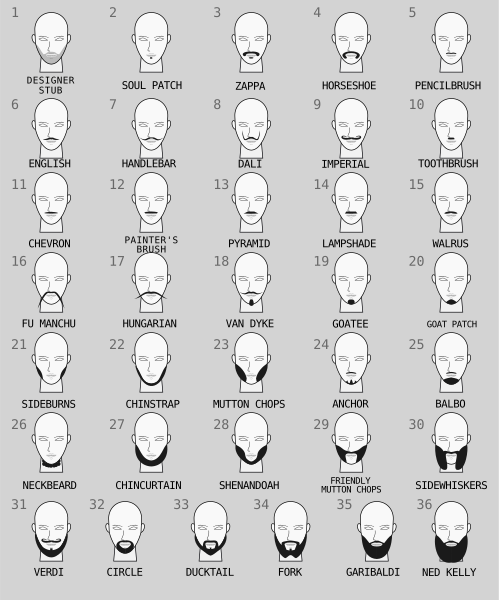
Men may style their facial hair into beards, moustaches, goatees or sideburns; many others completely shave their facial hair and this is referred to as being "clean-shaven". The term whiskers, when used to refer to human facial hair, indicates the hair on the chin and cheeks.
Women are also capable of developing facial hair, especially after menopause, though typically significantly less than men. Women with lots of facial hair, the extreme being bearded ladies, have been considered as freaks by society and sometimes been part of circuses. Trans men typically develop more facial hair while undergoing masculinizing hormone therapy as part of their wider gender transition.
History
In the West in the nineteenth century, most men maintained some facial hair. According to a 1976 study by University of Washington economist Dwight Robinson, who reviewed illustrations in the Illustrated London News, facial hair peaked in the 1880s (90%). The wearing of beards dropped significantly, although mustaches remained popular until the 1940s.
In male adolescence

The moustache forms its own stage in the development of facial hair in adolescent males. Facial hair in males does not always appear in a specific order during puberty and varies but may follow this process.
- During puberty, the first facial hair to appear tends to grow at the corners of the upper lip (age 10–14).
- It then spreads to form a moustache over the entire upper lip (age 14–16).
- This is followed by the appearance of hair on the upper part of the cheeks and the area under the lower lip (age 14–17).
- It eventually spreads to the sides and lower border of the chin and the rest of the lower face to form a full beard (age 16–19).
Although this order is commonly seen, it can vary widely, with some facial hair starting from the chin and up towards the sideburns. As with most human biological processes, this specific order may vary depending on one's genetic heritage or environment.
Military
Main article: Facial hair in the military
Depending on the periods and countries, facial hair has been prohibited in armies or, on the contrary, an integral part of the uniform.
In religion
Many religious male figures are recorded to have had facial hair; for example, numerous prophets mentioned in the Abrahamic religions (Judaism, Christianity and Islam) were known to grow beards. In Shia Islam, trimming beards is allowed but shaving them is forbidden. Amish men grow beards after marriage but continue to shave their moustaches in order to avoid historical associations with military facial hair due to their pacifistic beliefs. In Sikhism, one of the Five Ks followed by Khalsa Sikhs is kesh, which forbids the cutting or shaving of hair, both scalp and facial.
On women
Women typically have little hair on the face, apart from eyebrows and the vellus hair that covers most of the body. However, in some cases, women have noticeable facial hair growth, most commonly after menopause. Excessive hairiness (especially facially) is known as hirsutism and is usually an indication of atypical hormonal variation. Many women depilate facial hair that appears, as considerable social stigma is associated with facial hair on women, and freak shows and circuses have historically displayed bearded women. Many women globally choose to totally remove their facial hair by means of electrolysis (permanent) or laser hair removal (semi-permanent).
Styles of facial hair
Main article: List of facial hairstyles
Primates
Primates such as the bearded emperor tamarin have what look like whiskers. Adult orangutans have varying degrees of facial hair. In chimpanzees and gorillas, facial and body hair become sparser in adulthood due to the aging process, which is in stark contrast to humans, whose facial and body hair become stronger. Because infant great apes have thicker "facial" (as well as body) hair than their older counterparts, it is not androgenic but part of the fur complex. The sensitivity to androgens seems to have been acquired by humans on the gene KRT37 relatively recently.
References
References
- (2023). "Encyclopedia of Sexual Psychology and Behavior". [[Springer, Cham]].
- (2011). "Premature Moustache As Presenting Symptom of Nonclassic Congenital Adrenal Hyperplasia due to 2 Uncommon Mutations of the CYP21A2 Gene". Case Reports in Genetics.
- "whiskers".
- (2021-07-07). "Dermatologic Care of Hair in Transgender Patients: A Systematic Review of Literature". Dermatology and Therapy.
- (9 January 2014). "The Decline of Facial Hair Popularity". Business Insider.
- "Abraham Lincoln's Letter to Grace Bedell".
- (2002-06-01). "Adolescent Reproductive Health". UNESCO Regional Training Seminar on Guidance and Counselling.
- "Puberty – Changes for Males". pamf.org.
This article was imported from Wikipedia and is available under the Creative Commons Attribution-ShareAlike 4.0 License. Content has been adapted to SurfDoc format. Original contributors can be found on the article history page.
Ask Mako anything about Facial hair — get instant answers, deeper analysis, and related topics.
Research with MakoFree with your Surf account
Create a free account to save articles, ask Mako questions, and organize your research.
Sign up freeThis content may have been generated or modified by AI. CloudSurf Software LLC is not responsible for the accuracy, completeness, or reliability of AI-generated content. Always verify important information from primary sources.
Report