From Surf Wiki (app.surf) — the open knowledge base
Facial eczema
Mycotoxic disease of ungulates
Mycotoxic disease of ungulates
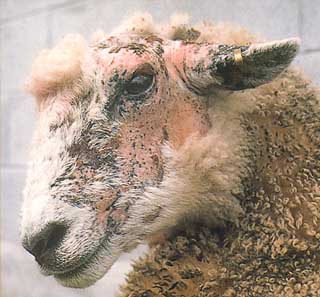
Facial eczema is a mycotoxic disease that affects the liver of several animals, mainly sheep and cattle, but can also infect other ungulates. It is caused by ingesting sporidesmins released by the fungus Pithomyces chartarum. Its visible symptoms are characterized by red skin that turns black and crusty before peeling off, as well as inflammation that can cause swelling of the udder, teats, ears and face. The disease is not always visible. Other symptoms include weight loss, weakness and death.
''P. chartarum''
It grows mostly in New Zealand but also occurs in Australia, France, South Africa, and South America. The fungus grows on dead plants, especially on perennial ryegrass near the ground (25mm height). It most commonly grows between January and May, as it requires warm, humid conditions, as well as moisture at ground level. Areas of spore growth can include urine patches and areas sheltered by hedges. The fungus grows in clusters and is normally invisible to human eye. It produces millions of spores with the toxic substance sporidesmin. Fresh spores are particularly toxic. Contaminated pasture loses its toxicity after 2 weeks.
Pathophysiology
The incubation period is 7-20 days after poison intake. Sporidesmin is hepatotoxic and leads to hepatogenous photosensitization and phylloerythrin accumulation in the bloodstream. It damages the bile ducts and then the liver. The worst case is liver necrosis. This causes – as a secondary effect – photosensitization, this means the inflammation of unpigmented areas and exposed skin (ears, teat, face) and photodynamic dermatitis. Only 5% of affected animals show the respective clinical signs.
Symptoms
Sheep
Infected sheep experience sunburn at face, ears, teats and vulva. It is the primary symptom of the poisoning caused by sporidesmin. The sunburn is caused by the fact that the lower tissue is swollen. The skin gets crusty, dark and then peels,. making it susceptible to infection.
Other symptoms include dullness, weakness, inappetence, and ill-thrift. An affection of the liver results in jaundice. In a worst-case, the sheep die.
Cattle
Infected cattle suffer from sunburn. Dark pigmented skin is often affected. Cattle produce less milk. Jaundice is possible and death after some months.
Treatment
Convalescence can take a long time, but some animals may not get healthy. External therapy is possible to treat the sunburn. Animals could be protected by the intake of zinc. Zinc reacts with sporidesmin to create a metallic complex, so that the poison can be eliminated from the body.
Prevention and control
If animals are sunburned, they should be placed in the stable to protect them from sunlight. Infected cattle should no longer be used in milk production.
Reduce flock density (0.45 hectare/ 15 cows or 100 sheep)
GGT (enzyme) is released by the damaged liver over the course of this disease and can be tested to indicate disease severity.
References
References
- Department of Economic Development, Jobs. "Facial eczema of sheep and cattle".
- "Facial Eczema".
- "Facial eczema prevention and diagnosis with Franklin Vets".
- "Photosensibilität".
- "Facial Eczema - Bayer Animal Health NZ - Facial Eczema".
- "Facial Eczema - Toxicology".
This article was imported from Wikipedia and is available under the Creative Commons Attribution-ShareAlike 4.0 License. Content has been adapted to SurfDoc format. Original contributors can be found on the article history page.
Ask Mako anything about Facial eczema — get instant answers, deeper analysis, and related topics.
Research with MakoFree with your Surf account
Create a free account to save articles, ask Mako questions, and organize your research.
Sign up freeThis content may have been generated or modified by AI. CloudSurf Software LLC is not responsible for the accuracy, completeness, or reliability of AI-generated content. Always verify important information from primary sources.
Report