From Surf Wiki (app.surf) — the open knowledge base
Extinct comet
Comet that lacks typical activity
.jpg)
Comet that lacks typical activity
An extinct comet is a comet that has expelled most of its volatile ice and has little left to form a tail and coma. In a dormant comet, rather than being depleted, any remaining volatile components have been sealed beneath an inactive surface layer.
Due to the near lack of a coma and tail, an extinct or dormant comet may resemble an asteroid rather than a comet and blur the distinction between these two classes of small Solar System bodies. When volatile materials such as nitrogen, water, carbon dioxide, ammonia, hydrogen and methane in the comet nucleus have evaporated away, all that remains is an inert rock or rubble pile. A comet may go through a transition phase as it comes close to extinction.
Nature of extinct comets
Extinct comets are those that have expelled most of their volatile ice and have little left to form a tail or coma. Over time, most of the volatile material contained in a comet nucleus evaporates away, and the comet becomes a small, dark, inert lump of rock or rubble{{Cite web

|access-date=6 March 2014 Other related types of comet include transition comets, that are close to becoming extinct, such as were looked for in the Hubble search for transition comets. Comets such as C/2001 OG108 (LONEOS) may represent the transition between extinct comets and typical Halley-type comets (periods of 20–200 years) or long period comets (periods longer than 200 years).{{cite conference
Dormant comets
Dormant comets are those within which volatiles may be sealed, but which have inactive surfaces. For example, 14827 Hypnos may be the nucleus of an extinct comet that is covered by a crust several centimeters thick that prevents any remaining volatiles from outgassing.
The term dormant comet is also used to describe comets that may become active but are not actively outgassing. For example, 60558 Echeclus has previously displayed a cometary coma and thus also has been given the cometary designation 174P/Echeclus. After passing perihelion in early 2008, centaur 52872 Okyrhoe significantly brightened.{{cite web |access-date=2008-10-12}}
Distinction between comets and asteroids
When discovered, asteroids were seen as a class of objects distinct from comets, and there was no unified term for the two until "small Solar System body" was coined by the IAU in 2006. The main difference between an asteroid and a comet is that a comet shows a coma due to sublimation of near-surface ices by solar radiation. A few objects have ended up being dual-listed because they were first classified as minor planets but later showed evidence of cometary activity. Conversely, some (perhaps all) comets are eventually depleted of their surface volatile ices and develop the appearance of asteroids. A further distinction is that comets typically have more eccentric orbits than most asteroids; most "asteroids" with notably eccentric orbits are probably dormant or extinct comets. Also, they are theorized to be common objects amongst the celestial bodies orbiting close to the Sun.
Roughly six percent of the near-Earth asteroids are thought to be extinct nuclei of comets which no longer experience outgassing.{{cite book |chapter-url = http://www.boulder.swri.edu/~bottke/Reprints/Morbidelli-etal_2002_AstIII_NEOs.pdf |editor-first1 = W. F. |editor-last1=Bottke Jr. |editor-first2=A. |editor-last2=Cellino |editor-first3=P. |editor-last3=Paolicchi |editor-first4=Richard P. |editor-last4=Binzel
Extinct comets

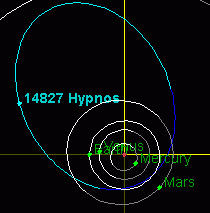
Suspected or hypothesized extinct comets include:
- 14827 Hypnos
- 2101 Adonis
- 2015 TB145
- 3200 Phaethon{{cite journal
- 3552 Don Quixote{{cite journal
- P/2007 R5 (SOHO 1)
- 1996 PW possibly an extinct long-period comet
References
References
- "Frequently asked questions - What is the difference between asteroids and comets?".
- Space Telescope Science Institute. (10 September 1992). "Amateur Astronomers Will Use NASA's Hubble Space Telescope".
- (25 September 2007). "SOHO's new catch: its first officially periodic comet". [[European Space Agency]].
- (22 August 1996). "New Object Moves Like a Comet But Looks Like an Asteroid". [[NASA]].
This article was imported from Wikipedia and is available under the Creative Commons Attribution-ShareAlike 4.0 License. Content has been adapted to SurfDoc format. Original contributors can be found on the article history page.
Ask Mako anything about Extinct comet — get instant answers, deeper analysis, and related topics.
Research with MakoFree with your Surf account
Create a free account to save articles, ask Mako questions, and organize your research.
Sign up freeThis content may have been generated or modified by AI. CloudSurf Software LLC is not responsible for the accuracy, completeness, or reliability of AI-generated content. Always verify important information from primary sources.
Report