From Surf Wiki (app.surf) — the open knowledge base
Extended metaphor
Use of a single metaphor or analogy at length
Use of a single metaphor or analogy at length
An extended metaphor, also known as a conceit or sustained metaphor, is the use of a single metaphor or analogy at length in a work of literature. It differs from a mere metaphor in its length, and in having more than one single point of contact between the object described (the so-called tenor) and the comparison used to describe it (the vehicle). These implications are repeatedly emphasized, discovered, rediscovered, and progressed in new ways.
History of meaning
In the Renaissance, the term conceit (which is related to the word concept) indicated the idea that informed a literary work—its theme. Later, it came to stand for the extended and heightened metaphor common in Renaissance poetry, and later still it came to denote the even more elaborate metaphors of 17th century poetry.
The Renaissance conceit, given its importance in Petrarch's Il Canzoniere, is also referred to as Petrarchan conceit. It is a comparison in which human experiences are described in terms of an outsized metaphor (a kind of metaphorical hyperbole)—as in Petrarch's comparison between the effect of the gaze of the beloved and the sun melting snow. The history of poetry often features contemporary poets referencing the verses of their predecessors, like Shakespeare building on Petrarchan imagery in his Sonnet 130: "My mistress' eyes are nothing like the sun".
The 17th-century and the sometimes so-called metaphysical poets extended the notion of the elaborate metaphor; their idea of conceit differs from an extended analogy in the sense that it does not have a clear-cut relationship between the things being compared. Helen Gardner, in her study of the metaphysical poets, observed that "a conceit is a comparison whose ingenuity is more striking than its justness" and that "a comparison becomes a conceit when we are made to concede likeness while being strongly conscious of unlikeness."
Petrarchan
The Petrarchan conceit is a form of love poetry wherein a man's love interest is referred to in hyperbole. For instance, the lover is a ship on a stormy sea, and his mistress is either "a cloud of dark disdain" or the sun.
The paradoxical pain and pleasure of lovesickness is often described using oxymoron, for instance uniting peace and war, burning and freezing, and so forth. But images which were novel in the sonnets of Petrarch, in his innovative exploration of human feelings, became clichés in the poetry of later imitators. Romeo uses hackneyed Petrarchan conceits when describing his love for Rosaline as "bright smoke, cold fire, sick health".
William Shakespeare
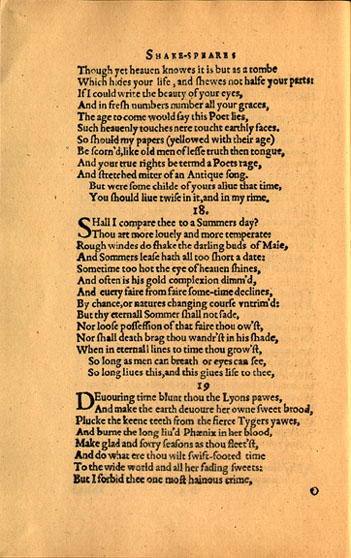
In Sonnet 18 the speaker offers an extended metaphor which compares his love to Summer. Shakespeare also makes use of extended metaphors in Romeo and Juliet, most notably in the balcony scene where Romeo offers an extended metaphor comparing Juliet to the sun.
:It is the east, and Juliet is the sun. :Arise, fair sun, and kill the envious moon, :Who is already sick and pale with grief, :That thou her maid art far more fair than she: :Be not her maid, since she is envious; :Her vestal livery is but sick and green :And none but fools do wear it; cast it off.
Metaphysical conceit
The metaphysical conceit is often imaginative, exploring specific parts of an experience. A frequently cited example is found in John Donne's "A Valediction: Forbidding Mourning", in which a couple faced with absence from each other is likened to the legs of a compass. is often cited and held sway until the early twentieth century, when poets like T. S. Eliot re-evaluated the English poetry of the seventeenth century. Well-known poets employing this type of conceit include John Donne, Andrew Marvell, and George Herbert.
Later examples
T. S. Eliot
In the following passage from "The Love Song of J. Alfred Prufrock", T. S. Eliot provides an example of an extended metaphor:
:The yellow fog that rubs its back upon the window-panes, :The yellow smoke that rubs its muzzle on the window-panes :Licked its tongue into the corners of the evening, :Lingered upon the pools that stand in drains, :Let fall upon its back the soot that falls from chimneys, :Slipped by the terrace, made a sudden leap, :And seeing that it was a soft October night, :Curled once about the house, and fell asleep.
Qualities (grounds) that we associate with cats (vehicle), color, rubbing, muzzling, licking, slipping, leaping, curling, sleeping, are used to describe the fog (tenor).
James Joyce
Joyce's Ulysses features an extended metaphor between its characters and those of the Ancient Greek epic, The Odyssey. Leopold Bloom maps to Odysseus, Stephen Dedalus maps to Telemachus, and Molly Bloom maps to Penelope; minor characters also demonstrate parallels, such as the one-eyed "Cyclops" character which Bloom interacts with. Used as a hypotext, many readers at the time of publication did not necessarily notice the connection, until it was pointed out by T.S. Eliot’s essay on the subject.Eliot, T.S. (1923) “Ulysses, Order and Myth,” The Dial, 75 (November), 480-84, and reprinted in The Selected Prose of T. S. Eliot, ed. Frank Kermode (London: Faber and Faber, 1975), pp. 175-78.
References
References
- (1998). "Patterns in Language: An Introduction to Language and Literary Style". Psychology Press.
- Brummett, Barry. (2009). "Techniques of Close Reading". SAGE.
- Johnson, C.. (2012). "The Princeton Encyclopedia of Poetry and Poetics: Fourth Edition". [[Princeton University Press]].
- Najat Ismaeel Sayakhan. (8 July 2014). "THE TEACHING PROBLEMS OF ENGLISH POETRY IN THE ENGLISH DEPARTMENTS". [[Author House]].
- Aubusson, Peter J.. (2005). "Metaphor and Analogy in Science Education". Springer.
- "Romeo and Juliet". Massachusetts Institute of Technology.
- Ray, Robert H.. (1998). "An Andrew Marvell Companion". [[Taylor & Francis]].
- Gardner, Helen. (1985). "The Metaphysical Poets". Penguin.
- Irvine, Ian. (May 17, 2005). "Was John Donne the Cole Porter of his time?". [[The Independent]].
- Perry, Seamus. (1999). "Coleridge and the Uses of Division". Clarendon Press.
- Altegoer, Diane B.. (2002). "Encyclopedia of Literature and Science". Greenwood.
- Eliot, T.S.. "1. The Love Song of J. Alfred Prufrock". Bartleby.com.
This article was imported from Wikipedia and is available under the Creative Commons Attribution-ShareAlike 4.0 License. Content has been adapted to SurfDoc format. Original contributors can be found on the article history page.
Ask Mako anything about Extended metaphor — get instant answers, deeper analysis, and related topics.
Research with MakoFree with your Surf account
Create a free account to save articles, ask Mako questions, and organize your research.
Sign up freeThis content may have been generated or modified by AI. CloudSurf Software LLC is not responsible for the accuracy, completeness, or reliability of AI-generated content. Always verify important information from primary sources.
Report