From Surf Wiki (app.surf) — the open knowledge base
Exhaust mixer
Turbofan engine component
.jpg)
Turbofan engine component

In aviation, an exhaust mixer or flow mixer is a feature of many turbofan engines, where slower, colder bypass air is mixed with faster, hotter core exhaust gases, before exhausting to atmospheric pressure through a common (mixed flow) propelling nozzle.
Benefits

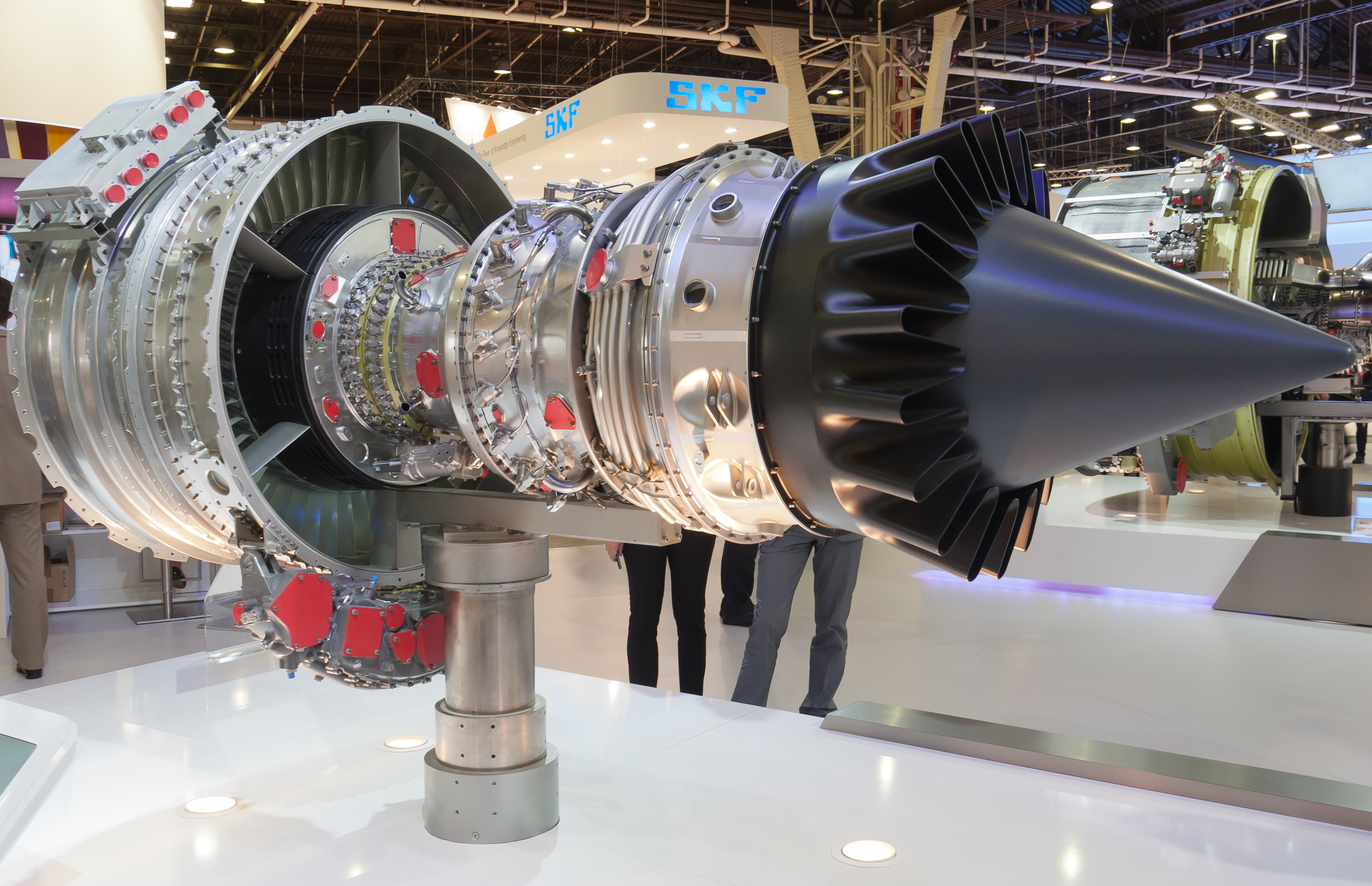
The mixer reduces the velocity of the core exiting air, and consequently, reducing the amount of noise produced. Additionally, the temperature of the exhaust is reduced, contributing to the overall reduction of the thermal signature of the aircraft. This attribute is critical in military aircraft where thermal detection or heat-seeking weapons are used, in particular stealth aircraft.
Ideally, a mixer is also a performance benefit to increasing thrust. The exhaust thrust from a jet engine is equal to exhaust mass flow times exhaust velocity, i.e., Thrust = ṁv, while the energy to make that thrust is given by Energy = 1/2mv2. A mixer helps reduce the fastest exhaust velocities from the core of the engine, while making the average exhaust velocity faster, producing more thrust with the same energy.
File:Airbus A319-131 G-EUPW (cn 1440) British Airways. (5873375140).jpg|The IAE V2500 on the A320 family, using a mixed exhaust File:AC A320-211 C-FKCR - 222 (cn 290) (2642674108).jpg|The CFM56-5A/B also powers the A320 family, but utilizing a separate exhaust nozzle
.jpg)
Mixer types
_Radom_-_panoramio.jpg)
- Annular - bypass and core streams are brought together co-annularly, mixing being achieved by the shearing effect at the stream interface
- Forced - hot and cold chutes, intertwined, force the two streams to mix
Mixing efficiency is defined in a number of ways, but simply, compares the actual thrust gain (due to mixing) to that of the ideal case. Annular mixers have a low pressure loss, but a low mixing efficiency. Forced mixers can have a high mixing efficiency, but this is offset by a high pressure loss.
Mixers are extremely common on military turbofans, since long coaxial exhaust pipes (i.e. hot and cold) are avoided. Afterburning, with the associated variable area nozzle, is also easier to accommodate.
Some high bypass ratio (e.g. civil) turbofans now feature a mixer, the advantage being a small thrust gain, which improves specific fuel consumption. Although the mixing process is not thorough, there is a jet noise benefit as well.
References
References
- "Patent Descriptions".
- https://understandingairplanes.com/Stealth-Airplane-Design.pdf {{Bare URL PDF. (August 2024)
- https://nsarchive2.gwu.edu/NSAEBB/NSAEBB443/docs/area51_14.PDF {{Bare URL PDF. (July 2025)
- (July 2025)
This article was imported from Wikipedia and is available under the Creative Commons Attribution-ShareAlike 4.0 License. Content has been adapted to SurfDoc format. Original contributors can be found on the article history page.
Ask Mako anything about Exhaust mixer — get instant answers, deeper analysis, and related topics.
Research with MakoFree with your Surf account
Create a free account to save articles, ask Mako questions, and organize your research.
Sign up freeThis content may have been generated or modified by AI. CloudSurf Software LLC is not responsible for the accuracy, completeness, or reliability of AI-generated content. Always verify important information from primary sources.
Report